- Guides
- B2B
-
#19607 (no title)
-
#15972 (no title)
- Climb Elbrus Individually
- Climb Elbrus from the South, 9 Days
- Climb Elbrus from the South, 7 Days
- Climb Elbrus from the South with Oxygen
- Climb Elbrus from the North, 10 Days
- Two Summits of Elbrus, 9 Days
- Elbrus Traverse from South to North, 9 Days
- Elbrus Traverse from North to South, 10 Days
- Cross of Elbrus, South to North, 9 Days
- Cross of Elbrus, North to South, 10 Days
- Climb Kazbek and Elbrus — 10-Day Two-Summit Expedition
- Climb Elbrus from the West, 11 Days
- Elbrus by Private Helicopter, 3 Days
- Elbrus Region Holiday and Trekking, 9 Days
- Elbrus Region Holiday, 7 Days
- Tinder Tour: Climbing Mount Elbrus, 9 Days
- Climb Elbrus from the South, 9 Days with Sergey Baranov
-
#15539 (no title)
- Climb Carstensz Pyramid, 8 Days with Helicopter Access
- Climb Mont Blanc, 4810 m — 8-Day Guided Ascent
- Climb the Matterhorn, 4478 m — 8-Day Guided Ascent
- Climb Mount Vinson, 15-Day Antarctic Expedition
- Climb Kosciuszko and Travel in Australia, 7 Days
- Climb Fisht, 2868 m — 3-Day Ascent by the 1B Route
- Climb Mount Wilhelm, 6 Days
-
#15546 (no title)
- Climb Kilimanjaro: the Marangu Route
- Climb Kilimanjaro: the Lemosho Route
- Climb Ararat, 5137 m — 7-Day Classic Climb
- Climb Kazbek from the South, 5033 m — 8 Days in Georgia
- Climb Kazbek and Elbrus — 10-Day Two-Summit Expedition
- Climb the Volcanoes of Mexico — Orizaba and Iztaccíhuatl, 9 Days
- Climb Alpamayo — 16-Day Technical Expedition
- Climb Margaret Peak (Stanley), 5109 m
- Climb Mount Kenya: Point Lenana, 4985 m
- Climb Dykh-Tau by the North Ridge, 13 Days
-
#15554 (no title)
- Aconcagua Climb — 17-Day Guided Expedition
- Island Peak Climb — 18-Day Expedition
- Climb Mera Peak, 6476 m — 16-Day Hinku Valley Expedition
- Climb Ama Dablam, 6812 m — 24-Day Expedition with Island Peak
- Climb Island Peak and Mera Peak — 24-Day Two-Summit Expedition
- Aconcagua and Ojos del Salado — 25-Day Combined Expedition
- Ojos del Salado Climb — 15-Day Expedition
- Climb Chimborazo and Cotopaxi — 14-Day Ecuador Expedition
- Climb Huascarán — 8-Day Technical Ascent
- Climb Razdelnaya Peak, 6148 m — 15-Day Pamir Expedition
- Climb Denali by the West Buttress, 23 Days
- #15565 (no title)
- #15572 (no title)
-
#15972 (no title)
-
#19592 (no title)
-
Trekking in Nepal: routes to the eight-thousanders
- K2 Base Camp Trek via the Gondogoro La
- Everest Base Camp Trek — 14 Days
- Everest Base Camp via Gokyo Lakes — 15 Days
- Short Everest Base Camp Trek in 10 Days
- Annapurna Circuit and Tilicho Lake Trek
- Manaslu Circuit Trek
- Kanchenjunga Circuit Trek (XXL)
- Kanchenjunga North Base Camp Trek (Short)
- Kanchenjunga from India: the Goecha La Trek in Sikkim
- Makalu Base Camp Trek
- Annapurna Base Camp Trek
- Trekking in South America
- Asia
- Trekking in Africa
-
Trekking in Russia
- Elbrus Region Holiday and Trekking, 9 Days
- Elbrus Region Holiday, 7 Days
- Oshten + Kardyvach — 9-Day Western Caucasus Trek
- Lake Kardyvach — 5-Day Base-Camp Trek
- Route 30: Through the Mountains to the Sea, with Oshten — 4 Days
- Trekking in Arkhyz — 7 Days over the Ayulyu Pass
- Gvandra Trek — 7 Days to the Ullu-Kyol Lakes
- Trekking in Dombai — 7 Days with the Murudzhu Lakes
- Europe
-
Trekking in Nepal: routes to the eight-thousanders
-
Adventure expeditions
-
Trekking in Africa
- 모로코 투어:북아프리카의 심장
- 투브칼 등반과 모로코 문화
- Eritrea: the Dahlak Archipelago and the Rashaida Nomads
- Rwanda: Mountain Gorillas and the Bisoke Volcano
- Ethiopia: Otherworldly Landscapes and the Peoples of the Omo Valley
- 우간다 투어:퀸즈 파크와 마운틴 고릴라
- Tanzania Safari: Serengeti, Ngorongoro and Tarangire
- 우간다 투어:흰 코뿔소와 산 고릴라
- Zimbabwe and South Africa: Victoria Falls, Cape Town and the Cape of Good Hope
- Namibia: Etosha National Park and the Himba
- Kenya Safari: the African Big Five
- 보츠와나 투어:오카방고 델타와 초베 공원
- Trekking in South America
- Asia
-
Trekking in Africa
- Ski touring and ski mountaineering: chasing freedom in the mountains
- VIP tours
- #19722 (no title)
- About
Ski the Last Degree to the South Pole, 16 Days
- Height (m)
- 2835
- Duration
- 16 days
- Difficulty
- High
- Continent
- Antarctica
- Children
- Not suitable for children
- Accommodation
- Some nights in tents
- suitable-for-beginners
- No
6323294 $
Why to go with us?
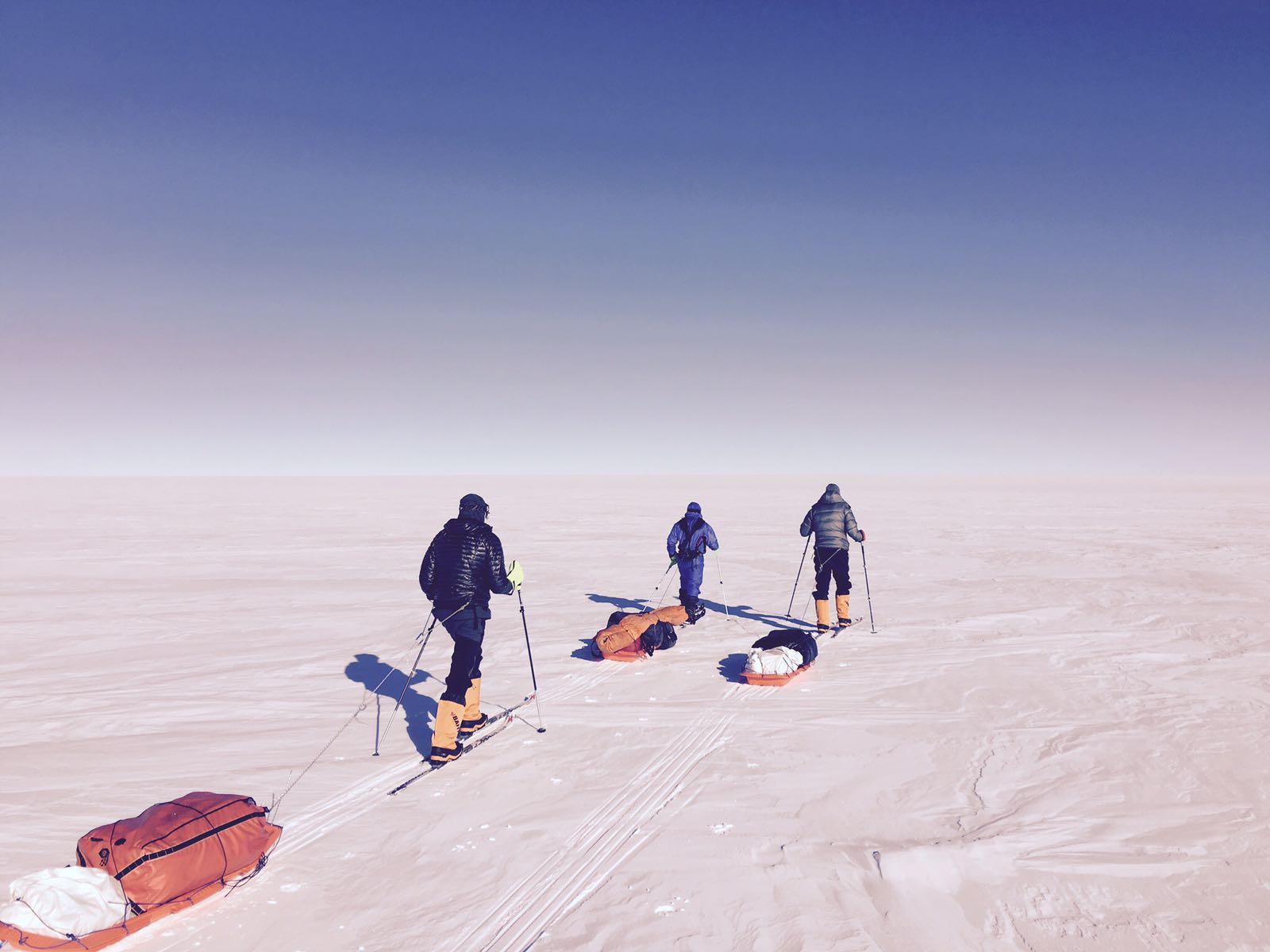
This ski expedition to the South Pole covers the last degree of latitude, from 89 degrees south to the geographic South Pole. Over several days the team skis 111 km, or 60 nautical miles, across the high polar plateau. There are no roads, no trees and no notable landmarks around, only wind, a white horizon, round-the-clock daylight and the track of the sleds stretching back across Antarctica.
After preparation at Union Glacier camp, participants are flown to the start point at 89°S. Each person hauls a sled of about 30 kg and helps to pitch the tents and run the camp. Wind gathers the snow into hard ridges of sastrugi, and the physical altitude of about 2835 m may feel to the body more like 3200 to 3350 m because of the way pressure behaves near the Pole.
This is not a trip for someone whose only experience is skiing on prepared pistes. Participation requires experience of cross-country skiing, of hauling a sled on skis, of multi-day winter camping in a tent and of working in low temperatures. Mountaineering and ski-touring experience is useful but does not replace polar preparation.
Important
- Antarctic flights depend on the weather. We recommend buying a changeable return ticket with a margin of about five days after the planned end of the trip
- Accommodation and meals in Punta Arenas are paid separately
- Mountain Guide does not buy or sell air tickets and does not arrange visas, and accepts no responsibility for disruption beyond its control involving international flights and border crossings
About the South Pole ski expedition
The last degree is the classic polar format, in which participants cover the final 60 nautical miles to the geographic South Pole. The start is at 89°S and the goal is 90°S, where all the meridians meet. The distance is 111 km. That is not much on an ordinary map, but on the polar plateau every kilometre has to be worked for: you ski, you haul a sled, you cross sastrugi and you build the camp again every day.
The expedition begins in Punta Arenas in southern Chile. After the equipment check and the compulsory pre-flight briefing the group crosses the Drake Passage on a charter aircraft and lands on a blue-ice runway at Union Glacier. Two preparation days are used to check clothing, practise hauling a sled and pack the loads. A ski-equipped aircraft then takes the team to 89°S.
The first hours after the drop-off are kept to a steady pace. The physical altitude of the polar plateau is about 2835 m, but its effect on the body feels greater because atmospheric pressure is lower in polar latitudes. The load increases gradually. A normal travelling day consists of hour-long stints with short stops to eat and check clothing. In the published schedule the team starts moving at about 10:00 and continues until roughly 19:00, but the actual rhythm is set by the leader according to the weather, the snow surface and the pace of the group.
The sleds weigh about 30 kg. How hard they pull changes with the temperature and the structure of the snow. On a smooth surface the movement becomes even, while hard wind ridges force you to step constantly, keep your balance and choose a line. Success depends not only on endurance but on not getting cold at the stops, changing layers in good time and working at the same pace as the team.
Every participant helps to pitch and strike the tents, organise the kitchen and prepare the meals. This is a self-supported polar expedition, not a stroll from one ready-made camp to the next. Communications and weather forecasts are provided by team equipment, but there is no permanent personal internet on the route.
As the goal comes closer, the buildings of the Amundsen-Scott station may appear on the horizon, yet the last kilometres often take another day or two. At the geographic Pole the group observes the rules of the specially managed area. Depending on aviation, a night in tents near the South Pole is possible before the return flight. Going inside the station is not part of the guaranteed trip.
The trip suits only participants with proven experience of cross-country skiing, of hauling a sled on skis, of winter camping in a tent and of sustained work in the cold. Skiing at a downhill resort does not count as adequate preparation. Experience of high-altitude expeditions, multi-day ski tours and long mountain treks is useful. Before booking, the team assesses the questionnaire, the experience and the physical readiness of every participant.
After the ski journey the trip can be combined with a Mount Vinson climb or a Mount Sidley climb. Such a combination requires separate confirmation of dates, Antarctic flights, reserve time and cost.
South Pole last-degree ski expedition itinerary, 16 days
Day 1. Arrival in Punta Arenas. An expedition representative meets participants at Punta Arenas airport and arranges the transfer to the hotel. After check-in there is a full check of clothing, personal equipment and baggage. In the evening the group meets the guides and gathers for dinner together. Accommodation and meals in Punta Arenas are paid separately. Night in a hotel.
Day 2. Preparation for the flight to Antarctica. After breakfast participants attend the compulsory pre-flight briefing given by the Antarctic air operator. It covers the flight, safety rules, baggage and what happens when the weather changes. Expedition duffel bags are handed over for checking and loading. The rest of the day is free. Night in a hotel.
Day 3. Flight to Antarctica. In suitable weather the group flies out of Punta Arenas on a charter jet. The flight across the Drake Passage takes about four hours and ends with a landing on a natural blue-ice runway near Union Glacier. Participants then travel about 8 km to the main camp in specially prepared vehicles, receive their briefing and settle into tents. Night at Union Glacier camp.
Day 4. Preparation at Union Glacier. The team checks clothing and personal equipment in field conditions and practises hauling a sled on a short training outing beyond the camp. The purpose of the day is to find problems before the self-supported stage and to settle on a working system of layers, bindings and packing. Night at Union Glacier camp.
Day 5. Final preparation and packing the sleds. Participants continue practising, share out the team equipment and pack the sleds for the last time. The guides check the readiness of the group, the forecast and the aviation situation before the flight to 89°S. Night at Union Glacier camp.
Day 6. Flight to 89°S and the start of the route. A ski-equipped Twin Otter takes the group to 89 degrees south, 60 nautical miles or 111 km from the South Pole. After unloading, participants assemble their sleds and cover a short section at a steady pace. The load must not be increased sharply on the first day because of the altitude, the cold and the flight. The team sets up its first self-supported camp. Night in tents.
Days 7-11. The ski journey to the South Pole. The length of the skiing sections increases gradually. Participants haul sleds weighing about 30 kg and cross the polar plateau in series of hour-long stints with short breaks. Wind can build hard snow ridges, or sastrugi, which slow progress and demand constant work on balance. Every evening the team pitches the tents and helps to prepare the meal. The pace, the start time and the campsite are decided by the leader, taking account of the weather, the snow surface, the distance covered and the state of the group. Nights in tents.
Day 12. The geographic South Pole. The team covers the last kilometres and reaches 90°S, the point where all the meridians of the Earth meet. Participants observe the rules of the specially managed area of the South Pole and prepare for the return flight. Depending on aviation, the group may spend a night in tents at the Pole. A visit to the Amundsen-Scott station is not guaranteed. Night in a field camp, or the return journey according to the actual flight schedule.
Day 13. Return to Union Glacier. The field guides agree a suitable weather window with the camp, after which the aircraft collects the team from the South Pole. The celebration dinner takes place either in the field camp or after the return to Union Glacier. Participants are given a commemorative certificate. If the schedule allows, there is time to rest at the camp. Night at Union Glacier.
Day 14. Flight to Chile. When the weather and the state of the ice runway allow, the group flies from Union Glacier to Punta Arenas. On landing a representative meets the participants and arranges the transfer to the hotel. Accommodation and meals in Punta Arenas are paid separately. Night in a hotel.
Day 15. Free day in Punta Arenas. The day is for rest, walking around the city and preparing for the international flight. If Antarctic aviation has changed the schedule, the trip is adjusted to the actual time of return. Night in a hotel.
Day 16. End of the trip. Check out of the hotel and make your own way home. The time of the airport transfer, and whether it is included, is confirmed before the trip according to the hotel and flight chosen.
Days 17-21. Reserve for delays. Reserve days are provided in case of poor weather and rescheduled Antarctic flights. The actual schedule may change at the decision of the expedition leader and the air operator. We recommend buying a changeable return ticket departing about five days after the planned end of the trip.
What's included
- Meeting at Punta Arenas airport and transfer to the hotel on the day of arrival
- Charter flights from Punta Arenas to Antarctica and back
- All internal Antarctic flights to 89°S, from the South Pole and back to Union Glacier
- Accommodation and camp services throughout the stay in Antarctica
- Meals throughout the Antarctic part of the trip
- The work of the polar expedition guides
- Group expedition equipment – tents, ropes and kitchen equipment
- Team communications – VHF radios and a satellite phone
- A daily specialist weather forecast during the ski journey
What's not included
- International and domestic flights to Punta Arenas and back
- Accommodation and meals in Punta Arenas
- Visas and transit permissions where these are required by nationality and flight routing
- Personal clothing, sleeping bag and other items from the compulsory kit list
- Medical and evacuation insurance – compulsory for participation
- Trip cancellation or interruption insurance – strongly recommended
- Bank and payment system fees
- Costs arising from weather and aviation delays, from ending participation early or from other circumstances beyond the organisers' control
- Personal expenses and services not expressly listed under what is included
The South Pole ski expedition for private groups
The last degree traverse can be arranged for a private team. The format suits people of comparable experience who want to agree a single training pace in advance and cover the route as their own team. The dates depend on the short Antarctic season, on the availability of intercontinental and polar flights, and on a qualified guide being free.
A Russian-speaking Mountain Guide leader can be requested separately. That leader's work, flights, accommodation, meals and all other Antarctic costs must be included in the individual quote and confirmed in writing before the contract. The basic price of the published trip covers the polar expedition guides' work, but promises no additional Russian-speaking guide.
On request, the ski expedition can be combined with the Vinson climb or the Sidley climb. Those are separate trips with their own requirements for experience and equipment. The order of the sections, the reserve days, the internal flights and the final price are confirmed for the particular season.
To quote a private format we need to know who is coming, their ages, their experience of cross-country skiing and of hauling a sled, their experience of winter camping, your preferred dates and any plans for other Antarctic trips.
Documents for the South Pole ski expedition
An Antarctic expedition needs its documents prepared early. Before buying non-refundable tickets you must have your place confirmed, obtain the registration forms and check the entry rules for Chile and for every transit country. The requirements depend on your nationality and your flight routing.
To take part you will need:
- A passport with enough validity remaining and enough blank pages
- International air tickets to Punta Arenas and back, with a changeable date
- A Chilean visa and any transit permits you require
- Medical insurance valid in Antarctica and covering a polar expedition and medical evacuation
- Confirmation of your insurance cover and the assistance company's contact details, in English
- The expedition's registration, medical and legal forms, completed
- Emergency contact details
Trip cancellation and curtailment insurance is strongly recommended, given the non-refundable payments and the high cost of Antarctic logistics. Check the policy, its exclusions, the territory it covers, the activities it allows and the evacuation limit before you pay. Our general advice is published in the Mountain Guide article on insurance for mountain and expedition trips.
Keep electronic copies of your documents on your phone and in a cloud service, and the paper ones in a waterproof wallet. The final list is checked again before departure, as visa, aviation and insurance requirements can change.
Weather and season for the South Pole ski expedition
The ski traverse takes place in the Antarctic summer, when the seasonal flights are running and the sun barely sets. The published departures fall in December 2026 and January 2027. Outside the operating window for polar flights the trip does not run.
The Antarctic interior is very dry, very cold and very windy. In sunshine with no wind, around -8 °C can feel relatively comfortable, but that is no basis for choosing your clothing. The records from the previous traverse show days of about -25 °C and spells down to roughly -40 °C. Wind sharply increases the chilling effect, and the weather and visibility can change faster than on an ordinary winter route.
The surface depends on the wind and the temperature. A sled runs more easily over flat, firm snow and markedly harder across sastrugi and soft patches. Round-the-clock light helps in choosing when to move, but it gets in the way of proper sleep, which is why an eye mask is on the compulsory list.
The physical altitude of the polar plateau is about 2835 m. Because of the atmospheric conditions at high latitudes, the body may experience it as roughly 3200-3350 m would feel at lower latitudes. Breathlessness and reduced performance are possible, so the first days are built around a gentle pace.
Every Antarctic flight runs only in suitable weather and with the runway in suitable condition. A delay of several hours or days is a normal risk of polar logistics. Buy a changeable international return ticket and leave about five days in reserve after the trip's official end.
Accommodation and meals on the South Pole expedition
In Punta Arenas participants stay in a hotel, which they pay for separately. The room category, single occupancy, early check-in and extra nights depend on the hotel chosen and on the actual Antarctic flight schedule. Meals in the city are likewise not part of the expedition price.
At Union Glacier the accommodation is in a tented camp. During the ski traverse the team pitches its field tents on the polar plateau each day. Depending on the time of the return flight, a night in tents at the South Pole is possible. All accommodation and camp services in Antarctica are included.
Meals are included throughout the Antarctic part of the trip. On the self-sufficient section, participants set up the kitchen together with the guides and help with the cooking. The celebration dinner after reaching the Pole may be held at the South Pole itself or after the return to Union Glacier - it depends on the flight schedule.
Food allergies, intolerances and medical restrictions must be reported before booking. Whether a special menu is possible is confirmed in advance, within the constraints of polar logistics. You bring your own favourite snacks from the compulsory or recommended list.
Day-to-day conditions on the South Pole ski expedition
There are no ready-made huts and no serviced intermediate camps along the route. Each participant hauls a sled of about 30 kg, helps pitch and strike the tents, shares out the equipment and prepares the food. The team's work continues after the day's skiing ends, so it matters to be able to work in gloves and not to lose small items in the snow.
A typical day is made up of hour-long stages with stops of about 5-10 minutes. In the published scheme, breakfast begins at about 08:00, the group sets out around 10:00, and camp is pitched by about 19:00. This is a guide, not a fixed timetable. The leader changes the rhythm according to the wind, the visibility, the surface, how the participants are going and the distance that needs covering.
There is no continuous personal internet on the self-sufficient stage. The VHF radios and the satellite phone are there above all for the team's work, contact with the aircraft, receiving forecasts and emergencies. Personal messages and calls depend on what is technically possible and on the terms of use.
There is no shower on the route. For hygiene you use wet wipes, hand sanitiser and your own toiletries. Charging electronics is possible only within limits, so you need power banks or an agreed independent power system. In round-the-clock daylight you need an eye mask to sleep, and earplugs are useful in a shared tent.
All personal kit is checked in Punta Arenas and tested again at Union Glacier. Unsuitable clothing, a sleeping bag or a footwear set-up that is not up to the job can all be grounds for being refused a place on the self-sufficient stage. Whether a participant is ready is decided by the expedition leader.
Insurance
НаверхEquipment list for the ski expedition to the South Pole
Скачать PDFThis list follows the trip's current requirements. Buy or hire everything in advance, test it in winter conditions and present it at the inspection in Punta Arenas. Polar skis, the sled, the hauling system and boot compatibility are confirmed separately before the trip: do not buy specialist kit without written agreement.
Base and mid layers
- Underwear - at least 3 sets
- A light or midweight base layer top - 2
- Light or midweight base layer bottoms - 2 pairs
- A light fleece top or a heavier base layer top - 1
- Light fleece trousers or heavier base layer bottoms - 1 pair
- A midweight fleece jacket - 1
- Trekking trousers - 1 pair
Wind protection and insulation
- A windproof, waterproof shell jacket with a hood - 1
- Windproof, waterproof shell trousers - 1 pair
- An expedition down parka with a hood - 1
- A down gilet - 1
- Down or synthetic insulated trousers with full-length side zips - 1 pair
- A down skirt or insulated shorts - optional
Head, face and eyes
- A wool or fleece hat that covers the ears - 1
- Buff - 2
- Balaclava - 1
- A protective face mask - 1
- A cap or sun hat for sunny weather - 1
- Sunglasses with side shields - 1 pair
- A hard case for your glasses - 1
- Ski goggles - 2
- Spare contact lenses or prescription glasses - if you need them
Gloves
- Thin liner gloves - 2 pairs
- Thinsulate fleece gloves or wool mittens - 2 pairs
- Midweight insulated gloves - 1 pair
- Thick expedition mittens - 1 pair
- Wool mittens - 1 pair
- Chemical hand warmers - 10
- Elastic cord for glove leashes - optional
Footwear and socks
- Thin liner socks - 3 pairs
- Midweight trekking socks - 3 pairs
- Thick warm socks - 2 pairs
- Insulated camp booties with a non-slip sole - 1 pair
- Light winter boots or heavy trekking boots - 1 pair
- Vapour barrier socks - optional
- Trainers - optional
- Custom insoles - optional
- An Intuition Mukluk insulated liner - optional
Sleeping and baggage
- An expedition sleeping bag - the temperature rating is confirmed before you buy or hire one
- A full-length closed-cell foam mat - 1
- A full-length inflatable mat with a repair kit - 1
- An eye mask for sleeping in round-the-clock daylight - 1
- Earplugs - 1 pair
- A very large expedition duffel - at least 1
- A cabin bag no larger than 46 x 41 x 26 cm - 1
- Coloured stuff sacks for organising your kit in the sled and the tent - 4-6
Utensils, water and personal items
- A vacuum flask of about 0.95 litres - 1
- Wide-mouthed drinking bottles of about 0.95 litres - 2
- Wide-mouthed bottles for night use, about 0.95 litres - 2, or one of about 1.4 litres
- Insulated bottle covers - 1-2
- A wide insulated plastic mug with a lid - 1
- A large, light, unbreakable bowl or mug with a lid - 1
- Sturdy plastic spoons - 2
- SPF 50 or higher lip balm - 1
- SPF 50 or higher sun cream - 2 tubes of about 50 ml
- A watch with an alarm, fresh batteries and a long strap - 1
- A sewing and repair kit with reinforced tape - 1
- Your own toiletries, wet wipes, hand sanitiser, plasters, blister treatment, cream and personal items
- Any medication you take regularly, enough for the whole expedition plus a further four weeks
- A shower towel
Optional extras
- Adapters for Chilean sockets, and chargers
- US dollars in cash for communications and purchases at Union Glacier
- A GPS and a compass with a global needle or balanced for the Southern Hemisphere
- Camera, memory cards, batteries and a protective case
- A phone or music player and two pairs of headphones
- Power banks, adapters and an agreed solar panel
- A light diary, pencil, pen or e-reader
- Personal treats, photographs and small keepsakes
- Bandanas and handkerchiefs
- A female urination device