- Guías
- B2B
-
Ascensiones
-
Ascensión al Elbrus
- Elbrus individually
- Elbrus from the South, 9 days
- Elbrus from the South, 7 days
- Elbrus from the South in 1 day
- Elbrus from the North
- Elbrus Two Summits
- Escalada en Elbrus, travesía de sur a Norte
- Escalada en Elbrus, travesía de Norte a sur
- Elbrus "Cross" from South
- Elbrus "Cross" from North
- Kazbek+Elbrus
- Elbrus from the West
- Elbrus en helicóptero
- Vacaciones en el Elbrus, 9 días
- El descanso en prielbrusye, 7 días
- Tinder Tour, escalada en Elbrus
- Elbrus desde el sur 9 días con Sergei Baranov
- Under 5000 m
- 5000+ meters
- 6000+ meters
- 7000+ meters
- 8000+ meters
-
Ascensión al Elbrus
-
Trekking
-
Trekking in Nepal: routes to the eight-thousanders
- K2 base camp
- Everest base camp
- Everest base camp via Gokyo
- Everest base camp in a week
- Anillo de trekking Annapurna + lago Tilicho
- Anillo De Trekking Manaslu
- Trekking al campamento base de Kanchenjunga
- Trekking al campamento base de Kanchenjunga (corto)
- Trekking al campamento base de Kanchenjunga (India)
- Trekking al campamento base de Makalu
- Trekking al campamento base de Annapurna
- Trekking in South America
- Asia
- Trekking in Africa
- Trekking in Russia
- Europe
-
Trekking in Nepal: routes to the eight-thousanders
-
Adventure expeditions
-
Trekking in Africa
- Tour por Marruecos: el corazón del Norte de África
- Morocco: Toubkal and the mysteries of the Sahara
- Tour a Eritrea: el archipiélago de Dahlak y los nómadas de Rashaid
- Tour a Ruanda: gorilas de montaña y volcán Bisoke
- Tour a Etiopía: paisajes espaciales y tribus del valle de Omo
- Tour a Uganda: parque de la Reina y gorilas de montaña
- Tour a Tanzania: Safari en el Serengeti, Ngorongoro y Tarangira
- Tour a Uganda: rinocerontes blancos y gorilas de montaña
- Tour por Zimbabue y Sudáfrica: cataratas victoria, ciudad del cabo y cabo De buena Esperanza
- Tour a Namibia: parque Etosha y tribus Himba
- Tour a Kenia: los Cinco grandes africanos
- Tour a Botswana: Delta del Okavango y parque Chobe
- Trekking in South America
- Asia
-
Trekking in Africa
- Ski touring and ski mountaineering: chasing freedom in the mountains
- VIP tours
- Useful
- About
Aconcagua Climb — 17-Day Guided Expedition
- Height (m)
- 6962
- Duration
- 17 días
- Difficulty
- Moderate
- Continent
- South America
- Children
- Ages 14+
- Accommodation
- Some nights in tents
6650 $
¿Por qué tal precio?
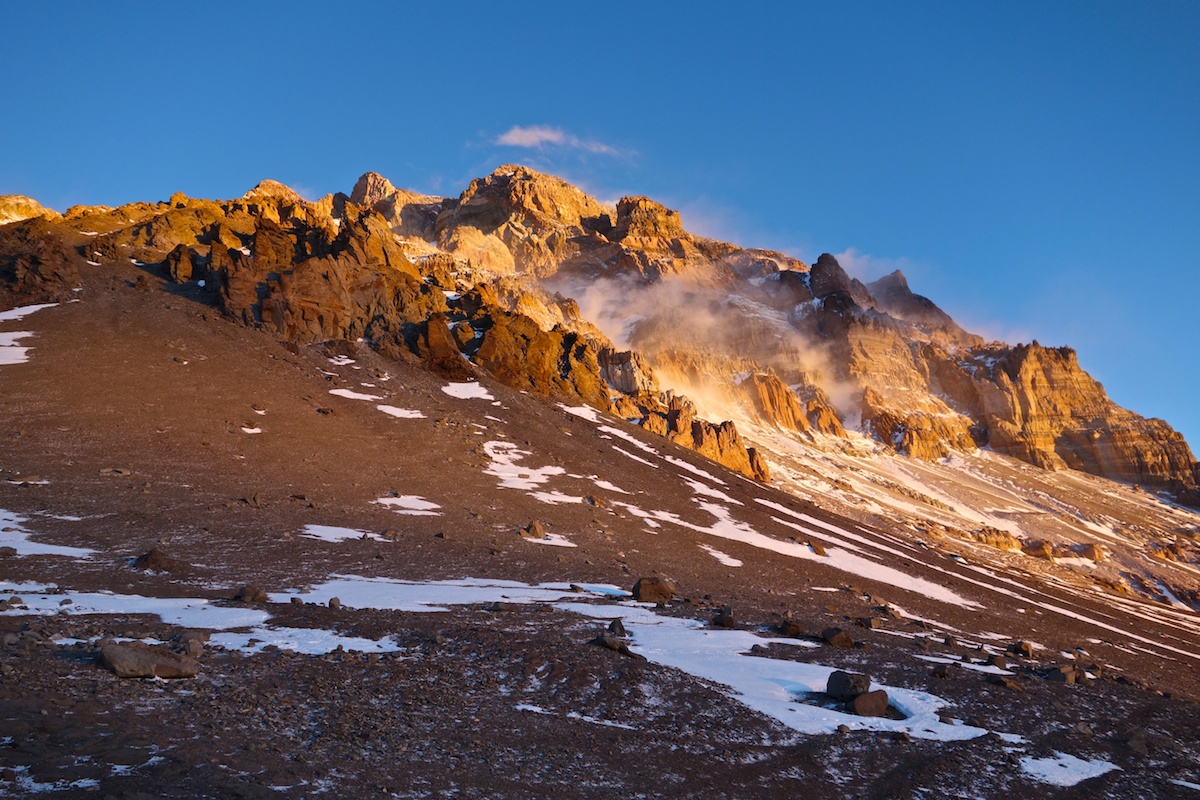
The classic 17-day Aconcagua climb by the Normal Route is the main and the longest of the three Mountain Guide programmes on this mountain. We run it every season. Staged acclimatization, two contingency days and a repeated push into the high camps give the team more time for adaptation, recovery and weather decisions than the shorter formats allow.
The programme is built for physically prepared climbers who have already been above 5000 m. Experience at 5500 m and higher is preferred — on Elbrus, in Ecuador, in Bolivia or on Ojos del Salado. Aconcagua can be your first objective close to 7000 m, but it should not be your first high-altitude climb.
There is normally no difficult technical climbing on the classic route. The altitude of 6962 m, wind, cold, dry air, life in tents and a long summit day nevertheless demand serious preparation and discipline. The summit is not guaranteed: pace, start time and the decision to continue are made on the basis of weather, route conditions and how each participant is doing.
The route runs from the west, through the Horcones valley, Confluencia and Plaza de Mulas. The schedule is organised around two high-altitude cycles. After an acclimatization walk to Plaza de Francia the group moves up to Plaza de Mulas, works through Plaza Canadá, Nido de Cóndores and the 6000 m level, descends to base camp to recover, and only then climbs again through Nido de Cóndores and Cólera towards the summit attempt. Two contingency days are held for weather and the condition of the team; they are not a guarantee of an extra attempt.
The published package covers a English-speaking guide throughout the programme in groups of three or more, local mountain guides on summit day at a ratio of one guide per three participants, two nights in a 4* hotel in Mendoza, transfers, mule transport of up to 30 kg of personal baggage to base camp and back, and the accommodation and meals set out in the inclusions list. The climbing permit, the mandatory high-altitude insurance and porters are paid separately.
Above base camp participants carry their personal kit and their share of the group load unless high-altitude porters are booked separately, so training with a loaded pack matters for the whole route and not only for summit day.
Important
- Minimum previous high-altitude experience — a climb above 5000 m; 5500 m and higher preferred
- Minimum age 14; final acceptance depends on experience, fitness and health
- The summit is not guaranteed — the guide decides whether the team continues
- The permit and medical insurance are not included in the price
Other formats on this mountain: the 12-day Aconcagua climb and the 7-day Aconcagua climb. Teams travelling with their own leader can use the Aconcagua logistics package with up to 4 full-board days or the package with up to 7 full-board days. Published groups are listed in the Mountain Guide calendar.
About the 17-day Aconcagua climb
Aconcagua stands in the Argentine Andes and reaches 6962 m. The classic Normal Route approaches from the west through the Horcones valley, Confluencia and Plaza de Mulas. There is normally no obligatory technical climbing on the route, but that accessibility does not reduce the main factors: an altitude close to 7000 m, dry cold, strong wind, self-sufficient life in tents and sustained effort on summit day.
The logic of the 17-day programme is built around two high-altitude cycles. After the acclimatization walk to Plaza de Francia the group moves up to Plaza de Mulas, passes Plaza Canadá, Nido de Cóndores and the 6000 m level, descends to base camp to recover, and then climbs again through Nido de Cóndores and Cólera towards the summit attempt. Two contingency days are kept for weather and the condition of the team, but they are not a guarantee of an additional attempt.
This is not a programme for a first encounter with big altitude. Before applying you need a climb above 5000 m; experience at 5500 m and higher is preferred — on Elbrus, in Ecuador, in Bolivia, on Ojos del Salado or on a comparable route. In the application form it matters not only what your highest point was, but how high you slept, how long the programme lasted and how your body responded.
Participants need aerobic endurance, strong legs and core, experience of multi-day mountain days, confidence with tent life and the willingness to hold a calm pace. A English-speaking guide accompanies the group throughout the programme in groups of three or more, and on summit day local mountain guides work at a ratio of one guide per three participants. If the weather, the state of the route or a participant’s condition deteriorates, the guide may change the plan, stop the ascent or turn a participant around.
Why 17 days remains the main programme
This schedule does not try to replace acclimatization with speed or willpower. The first push to the upper camps is used as part of high-altitude adaptation rather than as a premature summit attempt. Returning to Plaza de Mulas after the 6000 m level gives time to eat, sleep, rehydrate and assess how the body handled the first cycle. Only then does the second climb begin.
The two contingency days widen the range of decisions, but they do not automatically become two extra summit attempts. They may be needed earlier because of wind, snowfall, route conditions, the pace of the group or the condition of an individual participant. How the reserve is actually used is decided by the guide, who keeps enough time for a safe descent.
How previous experience is assessed
A climb above 5000 m matters for the application, preferably 5500 m and higher. The name of a summit on its own is not enough. We ask when the climb took place, how high you slept, how many days the programme lasted, what you carried, whether crampons were used and how you felt after the descent. Experience on Elbrus, in Ecuador, in Bolivia or on Ojos del Salado is useful when it shows not only the altitude reached but steady work at altitude.
Aconcagua can be a first summit close to 7000 m, but it should not be the first test of how your body reacts above 5000 m. If your experience is borderline or is no longer current, it is better to add a separate high-altitude trip in advance than to expect a long programme to compensate for a gap in preparation.
What the participant carries
Mules carry the agreed part of the baggage to Plaza de Mulas and back. Above base camp each participant carries personal belongings and a share of the group load unless high-altitude porters have been booked separately. That is why training with a pack is needed for more than summit day: it prepares you for several consecutive moves between camps, after each of which you still have to set up camp, eat and recover.
Altitude, difficulty and the place of the mountain in a wider plan
Before choosing a format it is worth understanding what the figure of 6962 m means in practice and where the mountain sits in Argentina and in the Andes. Reference material of that kind helps you judge the scale of the objective, but the conditions of participation are set by this programme and by the contract, and there is no single universal difficulty grade for Aconcagua. For climbers working through the Seven Summits the mountain often follows Elbrus, and it is worth comparing a self-led logistics package with a guided expedition before booking.
Aconcagua climbing programme, 17 days
Day 1. Arrival in Mendoza.
Meeting and transfer to the hotel. Introduction to the group, document and equipment check, and preparation of personal baggage for the mountain. This day is used to settle organisational matters before the route begins. Night in the hotel.
Day 2. Mendoza — Penitentes, 2700 m — Laguna Horcones — Confluencia, 3300 m.
Drive to Penitentes, handover of the main load to the mules and transfer to the national park entrance. The walk from Laguna Horcones to Confluencia takes 2–3 hours and starts the gradual gain in altitude. Night in camp.
Day 3. Acclimatization walk to Plaza de Francia, 4200 m.
A there-and-back walk to the viewpoint over the South Face of Aconcagua, some 2700 m high. The walk takes 4–5 hours. Returning to Confluencia gives an acclimatization load without moving camp any higher.
Day 4. Confluencia — Plaza de Mulas, 4350 m.
A long crossing of the wide Playa Ancha valley, usually 8–9 hours. The aim of the day is to cover a large distance calmly and settle into the main base camp without unnecessary haste. Night at Plaza de Mulas.
Day 5. Rest day at Plaza de Mulas, 4350 m.
Recovery after the approach and a short acclimatization walk onto the Horcones glacier. The day helps to assess how everyone feels before the first night above 5000 m and to prepare the loads for the high camps.
Day 6. Plaza de Mulas — Plaza Canadá, 5000 m.
The first move into a high camp and the first night at this level. A calm pace and attention to how you feel matter more than speed: the first high-altitude cycle begins here.
Day 7. Plaza Canadá — Nido de Cóndores, 5600 m.
The first high-altitude cycle continues. The group gains altitude, sets up camp and prepares for the push to the 6000 m level. Night in tents.
Day 8. Push to Cólera, 6000 m, and descent to Plaza de Mulas, 4350 m.
The climb to the upper camp completes the first acclimatization cycle. After the push the group descends to base camp to recover lower down before gaining altitude again.
Day 9. Rest day at Plaza de Mulas, 4350 m.
Full recovery, eating, rehydration, monitoring of how everyone feels and preparation for the second push. The decision to continue takes account of how the participants handled the first cycle.
Day 10. Plaza de Mulas — Nido de Cóndores, 5600 m.
The start of the second high-altitude cycle. Thanks to the previous push, the group returns to Nido de Cóndores with additional adaptation and rest in base camp behind it. Night in tents.
Day 11. Nido de Cóndores — Cólera, 6000 m.
The move to the upper camp, rest and preparation for an early summit start. Equipment, water, clothing and the condition of every participant are checked before nightfall.
Day 12. Climb of Aconcagua, 6962 m.
An early start from Cólera, the summit attempt and the descent back to the upper camp. This is the longest and hardest day of the programme. Continuing depends on weather, route conditions, pace and how each participant is doing; the summit is not guaranteed.
Day 13. First contingency day.
The reserve is used at the guides’ decision, taking account of weather, the condition of the team and the actual schedule. It may be needed before the summit push and does not mean an automatic second attempt.
Day 14. Second contingency day.
An additional weather and operational window. If it is used, enough time is kept for a safe descent and exit from the national park.
Day 15. Descent to Plaza de Mulas.
Return from the high camps to base camp. After the summit cycle the main task is to lose altitude calmly, recover and prepare the baggage for the walk out.
Day 16. Plaza de Mulas — Laguna Horcones — Mendoza.
Walk out from base camp to Laguna Horcones and transfer to Mendoza. The mountain part of the programme ends here, followed by rest and a night in the hotel.
Day 17. Transfer to the airport.
End of the programme and transfer for the flight home. Additional nights in Mendoza are arranged separately.
What the Aconcagua climb price includes
- English-speaking guide throughout the programme in groups of three or more
- Mountain guides — one guide per three participants on summit day
- Airport — hotel — airport transfer
- 4* hotel in Mendoza, 2 nights. Double rooms with breakfast
- Assistance in obtaining the necessary permits
- Transfer Mendoza — Puente del Inca — Mendoza
- Mules for equipment and food from Puente del Inca (Los Puquios) to Plaza de Mulas and back. Personal baggage 30 kg maximum
- Two nights in Confluencia with full board
- Base camp at Plaza de Mulas (5 nights)
- Food and fuel for the upper camps
- First aid kit
What the Aconcagua climb price does not include
- International flights
- Climbing permit — charged separately at the current park tariff, which depends on nationality, route and season
- Porters
- Personal equipment
- Additional costs arising from any deviation from the programme
- Medical insurance covering the stated activity and the maximum altitude of the programme
- Personal expenses (drinks, internet, phone calls and so on). A shower in base camp costs $20, internet in camp is free and a can of beer is about $5.
- Any costs connected with changes to the programme
Seguro
НаверхEquipment for the Aconcagua climb.
Скачать PDFDocuments:
- Valid passport.
- Flight tickets.
- Medical insurance.
Personal equipment:
- Backpack. 50-60l.
- Sleeping bag, comfort temperature from -25C to -15C.
- Sleeping mattress.
- Trekking poles.
- Crampons, can be aluminium.
- Ice axe. Classic, on a lanyard. Can be lightweight or combined with a ski pole.
- Helmet.
- Harness.
- Carabiners, 3 pieces.
- Cup-Spoon-Bowl.
Clothes and footwear:
- Mountaineering Double or triple boots. Double: plastic or leather. Among plastic ones we recommend Scarpa Vega – seem to be the warmest of all double shoes.
- Sneakers or trekking boots. Ideally, both. Sneakers for the track in the base camp, light boots – for acclimatization exit and base camp. Although you can have sneakers only.
- Waterproof layer – Jacket + trousers. The industry offers a wide range of products from simple membranes 5000/5000 to products from Gore-Tex.
- Fleece costume.
- Thermo underwear layer – top and bottom.
- Thick and warm down coat.
- Thick gloves.
- Thin gloves.
- Bandana (in addition to protection from the Sun in the valley can be used to warm your throat or face in the cold).
- Cap.
- Warm trekking socks for the summit day.
Miscellaneous:
- LED headlamp.
- A pair of sunglasses.
- Ski goggles.
- 1L thermos. Preferably without a button on the lid.
- Windproof mask for the lower part of the face (can be partially replaced by a scarf).
- Gaiters.
- Sun block and lip balm.
- Chemical heaters (not essential, but can be very useful).
- Personal first aid kit.
- Elastic bandage and/or support bandage.
También puede interesarte:
-
 8,785 $
Aconcagua and Ojos del Salado — 25-Day Combined Expedition
- Height (m)
- 6962
- Duration
- 25 días
- Difficulty
- Moderate
- Continent
- South America
- Children
- Ages 14+
- Accommodation
- Tented accommodation
- suitable-for-beginners
- No
-
 3,900 $
Climb Chimborazo and Cotopaxi — 14-Day Ecuador Expedition
- Height (m)
- 5897, 6384
- Duration
- 11 días
- Difficulty
- Moderate
- Continent
- South America
- Children
- Ages 14+
- Accommodation
- Hotels only
-
 3,200 $
Climb Lenin Peak, 7135 m — 21-Day Pamir Expedition
- Height (m)
- 7135
- Duration
- 21 día
- Difficulty
- Moderate
- Continent
- Asia
- Children
- Not suitable for children
- Accommodation
- Some nights in tents
-
 4,710 $
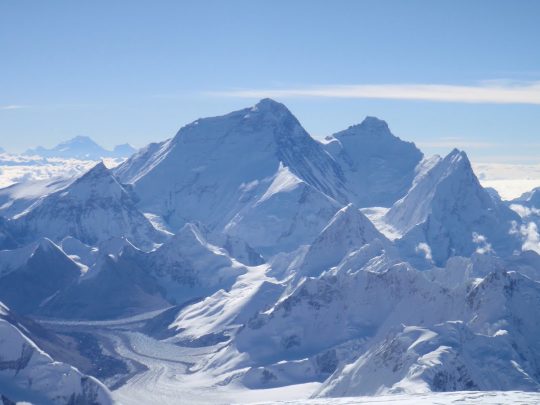
Climb Muztagh Ata, 7546 m — Classic Route Expedition
- Height (m)
- 7546
- Duration
- 22, 26 días
- Difficulty
- Challenging
- Continent
- Asia
- Children
- Not suitable for children
- Accommodation
- Some nights in tents