- Guías
- B2B
-
Ascensiones
-
Ascensión al Elbrus
- Elbrus individually
- Elbrus from the South, 9 days
- Elbrus from the South, 7 days
- Elbrus from the South in 1 day
- Elbrus from the North
- Elbrus Two Summits
- Escalada en Elbrus, travesía de sur a Norte
- Escalada en Elbrus, travesía de Norte a sur
- Elbrus "Cross" from South
- Elbrus "Cross" from North
- Kazbek+Elbrus
- Elbrus from the West
- Elbrus en helicóptero
- Vacaciones en el Elbrus, 9 días
- El descanso en prielbrusye, 7 días
- Tinder Tour, escalada en Elbrus
- Elbrus desde el sur 9 días con Sergei Baranov
- Under 5000 m
- 5000+ meters
- 6000+ meters
- 7000+ meters
- 8000+ meters
-
Ascensión al Elbrus
-
Trekking
-
Trekking in Nepal: routes to the eight-thousanders
- K2 base camp
- Everest base camp
- Everest base camp via Gokyo
- Everest base camp in a week
- Anillo de trekking Annapurna + lago Tilicho
- Anillo De Trekking Manaslu
- Trekking al campamento base de Kanchenjunga
- Trekking al campamento base de Kanchenjunga (corto)
- Trekking al campamento base de Kanchenjunga (India)
- Trekking al campamento base de Makalu
- Trekking al campamento base de Annapurna
- Trekking in South America
- Asia
- Trekking in Africa
- Trekking in Russia
- Europe
-
Trekking in Nepal: routes to the eight-thousanders
-
Adventure expeditions
-
Trekking in Africa
- Tour por Marruecos: el corazón del Norte de África
- Morocco: Toubkal and the mysteries of the Sahara
- Tour a Eritrea: el archipiélago de Dahlak y los nómadas de Rashaid
- Tour a Ruanda: gorilas de montaña y volcán Bisoke
- Tour a Etiopía: paisajes espaciales y tribus del valle de Omo
- Tour a Uganda: parque de la Reina y gorilas de montaña
- Tour a Tanzania: Safari en el Serengeti, Ngorongoro y Tarangira
- Tour a Uganda: rinocerontes blancos y gorilas de montaña
- Tour por Zimbabue y Sudáfrica: cataratas victoria, ciudad del cabo y cabo De buena Esperanza
- Tour a Namibia: parque Etosha y tribus Himba
- Tour a Kenia: los Cinco grandes africanos
- Tour a Botswana: Delta del Okavango y parque Chobe
- Trekking in South America
- Asia
-
Trekking in Africa
- Ski touring and ski mountaineering: chasing freedom in the mountains
- VIP tours
- Useful
- About
Everest Base Camp via Gokyo Lakes — 15 Days
- Height (m)
- 5645
- Duration
- 15 días
- Difficulty
- Moderate
- Continent
- Asia
- Children
- Ages 14+
- Accommodation
- No nights in tents
2000 $
¿Por qué tal precio?
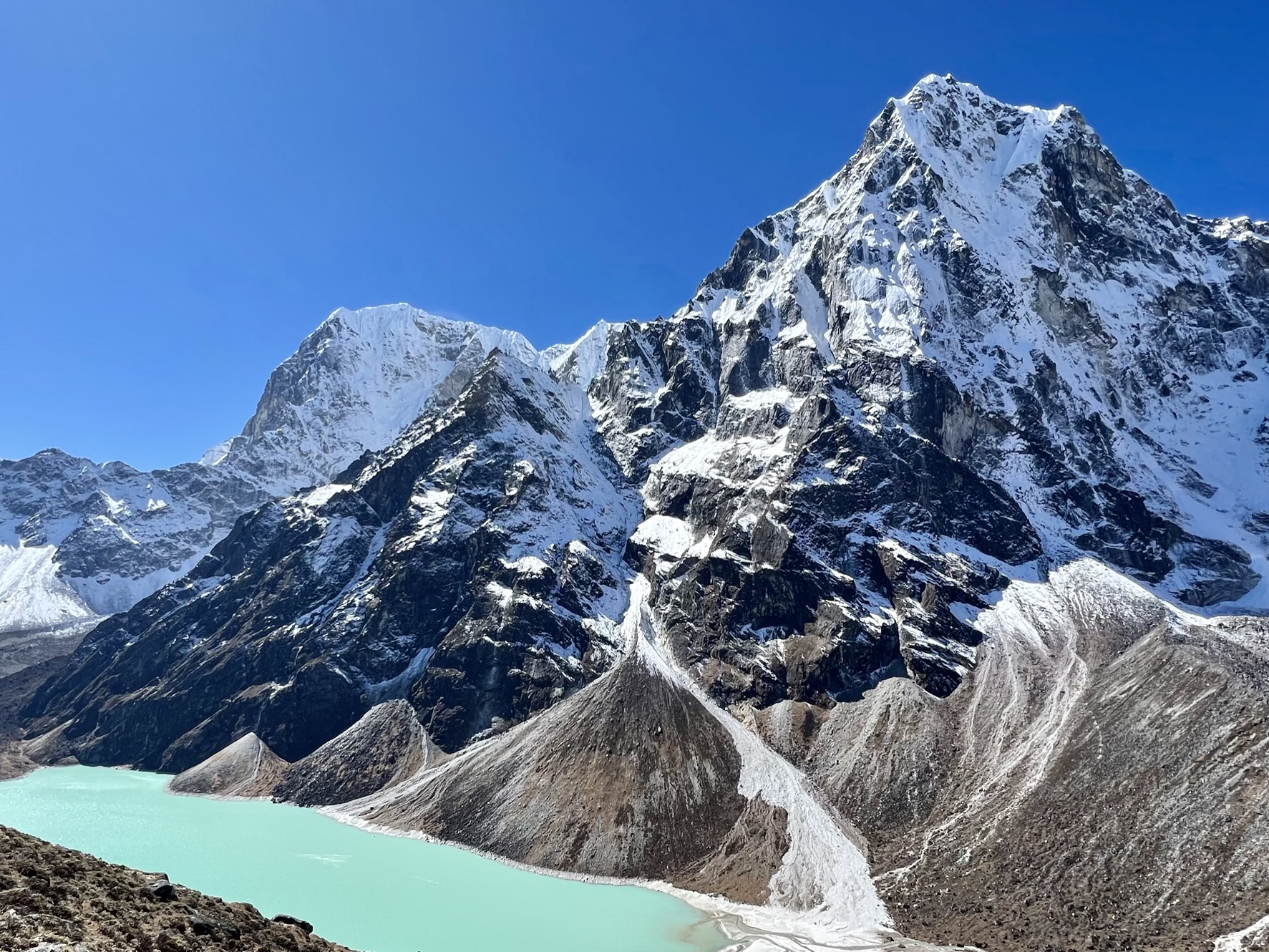
The trek to Everest via the Gokyo Lakes brings the main highlights of the Khumbu region together in a single 15-day route. The group walks up to Everest Base Camp, climbs Kala Patthar, crosses the Cho La pass, descends to the Gokyo Lakes and climbs Gokyo Ri.
- Everest Base Camp, 5364 m
- Kala Patthar, 5645 m
- The high Cho La pass, 5420 m
- The Gokyo Lakes and the village of Gokyo, 4750 m
- Gokyo Ri, 5357 m, with a panorama of four eight-thousanders
- The Khumbu and Ngozumpa glaciers
- Mountain Guide expedition leader in groups of 4 participants or more
This is the fullest and physically the most demanding of the Mountain Guide treks in the Everest region. Participants need good endurance, confident movement on rocky mountain trails and readiness for a long day on the pass. Experience of multi-day hiking and of time spent above 4000 m is strongly recommended.
Programme price — $2,000. The price is fixed in US dollars.
Instead of walking the same trail out and back, the route makes a high-altitude loop: up the Dudh Koshi valley through Lukla, Phakding and Namche Bazaar, then via Pangboche, Pheriche and Lobuche to Gorak Shep, and after Base Camp and Kala Patthar across to Dzongla, over the Cho La and down to the lakes. Kala Patthar gives a close view of Everest, Nuptse and Pumori; from Gokyo Ri, in good visibility, you see Everest, Lhotse, Makalu and Cho Oyu with the Ngozumpa glacier below.
The acclimatization logic keeps the extra night in Namche Bazaar, after which sleeping altitudes rise gradually. Even so, the combination of Base Camp, Kala Patthar, the Cho La and Gokyo Ri creates a greater cumulative load than the classic route, and the Cho La itself is approached over rocky and partly loose ground whose upper section changes after snowfall and in freezing conditions. It is not a technical climb, but the day demands stability, reserves of energy and strict adherence to the guide's decisions.
Important:
- The condition of the Cho La pass depends on snow, ice and weather; the final decision to cross is made by the guide
- Domestic flights, transfers to the departure airport for Lukla, meals on the trek and a personal porter are paid separately
- Flights to Lukla can be delayed, so international tickets must be planned with a margin
- The exact departure point for the Lukla flight and the baggage allowances are confirmed before the trip
- Mountain Guide does not sell air tickets and does not arrange visas
For a first high-altitude trek or a calmer pace it is more sensible to consider the classic trek to Everest Base Camp. Published groups are listed in the Mountain Guide calendar.
About the trek to Everest via Gokyo
The route via Gokyo turns the classic trek to Everest into a high-altitude loop. The first part follows the Dudh Koshi valley through Lukla, Phakding and Namche Bazaar; the group then climbs through Pangboche, Pheriche and Lobuche to Gorak Shep. After visiting Everest Base Camp and climbing Kala Patthar, the route heads for Dzongla, crosses the Cho La pass and comes out at the Gokyo Lakes.
Kala Patthar opens up a close view of Everest, Nuptse and Pumori. Gokyo Ri offers a different panorama: in good visibility you can see Everest, Lhotse, Makalu and Cho Oyu, with the Ngozumpa glacier stretching out below.
The main difference of this programme is the Cho La pass at 5420 m. The approach runs over rocky and in places loose ground, and the condition of the upper section changes after snowfall and during frosts. It is not a technical climb, but the day requires steadiness, reserves of energy and strict compliance with the guide’s decisions. If conditions are unsafe, the route can be changed.
The acclimatization logic keeps the additional night in Namche Bazaar, after which sleeping altitudes increase gradually. Even so, the combination of Base Camp, Kala Patthar, the Cho La and Gokyo Ri creates a greater cumulative load than the classic route. Participants should prepare their legs in advance for long descents and their cardiovascular system for several days above 4500 m. Reading up on the prevention of altitude sickness before the trip is essential.
The programme suits people who would rather not see the Khumbu along the same trail in both directions. For a first high-altitude trek or a calmer pace it makes more sense to consider the classic trek to Everest Base Camp.
In groups of 4 participants or more the trek is led by a Mountain Guide expedition leader. A small group of up to 3 people walks the route with a Nepali guide in accordance with the selected rate. The composition of the team and the language of the guiding are confirmed before booking.
Trekking programme to Everest via Gokyo and the Cho La
Day 1. Arrival in Kathmandu.
Participants fly to Kathmandu independently. A team representative meets the group at the airport and arranges the transfer to the hotel. After check-in there is an introduction to the guide, a check of personal equipment and a detailed briefing on altitude, the Cho La pass and the logistics of the Lukla flight. The evening is free for rest. Night in the hotel.
Day 2. Flight to Lukla, 2860 m, and walk to Phakding, 2610 m.
The group flies to Lukla from the airport confirmed before the trip. After collecting and distributing the baggage the first walking stage begins. The trail mostly loses height, passes through the settlements of the Dudh Koshi valley and leads to Phakding. The light load helps you settle into a rhythm before the climb to Namche Bazaar. Night in a lodge.
Day 3. Walk to Namche Bazaar, 3440 m.
After breakfast we follow the Dudh Koshi, cross suspension bridges and pass the checkpoint at the entrance to Sagarmatha National Park. Beyond Jorsale the long climb to Namche Bazaar begins. The day calls for an even pace and is the first test of fitness. In clear weather a view of Everest appears on the approach. Night in a lodge.
Day 4. Acclimatization in Namche Bazaar, 3440 m.
We stay for a second night in Namche Bazaar and make a walk that gains height and returns. The guide chooses the specific objective according to the weather and the condition of the group. The day is needed for adaptation before the climb towards the 4000 m mark and allows you to check footwear, clothing and your drinking routine before the remote stages of the route. Night in a lodge.
Day 5. Walk to Pangboche, 3928 m.
The trail runs through the upper part of the valley, alternating between descents and climbs. The stage takes about 5–6 hours. Ama Dablam becomes the dominant peak of the panorama and the sleeping altitude approaches 4000 m. Rest and attention to how you feel are important after check-in. Night in a lodge.
Day 6. Walk to Pheriche, 4240 m.
We continue through more open and colder high-mountain terrain. The pace drops in line with the altitude. The guide assesses the condition of the participants before the stage to Lobuche and repeats the criteria under which the route has to be stopped. In the evening we prepare warm clothing and a head torch. Night in a lodge.
Day 7. Walk to Lobuche, 4940 m.
We climb to the moraine of the Khumbu glacier and pass the memorial site between Dughla and Lobuche. Altitude noticeably affects speed and recovery, so the group moves steadily and without surges. The main task is to arrive in Lobuche with enough energy in reserve for the walk to Base Camp. Night in a lodge.
Day 8. Gorak Shep, 5164 m, and Everest Base Camp, 5364 m.
After the walk to Gorak Shep we check in and take a short break. We then set out for Everest Base Camp over uneven rocky ground alongside the Khumbu glacier. Time at the final point is limited by the need to return safely. If the weather or anyone’s condition deteriorates, the guide is entitled to change the length of the walk. Night in a lodge.
Day 9. Kala Patthar, 5645 m, and walk to Dzongla, 4830 m.
Early in the morning, in suitable conditions, we climb Kala Patthar. The altitude makes this a physically hard effort, although there are no technical obstacles. After descending to Gorak Shep the group continues to Dzongla. In the evening the guide checks the forecast, the condition of the pass and every participant’s equipment before the hardest day of the programme. Night in a lodge.
Day 10. The Cho La pass, 5420 m, and walk to Gokyo, 4750 m.
We start early in order to cross the upper section in the most suitable conditions. The climb to the Cho La follows a steep, rocky and in places loose trail; snow and ice can change the difficulty. The decision to cross or to turn back is made by the guide. Beyond the pass there is a long descent and the walk to the village of Gokyo beside the high-altitude lakes. This is the most demanding day of the route. Night in a lodge.
Day 11. Ascent of Gokyo Ri, 5357 m, and walk to Dole.
In good weather the group climbs Gokyo Ri. From the top there is a panorama of Everest, Lhotse, Makalu and Cho Oyu, the Gokyo Lakes and the Ngozumpa glacier. After the descent we collect our belongings and continue down towards Dole. Losing height helps recovery, but accumulated fatigue calls for care on the rocky trail. Night in a lodge.
Day 12. Walk from Dole to Namche Bazaar, 3440 m.
The route returns to the greener part of the Khumbu and passes through several mountain settlements. Despite the overall loss of height, the trail includes separate climbs. In Namche Bazaar the group rests after the high-altitude loop and prepares for the final stage. Night in a lodge.
Day 13. Walk to Lukla, 2860 m.
We descend to the Dudh Koshi, cross the suspension bridges again and return along the familiar section to Lukla. After check-in the guide confirms the flight and the ground logistics for the next day. The evening is for rest and for closing out the work with the local team. Night in a lodge.
Day 14. Flight and return to Kathmandu.
In suitable weather we fly out of Lukla and drive on to Kathmandu after landing. The actual arrival time depends on the schedule of the mountain flights. At the hotel there is time for a shower, sorting equipment and recovery; city activities are only planned if time allows. Night in the hotel.
Day 15. End of the programme.
Breakfast and transfer to the international airport at the agreed time. Participants check in themselves. The return ticket should be chosen with a possible delay of the Lukla flight in mind.
What the trek to Everest via Gokyo price includes
- Mountain Guide expedition leader in groups of 4 participants or more
- Nepali guide
- Meeting and send-off at Kathmandu airport
- Accommodation in a 4* hotel in Kathmandu — 2 nights
- Accommodation in lodges on the trekking route
- Group equipment — first aid kit and satellite navigator
- Duffel bag for personal belongings — provided on site
- Arrangement of the permits, passes and entry fees required for the confirmed route
What the trek to Everest via Gokyo price does not include
- International flights to Kathmandu and back
- Domestic flights to Lukla and back — the cost and baggage allowances are confirmed before the trip
- Transfers between Kathmandu and the departure airport for Lukla
- Nepal visa — $30 for a 15-day visa; the validity matches the length of the programme
- Medical insurance covering trekking to an altitude of at least 5645 m, search and rescue operations and helicopter evacuation
- Single occupancy
- Early check-in and late check-out at the hotel
- Meals on the trekking route — approximately $30–50 per day in the lodges
- Personal porter services — $30 per day, including transport. In a trekking group one porter can carry the belongings of two participants
- Additional personal equipment that the guide may recommend depending on the actual condition of the pass
- Tips for the local team
- Costs arising if you leave the programme early for health or personal reasons
- Additional costs caused by flight delays, weather or an unavoidable change of route
Seguro
НаверхEquipment.
Скачать PDFDocumentos:
• Pasaporte internacional
• Boletos de avión
• Seguro médico que cubre evacuación en helicóptero
Equipo personal:
• Mochila 30-50 litros
• Bolsa para pertenencias personales (nuestro equipo la proporcionará en el lugar)
• Saco de dormir, temperatura de confort -5 °C
• Colchoneta
• Bastones de trekking, obligatorios con anillos
Ropa y calzado:
• Botas de trekking previamente impermeabilizadas con un producto especial
• Zapatillas (para la ciudad)
• Capa impermeable con membrana – chaqueta + pantalones
• Conjunto de forro polar
• Ropa interior térmica (parte superior e inferior)
• Chaqueta de plumas con capucha
• Guantes gruesos
• Guantes finos
• Bandana o buff (además de protección solar en el valle, puede usarse para abrigar garganta o rostro en frío)
• Gorro
• Calcetines de trekking cálidos
Varios:
• Linterna LED de cabeza con autonomía mínima de 12 horas
• Powerbank
• Gafas de sol
• Impermeable
• Funda impermeable para mochila
• Termo o cantimplora – 1 litro
• Polainas
• Crema solar SPF 50
• Bálsamo labial SPF 10-15
• Botiquín personal
• Vendaje elástico y/o soporte ortopédico
• Pasta dental, cepillo, jabón, champú, chanclas
• Toalla
• Papel higiénico (se vende en los lodges a lo largo del recorrido)