- Guías
- B2B
-
Ascensiones
-
Ascensión al Elbrus
- Elbrus individually
- Elbrus from the South, 9 days
- Elbrus from the South, 7 days
- Elbrus from the South in 1 day
- Elbrus from the North
- Elbrus Two Summits
- Escalada en Elbrus, travesía de sur a Norte
- Escalada en Elbrus, travesía de Norte a sur
- Elbrus "Cross" from South
- Elbrus "Cross" from North
- Kazbek+Elbrus
- Elbrus from the West
- Elbrus en helicóptero
- Vacaciones en el Elbrus, 9 días
- El descanso en prielbrusye, 7 días
- Tinder Tour, escalada en Elbrus
- Elbrus desde el sur 9 días con Sergei Baranov
- Under 5000 m
- 5000+ meters
- 6000+ meters
- 7000+ meters
- 8000+ meters
-
Ascensión al Elbrus
-
Trekking
-
See 8000m
- K2 base camp
- Everest base camp
- Everest base camp via Gokyo
- Everest base camp in a week
- Anillo de trekking Annapurna + lago Tilicho
- Anillo De Trekking Manaslu
- Trekking al campamento base de Kanchenjunga
- Trekking al campamento base de Kanchenjunga (corto)
- Trekking al campamento base de Kanchenjunga (India)
- Trekking al campamento base de Makalu
- Trekking al campamento base de Annapurna
- South America
- Asia
- Africa
- Russia
- Europe
-
See 8000m
-
Adventures
-
Africa
- Tour por Marruecos: el corazón del Norte de África
- Morocco: Toubkal and the mysteries of the Sahara
- Tour a Eritrea: el archipiélago de Dahlak y los nómadas de Rashaid
- Tour a Ruanda: gorilas de montaña y volcán Bisoke
- Tour a Etiopía: paisajes espaciales y tribus del valle de Omo
- Tour a Uganda: parque de la Reina y gorilas de montaña
- Tour a Tanzania: Safari en el Serengeti, Ngorongoro y Tarangira
- Tour a Uganda: rinocerontes blancos y gorilas de montaña
- Tour por Zimbabue y Sudáfrica: cataratas victoria, ciudad del cabo y cabo De buena Esperanza
- Tour a Namibia: parque Etosha y tribus Himba
- Tour a Kenia: los Cinco grandes africanos
- Tour a Botswana: Delta del Okavango y parque Chobe
- South America
- Asia
-
Africa
- Ski-touring
- VIP
- Useful
- About
Mera Peak Climb with a Local Guide, 16 Days
- Height (m)
- 6476
- Duration
- 16 días
- Difficulty
- Moderate
- Continent
- Asia
- Children
- Not suitable for children
- Accommodation
- Includes camping
- suitable-for-beginners
- No
235000 $
¿Por qué tal precio?
The ascent of Mera Peak is a 16-day Himalayan trip for physically prepared participants who want their first experience above 6000 m. The route runs through the Hinku valley and settlements less crowded than the classic Everest trail, and before the summit it includes acclimatisation in Khare and a night in a high camp.
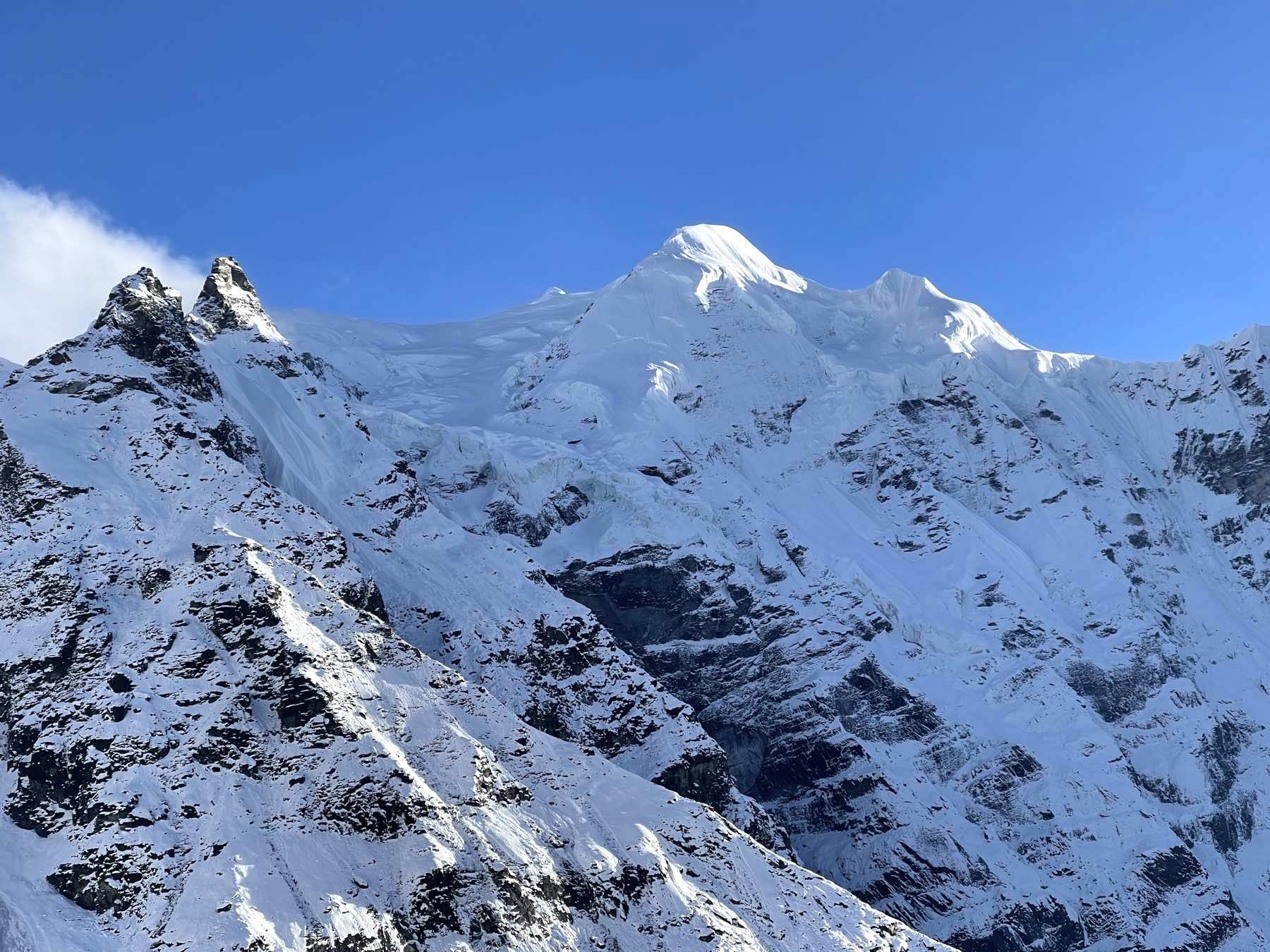
- The summit of Mera Peak, 6476 m
- A panorama of Everest, Lhotse, Makalu and Kanchenjunga
- The Zatrwa La pass, 4610 m
- Consecutive acclimatisation in Chutanga, Thagnag and Khare
- Training and a check of technical equipment before the ascent
- A high camp at 5800 m
- A local Nepali guide with the group under the package option selected
- Assistant guides on summit day, no more than 3 participants per guide
Mera Peak is often chosen as a first Himalayan six-thousander, but the word 'trekking peak' does not mean easy. The summit is reached over snow and glacier in crampons, with a harness and an ice axe. The main requirements are endurance, confident use of the agreed equipment and the ability to keep working at high altitude.
The price of this trip is fixed in US dollars.
Important
- International and internal flights, the transfers to Ramechhap airport, meals in the lodges and a personal porter are paid separately
- Flights to Lukla depend on the weather, so the international departure must be planned with spare time
- Personal technical equipment must be agreed with the guide before the trip
- The summit is not guaranteed; the decision to continue or turn back is taken by the lead guide
- Mountain Guide does not sell air tickets and does not process visas
About the ascent of Mera Peak
Mera Peak lies in the Nepali Khumbu region, but the approach does not follow the main trail to Everest Base Camp; it runs through the Hinku valley. After the flight to Lukla the group climbs to Chutanga, crosses the Zatrwa La pass, descends to Kothe and then gains height step by step through Thagnag to Khare. This logic combines remote trekking, lodge accommodation and a self-contained high-altitude section in a tented camp.
Mera Peak is counted among the popular first six-thousanders of Nepal. The route requires no difficult rock climbing, but it crosses snow and glacier. Participants use crampons, an ice axe, a harness, an ascender and a descender. Before the summit push the guide checks technique and the compatibility of each personal kit.
Acclimatisation begins immediately after Lukla. In Chutanga an outing in the direction of Zatrwa La is provided, after which the overnight stops rise gradually to Thagnag and Khare. An additional day in Khare is needed for recovery, for assessing wellbeing and for working with equipment. The tented night at 5800 m reduces the height difference on summit day, but the night itself calls for a good sleeping bag and the ability to look after yourself in a cold camp.
On summit day the group starts before dawn. The ascent takes approximately 6 to 8 hours and the descent to the high camp about 3 to 4 hours, after which the trip continues back to Khare. Altitude, wind, cold and the state of the snow can change the pace and the tactics. Assistant guides work at a ratio of no more than three participants per guide, and the final decision on going up or turning back rests with the lead guide.
The trip suits a person with good aerobic conditioning and experience of multi-day treks. A previous 5000 m summit is desirable: it helps in understanding your own reaction to altitude. If your technical skills are minimal, they must be practised before the trip and revised in Khare.
For a first technical ascent that also visits Everest Base Camp, Island Peak can be considered, and experienced, well-prepared participants can take on the Island Peak and Mera Peak combination. Both are sold as separate products.
This listing is the local-guide format, run with a local Nepali guide. The composition of the local team, the working language and the ratio of participants to assistants are confirmed before booking. A trip with a leader from the Mountain Guide team is sold under a different package and can be quoted individually on request.
Itinerary of the guided ascent of Mera Peak
Day 1. Arrival in Kathmandu.
Participants make their own way to Kathmandu, where a team representative meets them and takes them to the hotel. After check-in there is an introduction to the local guide, a check of personal and technical equipment, the distribution of baggage and a route briefing. The day is set aside for recovery after the flight and for replacing unsuitable items before departure for the mountains. In the evening there is a group dinner. Night in a hotel.
Day 2. Flight to Lukla, 2800 m.
The group travels to the departure airport and flies to Lukla. The place, the flight time and the ground logistics are confirmed before the trip. On arrival participants check into a lodge, rest and get used to the altitude. The local guide checks the baggage again, because the self-contained walking section begins the next day. Night in a lodge.
Day 3. Trek to Chutanga, 3537 m, and acclimatisation outing.
The first full stage runs through rhododendron, pine and birch forest with a gradual height gain. After checking in at Chutanga the group makes an acclimatisation outing to approximately 4000 m in the direction of the Zatrwa La pass and returns. Such an outing prepares the body for the next high overnight stop and lets the local guide judge the pace of the participants. Night in a lodge.
Day 4. Zatrwa La pass, 4610 m, and trek to Thuli Kharka, 4250 m.
An early start is needed for the long stage over the pass. In 6 to 8 hours the group climbs into the alpine zone, crosses the high point of the day and descends to Thuli Kharka. This is the first serious test of acclimatisation and endurance; cold, wind and snow are possible on the pass. After arrival there is recovery and monitoring of wellbeing. Night in a lodge.
Day 5. Descent to Kothe, 3400 m.
A stage of about 4 to 6 hours leads down through forest and along the valley to the river. Losing height after the pass gives the body a chance to recover before the further climb. In Kothe participants rest, dry their clothing and prepare their day packs for the ascent into the upper Hinku valley. Night in a lodge.
Day 6. Trek to Thagnag, 4267 m.
The group climbs along the Hinku river towards more open high-altitude terrain. The pace stays even, because the height difference is noticeable and acclimatisation is continuing. On arrival it is important to rest, to drink enough and to report headache, nausea or unusual weakness to the local guide immediately. Night in a lodge.
Day 7. Trek to Khare, 4810 m.
In 3 to 4 hours participants reach the main preparation base before Mera Peak. The short duration does not make this a recovery day: the body takes on a new altitude load. After check-in the local guide checks wellbeing and confirms the plan for the next day, while participants prepare crampons, harness and ice axe. Night in a lodge.
Day 8. Acclimatisation and preparation in Khare.
The group stays for a second night in Khare. Depending on the condition of the participants there is a short acclimatisation outing, training or revision of work in crampons and with an ice axe, an ascender and a descender. The day is also needed for rest, final adjustment of equipment and packing for the high camp. Night in a lodge.
Day 9. Climb to the high camp, 5800 m.
Participants leave Khare and climb over snow and ice to the camp below the summit. Movement slows at altitude, so keeping the spacing and following the local guide's instructions matters. After the tents are pitched the group rests, eats and prepares clothing and technical equipment for the night start. Night in tents.
Day 10. Ascent of Mera Peak, 6476 m.
The start is before dawn. The climb up snow slopes takes approximately 6 to 8 hours and requires participants to move in crampons while roped up, as directed by the local guides. In suitable conditions Everest, Lhotse, Makalu and Kanchenjunga are visible from the summit. After a short stop the group descends to the high camp in about 3 to 4 hours and continues to Khare. This is the hardest day of the trip. Night in a lodge.
Day 11. Descent to Kothe.
The long descent takes about 6 to 8 hours. Losing height makes recovery easier, but after summit day it is especially important to stay alert on the stony trail. On arrival the group rests, dries equipment and assesses everyone's condition before the final stages. Night in a lodge.
Day 12. Descent to Thale Kharka.
The route continues through alpine meadows and the forest zone. The day returns participants to a milder climate with more oxygen, but the accumulated fatigue calls for a steady pace. In the evening the local guide checks the weather and the state of the trail before the stage to Lukla. Night in a lodge.
Day 13. Trek to Lukla.
The final walking stage brings the group to Lukla. After check-in the local team prepares the baggage for the flight and the local guide confirms the flight information and the ground transfer. In the evening there is a group dinner marking the end of the mountain section. Night in a lodge.
Day 14. Reserve day.
The day is kept in case of unfavourable weather, a delay on the route or a need for additional acclimatisation. Its use is decided by the lead local guide. If the reserve is not needed, the group rests and stays ready to fly; changing plans independently without agreement is not permitted. The overnight stop is determined by the actual schedule.
Day 15. Flight from Lukla and return to Kathmandu.
In suitable conditions the group flies out of Lukla and returns to Kathmandu after landing on the agreed transfer. The actual timing depends on how the mountain airport is operating. After checking into the hotel participants rest, sort their equipment and prepare for the international departure. Night in a hotel.
Day 16. End of the trip.
After breakfast there is a transfer to the international airport. Participants check in on their own. Return tickets must be chosen with possible weather delays in Lukla and the confirmed reserve day of the trip in mind.
What's included
- A Nepali mountain guide in a group of up to 3 participants
- Assistant guides on summit day, no more than 3 participants per guide
- Meeting and seeing off at Kathmandu airport
- Accommodation in a four-star hotel in Kathmandu, 2 nights
- Breakfasts in Kathmandu
- Accommodation in lodges on the trek
- Accommodation and meals in tents during the high-altitude section
- Group climbing equipment: high-altitude tents, gas, stoves and ropes
- Porters for the group equipment and the high camp supplies
- A soft duffel bag for personal belongings, provided locally
- The climbing permit and the necessary route permissions
- The compulsory rubbish fee
What's not included
- International flights
- The internal flights Ramechhap to Lukla and Lukla to Ramechhap
- Transfers Kathmandu to Ramechhap airport to Kathmandu
- A Nepal visa, 50 US dollars for a 30-day visa; the validity matches the length of the trip
- Personal mountaineering and trekking equipment
- Mountaineering medical insurance covering an ascent to an altitude of at least 6476 m, search and rescue operations and helicopter evacuation
- Rescue operations and evacuation
- Single occupancy
- Early check-in, late check-out and additional nights
- Lunches and dinners in Kathmandu
- Meals in the lodges during the trek, 30 to 50 US dollars a day
- Drinks
- A personal porter for a participant's baggage, 30 US dollars a day including transport. In a trekking group one porter can carry the belongings of two participants
- Tips for the local team
- Costs arising if a participant ends their participation early
- Additional costs caused by delays, weather or forced change to the itinerary
Private groups: a private Mera Peak climb
How you are accompanied. The price shown on this page is the format with a local Nepali guide. Their name, experience, working language and the make-up of the assistant team are confirmed before booking. A Russian-speaking leader from the Mountain Guide team can be requested separately; availability depends on the dates and the size of the group.
The Mera Peak expedition can be arranged for a closed group of friends, a climbing club, a family with confirmed altitude experience or a corporate team. Dates, the working language, the guiding team, personal porters, single rooms in Kathmandu and extra days before or after the route are all agreed individually.
The itinerary can only be adapted in ways that do not shorten the key acclimatisation stages. The nights in Chutanga, Tagnag and Khare, the training day and the high camp each serve a specific safety purpose. The lead guide decides on postponing the summit day, on using the reserve and on turning back.
A Russian-speaking leader from the Mountain Guide team, and the number of assistants needed, are confirmed before booking.
Documents for the Mera Peak climb
Start preparing your documents before you buy non-refundable tickets. The international routing, the internal flights to Lukla, the permit and the insurance policy are all issued against your passport details, so the first name and surname on every document must match your passport.
Visa requirements and the passport validity you need are checked on the website of the Nepal Department of Immigration for your own nationality. Mountain Guide does not arrange visas and does not sell air tickets.
Documents
- A passport that meets Nepal's current requirements
- A tourist visa or another valid entry permit
- International air tickets to Kathmandu and back
- Tickets or confirmations for the internal flights
- An insurance policy covering mountaineering to at least 6476 m, rescue operations and helicopter evacuation
- Your policy number and the insurer's 24-hour emergency contact details
- Your booking confirmation and the organisers' contact details
- Documents for a participant under 18, where these apply
- Digital copies of your passport, visa, tickets and insurance
- Waterproof document wallet
The local team obtains the Mera Peak permit and the other permissions for the confirmed route. You provide photographs and document copies in the format requested, in good time.
Weather and seasons on the Mera Peak climb
The climbing dates are chosen for the periods when the route is usually accessible and steady visibility is more likely than during the summer monsoon. Even within the season, conditions on the Zatrwa La, in the Hinku valley and above Khare can differ greatly. The final assessment is made against your particular dates and the current state of the route.
The forested section can bring rain and humidity. On the pass, at Khare and at the high camp there is snow, strong wind, ice and sub-zero temperatures. The state of the glacier changes, so the guide decides the line to take, whether to rope up and the start time immediately before setting out.
Flights to Lukla operate only in suitable weather. A reserve day is built into the itinerary, but it does not rule out a longer delay. Buy international tickets with a margin after the planned return from the mountains.
Accommodation and meals on Mera Peak
Two nights in a 4-star hotel in Kathmandu, with breakfast, are included. The specific property and room type are named in your booking confirmation. Single occupancy, early check-in, late check-out and additional nights are paid separately.
For most of the trek the group stays in mountain lodges. The more remote and higher the village, the simpler the rooms, the sanitation and the services available. Which lodges are used depends on availability. At the high camp at 5800 m participants sleep in tents; group tents, fuel and meals on the tented stage are included in the price.
Meals in the lodges, and lunches and dinners in Kathmandu, are paid for by participants themselves. The menu can be limited in the remote part of the valley. Drinks and your own snacks are not included. Tell us about dietary restrictions in advance, though a special diet cannot be guaranteed in every lodge.
Facilities on the Mera Peak route
Showers and water. A hot shower may be available for a charge in some lodges only. It is not guaranteed in Khare or at the tented camp. For the high-altitude section you need wet wipes, a small towel and the habit of using water sparingly.
Toilets. Toilet and washing facilities in the lodges vary from village to village. The high camp uses a field toilet arrangement, which the local team explains. A head torch is essential at night.
Power and charging. Charging in the lodges may cost extra and may be limited. You cannot count on a socket at the high camp. You bring your own power bank, spare cells and batteries.
Internet and phone signal. There may be a mobile signal and Wi-Fi on part of the trek, but they can be absent in the Hinku valley and on the high-altitude section. Warn family and friends that there may be gaps in your messages.
Laundry and drying. Do not plan on proper laundry in the mountains. Damp things dry slowly, so bring spare socks, underwear and gloves, and separate dry bags for wet and dry clothing.
Seguro
НаверхEquipment and useful extras for the Mera Peak climb
Скачать PDFYou bring all of your own personal equipment. Before the trip, agree your boots, crampons, ice axe, harness, ascender, descender and sleeping bag with the guide. You may not drop or substitute incompatible or unsuitable technical equipment on your own initiative.
Documents
- Passport
- Air tickets or e-ticket receipts
- Mountaineering medical insurance
- Digital copies of your documents
- Waterproof cover
Personal and technical equipment
- Rucksack of about 60 litres
- Soft duffel bag, provided locally
- Sleeping bag with a comfort rating of -20 to -30 °C
- Insulated sleeping mat
- Two trekking poles with baskets at least 70 mm across
- Steel crampons
- Classic ice axe with a steel pick, or an ice tool agreed with the guide
- Climbing harness
- Climbing helmet
- 3 karabiners
- Cow's-tail lanyards
- Ascender
- Descender
- Mug, spoon and bowl
Clothing and footwear
- Triple or double mountaineering boots
- Broken-in waterproof trekking boots
- Light footwear for towns and lodges
- Waterproof shell jacket and waterproof trousers
- Fleece set
- Base layer, top and bottoms
- Thick down jacket with a hood
- Warm mittens
- Thick gloves
- Thin gloves
- Buff or bandana
- Warm hat
- Warm trekking socks for summit day
- Gaiters
Useful extras
- Head torch with at least 12 hours of battery life
- Power bank
- Sunglasses
- Ski goggles
- Rain jacket
- Vacuum flask, 1 litre, without a push-button lid
- SPF 50 sun cream
- Lip balm with sun protection
- Chemical hand warmers, optional
- Personal first-aid kit
- Elastic bandage or a personal support brace
- Personal toiletries and a quick-drying towel
- Toilet paper