- Guides
- B2B
-
#19607 (sem título)
-
#15972 (sem título)
- Climb Elbrus Individually
- Climb Elbrus from the South, 9 Days
- Climb Elbrus from the South, 7 Days
- Climb Elbrus from the South with Oxygen
- Climb Elbrus from the North, 10 Days
- Two Summits of Elbrus, 9 Days
- Elbrus Traverse from South to North, 9 Days
- Elbrus Traverse from North to South, 10 Days
- Cross of Elbrus, South to North, 9 Days
- Escalando o Elbrus de acordo com o programa”Cruz do Norte”
- Climb Kazbek and Elbrus — 10-Day Two-Summit Programme
- Climb Elbrus from the West, 11 Days
- Elbrus em helicóptero
- Elbrus Region Holiday and Trekking, 9 Days
- Elbrus Region Holiday, 7 Days
- Tinder Tour, escalando o Elbrus
- Climb Elbrus from the South, 9 Days with Sergey Baranov
- #15539 (sem título)
-
#15546 (sem título)
- Climb Kilimanjaro: the Marangu Route
- Climb Kilimanjaro: the Lemosho Route
- Climb Ararat, 5137 m — 7-Day Classic Programme
- Climb Kazbek from the South, 5033 m — 8 Days in Georgia
- Climb Kazbek and Elbrus — 10-Day Two-Summit Programme
- Escalando os vulcões do México
- Climbing Alpamayo — 16-Day Technical Expedition
- Escalada no pico de Margaret (Stanley)
- Climbing Mount Kenya: Point Lenana, 4,985 m
- Climb Dykh-Tau by the North Ridge, 13 Days
-
#15554 (sem título)
- Aconcagua Climb — 17-Day Guided Expedition
- Island Peak Climb — 18-Day Expedition
- Climb Mera Peak, 6476 m — 16-Day Hinku Valley Programme
- Climb Ama Dablam, 6812 m — 24-Day Expedition with Island Peak
- Climb Island Peak and Mera Peak — 24-Day Two-Summit Expedition
- Aconcagua and Ojos del Salado — 25-Day Combined Expedition
- Ojos del Salado Climb — 15-Day Expedition
- Escalando Chimborazo, Cotopaxi
- Escalando Huascaran
- Climb Razdelnaya Peak, 6148 m — 15-Day Pamir Expedition
- Climb Denali by the West Buttress, 23 Days
- #15565 (sem título)
- #15572 (sem título)
-
#15972 (sem título)
-
#19592 (sem título)
-
See 8000m
- K2 Base Camp Trek via the Gondogoro La
- Everest Base Camp Trek — 14 Days
- Everest Base Camp via Gokyo Lakes — 15 Days
- Trekking ao Everest em uma semana
- Annapurna Circuit and Tilicho Lake Trek
- Manaslu Circuit Trek
- Kanchenjunga Circuit Trek (XXL)
- Kanchenjunga North Base Camp Trek (Short)
- Kanchenjunga from India: the Goecha La Trek in Sikkim
- Trekking no acampamento base Makalu
- Trekking no acampamento base de Annapurna
- South America
- Asia
- Africa
-
Russia
- Elbrus Region Holiday and Trekking, 9 Days
- Elbrus Region Holiday, 7 Days
- Trekking Oshten + Kardyvach
- Lake Kardyvach — 5-Day Base-Camp Trek
- Route 30: Through the Mountains to the Sea, with Oshten — 4 Days
- Trekking in Arkhyz — 7 Days over the Ayulyu Pass
- Gvandra Trek — 7 Days to the Ullu-Kyol Lakes
- Trekking in Dombai — 7 Days with the Murudzhu Lakes
- Europe
-
See 8000m
-
Adventures
-
Africa
- Marrocos: o coração do Norte da África
- A escalada de Toubkal e a cultura marroquina
- Excursão à Eritreia: O arquipélago de Dahlak e os nômades de Rashaid
- Excursão A Ruanda: gorilas da montanha e Vulcão Bisoke
- Excursão à Etiópia: paisagens espaciais e tribos do Vale do Omo
- Excursão A Uganda: Parque da Rainha e gorilas da montanha
- Tanzania Safari: Serengeti, Ngorongoro and Tarangire
- Excursão A Uganda: rinocerontes brancos e gorilas da montanha
- Excursão ao Zimbábue e África do Sul: Victoria Falls, Cidade Do Cabo e cabo da Boa Esperança
- Excursão à Namíbia: Etosha Park e as tribos Himba
- Excursão ao Quênia: Os cinco grandes africanos
- Excursão ao Botswana: Delta do Okavango e Parque Chobe
- South America
- Asia
-
Africa
- Ski-touring
- VIP
- #19722 (sem título)
- About
Two Summits of Elbrus, 9 Days
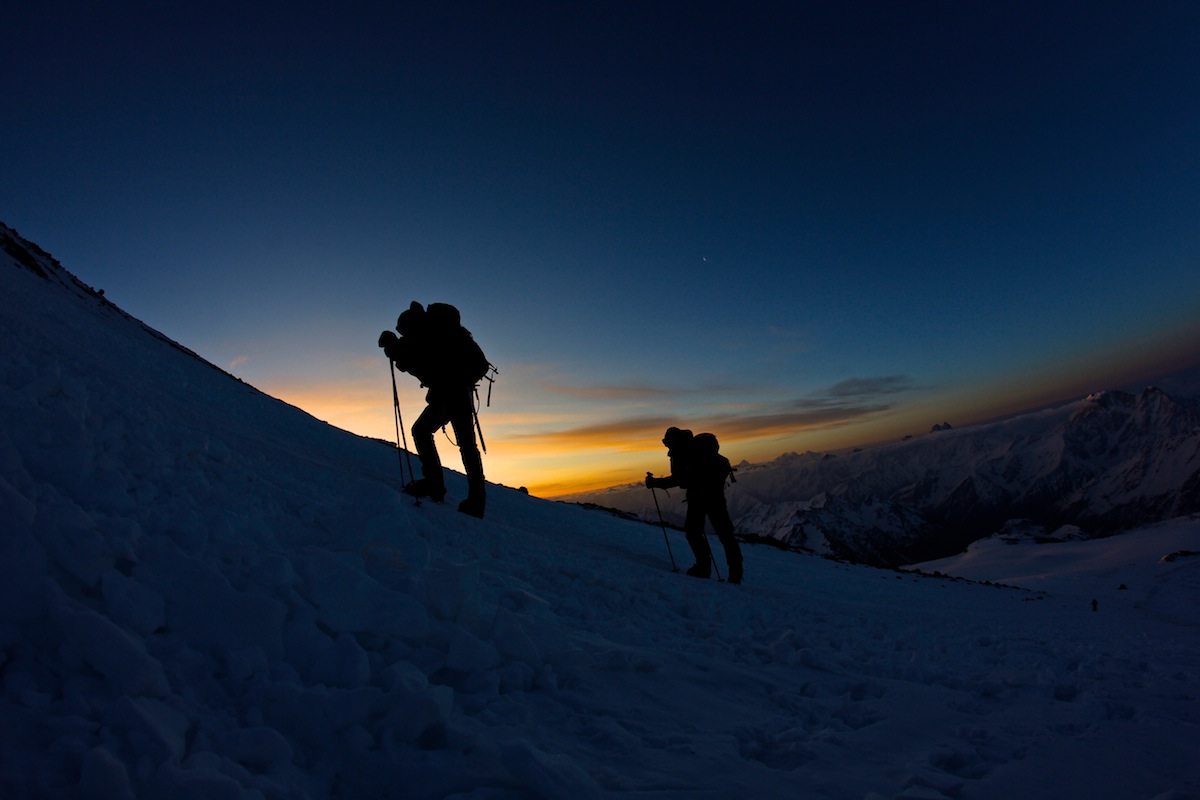
- Height (m)
- 5642
- Duration
- 9 дней
- Difficulty
- Low
- Continent
- Europe
- Children
- From 14 years old
- Accommodation
- Without tents
1860 $
Почему такая цена?
The ascent of both summits of Elbrus is a nine-day programme for participants who want to stand on both summits of the highest mountain in Europe: the West summit at 5642 m and the East summit at 5621 m. It is the fullest version of an ascent of Elbrus from the south.
Programme price — $1 860.
After climbing the West summit the group descends to the saddle and continues towards the East summit. Whether both summits can be climbed depends on the time available, the weather, the state of the route and how participants feel. The final decision is taken by the lead guide on the route itself.
Compared with a standard ascent of one summit, the programme requires more endurance and readiness for a longer summit day. It suits those who want to see Elbrus from two different summits and finish the route without a sense of something left undone.
The key strength of the programme is the Mountain Guide team. We name the specialists who work with the groups and who are responsible for the organisation of the ascent, for the decisions on the route and for the safety of the participants.
The number of group attempts within the main and reserve days is not limited. If the whole group did not start, or had to turn back because of the weather, a repeat group attempt within the programme carries no extra charge. If part of the group completed the ascent, additional attempts for the remaining participants are paid separately.
Between the acclimatisation hikes the group recovers at a hotel in Terskol and in the equipped high-mountain shelter on the slope of Elbrus. The programme includes three meals a day with fresh meat, fruit and vegetables.
All ascents published in the dates and prices section run with a minimum group size of two participants.
For partners, family and friends who want to spend the holiday with you but are not going to the summits, a separate recreation programme in the Elbrus region can be arranged, with accommodation, walks and excursions.
Would you prefer to climb both summits with your own group only? We arrange a private Elbrus ascent on convenient dates subject to guide availability, and the acclimatisation schedule, the number of reserve days, the team and the standard of accommodation can all be adapted.
Important
- Participants carry the food for the high-altitude section themselves. This is a standard feature of how ascents of Elbrus from the south are organised. The food travels up by cable car with the group and is moved onwards by snowcat; it only has to be carried by hand over short sections of no more than 20 m.
- All published departures run with a minimum group size of two participants.
- Any departure from the shelter on summit day counts as a summit attempt.
About the ascent of both summits of Elbrus
The ascent of both summits of Elbrus is the fullest version of the classic southern route. In a single summit push participants climb the West summit at 5642 m and the East summit at 5621 m.
Elbrus has two independent summits separated by a saddle. They differ in shape, in height and in the views they open onto the Caucasus. Most programmes include only the higher West summit, whereas this route lets you see both sides of Elbrus and finish the ascent without having to choose between two objectives.
The programme follows the southern route and uses the infrastructure of the Elbrus region and the high-altitude shelter. Acclimatisation begins in the valley, continues on the treks and finishes with high-altitude hikes on the slope of Elbrus. That sequence helps prepare the body for long work at altitude, but it does not remove the effect of thin air.
Unlike the standard nine-day ascent of Elbrus from the south, the aim of this programme is to climb both summits in one summit push. After the West summit the group returns to the saddle and, in suitable conditions, continues to the East summit.
Climbing the second summit does not require a full descent to the shelter and a repeat of the main part of the route. From the saddle to the East summit there is about 300 m of ascent. The second summit takes roughly 2–3 additional hours, although the actual time depends on the state of the slope, the weather and the pace of the group.
Climbing both summits of Elbrus is harder than the standard route not technically but above all in length and total effort. After the West summit participants have to keep enough strength for the additional altitude gain, for the return to the saddle and for the subsequent descent to the shelter. Good physical condition, properly completed acclimatisation and discipline on the move therefore matter especially.
Altitude affects each person individually. Even a strong and well-prepared participant can adapt slowly to the lack of oxygen. Any deterioration in how you feel must be reported to the guide at once.
The decision to continue after the first summit is taken by the lead guide, who considers the time, the forecast and the actual weather, the state of the route, the speed of movement and how participants feel. If there is not enough safe time or strength in hand, the group begins the descent. The aim of the programme is both summits, but safety always outweighs the original plan.
A long summit day requires general endurance and readiness to move for many hours at altitude. Preparation is best started well in advance.
Weather has a direct effect on whether both summits can be climbed. Strong wind, precipitation, poor visibility or deteriorating snow may make it necessary to shorten the route even after a successful ascent of the first summit.
The route between the summits crosses the saddle of Elbrus. In this area you can see the remains of a Land Rover taken up the mountain in 1997 and now partly buried in snow. This unusual object has become part of the history of climbing on Elbrus.
Guided programme for both summits of Elbrus, 9 days
Day 1. Meeting in Mineralnye Vody and transfer to the Elbrus region.
The group meets at Mineralnye Vody airport. Two group transfers are provided on the first day of the programme: the first leaves at 12:00 for participants whose flights are scheduled to land no later than 11:00, and the second leaves at 15:00 for participants whose flights are scheduled to land no later than 14:00. Please allow time for baggage reclaim and for leaving the terminal when booking. If a flight is delayed and you miss the group transfer by more than 30 minutes, we will help you order a private transfer, which the participant pays for separately. We drive about 200 km to the hotel in the upper Baksan valley at the foot of Elbrus; the journey takes around three hours. After checking in we have dinner, meet the other participants and hold a briefing on the programme, the route, acclimatisation and the safety rules. Overnight at the hotel.
Day 2. Acclimatisation hike on Cheget, 3000 m.
After breakfast we make the first acclimatisation hike of the programme, climbing the slope of Cheget to about 3000 m. A gradual altitude gain helps the body begin adapting to the lack of oxygen and lets the guide assess the pace and condition of the participants. After reaching the planned altitude we descend on foot into the valley and return to the hotel. Overnight at the hotel. Ascent about 1000 m.
Day 3. Acclimatisation trek to the Devichyi Kosy waterfall and the observatory, 3100 m.
We continue acclimatising on a trek to the Devichyi Kosy waterfall at about 2700 m. After a short rest we climb to the observatory at 3100 m. A second consecutive hike allows more time at altitude and prepares us for the move up to the shelter. After the route we descend to the hotel to rest and recover. Overnight at the hotel. Ascent about 1000 m.
Day 4. Move up to the high-mountain shelter and acclimatisation hike to 4200 m.
After breakfast we ride the cable car up to the high-mountain shelter at 3888 m.
In September the cable car may be closed for scheduled maintenance. If the cable car cannot be used, the guide decides the onward logistics according to the actual situation; a vehicle is hired for the ascent if necessary. If the cost of the vehicle exceeds the price of a cable car ticket, participants pay the difference. We settle in, rest and after a light lunch or snack walk up the slope of Elbrus to about 4200 m. This first hike after moving up to the shelter helps judge how the body reacts to the sharp change in altitude and prepares us for the next stage of acclimatisation. We return to the shelter. Overnight in the shelter. Ascent about 500 m.
Day 5. Acclimatisation hike to the Pastukhov Rocks, 4700 m.
We climb to the Pastukhov Rocks at about 4700 m. This is the highest acclimatisation hike of the programme before the ascent of the West and East summits of Elbrus. We move at a calm pace, watch how everyone feels and spend several hours well above the shelter. After reaching the planned altitude we descend to rest and recover. Overnight in the shelter. Ascent about 800 m.
Day 6. Rest and preparation for the ascent of both summits.
The day is given to recovering strength before a long summit day. We check personal and group equipment and prepare clothing, boots and everything else that is needed. The guides give the final briefing and go through the order of movement, communication within the group and the specifics of the crossing between the West and East summits. The final plan is made according to the forecast, the state of the route and how participants feel. Overnight in the shelter.
Day 7. Ascent of the West summit, 5642 m, and the East summit, 5621 m.
We set out early in the morning, usually between 02:00 and 04:00. The exact time is decided by the lead guide according to the weather, the state of the slope and the readiness of the group. We first climb the West summit of Elbrus at 5642 m. After returning to the saddle we assess the time remaining, the weather and the condition of the participants. If conditions allow the route to continue safely, we head for the East summit at 5621 m. The second summit requires about 300 m of additional ascent and takes roughly 2–3 hours. The decision to continue is always taken by the lead guide on the route itself.
A snowcat may be used on the ascent where necessary. The decision to use it is taken in advance, no later than 12:00 on the previous day. On summit day the ratio is one guide to three participants. After completing the route we descend to the high-mountain shelter. Overnight in the shelter. The height difference between the shelter and the high point of the route is 1754 m.
Day 8. Reserve day and return to the hotel.
If the weather, the state of the route or the condition of the group prevented the ascent on the main day, the reserve day is used for a further attempt. The decision is taken by the lead guide on the basis of the actual conditions. If the ascent took place on day 7, we descend by cable car in the morning and return to the hotel. After the end of the high-altitude part of the programme there is time to rest and recover. Overnight at the hotel.
Day 9. Departure to the airport.
The group transfer to Mineralnye Vody airport leaves at 07:00 — please take this into account when choosing your return flight. If your flight is in the evening, you can leave your luggage in the airport left-luggage office and travel independently by taxi to Pyatigorsk. In the town you can visit the site of Mikhail Lermontov’s duel, the Proval cave and the viewpoint, which in clear weather looks out over Pyatigorsk and Elbrus.
What the two-summits ascent includes
- Professional guides — a lead guide accompanies the group throughout the programme, and assistant guides join for summit day. The ratio is strict: no more than three participants to one guide, so a group of four participants is accompanied by two guides
- Repeat group summit attempts within the days provided by the programme, at no extra charge. If part of the group reaches the summit, the ascent counts as completed and additional attempts for the remaining participants are paid separately
- The services of a cook
- Hotel accommodation in twin rooms for all nights set out in the programme
- Accommodation in the high-mountain shelter for the number of nights set out in the programme
- All transfers within the programme from Mineralnye Vody airport or railway station and back
- Cable car tickets as set out in the programme
- Three meals a day throughout the programme, from dinner on the day of arrival to breakfast on the day of departure
- Group mountaineering and emergency equipment — ropes, ice screws, radios, satellite navigators and a first aid kit
- Hire of a duffel bag for carrying personal and rented equipment for the duration of the ascent
What the two-summits ascent does not include
- The snowcat on summit day, paid separately on the spot where it is used. The snowcat is charged by the operator at the current season tariff and is paid separately on the spot. We try to agree additional options with our partners, and when rooms are free early check-in or late check-out is sometimes provided at no charge
- Personal equipment
- Medical insurance
- Additional costs arising from changes to the programme requested by participants or caused by circumstances the programme does not provide for
- The supplement for an alternative ascent by vehicle if the cable car is closed for maintenance in September and the cost of the vehicle exceeds the price of a cable car ticket
Страхование
НаверхList of equipment for climbing mount Elbrus from the South:
Скачать PDFNo Rock-and-Rent, há absolutamente tudo, de alta qualidade. Você pode chegar até de shorts (especialmente se reservar tudo com antecedência). Todo o equipamento foi selecionado com base em um único fator: máxima adequação às condições do Elbrus, onde guiamos desde 2001.
E sim, compilamos esta lista com muito cuidado; nossos guias já realizaram milhares de ascensões, e não acreditamos que haja qualquer item desnecessário!
Documentos:
- Passaporte
- Passagens aéreas/trem
- Seguro de saúde
- Voucher (para estrangeiros)
Equipamento pessoal:
- Mochila, 30-40 litros
- Saco de viagem/baú, 80-100 litros
- Colchonete
- Saco de dormir, conforto de 0°C a +10°C (junho a setembro), -20°C a 0°C (outubro a maio)
- Bastões de trekking, obrigatórios com argolas de pelo menos 70 mm
- Crampons
- Piolet clássico, com corda de segurança 5-6 mm (2-3 metros)
- Sistema de escalada/alpinismo
- Capacete
- Mosquetões, 3 unidades (preferencialmente grandes, mais fácil de manusear com luvas)
- Cordas de segurança
Roupa e calçado:
- Botas de alpinismo duplas/triplas – plásticas ou de couro. Camada única só com o uso de polainas (não confundir com gamas)
- Tênis de trekking ou botas de trekking. Em maio e início de junho, nos primeiros treinos de aclimatação, ainda pode haver neve, portanto botas são preferíveis; depois de meados de junho até o fim de setembro, tênis podem substituir botas (verifique se são resistentes à água)
- Camada impermeável – jaqueta + calça, recomendação de membrana 10.000/10.000 ou superior
- Fato de fleece
- Roupa térmica superior e inferior
- Casaco de pluma com capuz, grosso e quente, peso usual ≥700 g
- Luva grossa
- Luvas quentes (esqui)
- Luvas finas (fleece)
- Bandana (proteção solar ou para aquecer o pescoço/rosto no frio)
- Gorro
- Meias térmicas para o dia da ascensão
- Chapéu para sol
- Calças e camisetas de trekking (preferencialmente mangas compridas)
- Meias de trekking para os dias de caminhada
Diversos:
- Lanterna de cabeça LED, autonomia ≥12h
- Óculos de sol, categoria 3-4, proteção lateral completa
- Máscara de esqui, categoria 1-2 (para mau tempo)
- Garrafa térmica, 1 litro, preferencial sem botão na tampa
- Máscara de proteção contra vento para a face (pode substituir por lenço/buff)
- Protetor solar, SPF 30-50
- Bálsamo labial, SPF-15
- Kit de primeiros socorros pessoal
- Bandagem elástica e/ou suporte
- Gamas (opcional, útil especialmente em maio-junho)
- Aquecedores químicos (opcional, podem ser muito úteis)
Вам также будет интересно:
-
 2,400 $
Climb Kazbek and Elbrus — 10-Day Two-Summit Programme
- Height (m)
- 5642
- Duration
- 10 дней
- Difficulty
- Moderate
- Continent
- Europe
- Children
- From 14 years old
- Accommodation
- Without tents
-
 3,200 $
Climb Lenin Peak, 7134 m — 21-Day Pamir Expedition
-
 2,960 $
A subida do Mont Blanc
- Height (m)
- 4810
- Duration
- 7 дней
- Difficulty
- Moderate
- Continent
- Europe
- Children
- From 14 years old
- Accommodation
- Without tents
-
 2,160 $
Cross of Elbrus, South to North, 9 Days
- Height (m)
- 5642
- Duration
- 9 дней
- Difficulty
- Moderate
- Continent
- Europe
- Children
- From 14 years old
- Accommodation
- Without tents