- Guides
- B2B
-
#19607 (sem título)
-
#15972 (sem título)
- Climb Elbrus Individually
- Climb Elbrus from the South, 9 Days
- Climb Elbrus from the South, 7 Days
- Climb Elbrus from the South with Oxygen
- Climb Elbrus from the North, 10 Days
- Two Summits of Elbrus, 9 Days
- Elbrus Traverse from South to North, 9 Days
- Elbrus Traverse from North to South, 10 Days
- Cross of Elbrus, South to North, 9 Days
- Cross of Elbrus, North to South, 10 Days
- Climb Kazbek and Elbrus — 10-Day Two-Summit Expedition
- Climb Elbrus from the West, 11 Days
- Elbrus by Private Helicopter, 3 Days
- Elbrus Region Holiday and Trekking, 9 Days
- Elbrus Region Holiday, 7 Days
- Elbrus Dating
- Climb Elbrus from the South, 9 Days with Sergey Baranov
-
#15539 (sem título)
- Climb Carstensz Pyramid, 8 Days with Helicopter Access
- Climb Mont Blanc, 4810 m — 8-Day Guided Ascent
- Climb the Matterhorn, 4478 m — 8-Day Guided Ascent
- Climb Mount Vinson, 15-Day Antarctic Expedition
- Climb Kosciuszko and Travel in Australia, 7 Days
- Climb Fisht, 2868 m — 3-Day Ascent by the 1B Route
- Climb Mount Wilhelm, 6 Days
-
#15546 (sem título)
- Climb Kilimanjaro: the Marangu Route
- Climb Kilimanjaro: the Lemosho Route
- Climb Ararat, 5137 m — 7-Day Classic Climb
- Climb Kazbek from the South, 5033 m — 8 Days in Georgia
- Climb Kazbek and Elbrus — 10-Day Two-Summit Expedition
- Climb the Volcanoes of Mexico — Orizaba and Iztaccíhuatl, 9 Days
- Climb Alpamayo — 16-Day Technical Expedition
- Climb Margaret Peak (Stanley), 5109 m
- Climb Mount Kenya: Point Lenana, 4985 m
- Climb Dykh-Tau by the North Ridge, 13 Days
-
#15554 (sem título)
- Aconcagua Climb — 17-Day Guided Expedition
- Island Peak Climb — 18-Day Expedition
- Climb Mera Peak, 6476 m — 16-Day Hinku Valley Expedition
- Climb Ama Dablam, 6812 m — 24-Day Expedition with Island Peak
- Climb Island Peak and Mera Peak — 24-Day Two-Summit Expedition
- Aconcagua and Ojos del Salado — 25-Day Combined Expedition
- Ojos del Salado Climb — 15-Day Expedition
- Climb Chimborazo and Cotopaxi — 14-Day Ecuador Expedition
- Climb Huascarán — 8-Day Technical Ascent
- Climb Razdelnaya Peak, 6148 m — 15-Day Pamir Expedition
- Climb Denali by the West Buttress, 23 Days
- #15565 (sem título)
- #15572 (sem título)
-
#15972 (sem título)
-
#19592 (sem título)
-
Trekking in Nepal: routes to the eight-thousanders
- K2 Base Camp Trek via the Gondogoro La
- Everest Base Camp Trek — 14 Days
- Everest Base Camp via Gokyo Lakes — 15 Days
- Short Everest Base Camp Trek in 10 Days
- Annapurna Circuit and Tilicho Lake Trek
- Manaslu Circuit Trek
- Kanchenjunga Circuit Trek (XXL)
- Kanchenjunga North Base Camp Trek (Short)
- Kanchenjunga from India: the Goecha La Trek in Sikkim
- Makalu Base Camp Trek
- Annapurna Base Camp Trek
- Trekking in South America
- Asia
- Trekking in Africa
-
Trekking in Russia
- Elbrus Region Holiday and Trekking, 9 Days
- Elbrus Region Holiday, 7 Days
- Oshten + Kardyvach — 9-Day Western Caucasus Trek
- Lake Kardyvach — 5-Day Base-Camp Trek
- Route 30: Through the Mountains to the Sea, with Oshten — 4 Days
- Trekking in Arkhyz — 7 Days over the Ayulyu Pass
- Gvandra Trek — 7 Days to the Ullu-Kyol Lakes
- Trekking in Dombai — 7 Days with the Murudzhu Lakes
- Europe
-
Trekking in Nepal: routes to the eight-thousanders
-
Adventure expeditions
-
Trekking in Africa
- Marrocos: o coração do Norte da África
- A escalada de Toubkal e a cultura marroquina
- Eritrea: the Dahlak Archipelago and the Rashaida Nomads
- Rwanda: Mountain Gorillas and the Bisoke Volcano
- Ethiopia: Otherworldly Landscapes and the Peoples of the Omo Valley
- Excursão A Uganda: Parque da Rainha e gorilas da montanha
- Tanzania Safari: Serengeti, Ngorongoro and Tarangire
- Excursão A Uganda: rinocerontes brancos e gorilas da montanha
- Zimbabwe and South Africa: Victoria Falls, Cape Town and the Cape of Good Hope
- Namibia: Etosha National Park and the Himba
- Kenya Safari: the African Big Five
- Excursão ao Botswana: Delta do Okavango e Parque Chobe
- Trekking in South America
- Asia
-
Trekking in Africa
- Ski touring and ski mountaineering: chasing freedom in the mountains
- VIP tours
- #19722 (sem título)
- About
Tour du Mont Blanc — 12-Day Trek Around the Massif
- Height (m)
- 2665
- Duration
- 12 дней
- Difficulty
- Low
- Continent
- Europe
- Children
- Ages 10+
- Accommodation
- No nights in tents
3400 $
Почему такая цена?
Тур временно недоступен
The Tour du Mont Blanc — a 12-day trip built around the full circuit of the Mont Blanc massif, with ten trekking days through France, Italy and Switzerland.
- One of the world's top ten treks, walked as the full circuit rather than the shortened version
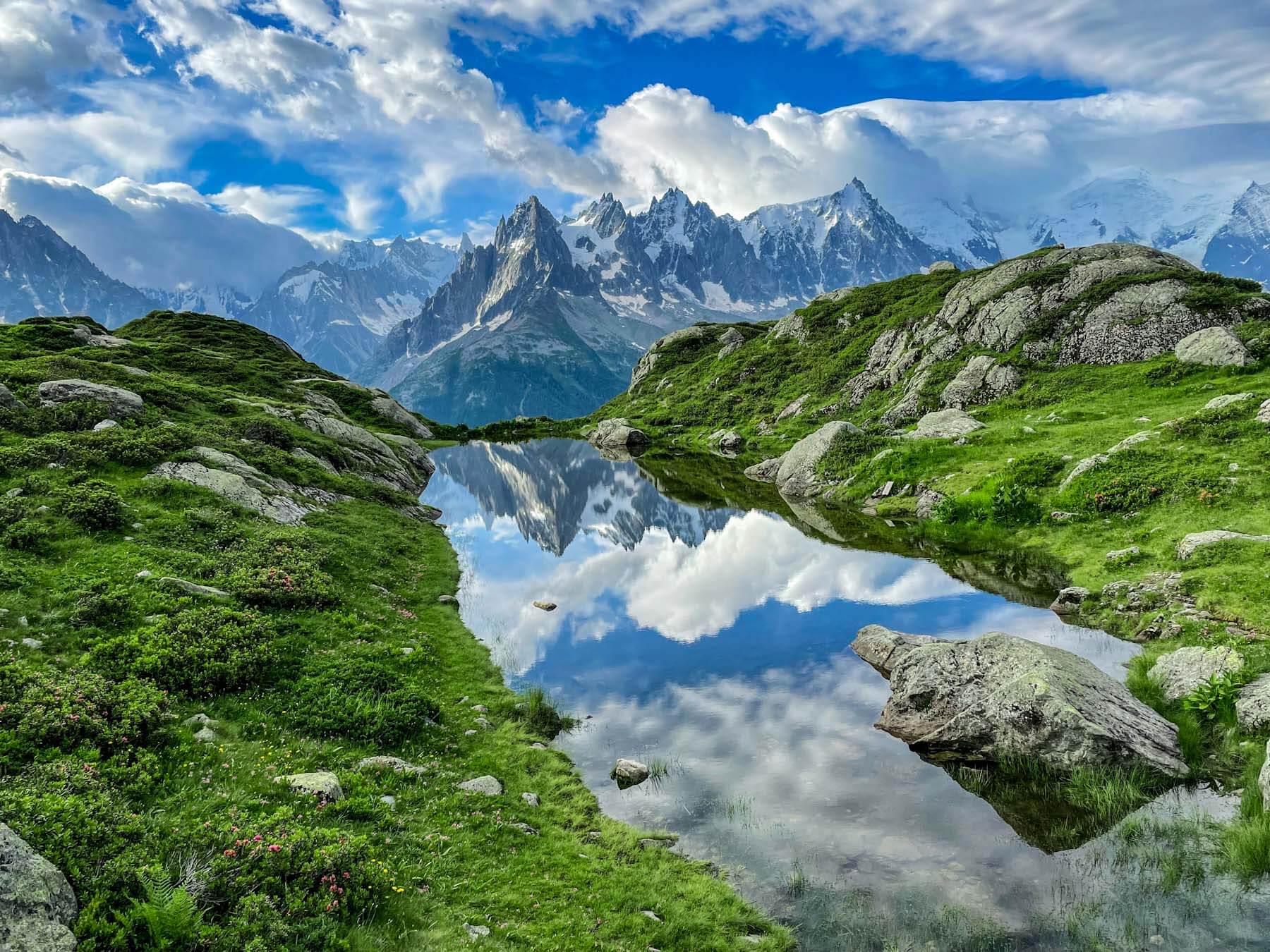
- Serene lakes reflecting the Alpine summits
- Real Alpine pastures
- Local cuisine, including farm produce from remote corners of Europe
- Villages that are completely cut off in winter
- Mont Blanc seen from three countries: France, Italy and Switzerland
Unlike other companies, we arrange comfortable accommodation for the whole trek: hotels and mountain refuges, no tents. Daily stages run from 13 to 20 km.
Important:
- Check-in and check-out times are set by the hotels: check-in from 15:00, check-out by 11:00–12:00. Luggage can be left at reception while you walk around town, or, where the hotel can arrange it, an early check-in or late check-out can be paid for
- Mountain Guide does not sell air tickets and does not process visas, and so is not responsible for disruption beyond its control involving flights or border crossings
- The trip price is fixed in US dollars
About the Tour du Mont Blanc
The Tour du Mont Blanc is one of the most spectacular trekking routes in the world and is consistently placed in the top ten, alongside routes such as the trek to Everest Base Camp or the Lycian Way. The full circuit is about 170 km around the Mont Blanc massif, with a cumulative ascent and descent of roughly 10000 m. The route passes through three Alpine regions — France, Italy and Switzerland — encircling Mont Blanc, 4810 m.
There are several versions of the route: a shortened six-day version focused on the best known highlights, and the full circuit walked in ten days. We offer the full ten-day circuit, set inside a twelve-day trip with an arrival day in Chamonix and a departure day, so that the walking stages are not compressed.
The history of the circuit goes back to the eighteenth century, when explorers, scientists and geologists were drawn to this region. As often happens in the Alps, the line originally served as a trade route linking remote corners of Europe, though no detailed record of those journeys survives. The first documented completion of the Mont Blanc circuit is dated 1767, when Horace-Bénédict de Saussure travelled it with friends and porters from Chamonix on a scientific expedition to study the geography of the massif. Later, in the Victorian era, the Tour du Mont Blanc became an obligatory journey for wealthy aristocrats, merchants and other members of society — although they generally covered the distance on muleback. It has since become one of the most popular multi-day routes in the European Alps.
The landscapes have no equal: from the rocky, almost lunar terrain of the Aiguilles Rouges to the pastures of the Contamines valley. Every day of the trek offers something new, and one constant — the snow-white summit of Mont Blanc, shifting only slightly in perspective from day to day.
Participants walk with a day pack; a personal porter is not included in the price. Accommodation is in hotels and mountain refuges, with shared dormitories on the refuge nights and an upgrade available on request. This page is the circuit trek around the massif. The guided ascent of Mont Blanc is a separate trip and is not part of this product.
Tour du Mont Blanc trekking itinerary, 12 days
Day 1. Arrival in Chamonix, a town steeped in the spirit of mountaineering and regarded as its capital. It is a genuinely striking place, tucked in below the highest summit in Western Europe. For centuries explorers, scientists and climbers have come here to learn more about the region. Check-in at the hotel. In the evening, a briefing with the guide and introductions to the rest of the team. Night at the hotel.
Day 2. The trek begins in the morning after breakfast with the cable car up to Planpraz at 2000 m. From there the route heads for the Brévent pass at 2525 m and continues to the Bellachat refuge. From the refuge comes a long and somewhat demanding descent to Les Houches and the hotel, a small, quiet village in the Chamonix valley with striking views of Mont Blanc. This day often feels like one of the hardest on the route, mainly because participants have not yet acclimatised. The descent can feel exhausting and is probably the most challenging of the whole trek, because of its 1500 m of loss and the occasionally rocky ground. Trekking distance 13 km. Night at the hotel.
Day 3. The day starts with the cable car up to Bellevue at 1802 m, with fine views of the Mont Blanc massif. Yesterday was a full day and acclimatisation is still under way, so today’s easier stage is welcome. The route leads to Les Contamines via Bionnassay and the chapel. The ground today is very different — less rocky and greener, as the trail crosses high pastures. Trekking distance 15 km. Night at the hotel.
Day 4. A full day with an early start: three passes in a row, Col du Bonhomme, Col de la Croix du Bonhomme and Col des Fours at 2665 m. A steep descent then leads through wild and remote country to Ville des Glaciers, a village completely cut off in winter but known for its dairy, where the group tastes the local cheese. The day ends at the atmospheric Les Mottets refuge. Although “three passes” may sound intimidating, it is a perfectly manageable trekking day: steep sections alternate with easier ground where you can recover. Trekking distance 20 km. Night in a refuge (shared dormitory, upgrade available on request).
Day 5. After the night at Les Mottets, below the Col de la Seigne at 2516 m, the group climbs quickly to the pass in the morning and crosses from France into Italy. The route then drops into the striking Val Veny and reaches Lake Combal. From there it descends to La Visaille, and a vehicle takes the group on to Courmayeur, a charming Italian Alpine town that matches and in places surpasses the better known Chamonix. This day stays in the memory: the views from the Col de la Seigne have no equal. At the top of the pass the group rests and takes in the wide panorama over Italy and Switzerland. Trekking distance 14 km. Night at the hotel.
Day 6. After a comfortable night the group sets off early for the next refuge, with striking views of Mont Blanc and of Courmayeur far below. Midday brings a coffee stop with views of the peaks of the European Alps, including Mont Blanc and the Grandes Jorasses. The rest of the walking day runs high above the valley, with fine views of the Italian side of Mont Blanc, before reaching the beautiful Bonatti refuge at 2056 m. Trekking distance 17 km. Night in a refuge (shared dormitory, upgrade available on request).
Day 7. Another early start, and a new country ahead. The route continues through the Italian Val Ferret to Arnouvaz before the long climb to the Col Ferret at 2537 m, from where the whole line of the last three days is visible. On the way it passes the Elena refuge, where there is a chance to eat and rest, and crosses the Italian–Swiss border. A relatively easy and pleasant descent follows on a good trail, with a stop in La Fouly for a snack, and the hotel is reached soon afterwards. Trekking distance 20 km. Night at the hotel.
Day 8. A comparatively easy day walking through the beautiful Swiss Val Ferret. The route passes the small villages of Praz-de-Fort and Issert before climbing to the charming village of Champex-Lac, where the group stays the night. This is a classic Swiss village with a fine lake, a good place to rest, with plenty of bars, restaurants and shops. On the way it passes another point of interest, the high farm at Bovine, where local produce can be bought and a picnic taken on the terrace, with views over Lake Geneva and down the Rhône valley. Trekking distance 18 km. Night in a lodge.
Day 9. The day starts easily on gentle trails to Plan de l’Au, then climbs steadily to Alpine pastures at 1987 m, with magnificent views of the town of Martigny and the canton of Valais. The rest of the day is spent descending to the Col de la Forclaz at 1526 m, with a final descent to Trient. Trekking distance 18 km. Night in a lodge.
Day 10. After breakfast the route sets off for the attractive small village of Argentière, at the head of the Chamonix valley below Mont Blanc. On the way there are views from above of the Emosson dam and the Aiguilles Rouges nature reserve. Trekking distance 15 km. Night at the hotel.
Day 11. The final day, and a fitting close to the circuit, returns to the Aiguilles Rouges nature reserve and the striking Chéserys lakes and Lac Blanc at 2352 m. The route then descends to La Flégère and continues along the high trail above the Chamonix valley to Planpraz, the starting point, completing the circle. The last descent is by cable car back to Chamonix, for a celebratory dinner marking the completion of the Tour du Mont Blanc, one of the best multi-day treks in the world. Trekking distance 14 km. Night at the hotel.
Day 12. Transfer to the airport. Departure home.
What's included
- A Mountain Guide trek leader for groups of 4 participants or more
- Meeting and seeing off at the airport
- Accommodation at a 4-star hotel in Chamonix — 2 nights
- Accommodation in refuges and hotels along the trek
- Group equipment — first-aid kit, satellite navigator and other items
- Arrangement of all the permits and paperwork required for the trek, including trekking permits and national park entries
- Transfers according to the itinerary
What's not included
- Lunches and dinners during the stay in Chamonix
- Visa, if required
- Meals on the trek, ordered individually from the menu
- A personal porter
- Tips for the staff
- Medical insurance and emergency evacuation
- Single-room accommodation
- Early check-in or late check-out at the hotel before or after the trip. We always try to arrange additional benefits for our guests with our partners, and early check-in or late check-out is often granted free of charge
- Any departure from the itinerary
- Any costs arising from a change to the itinerary
Private groups
A private group can agree its own dates, pace, standard of accommodation and extra days in the Chamonix or Courmayeur valleys or in Switzerland. Baggage transfer can be arranged on the sections where it is available. The basic shape of the full circuit and the safe length of the stages are kept.
Documents you need
- Passport
- The documents you need to enter France, Italy and Switzerland for your nationality
- Medical insurance covering mountain trekking, search and rescue and evacuation
- Tickets and accommodation confirmations
- We recommend keeping digital copies of your documents on your phone and in cloud storage
Weather and seasons
The full circuit is usually walked in summer and early autumn, when the high passes are clear of dangerous snow and the seasonal infrastructure is running. The route can bring heat in the valleys, rain, thunderstorms, strong wind and a sharp drop in temperature on the passes. The state of the trails is checked before each stage.
Accommodation and meals
In Chamonix the trip uses a hotel; on the trek, hotels and mountain refuges along the route. Accommodation is mainly twin in the hotels and shared in the refuges. Meals on the trek are paid for from the menu unless your confirmed package says otherwise; tell us about any dietary restrictions in advance.
Facilities on the route
- The refuges may have shared rooms and limited personal space
- Showers, hot water, electricity and charging depend on the particular refuge
- Mobile signal and internet are not available on every stage
- You carry your own day pack
- Stages can change because of thunderstorms, snow, the state of the passes or the transport timetable
Страхование
НаверхEquipment and useful extras for the trip.
Скачать PDFDocuments:
- Passport
- Air tickets
- Medical insurance covering helicopter evacuation
Personal equipment:
- Rucksack, 30-50 litres.
- Sleeping bag with a comfort rating of -5 °C.
- Trekking poles, which must have baskets
Clothing and footwear:
- Trekking boots, thoroughly treated with a waterproofing product beforehand
- Trainers (for town)
- Waterproof membrane shell: jacket and trousers
- Fleece top and bottoms
- Base layer, top and bottoms
- Down jacket with a hood
- Thick gloves
- Thin gloves
- Bandana or buff (as well as sun protection in the valley, it can keep your throat or face warm in the cold)
- Warm hat
- Warm trekking socks
Other items:
- LED head torch with at least 12 hours of battery life
- Powerbank
- Sunglasses
- Rain jacket
- Rain cover for your rucksack
- Vacuum flask or water bottle, 1 litre. (optional)
- Gaiters
- SPF 50 sun cream
- SPF 10-15 lip balm
- Personal first-aid kit
- Elastic bandage and/or a support brace
- Toothpaste, toothbrush, soap, shampoo and flip-flops
- Towel
- Toilet paper (on sale in the lodges along the way)