- Guides
- B2B
-
#19607 (sem título)
-
#15972 (sem título)
- Climb Elbrus Individually
- Climb Elbrus from the South, 9 Days
- Climb Elbrus from the South, 7 Days
- Climb Elbrus from the South with Oxygen
- Climb Elbrus from the North, 10 Days
- Two Summits of Elbrus, 9 Days
- Elbrus Traverse from South to North, 9 Days
- Elbrus Traverse from North to South, 10 Days
- Cross of Elbrus, South to North, 9 Days
- Cross of Elbrus, North to South, 10 Days
- Climb Kazbek and Elbrus — 10-Day Two-Summit Expedition
- Climb Elbrus from the West, 11 Days
- Elbrus by Private Helicopter, 3 Days
- Elbrus Region Holiday and Trekking, 9 Days
- Elbrus Region Holiday, 7 Days
- Elbrus Dating
- Climb Elbrus from the South, 9 Days with Sergey Baranov
-
#15539 (sem título)
- Climb Carstensz Pyramid, 8 Days with Helicopter Access
- Climb Mont Blanc, 4810 m — 8-Day Guided Ascent
- Climb the Matterhorn, 4478 m — 8-Day Guided Ascent
- Climb Mount Vinson, 15-Day Antarctic Expedition
- Climb Kosciuszko and Travel in Australia, 7 Days
- Climb Fisht, 2868 m — 3-Day Ascent by the 1B Route
- Climb Mount Wilhelm, 6 Days
-
#15546 (sem título)
- Climb Kilimanjaro: the Marangu Route
- Climb Kilimanjaro: the Lemosho Route
- Climb Ararat, 5137 m — 7-Day Classic Climb
- Climb Kazbek from the South, 5033 m — 8 Days in Georgia
- Climb Kazbek and Elbrus — 10-Day Two-Summit Expedition
- Climb the Volcanoes of Mexico — Orizaba and Iztaccíhuatl, 9 Days
- Climb Alpamayo — 16-Day Technical Expedition
- Climb Margaret Peak (Stanley), 5109 m
- Climb Mount Kenya: Point Lenana, 4985 m
- Climb Dykh-Tau by the North Ridge, 13 Days
-
#15554 (sem título)
- Aconcagua Climb — 17-Day Guided Expedition
- Island Peak Climb — 18-Day Expedition
- Climb Mera Peak, 6476 m — 16-Day Hinku Valley Expedition
- Climb Ama Dablam, 6812 m — 24-Day Expedition with Island Peak
- Climb Island Peak and Mera Peak — 24-Day Two-Summit Expedition
- Aconcagua and Ojos del Salado — 25-Day Combined Expedition
- Ojos del Salado Climb — 15-Day Expedition
- Climb Chimborazo and Cotopaxi — 14-Day Ecuador Expedition
- Climb Huascarán — 8-Day Technical Ascent
- Climb Razdelnaya Peak, 6148 m — 15-Day Pamir Expedition
- Climb Denali by the West Buttress, 23 Days
- #15565 (sem título)
- #15572 (sem título)
-
#15972 (sem título)
-
#19592 (sem título)
-
Trekking in Nepal: routes to the eight-thousanders
- K2 Base Camp Trek via the Gondogoro La
- Everest Base Camp Trek — 14 Days
- Everest Base Camp via Gokyo Lakes — 15 Days
- Short Everest Base Camp Trek in 10 Days
- Annapurna Circuit and Tilicho Lake Trek
- Manaslu Circuit Trek
- Kanchenjunga Circuit Trek (XXL)
- Kanchenjunga North Base Camp Trek (Short)
- Kanchenjunga from India: the Goecha La Trek in Sikkim
- Makalu Base Camp Trek
- Annapurna Base Camp Trek
- Trekking in South America
- Asia
- Trekking in Africa
-
Trekking in Russia
- Elbrus Region Holiday and Trekking, 9 Days
- Elbrus Region Holiday, 7 Days
- Oshten + Kardyvach — 9-Day Western Caucasus Trek
- Lake Kardyvach — 5-Day Base-Camp Trek
- Route 30: Through the Mountains to the Sea, with Oshten — 4 Days
- Trekking in Arkhyz — 7 Days over the Ayulyu Pass
- Gvandra Trek — 7 Days to the Ullu-Kyol Lakes
- Trekking in Dombai — 7 Days with the Murudzhu Lakes
- Europe
-
Trekking in Nepal: routes to the eight-thousanders
-
Adventure expeditions
-
Trekking in Africa
- Marrocos: o coração do Norte da África
- A escalada de Toubkal e a cultura marroquina
- Eritrea: the Dahlak Archipelago and the Rashaida Nomads
- Rwanda: Mountain Gorillas and the Bisoke Volcano
- Ethiopia: Otherworldly Landscapes and the Peoples of the Omo Valley
- Excursão A Uganda: Parque da Rainha e gorilas da montanha
- Tanzania Safari: Serengeti, Ngorongoro and Tarangire
- Excursão A Uganda: rinocerontes brancos e gorilas da montanha
- Zimbabwe and South Africa: Victoria Falls, Cape Town and the Cape of Good Hope
- Namibia: Etosha National Park and the Himba
- Kenya Safari: the African Big Five
- Excursão ao Botswana: Delta do Okavango e Parque Chobe
- Trekking in South America
- Asia
-
Trekking in Africa
- Ski touring and ski mountaineering: chasing freedom in the mountains
- VIP tours
- #19722 (sem título)
- About
Ski Touring in South Tyrol, Italy, 7 Days
- Height (m)
- 3230
- Duration
- 7 дней
- Difficulty
- Low
- Continent
- Europe
- Children
- Not suitable for children
- Accommodation
- No nights in tents
1600 $
Почему такая цена?
Тур временно недоступен
The 7-day ski tour in South Tyrol is a trip based in the valley with daily out-and-back outings in the Dolomites, the Stubai Alps and the Ortler group. The first session is devoted to avalanche safety and an equipment check, after which the group picks a new route each day.
The trip is suitable as a first introduction to ski touring, but not for learning to ski from scratch. Participants must be able to control their speed and direction confidently on prepared pistes and be ready to learn climbing on skins and descending off piste.
Mountain Guide provides the lead guide and the group transfers from the accommodation to the routes and back. Accommodation, meals, the journey to Bolzano, cable cars and personal equipment are not part of the basic price. The group has no more than six participants to one guide.
The list of summits is a plan, not a guarantee that every point will be reached. Each day the guide chooses the route according to the weather, the avalanche bulletin, the state of the snow and the preparation of the group. On the day the group goes onto the glacier, additional mountaineering equipment may be required.
Important
- Previous ski-touring experience is not required, but confident skiing and adequate physical condition are
- An avalanche transceiver, probe and shovel are compulsory for every participant on every route day
- Participants book and pay for accommodation and meals separately
- Participants make their own way to Bolzano and leave independently after the trip
- Routes and summits may be substituted in the interest of safety and suitable snow
About the South Tyrol ski tour
South Tyrol makes it possible to build a ski-touring week around a single base with daily outings. Participants do not move their baggage between camps and return to the valley after every route. That makes the trip convenient as a first introduction to ski touring and allows the area to be changed according to the snow and the avalanche situation.
On the first route day the group goes over the basics of handling the transceiver, the probe and the shovel, and then sets out in the Plose area towards Grosser Gabler, 2575 m. The plans that follow take in Zendleser Kofel, 2422 m, Heachenberg, 2631 m, Stulser Hochwart and Eisseespitze, 3230 m. The actual set of routes is decided by the guide.
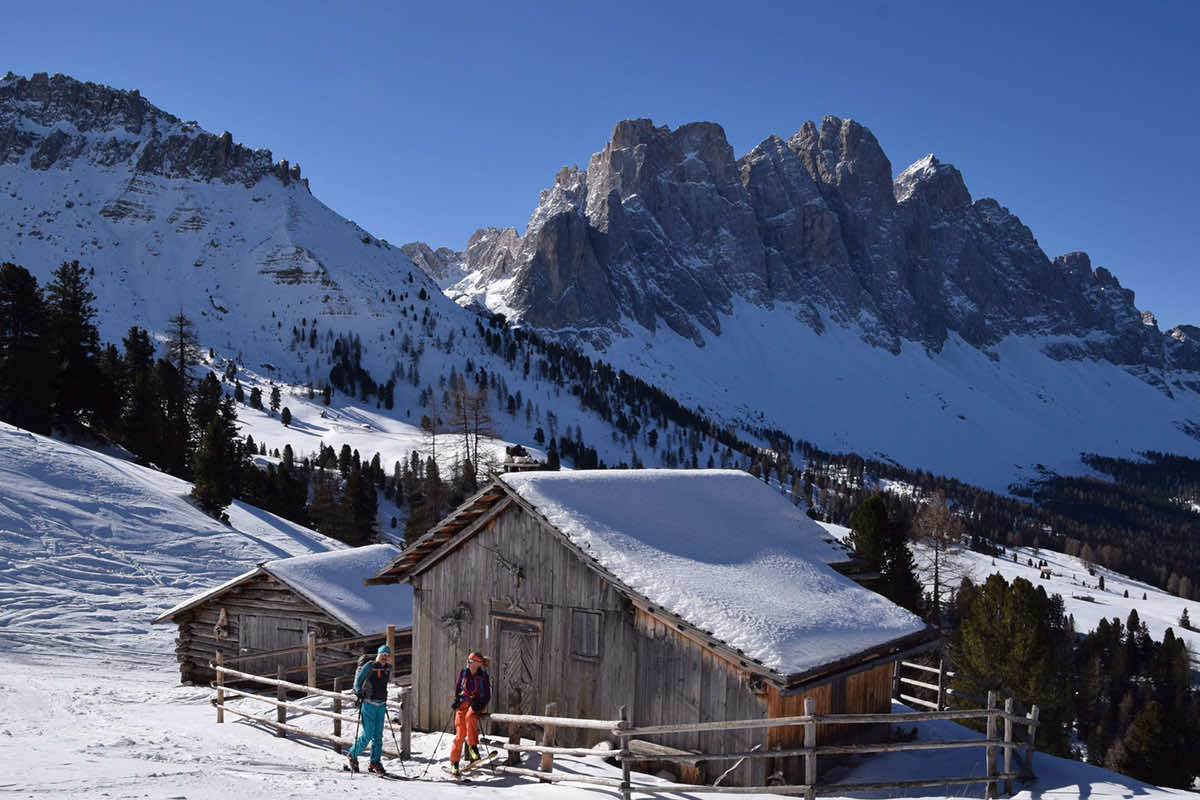
The days differ in character. In the Dolomites the routes are panoramic and of moderate altitude; in the Timmelstal and the Passeiertal the slopes are longer and more technical; and the outing to Eisseespitze crosses glacier terrain. The description ‘for beginners’ therefore refers to the absence of any requirement for previous ski-touring experience, not to an absence of requirements in skiing technique and safety.
On every outing participants carry a personal avalanche kit and must know how to use it. The training day helps to refresh the search procedure, but it does not turn a week-long trip into a full avalanche course. Route decisions are taken on the basis of the official avalanche bulletin, the weather, the visibility and the actual readiness of the group.
Participants choose their own accommodation in Bolzano or another base agreed in advance. Before booking it is worth checking whether breakfast, parking, a ski room and somewhere to dry boots and clothing are included. The daily group transfers to the routes are part of the trip.
South Tyrol ski tour itinerary, 7 days
Day 1. Independent arrival in Bolzano. Participants make their own way to Bolzano and check into the hotel or apartment they have chosen in advance. In the evening the group meets the guide, goes through the forecast and the principles behind route choice, and checks the compatibility of skis, bindings, skins, ski crampons, boots and the avalanche kit. Night in the accommodation you have chosen.
Day 2. Avalanche training and ski tour to Grosser Gabler, 2575 m. The group travels to the Plose area. Before setting out, participants check their avalanche transceivers and practise searching for and digging out a simulated casualty. If conditions are suitable, the ski tour to Grosser Gabler then follows. The purpose of the day is for the guide to assess the pace, the technique of climbing on skins and the control of the skis on the descent. If the route does not suit the situation, a safe alternative in the same or a neighbouring area is chosen.
Day 3. Ski tour to Zendleser Kofel, 2422 m. After the transfer to Villnoss the group sets out on a route of moderate length. The day allows kick turns on the ascent, work with skins and safe spacing on the descent to be consolidated. Even on a comparatively low summit, the quality of the snow and the avalanche situation can change the line of travel or lead to a change of route. After the descent, the return to the accommodation.
Day 4. Ski tour to Heachenberg, 2631 m. Transfer to the Timmelstal. The route crosses open ski-touring terrain and requires confident work on the ascent and a controlled off-piste descent. The guide chooses the aspect and the turnaround point according to the actual snow and the avalanche bulletin. In unsuitable conditions Heachenberg is replaced by another route of comparable difficulty.
Day 5. Ski tour to Stulser Hochwart. The group travels to the Passeiertal. The basic plan is an outing to Stulser Hochwart with a possible short technical section before the summit. Whether additional equipment is needed, and whether that section is acceptable, is decided by the guide in advance. If the preparation of the group or the conditions do not match the plan, a route without the technical section is chosen.
Day 6. Ski tour to Eisseespitze, 3230 m. The final planned outing takes place in the Martelltal and the Ortler group. The route leads by way of the Zufallhutte area to glacier terrain, so depending on conditions a harness, mountaineering crampons and travel under the guide’s direction may be required. This is the highest day of the trip. Reaching the summit is not compulsory: in poor visibility, wind or unsafe snow a more suitable objective is chosen.
Day 7. End of the trip. After breakfast participants leave the accommodation independently and either continue their trip or travel home. An individual transfer to the airport or the railway station is not part of the basic trip.
What's included
- Mountain Guide's guides: a lead guide throughout the trip; no more than six participants to one guide
- Group transfers from the agreed accommodation to the routes and back on every route day
- A check of personal equipment and a practical session on the use of the avalanche kit on the first route day
- Daily route selection and adjustment according to the weather, the snow, the avalanche situation and the preparation of the group
What's not included
- International and domestic flights
- Transfers to Bolzano and after the trip ends
- Accommodation
- Meals and drinks
- Cable cars and other paid lifts where these are used
- Personal ski-touring, avalanche and mountaineering equipment
- Medical insurance and the costs of search and rescue, transport and evacuation
- The visa and other entry documents where these are required by the participant’s nationality
- Tips for the guides
- Personal expenses and additional services
- Costs arising from change to the itinerary beyond the included scope of services
The South Tyrol ski tour for private groups
The South Tyrol ski tour can be arranged for a private group on agreed dates, subject to a guide being free and conditions being suitable. The format suits groups of friends, ski clubs, corporate teams and adult families of comparable skiing ability.
Before confirming the trip we establish each participant’s experience, their technique for controlled descent, their fitness and their familiarity with avalanche equipment. For a group new to ski touring the first outings are chosen to be easier, but the trip is not a course in learning to ski from scratch.
A private group can agree the length, where it stays, the standard of the hotel, extra days of skiing and the difficulty of the routes. Particular summits are not fixed at the expense of safety: the final plan is set by the guide each day. Get in touch for a quote.
Documents required for the South Tyrol ski tour
To join the South Tyrol ski tour you need to prepare:
- A passport meeting the requirements for entering Italy and the Schengen area
- Tickets to the start of the trip and back
- A visa and any other entry documents required for your nationality
- Medical insurance valid in Italy and covering ski touring, off-piste skiing, search and rescue, transport and medical evacuation
Check the document requirements before buying any non-refundable tickets. We recommend keeping digital copies of your passport, insurance, tickets and visa documents on your phone and in cloud storage, separately from the originals.
Weather and seasons for the South Tyrol ski tour
The main season runs through winter and spring, roughly from December to April. Even so, the amount of snow, the temperature, the wind and the avalanche conditions differ between the Dolomites, the Stubai Alps and the Ortler group, and change over the course of a week.
In winter you can meet fresh snow, blizzards, short daylight hours and wind slab. In spring, the overnight freeze, the start time and the softening of the snow during the day all matter. Good weather does not automatically mean safe avalanche conditions.
Each day your guide studies the forecast and the official avalanche bulletin, then chooses the area, the aspect and the altitude of the route. Any of the summits listed may be replaced, shortened or cancelled if conditions do not suit the group.
Accommodation and meals on the South Tyrol ski tour
Accommodation is not part of the basic price; participants book it themselves in Bolzano or at another location agreed in advance. You can choose a hotel or apartment of whatever standard you like, but the location must allow the group to gather in time for the daily transfers.
Before booking, we recommend checking whether breakfast, parking, a ski room and somewhere to dry boots and clothing are available. Mountain Guide can help you choose an area to stay in, but the particular property and its price are confirmed separately.
Participants arrange their own meals. For the days out you need water in a flask, a snack and enough food for the length of the outing. Allergies and dietary restrictions should be taken into account when choosing where to stay and where to eat.
Day-to-day conditions on the South Tyrol ski tour
The facilities depend on the hotel or apartment you choose. Whether there is Wi-Fi, parking, breakfast, a washing machine, a sauna or anything else must be checked against the terms of the particular property, as none of it is automatically part of the ski tour.
For a week-long trip, secure ski storage, somewhere to dry boots, gloves and outer clothing, and access to charging for avalanche transceivers, phones and other devices all matter particularly. Check for these before booking.
During the days out, participants are away from any hotel infrastructure. Everyone carries water, a snack, a spare insulating layer, avalanche equipment, a first-aid kit and communications equipment, as set out on their guide’s list.
Страхование
НаверхEquipment and useful extras for ski touring in South Tyrol
Скачать PDFThe trip calls for a full set of kit for day ski tours. Check every item before you travel: your boots must fit your bindings, your skins your skis, and your ski crampons the particular model of binding. Additional glacier equipment is needed only for the routes where your guide specifies it.
Documents
- Passport
- Tickets
- Insurance policy
- A visa and any other entry documents, where these are required
Ski-touring and avalanche kit
- Touring skis or a splitboard with bindings that have a walk mode
- Skins, trimmed to your own skis or splitboard
- Ski crampons compatible with your bindings
- Touring boots compatible with your bindings
- Adjustable ski poles with winter baskets
- Avalanche transceiver and a spare set of batteries
- Avalanche probe at least 240 cm long
- Avalanche shovel
- Ski or climbing helmet
- A 30-40 litre rucksack with a ski carry system
Additional items for a glacier route, as your guide directs
- Climbing harness
- Mountaineering crampons compatible with ski-touring boots
- Classic ice axe
- Karabiners, a personal safety line and accessory cord to your guide’s list
Clothing
- Base layers
- Warm mid layer
- Softshell jacket and trousers for walking
- Waterproof shell jacket with a hood
- Waterproof shell trousers
- An insulated jacket
- Thin gloves for the ascent
- Warm ski gloves
- Warm hat, buff or balaclava
- Ski touring socks
- Everyday shoes and clothing for the valley
Personal items
- Category 3-4 mountain sunglasses
- Ski goggles for wind and poor visibility
- A 1-litre vacuum flask
- A snack for the day
- SPF 30-50 sun cream and lip balm with SPF
- A personal first-aid kit suited to your own medical needs
- Head torch and a spare set of batteries
- Phone, power bank and waterproof packing for electronics