- Guides
- B2B
-
#19607 (sem título)
-
#15972 (sem título)
- Climb Elbrus Individually
- Climb Elbrus from the South, 9 Days
- Climb Elbrus from the South, 7 Days
- Climb Elbrus from the South with Oxygen
- Climb Elbrus from the North, 10 Days
- Two Summits of Elbrus, 9 Days
- Elbrus Traverse from South to North, 9 Days
- Elbrus Traverse from North to South, 10 Days
- Cross of Elbrus, South to North, 9 Days
- Cross of Elbrus, North to South, 10 Days
- Climb Kazbek and Elbrus — 10-Day Two-Summit Expedition
- Climb Elbrus from the West, 11 Days
- Elbrus by Private Helicopter, 3 Days
- Elbrus Region Holiday and Trekking, 9 Days
- Elbrus Region Holiday, 7 Days
- Elbrus Dating
- Climb Elbrus from the South, 9 Days with Sergey Baranov
-
#15539 (sem título)
- Climb Carstensz Pyramid, 8 Days with Helicopter Access
- Climb Mont Blanc, 4810 m — 8-Day Guided Ascent
- Climb the Matterhorn, 4478 m — 8-Day Guided Ascent
- Climb Mount Vinson, 15-Day Antarctic Expedition
- Climb Kosciuszko and Travel in Australia, 7 Days
- Climb Fisht, 2868 m — 3-Day Ascent by the 1B Route
- Climb Mount Wilhelm, 6 Days
-
#15546 (sem título)
- Climb Kilimanjaro: the Marangu Route
- Climb Kilimanjaro: the Lemosho Route
- Climb Ararat, 5137 m — 7-Day Classic Climb
- Climb Kazbek from the South, 5033 m — 8 Days in Georgia
- Climb Kazbek and Elbrus — 10-Day Two-Summit Expedition
- Climb the Volcanoes of Mexico — Orizaba and Iztaccíhuatl, 9 Days
- Climb Alpamayo — 16-Day Technical Expedition
- Climb Margaret Peak (Stanley), 5109 m
- Climb Mount Kenya: Point Lenana, 4985 m
- Climb Dykh-Tau by the North Ridge, 13 Days
-
#15554 (sem título)
- Aconcagua Climb — 17-Day Guided Expedition
- Island Peak Climb — 18-Day Expedition
- Climb Mera Peak, 6476 m — 16-Day Hinku Valley Expedition
- Climb Ama Dablam, 6812 m — 24-Day Expedition with Island Peak
- Climb Island Peak and Mera Peak — 24-Day Two-Summit Expedition
- Aconcagua and Ojos del Salado — 25-Day Combined Expedition
- Ojos del Salado Climb — 15-Day Expedition
- Climb Chimborazo and Cotopaxi — 14-Day Ecuador Expedition
- Climb Huascarán — 8-Day Technical Ascent
- Climb Razdelnaya Peak, 6148 m — 15-Day Pamir Expedition
- Climb Denali by the West Buttress, 23 Days
- #15565 (sem título)
- #15572 (sem título)
-
#15972 (sem título)
-
#19592 (sem título)
-
Trekking in Nepal: routes to the eight-thousanders
- K2 Base Camp Trek via the Gondogoro La
- Everest Base Camp Trek — 14 Days
- Everest Base Camp via Gokyo Lakes — 15 Days
- Short Everest Base Camp Trek in 10 Days
- Annapurna Circuit and Tilicho Lake Trek
- Manaslu Circuit Trek
- Kanchenjunga Circuit Trek (XXL)
- Kanchenjunga North Base Camp Trek (Short)
- Kanchenjunga from India: the Goecha La Trek in Sikkim
- Makalu Base Camp Trek
- Annapurna Base Camp Trek
- Trekking in South America
- Asia
- Trekking in Africa
-
Trekking in Russia
- Elbrus Region Holiday and Trekking, 9 Days
- Elbrus Region Holiday, 7 Days
- Oshten + Kardyvach — 9-Day Western Caucasus Trek
- Lake Kardyvach — 5-Day Base-Camp Trek
- Route 30: Through the Mountains to the Sea, with Oshten — 4 Days
- Trekking in Arkhyz — 7 Days over the Ayulyu Pass
- Gvandra Trek — 7 Days to the Ullu-Kyol Lakes
- Trekking in Dombai — 7 Days with the Murudzhu Lakes
- Europe
-
Trekking in Nepal: routes to the eight-thousanders
-
Adventure expeditions
-
Trekking in Africa
- Marrocos: o coração do Norte da África
- A escalada de Toubkal e a cultura marroquina
- Eritrea: the Dahlak Archipelago and the Rashaida Nomads
- Rwanda: Mountain Gorillas and the Bisoke Volcano
- Ethiopia: Otherworldly Landscapes and the Peoples of the Omo Valley
- Excursão A Uganda: Parque da Rainha e gorilas da montanha
- Tanzania Safari: Serengeti, Ngorongoro and Tarangire
- Excursão A Uganda: rinocerontes brancos e gorilas da montanha
- Zimbabwe and South Africa: Victoria Falls, Cape Town and the Cape of Good Hope
- Namibia: Etosha National Park and the Himba
- Kenya Safari: the African Big Five
- Excursão ao Botswana: Delta do Okavango e Parque Chobe
- Trekking in South America
- Asia
-
Trekking in Africa
- Ski touring and ski mountaineering: chasing freedom in the mountains
- VIP tours
- #19722 (sem título)
- About
Climb Mount Kenya: Point Lenana, 4985 m
- Height (m)
- 4985, 5199
- Duration
- 8 дней
- Difficulty
- Moderate
- Continent
- Africa
- Children
- Ages 14+
- Accommodation
- Some nights in tents
3000 $
Почему такая цена?
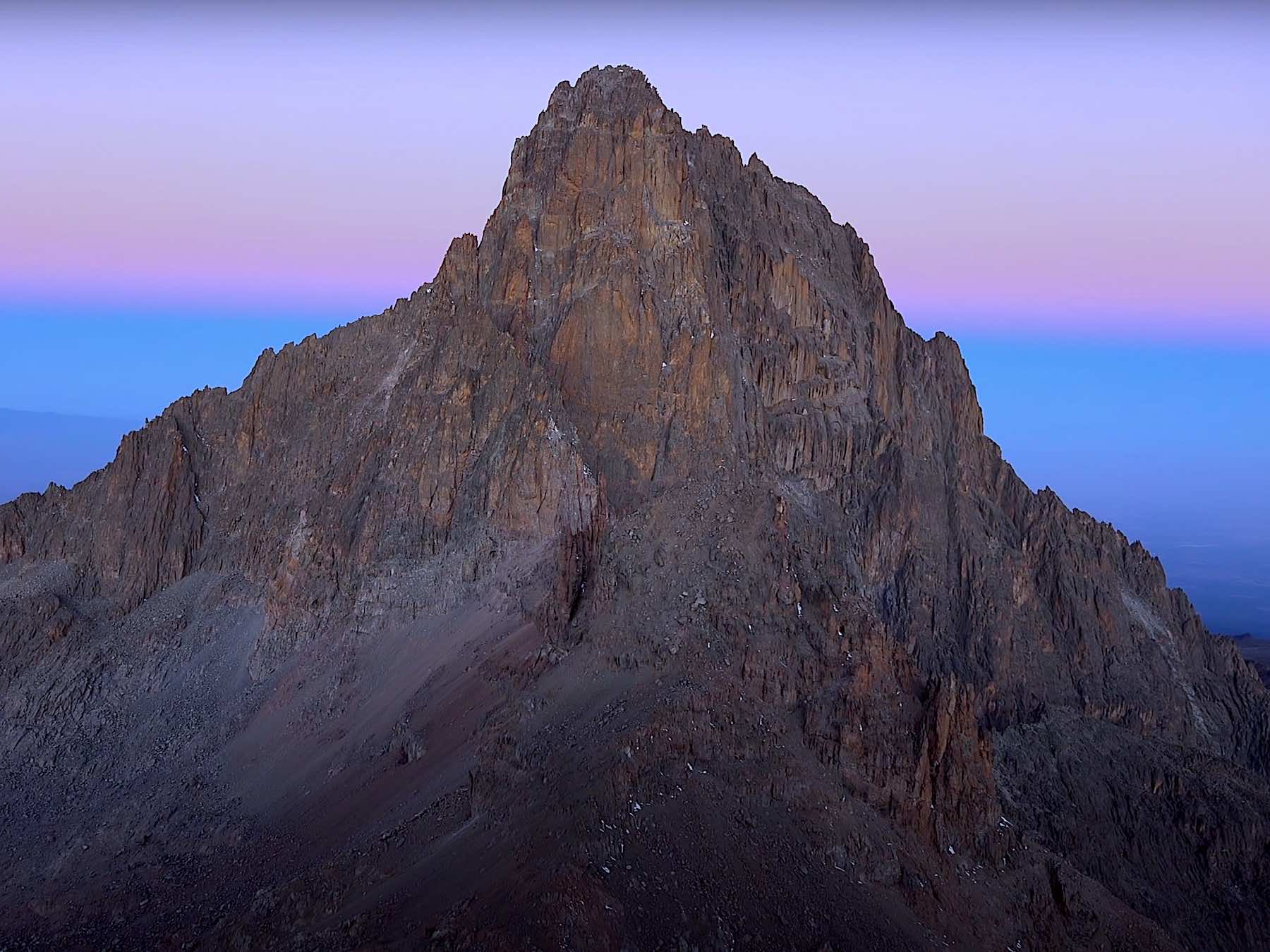
Mount Kenya, 5199 m, is the highest mountain in Kenya and the second highest summit in Africa after Kilimanjaro. It is an ancient extinct volcano with deep glacial valleys, high-altitude lakes, equatorial glaciers and rock peaks rising sharply above the afro-alpine landscapes of the national park.
Please note that our company does not buy or sell air tickets and does not arrange visas, and is therefore not responsible for disruption beyond its control involving flights or border crossings.
Mount Kenya has three main summits and two fundamentally different forms of ascent. Point Lenana, 4985 m, is a high-altitude summit accessible to physically prepared trekkers. Batian, 5199 m, is the highest point of the massif and a serious mountaineering objective. Neighbouring Nelion, 5188 m, is also a technical summit. Even the simplest routes on Batian and Nelion are graded IV on the UIAA scale and require experience of multi-pitch climbing, belaying, abseiling and work on high-altitude rock.
The main eight-day Mountain Guide trip leads to Point Lenana by a route that ascends from the Chogoria side and descends by Sirimon. This structure allows you to see different sides of the massif: forest and heather moorland, valleys with giant lobelias and groundsels, mountain lakes, rock towers and the glaciers of the central part of the mountain. No technical rock-climbing experience is needed for Point Lenana, but good physical condition is essential, together with a readiness for multi-day walking, for cold and for an altitude of almost 5000 m.
The trekking version suits prepared beginners, travellers with experience of long walks and participants who want to get to know the high mountains of East Africa without a difficult mountaineering route. A gradual gain in altitude and proper acclimatisation matter even on Point Lenana: proximity to the equator does not remove the cold, the sudden changes of weather or the risk of altitude sickness.
The technical ascent of Batian is arranged separately and is not part of the base trekking trip. It requires extra days, a separate qualified mountaineering guide, special personal and group equipment, and confirmed experience of rock climbing. Whether Batian or Nelion can be climbed depends on the season, the condition of the route, the participant's preparation and the guide's decision.
Mountain Guide separates the Point Lenana trek from the mountaineering ascent of Batian from the outset: reaching the trekking summit is not presented as reaching the highest point of the massif. With a group of four participants or more, an experienced Mountain Guide team leader accompanies the trekking trip. For participants aiming at Batian or Nelion we help in advance to assess experience, choose a suitable season and determine the technical support required.
About climbing Mount Kenya
Mount Kenya is an ancient extinct stratovolcano whose period of activity is placed at roughly 3.1 to 2.6 million years ago. The volcano is thought to have originally reached about 6500 m, but long glacial erosion destroyed its upper part and formed the sharp summits, moraines, high-altitude lakes and deep valleys that radiate from the centre of the massif. Rapidly shrinking glaciers survive on the mountain, and the massif itself remains one of the most important water catchments in East Africa.
The first European to report a snow-covered mountain near the equator was the German missionary Johann Ludwig Krapf in 1849. His observations were met with scepticism at first, and the existence of the mountain was confirmed by the Scottish explorer Joseph Thomson in 1883. Mount Kenya National Park was created in 1949, and in 1997 the national park and the natural forest reserve were inscribed on the UNESCO World Heritage List.
The main natural feature of the route is the rapid change of altitude zones. Mountain forest and bamboo thickets give way to heather moorland, afro-alpine meadows, giant lobelias and tree groundsels. Higher up begin the screes, the rock walls, the snow and the glaciers. Elephants, buffalo, leopards and other animals live on the lower slopes, but meeting them is a matter of chance and is not part of the trip. Higher on the mountain you are more likely to see rock hyraxes and birds.
Climbing Mount Kenya brings together two fundamentally different objectives. Point Lenana, 4985 m, is a high-altitude summit accessible to prepared trekkers. Batian, 5199 m, is the highest point of Mount Kenya and a serious technical objective for experienced mountaineers. Nelion, 5188 m, alongside it, also requires a full rock climb. Even the simplest routes on Batian and Nelion are graded IV on the UIAA scale and involve multi-pitch climbing, setting up belays and long abseils. Mountain Guide separates these formats from the outset and does not present the Point Lenana trek as reaching the highest point of the massif.
The main eight-day trip leads to Point Lenana by the Chogoria to Sirimon route. After the approach from Chogoria the group passes the area of the Nithi river and the Gates waterfall, climbs the ridge above the Gorges valley and reaches the Hall Tarns. From there it looks down on Lake Michaelson. The route then continues through Square Tarn, the American Camp and the high part of the summit circuit. After the ascent of Point Lenana the group descends through Shipton’s Camp by the Sirimon route. The ascent and the descent run on different sides of the massif, so participants see the central summits, the glaciers and the valleys of Mount Kenya from different angles.
Technical mountaineering experience is not required for Point Lenana, but an altitude of almost 5000 m, cold, long days of walking and rapidly changing weather all call for good physical condition. A gradual gain in altitude and intermediate overnight stops help acclimatisation but do not remove the risk of altitude sickness. The upper part of the route may cross scree, snow or iced ground. Depending on the actual conditions, the guide may add crampons or microspikes and an ice axe to the final equipment list.
An ascent of Batian or Nelion is organised separately and is not part of the base trip. A technical route requires confirmed experience of multi-pitch climbing, a separate qualified mountaineering guide, special personal and group equipment and additional days. The choice of summit, route and season depends on the condition of the north or south faces and on the decision of the technical guide.
With a group of four participants or more, a Mountain Guide team leader accompanies the trekking trip. Before the trip you should build general endurance, strengthen your legs and get used to long days of walking with a rucksack.
Itinerary of the Mount Kenya climb to Point Lenana, 4985 m
The eight-day trip leads to the trekking summit of Point Lenana, 4985 m, by the Chogoria to Sirimon route, taking in part of the summit circuit. Technical ascents of Batian, 5199 m, and Nelion, 5188 m, are not part of this trip and are arranged separately.
Day 1. Arrival in Nairobi and the transfer to the Chogoria route.
A representative of the team meets participants at Nairobi airport. Once the group is assembled there is a transfer to the village of Chogoria, lunch and preparation for the start of the mountain section. Participants then drive up in four-wheel-drive transport to the Meru huts at the boundary of the national park. A night at altitude allows acclimatisation to begin before the first long day of walking. Night in the Meru huts.
Day 2. The start of the trek on the Chogoria route.
The team sets out from the Meru huts and passes the area of the Nithi river and the Gates waterfall. The trail climbs gradually through mountain forest and the bamboo zone to the open slopes above the Gorges valley. The first day helps the group settle into a working rhythm and continue its gradual adaptation to altitude. Night in a tented camp on the Chogoria route.
Day 3. To the Hall Tarns.
The route continues along the ridge above the Gorges valley to the high-altitude Hall Tarns. As height is gained, forest gives way to heather moorland and afro-alpine vegetation with giant lobelias and tree groundsels. From the upper part of the route there are views of Lake Michaelson, rock walls and the central summits of the massif. Night in tents near the Hall Tarns.
Day 4. The summit circuit and the crossing to the American Camp.
The team moves onto the high part of the Mount Kenya summit circuit, passes the area of Square Tarn and rounds the central massif from the south. The way crosses rocky ground with close views of Point Lenana, Nelion and Batian. After the height gained, participants descend to the American Camp in the upper part of the Teleki valley. This crossing gives additional acclimatisation before the ascent. Night in tents at the American Camp.
Day 5. The ascent of Point Lenana, 4985 m, and the descent to Shipton’s Camp.
The team sets out before dawn and climbs from the American Camp to the area of the Austrian Hut, from where it continues to Point Lenana at 4985 m. In favourable weather participants meet the sunrise on the summit and see Batian, Nelion, the glaciers and the high valleys of the massif. After the ascent the group descends the northern side of the mountain to Shipton’s Camp. This is the longest and most physically demanding day of the trip. Night at Shipton’s Camp.
Day 6. The descent by the Sirimon route.
The team descends from Shipton’s Camp through the Mackinder valley and the high plateaux of the Sirimon route. As height is lost, rocky ground gives way to afro-alpine meadows, heather moorland and mountain forest. The day finishes in the area of the Judmeier camp, also known as Old Moses. Night in camp.
Day 7. Out through the Sirimon gate and back to Nairobi.
Participants walk the final section of the route through forest to the Sirimon gate. After leaving the national park the group transfers to Nairobi and checks into a hotel. The rest of the day is for recovering after the climb. Night at the hotel.
Day 8. End of the trip.
After breakfast participants check out of the hotel. Transfer to Nairobi international airport and the flight home.
The order of the high-altitude stages, the times of departure and the direction of travel on individual sections of the summit circuit may change depending on the weather, the state of the trail, snow and ice conditions, acclimatisation and how participants feel. The final decision is taken by the guide.
What's included
- A Mountain Guide team leader accompanying the group, with four participants or more
- The work of a qualified local mountain guide
- The work of a cook and porters to carry the group equipment
- Meeting at the airport and all the transfers set out in the itinerary
- Hotel accommodation, for the number of nights set out in the itinerary
- Accommodation in tents during the mountain section of the trip
- Full board during the mountain section of the trip
- National park entry fees and the permits required for the Point Lenana route
- A group first-aid kit
- Group camp and kitchen equipment
What's not included
- International flights
- An eTA electronic authorisation or other entry document, where the participant requires one
- Medical insurance covering high-altitude trekking to 4985 m, search and rescue, and evacuation
- Single occupancy
- Additional nights in Nairobi before or after the trip
- Early check-in and late check-out at the hotel
- Lunches and dinners in Nairobi
- Alcoholic and soft drinks
- Personal snacks and specialist sports nutrition
- Personal clothing, footwear, trekking equipment and a sleeping bag
- Hire of personal equipment
- Carriage of personal luggage above the agreed limit
- Tips for the local guide, the cook and the porters
- Personal expenses
- Rescue and evacuation costs not covered by the insurance policy
- Any departure from the main trip and the costs arising from it
- The technical ascent of Batian, 5199 m, or Nelion, 5188 m, including the additional days, the technical mountain guide, the mountaineering equipment, the separate permits and the change to the mountain logistics
The Mount Kenya climb for private groups
The Point Lenana 4985 m climb can be arranged privately for individuals, families and closed groups. Dates are agreed around the dry season, the state of the route and the local team’s availability. The basic Chogoria – Point Lenana – Sirimon scheme is kept, because steady altitude gain and enough time to acclimatise matter more than making the trip formally shorter. A private format lets you set a workable pace, build in an extra acclimatisation day and give more attention to preparing the participants. For corporate groups the trip can be extended with a separate briefing, team tasks and additional days in Kenya. Participation by under-18s is considered case by case, taking account of age, fitness, altitude experience and the insurance terms. For climbers with multi-pitch experience, a technical ascent of Batian 5199 m or Nelion 5188 m is arranged separately. The choice of summit, route and season depends on the state of the north and south faces. That version needs a technical mountain guide, extra days, a separate set of equipment and full acclimatisation. It is not an automatic continuation of the Point Lenana trek. After the climb you can carry on with a safari in Kenya’s national parks. The length, accommodation and content of that extension are agreed individually.
Documents for the Mount Kenya climb
Most foreign participants must obtain a Kenya eTA electronic travel authorisation themselves before flying. Whether any exemption applies, and which documents you need, depend on your nationality and status. Your passport must be valid for at least six months beyond your planned arrival date in Kenya and have at least one blank page. An eTA application normally needs a photograph, your flight details, your address in Kenya and your booking confirmation. In some cases further documents may be requested. Check the current requirements again on the official site immediately before you apply and before you fly. Your insurance policy must match the version of the trip you choose. For Point Lenana it must cover high-altitude trekking to 4985 m, search and rescue, and medical evacuation. For a technical ascent of Batian or Nelion the policy must separately cover mountaineering, rock climbing and rope work to 5199 m. An ordinary travel policy that does not state an altitude and an activity is not sufficient. Keep the originals of your main documents in your hand luggage. Pack paper copies in a waterproof bag, and keep digital versions on your phone and in cloud storage. Your policy number and the 24-hour assistance company’s contact details must be available to you and to the group leader. To take part you will need:
- A passport valid for at least six months beyond your arrival date in Kenya, with at least one blank page
- An approved Kenya eTA, where one is required for your nationality
- International air tickets to Kenya and back, or an onward ticket
- Your booking confirmation and your address in Kenya
- An insurance policy covering the route chosen, the maximum altitude, search and rescue, and medical evacuation
- The 24-hour assistance company’s contact details and your policy number
- A yellow fever vaccination certificate, where one is required given your country of arrival, previous travel or transit route
- Paper and digital copies of your passport, eTA, air tickets, insurance and medical documents
Weather and seasons on the Mount Kenya climb
The best periods for trekking to Point Lenana 4985 m are January, February and early March, and from late June to September. Conditions are often especially settled, with good visibility, in August. Even in the dry season the weather on an equatorial mountain changes quickly: a sunny morning can turn to mist, rain, hail or snow. The lower part of the route is usually warm and humid, but the temperature falls quickly as you gain height. There can be frost at the higher camps and on the pre-dawn start, and strong wind makes the cold noticeably worse. Warm clothing, a proper waterproof layer and a way of keeping your kit dry are needed in any month. The main rainy periods run roughly from mid-March to June and from October to December. At those times the Chogoria paths can be wet and slippery, cloud limits visibility, and wet and iced sections form on the rock routes. The seasons on Mount Kenya have to be considered separately for the trekking and the climbing versions. A technical ascent of Nelion 5188 m by the southern rock routes is usually done between late December and mid-March. The northern routes on Batian 5199 m are more often suited to the period from late June to mid-October. The final choice of summit and route depends on the current state of the rock and the glacier sections, and on the technical guide’s decision.
Accommodation and meals on the Mount Kenya climb
The first night on the mountain is at the Meru Mount Kenya Bandas, on the Chogoria side. These are simple mountain huts with beds and basic toilet and washing facilities. For the rest of the route the group sleeps in two-person tents. On the Chogoria side tents are necessary, because there are no proper huts along the main part of the route. On the Sirimon side there are the Shipton and Judmaier camps, with basic mountain infrastructure. The standard version of the trip uses tents throughout, so whether there are free places in the huts’ shared rooms does not affect the route. After the trek the group spends one night in a hotel in Nairobi, in twin rooms. A cook works on the mountain section and full board is provided. Breakfast and dinner are cooked in camp, and lunch is either hot or a packed meal, depending on how long the day is. Bring your own energy bars, nuts or other snacks for the long days and for the early start to Point Lenana. Tell us at the time of booking about vegetarian or vegan diets, food allergies, medical restrictions and any other dietary requirements. Whether a suitable menu can be prepared is confirmed individually before the trip starts.
Day-to-day conditions on the Mount Kenya climb
The Meru Mount Kenya Bandas have beds and basic facilities, but hot water and electricity may be limited. There is no shower in the high camps. Toilets at the established sites are simple, and on the self-sufficient sections you use whatever the camp provides. Do not count on electricity, Wi-Fi or a reliable mobile signal on the mountain section. Bring your own power bank for your phone, watch and camera gear. There is no way to wash clothes and dry them fully during the trek, so bring quick-drying items and keep a spare set in a dry bag. Porters carry the group equipment and the agreed share of your personal baggage. You carry your own day pack with water, a snack, warm clothing, waterproofs, a torch, your documents and your first-aid kit. Porters may travel separately from the main group, so anything you need before the next camp must stay with you. The team collects drinking water from the mountain sources available and treats it in camp. Each participant needs a supply of water in reusable containers for the day’s walk. All personal rubbish and used hygiene products must be bagged and carried out of the national park.
Страхование
НаверхEquipment list for the Mount Kenya climb
Скачать PDFThe main list is written for the Chogoria – Point Lenana 4985 m – Sirimon trek. Batian 5199 m and Nelion 5188 m need a separate climbing set, which the technical guide approves once the route and season are chosen. Test your equipment beforehand, on walks and in training. Advice on fitness is gathered in our piece on training for the mountains, and on high-altitude acclimatisation in our article on altitude sickness. Baggage
- A soft duffel or 65-75 litre rucksack for the items your porter carries
- A 30-40 litre rucksack with a rain cover for the daily stages
- Dry bags, or strong waterproof bags, for clothing, sleeping bag, documents and electronics
- A small bag for the things you leave in Nairobi
Personal equipment
- Sleeping bag with a comfort rating of -5 °C or lower
- Trekking poles
- Head torch with a spare set of batteries
- Reusable water containers holding 2-3 litres in total
- Vacuum flask of 0.75-1 litre
- Sit mat
- Emergency foil blanket
- Whistle
- A small personal repair kit
Clothing and footwear
- Broken-in waterproof trekking boots with a stiff, non-slip sole
- Light trainers, sandals or flip-flops for camp and town
- High gaiters
- Waterproof shell jacket
- Waterproof shell trousers
- Base layer, top and bottoms
- Fleece top or a lightweight insulated jacket
- Warm down jacket with a hood
- Trekking trousers
- Lightweight trousers or shorts for the lower part of the route
- Warm socks for the pre-dawn start
- Trekking socks
- Quick-drying underwear
- Warm hat
- Sun hat or cap
- Buff
- Thin gloves
- Warm waterproof gloves or mittens
Other items
- Category 3 or 4 sunglasses
- SPF 50 sun cream
- Lip balm with SPF
- Power bank and charging cables
- Adapter for the British type G socket
- Your own energy snacks
- Insect repellent for the lower part of the route and for travel elsewhere in Kenya
- Quick-drying towel
- Personal toiletries
- Wet wipes and hand sanitiser
- Toilet paper
- Strong bags for your own rubbish
- Earplugs
- A personal first-aid kit suited to your own medical needs
- Any medication prescribed by your doctor
- Copies of your documents in waterproof packaging
Discuss the contents of your first-aid kit, and whether you need malaria prophylaxis, with your doctor in advance. There is more in our article on avoiding malaria. Additional equipment for Point Lenana
The usual route up Point Lenana is not a technical climb. In snow or ice, however, the guide may add an ice axe and some form of traction to the final list. There is no need to buy or hire them before the state of the route is confirmed.
- Lightweight crampons or microspikes, if the guide puts them on the final list
- Ice axe, if the guide puts it on the final list
Additional climbing equipment for Batian and Nelion
The technical set is decided only once the summit, the particular route and the season have been chosen. The technical guide’s list takes precedence, because the state of the approaches, glaciers and rock routes changes.
- A compact 25-30 litre climbing rucksack
- Climbing helmet
- Climbing harness
- Belay and abseil device
- Screwgate karabiners
- Slings and prusiks, following the technical guide’s list
- Rock shoes, or approach boots with good grip
- Mountaineering boots compatible with crampons
- Crampons and an ice axe, if they are needed on the approach or route chosen
- Warm gloves you can still handle equipment in
- Bivouac bag
- An extra insulating layer
- Spare gloves, socks and hat
- Head torch with spare batteries
Ropes, nuts, cams, quickdraws, belay and bivouac equipment are agreed separately with the technical guide. These items are not part of the basic Point Lenana trekking trip.