- Guides
- B2B
-
Climbs
-
Climb Elbrus
- Elbrus individually
- Elbrus from the South, 9 days
- Elbrus from the South, 7 days
- Climb Elbrus with Oxygen
- Elbrus from the North
- Elbrus Two Summits
- Elbrus Traverse from South to North, 9 Days
- Elbrus Traverse from North to South, 10 Days
- Elbrus "Cross" from South
- Elbrus "Cross" from North
- Kazbek+Elbrus
- Elbrus from the West
- Elbrus by Private Helicopter, 3 Days
- Elbrus Region Holiday and Trekking, 9 Days
- Elbrus Region Holiday, 7 Days
- Elbrus Dating
- Climb Elbrus from the South, 9 Days with Sergey Baranov
- Under 5000 m
- 5000+ meters
- 6000+ meters
- 7000+ meters
- 8000+ meters
-
Climb Elbrus
-
Trekking
-
Trekking in Nepal: routes to the eight-thousanders
- K2 base camp
- Everest base camp
- Everest base camp via Gokyo
- Everest base camp in a week
- Annapurna Circuit and Tilicho Lake Trek
- Manaslu Circuit Trek
- Kanchenjunga Circuit Trek (XXL)
- Kanchenjunga North Base Camp Trek (Short)
- Kanchenjunga from India: the Goecha La Trek in Sikkim
- Makalu Base Camp Trek
- Annapurna Base Camp Trek
- Trekking in South America
- Asia
- Trekking in Africa
-
Trekking in Russia
- Elbrus Region Holiday and Trekking, 9 Days
- Elbrus Region Holiday, 7 Days
- Oshten + Kardyvach — 9-Day Western Caucasus Trek
- Lake Kardyvach — 5-Day Base-Camp Trek
- Route 30: Through the Mountains to the Sea, with Oshten — 4 Days
- Trekking in Arkhyz — 7 Days over the Ayulyu Pass
- Gvandra Trek — 7 Days to the Ullu-Kyol Lakes
- Trekking in Dombai — 7 Days with the Murudzhu Lakes
- Europe
-
Trekking in Nepal: routes to the eight-thousanders
-
Adventure expeditions
-
Trekking in Africa
- Tour to Morocco for New Year
- Morocco: Toubkal and the mysteries of the Sahara
- Eritrea: the Dahlak Archipelago and the Rashaida Nomads
- Rwanda: Mountain Gorillas and the Bisoke Volcano
- Ethiopia: Otherworldly Landscapes and the Peoples of the Omo Valley
- Tanzania Safari: Serengeti, Ngorongoro and Tarangire
- Zimbabwe and South Africa: Victoria Falls, Cape Town and the Cape of Good Hope
- Namibia: Etosha National Park and the Himba
- Kenya Safari: the African Big Five
- Trekking in South America
- Asia
-
Trekking in Africa
- Ski touring and ski mountaineering: chasing freedom in the mountains
- VIP tours
- Useful
- About
Elbrus Traverse from South to North, 9 Days
- Height (m)
- 5642
- Duration
- 9 days
- Difficulty
- Low
- Continent
- Europe
- Children
- Ages 14+
- Accommodation
- No nights in tents
2390 $
Why to go with us?
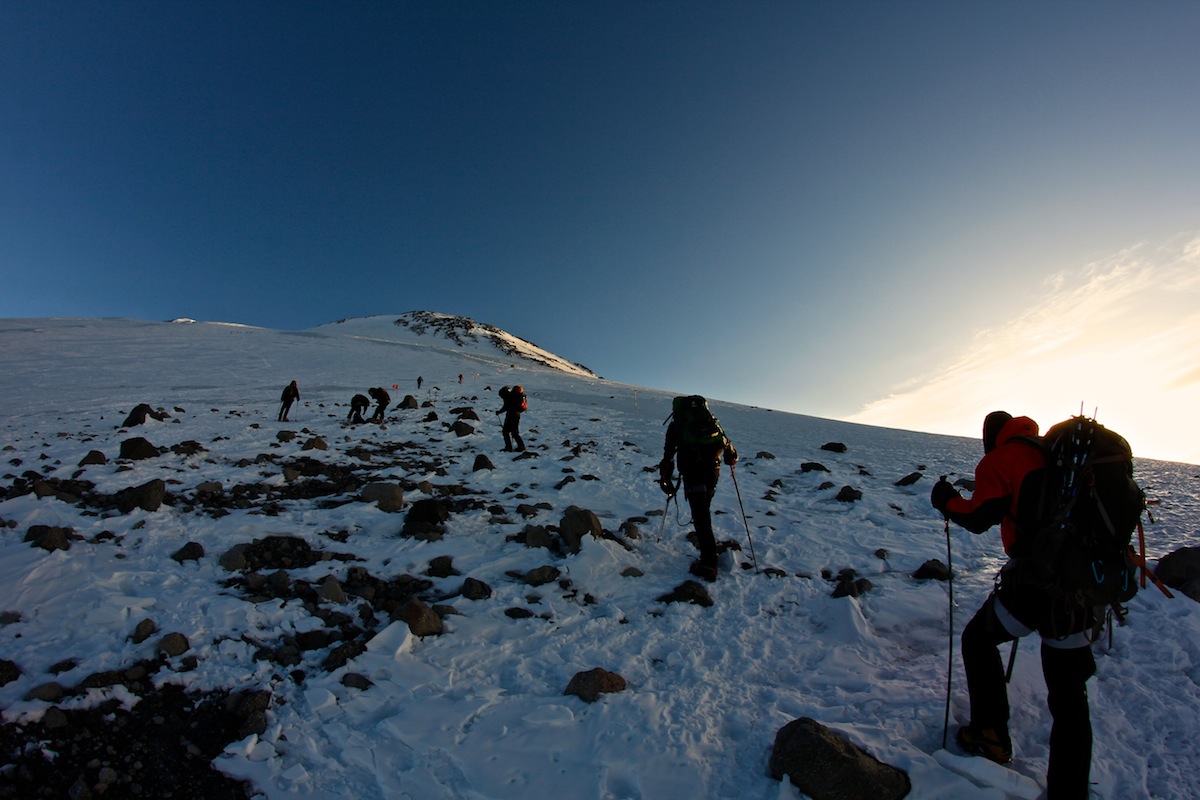
The traverse of Elbrus from south to north is a nine-day trip in which the route does not end by returning the way you came up. Participants climb the West summit of Elbrus, 5642 m, by the classic southern route, then cross the mountain and descend its northern slope.
Programme price — $2 390.
The defining feature of the trip is the chance to cross Elbrus and see two completely different sides of the mountain. The southern slope allows the use of the cable car, the high-mountain shelter and the developed infrastructure of the Elbrus region; after the summit the route continues on the northern side, away from the main flow of visitors.
The traverse suits participants who want a fuller experience than a standard ascent with a return to the south. You need to be ready for a long summit day, for the descent of the northern glacier, for moving in roped parties and for more self-supported conditions after the summit.
The key strength of the trip is the Mountain Guide team. On a traverse, choosing the right departure time, judging the state of the glacier, organising roped travel and deciding whether the route can continue to the north all matter especially. We name the specialists who lead our groups and who take the decisions on the route.
The number of group attempts within the days provided on the trip is not limited. If the whole group did not start, or had to turn back because of the weather, a repeat group attempt on the trip carries no extra charge. If part of the group reaches the summit, the ascent counts as completed and additional attempts for the remaining participants are paid separately.
Before the high-altitude section the group stays at our hotel in the Elbrus region. During the mountain part accommodation is in shelters on Elbrus, with catering provided: hot meals, fresh meat, vegetables and fruit.
All traverses published in the dates and prices section run with a minimum group size of two participants.
For partners, family and friends who want to spend the holiday with you but are not climbing, a separate holiday trip in the Elbrus region can be arranged, with accommodation, walks and excursions.
Would you prefer to traverse Elbrus with your own group only? We arrange a private Elbrus ascent on convenient dates subject to guide availability, and the acclimatisation schedule, the number of reserve days, the team and the additional services can all be adapted.
Important
- Participants carry the food for the high-altitude section themselves. This is a standard feature of how ascents of Elbrus from the south are organised. The food travels up by cable car with the group and is moved onwards by snowcat; it only has to be carried by hand over short sections of no more than 20 m.
- All published departures run with a minimum group size of two participants.
- Any departure from the shelter on summit day counts as a summit attempt.
About the south to north traverse of Elbrus
The traverse of Elbrus from south to north is a route that begins and ends on different sides of the mountain. Participants climb the West summit of Elbrus, 5642 m, by the classic southern route, then return to the saddle and continue down the northern slope.
This format lets you see two different Elbruses in a single trip. The southern side is defined by cable cars, high-mountain shelters and the developed infrastructure of the Elbrus region. The northern side is considerably more self-supported: there is no cable car and no resort infrastructure, and the route finishes in a more solitary mountain setting.
The acclimatisation part of the traverse takes place in the south. The group gains altitude gradually on treks in the valley, then moves up to the high-mountain shelter and makes hikes on the slope of Elbrus. That sequence follows the logic of the classic ascent of Elbrus from the south, but after the summit participants do not return the same way.
The main difference shows on summit day. After climbing from the south to the West summit the group descends to the saddle and comes out onto the northern side of Elbrus. From there the route continues across the glacier in roped parties under the guides’ direction. It finishes on the northern slope, where a separate ground logistics chain begins.
The traverse requires readiness for a longer summit day than a standard ascent returning to the southern shelter. After the summit participants face a long descent by the northern route, so endurance, conserving strength and following the guides’ instructions exactly all matter especially.
On the northern part of the route there is no cable car available for a quick descent. Participants continue on foot using crampons, ice axes, harnesses and other necessary equipment. The guides organise roped travel and control the pace of the group on the glacier.
Where necessary, the southern part of the climb on summit day can be shortened by snowcat to about 5100 m. That reduces the effort before the summit and the northern descent, but it does not replace acclimatisation and does not make the traverse easy. The snowcat is paid for separately and the decision on whether it can be used is taken in advance.
Weather is decisive for completing the traverse. A safe descent to the north requires adequate visibility, acceptable wind and enough time in hand. The final decision on setting out, on continuing over the summit and on descending the northern slope is taken by the lead guide, on the basis of the actual conditions and the state of the participants.
Altitude affects each person individually. Good physical condition helps you carry a long effort, but it does not guarantee quick adaptation to the lack of oxygen.
Physical preparation for the traverse has to begin well in advance. The main focus should be general endurance, long days of walking and the ability to hold a working pace after many hours of movement.
The season for the trip is chosen according to the state of the glaciers and the weather conditions on both sides of the mountain.
Participants who prefer a gradual altitude gain and a self-supported atmosphere from the first days of the trip should compare the traverse with the classic ascent of Elbrus from the north.
Elbrus south to north traverse itinerary, 9 days
Day 1. Meeting in Mineralnye Vody and transfer to the Elbrus region.
The group meets at Mineralnye Vody airport. Two group transfers are provided on the first day of the trip: the first leaves at 12:00 for participants whose flights are scheduled to land no later than 11:00, and the second leaves at 15:00 for participants whose flights are scheduled to land no later than 14:00. Please allow time for baggage reclaim and for leaving the terminal when booking. If a flight is delayed and you miss the group transfer by more than 30 minutes, we will help you order a private transfer, which the participant pays for separately. We drive about 200 km to the hotel at the foot of Elbrus; the journey takes around three hours. After checking in we have dinner, meet the group and hold a briefing on the south to north traverse trip, acclimatisation, equipment and the safety rules. Night at the hotel.
Day 2. Acclimatisation hike on the slope of Cheget, 3000 m.
After breakfast we make the first acclimatisation hike of the trip, climbing the slope of Cheget to about 3000 m. A gradual altitude gain helps the body begin adapting to the lack of oxygen and lets the guide assess the pace and condition of the participants. The route looks out onto the southern slope of Elbrus, along which the climb to the summit will run. After reaching the planned altitude we descend on foot into the valley and return to the hotel. Night at the hotel. Ascent 1100 m. Distance 11 km.
Day 3. Acclimatisation trek to the Devichyi Kosy waterfall and the observatory, 3100 m.
We continue the preparation with a trek to the Devichyi Kosy waterfall at about 2700 m. After a short rest we climb on to the observatory at 3100 m. A second consecutive hike allows more time at altitude, a check of clothing and trekking equipment and preparation for the move up to the shelter. After the route we descend to the hotel to rest and recover. Night at the hotel. Ascent 1200 m. Distance 13 km.
Day 4. Move up to the high-mountain shelter and acclimatisation hike to 4200 m.
After breakfast we ride the cable car up to the high-mountain shelter at 3888 m.
In September the cable car may be closed for scheduled maintenance. If the cable car cannot be used, the guide decides the onward logistics according to the actual situation; a vehicle is hired for the ascent if necessary. If the cost of the vehicle exceeds the price of a cable car ticket, participants pay the difference. We settle in, rest and after a light lunch make a short acclimatisation hike up to 4200 m. The main aim of the day is to begin adapting to sleeping at altitude and to judge how everyone feels after coming up from the valley. In the evening we return to the shelter. Night at the shelter. Ascent 312 m. Distance 2 km.
Day 5. Acclimatisation hike to the Pastukhov Rocks, 4700 m.
We climb to the Pastukhov Rocks at about 4700 m. This is the highest acclimatisation hike before the traverse of Elbrus. We move at a steady pace, watch how everyone feels and spend several hours well above the shelter. The guides assess whether participants are ready for a long summit day and adjust the tactics if necessary. After reaching the planned altitude we descend to rest and recover. Night at the shelter. Ascent 812 m. Distance 6 km.
Day 6. Rest and preparation for the traverse of Elbrus.
The day is given to recovering strength before the main day of the trip. We check personal and group equipment and prepare clothing, boots and rucksacks. The guides give the final briefing on the order of movement, communication within the group, the summit itself and the descent of the northern glacier. The final plan is made according to the forecast, the state of the route and how participants feel. Night at the shelter.
Day 7. Ascent of the West summit of Elbrus, 5642 m, and descent to the north.
We set out early in the morning, usually between 02:00 and 04:00. The exact time is decided by the lead guide according to the weather, the state of the slope and the readiness of the group. We climb the classic southern route to the West summit of Elbrus, 5642 m.
In suitable conditions part of the southern climb can be shortened by snowcat to about 5100 m. Whether it can be used, and to what altitude, depends on the state of the slope. The snowcat is paid for separately and the decision to use it is taken in advance.
After the summit we return to the saddle and begin the descent of the northern slope. The group moves across the glacier in roped parties under the guides’ control. On this part of the route there is no cable car and no way of shortening the descent with machinery, so conserving strength, discipline and following instructions exactly matter especially. On summit day the ratio is one guide to three participants. Night in the shelter on the northern slope.
Day 8. Reserve day, or completing the northern part of the traverse.
If the traverse was completed on day 7, we continue the descent by the northern route to Emmanuel Glade after breakfast. Transport meets the group there for the drive to the hotel in Mineralnye Vody.
If the weather or other circumstances prevented the group from setting out on the main day, day 8 is used for a repeat attempt. The decision is taken by the lead guide on the basis of the actual conditions. In that case the place of the night and the time of the subsequent transfer depend on how the route goes. The night is spent in a shelter or at the hotel according to the actual schedule.
Day 9. End of the trip and departure.
If the traverse was completed on the main schedule, a transfer is arranged after breakfast from the hotel to the airport or the railway station in Mineralnye Vody. If the reserve day was used for the ascent, the group completes the descent from the northern slope in the morning and travels to Mineralnye Vody. We recommend choosing evening flights and trains so that there is a margin in case the schedule changes because of the weather or the length of the route. End of the trip.
What's included
- Professional guides — a lead guide accompanies the group throughout the trip, and assistant guides join for summit day. The ratio is strict: no more than three participants to one guide, so a group of four participants is accompanied by two guides
- Repeat group summit attempts within the days provided on the trip, at no extra charge. If part of the group reaches the summit, the ascent counts as completed and additional attempts for the remaining participants are paid separately
- The services of a cook
- Hotel accommodation in twin rooms for all nights set out in the itinerary
- Accommodation in the shelters for the number of nights set out in the itinerary
- All transfers on the trip from Mineralnye Vody airport or railway station and back, including cable car tickets
- Three meals a day throughout the trip, other than during the stay in Mineralnye Vody. Dinner on the day of arrival and breakfast on the day of departure are included
- Group mountaineering and emergency equipment — ropes, ice screws, radios, satellite navigators and a first aid kit
- Hire of a duffel bag for carrying personal and rented equipment for the duration of the ascent
What's not included
- The snowcat on summit day. Where it is used, the stated 2026-season charges are 14,000 RUB up, 8,000 RUB down or 22,000 RUB return
- Single occupancy
- National park permit, if one is required for the dates of the trip
- Early check-in or late check-out at the hotel before the start or after the end of the trip. We try to agree additional options with our partners, and when rooms are free early check-in or late check-out is sometimes provided at no charge
- Personal equipment
- Medical insurance
- Lunches and dinners during the stay in Mineralnye Vody
- Additional costs arising from change to the itinerary requested by participants or caused by circumstances the trip does not provide for
- The supplement for an alternative ascent by vehicle if the cable car is closed for maintenance in September and the cost of the vehicle exceeds the price of a cable car ticket
The Elbrus traverse from south to north for private groups
The Elbrus traverse from south to north can be arranged privately for a family, a group of friends, a climbing club, a corporate team or any other private group. Dates are agreed around what suits you and the availability of guides. For a private group we can:
- Run the traverse with no outside participants joining
- Set the number of guides to suit the group and its objectives
- Adapt the pace to the fitness of the group
- Add days for acclimatisation, rest or reserve
- Change the standard of accommodation and the set of extra services
- Arrange a corporate trip
Before the trip we discuss each participant’s fitness and altitude experience, the group composition, the equipment and how many guides are needed. For a traverse it matters especially to establish in advance that the team is ready for a long summit day, for roped travel and for the descent of the northern glacier. You can read more about how this is arranged on the private Elbrus ascent page. Get in touch to discuss dates and receive a quote for your group.
Documents you need for the Elbrus traverse from south to north
To join this trip you will need:
- A valid passport
- Air or rail tickets to Mineralnye Vody and back
- Medical insurance valid in Russia and covering mountaineering, ascents to at least 6000 m, search and rescue, transport and medical evacuation
- For foreign participants: the documents needed to enter the Russian Federation, including a visa where your nationality requires one
We obtain the permits and registrations the route requires ourselves. Where it is needed we give foreign participants visa support and provide the documents for a visa application. We recommend keeping digital copies of your documents on your phone and in cloud storage.
Important
- Before the trip, check the terms of your policy and make sure that the Elbrus traverse, mountaineering, an altitude of 5642 m, search and rescue and medical evacuation are all covered
Weather and seasons for the Elbrus traverse from south to north
The main season for the Elbrus traverse from south to north is June to September. In that period the length of daylight and the state of the route usually give the best conditions for acclimatisation, for climbing Elbrus West and for the descent of the northern glacier. The weather window for a traverse has to work for both sides of Elbrus. Conditions on the south and north sides can differ in wind, visibility and the state of the snow. Suitable weather on the way up from the south is no guarantee that the route can safely be continued to the north. In June a great deal of snow usually remains on Elbrus. The route is more wintry in character, with the possibility of cold spells, strong wind and a rapid loss of visibility. The state of the snow cover and the glacier needs especially careful assessment before setting out. July and August are the most popular months for climbing Elbrus. Suitable weather windows form more often at this time, and the long daylight leaves more time for the summit and the northern descent. Even in midsummer, though, at 5642 m there can be snowfall, frost and strong wind. September brings fewer people to the route, but temperatures fall steadily, daylight shortens and early winter conditions become more likely. The Elbrus traverse from south to north is possible where the forecast is favourable and the northern glacier is in suitable condition. October to May is not the main season for this trip. Elbrus is considerably colder at this time, daylight is shorter, and strong wind, snowfall and difficult route conditions are more likely. A traverse then is considered separately and calls for appropriate winter experience and preparation. Above 5000 m the weather can be sharply different from conditions in the valley. A sunny morning below does not mean conditions on the summit and the north side will stay acceptable for a long route. The lead guide takes the final decision on the start time, on continuing past the summit and on descending to the north. They take account of the forecast, the actual weather, the state of the glacier, the group’s pace and how participants are feeling. There is more on the seasons and on choosing dates in our piece on the best time to climb Elbrus.
Accommodation and meals on the Elbrus traverse from south to north
During the trip you stay in a hotel in the Elbrus region, in high-altitude refuges on the south and north sides of Elbrus, and in a hotel in Mineralnye Vody. The number of nights in each place is set by the itinerary and by how the traverse actually goes. The first days are spent in twin rooms in a hotel in the Baksan valley. Here the group rests after the journey, recovers between acclimatisation days and prepares for the high-altitude section. After taking the cable car up, participants stay in the high-altitude refuge on the south side at 3888 m. The refuge becomes the main base for the acclimatisation days, for preparing equipment and for the start on summit day. After climbing Elbrus West and descending the northern glacier, the group spends the night in the refuge on the north side. If the traverse runs to the main schedule, the next day participants descend to Emmanuel Meadow and travel on to the hotel in Mineralnye Vody. The trip does not include camping. Three meals a day are provided throughout, apart from lunches and dinners while you are in Mineralnye Vody. Dinner on the day you arrive and breakfast on the day you leave are included. Meals are provided at the hotel and in the high-altitude refuges, with the sustained physical effort in mind. We pay particular attention to the quality of the food: the diet includes hot dishes, fresh meat, vegetables and fruit. A cook prepares the meals on the mountain section. On the day of the traverse the meal pattern allows for the early start and the long crossing over the summit to the north side. Participants prepare the food and drinks provided for in the itinerary in advance and carry them on the route. Staying on both sides of Elbrus with meals arranged for you means you can recover between days out without spending energy on sorting out the practicalities yourself.
Day-to-day conditions on the Elbrus traverse from south to north
Conditions change as the route goes on: from hotel accommodation in the valley and an equipped refuge on the south side, to a more self-sufficient set-up on the north side of Elbrus. In the Baksan valley the group stays in a hotel. The rooms have a shower, heating and what you need to rest after the acclimatisation days. Anything you will not need on the high-altitude section can be left at the hotel. On the south side participants stay in the National Park refuge at 3888 m. There are heated four-person units with individual beds and bed linen. The refuge has a kitchen, a clean toilet, a constant power supply and sockets for charging electronic devices. After climbing Elbrus West the group descends the northern glacier and spends the night in the refuge on the north side of Elbrus. Conditions here are simpler than in the valley or on the south side, so be ready for a limited level of comfort after a long day on the traverse. There is mobile coverage and 4G internet from MTS around the southern refuge. Other networks can be unreliable. Higher on the route and on the north side, signal quality depends on where you are and on the network, so do not count on constant internet access. Drinking water, meals and the basic practicalities are arranged where the group is staying. Bring your own toiletries, a vacuum flask and clothing suitable for resting in a high-altitude refuge. On the high-altitude section, allow for early starts, low temperatures, dry air, limited personal space and the need to prepare clothing and equipment in advance. Before the traverse, pack everything for summit day the evening before, so that you are not hunting for kit in the night. The Elbrus traverse from south to north combines comfortable preparation on the south side with a more self-sufficient finish in the north. That change of conditions is one of the defining features of the trip and calls for participants to be ready for it.
Insurance
Show insurance calculator (Russian)
This calculator is provided by an external provider and uses a Russian-language interface.
Equipment and useful extras for the Elbrus traverse from south to north
Download PDFRock and Rent stocks all the good-quality equipment you need for the Elbrus traverse from south to north. If you book in advance we will prepare the full set beforehand, so you can arrive with almost no specialist kit at all, even in shorts. We chose this kit against one criterion above all: how well it suits real conditions on the south and north sides of Elbrus, where we have been running climbs since 2001.
We have put this list together with a great deal of care. Between them the company’s guides have run several thousand ascents, so there is nothing superfluous here.
Documents you need:
- Passport
- Air or rail tickets
- Medical insurance
- A voucher for foreign participants
We recommend keeping digital copies of your documents on your phone and in cloud storage.
Personal equipment:
- Rucksack of 50-60 litres
- Duffel bag of 60-100 litres
- Sleeping bag with a comfort rating of -10 to 0 °C from June to September inclusive, and -30 to -15 °C from October to May inclusive
- Trekking poles with baskets at least 70 mm across
- Crampons
- Classic ice axe with 2-3 metres of 5-6 mm accessory cord for clipping to your harness
- Ice screw on its own karabiner
- Climbing harness
- Helmet
- Five karabiners, ideally at least three of them large, which are easier to handle in mittens
- Cow’s-tail lanyards
Clothing and footwear:
Is downhill ski clothing suitable for Elbrus?
- Double or triple mountaineering boots, plastic or leather
- Trekking boots
- Waterproof shell jacket and trousers, ideally rated 10,000/10,000 or better
- Fleece top and bottoms
- Base layer, top and bottoms
- A thick, warm down jacket with a hood; a model suitable for Elbrus usually weighs upwards of about 700 g
- Warm mittens
- Thick ski gloves
- Thin fleece gloves
- Bandana, for sun protection in the valley and to keep your throat or face warm in the cold
- Warm hat
- Warm trekking socks for summit day
- Sun hat
- Trekking trousers and T-shirts, preferably long-sleeved
- Trekking socks, ideally a separate pair for each day of the trek
Other items:
- LED head torch with at least 24 hours of battery life
- Category 3-4 sunglasses that fully shield the eyes from side light
- Category 1-2 ski goggles for poor weather
- Vacuum flask, 1 litre, preferably without a push-button lid
- Windproof mask for the lower face; a scarf will partly do the same job
- Good sun cream, SPF 30-50
- SPF 15 lip balm
- Personal first-aid kit
- Elastic bandage and/or a support brace
- Gaiters: not compulsory, but they can be needed, especially in May and June
- Chemical hand warmers: not compulsory, but they can be very useful
You may also like
-
 4,500 $
Aconcagua Climb — 12-Day Guided Climb
- Height (m)
- 6962
- Duration
- 12 days
- Difficulty
- Average
- Continent
- South America
- Children
- Not suitable for children
- Accommodation
- Tented accommodation
- suitable-for-beginners
- No
-
 3,200 $
Climb Lenin Peak, 7135 m — 21-Day Pamir Expedition
- Height (m)
- 7135
- Duration
- 21 day
- Difficulty
- Moderate
- Continent
- Asia
- Children
- Not suitable for children
- Accommodation
- Some nights in tents
-
 2,960 $
Climb Mont Blanc, 4810 m — 8-Day Guided Ascent
-
 2,540 $
Cross of Elbrus, South to North, 9 Days