- Guides
- B2B
-
Climbs
-
Climb Elbrus
- Elbrus individually
- Elbrus from the South, 9 days
- Elbrus from the South, 7 days
- Climb Elbrus with Oxygen
- Elbrus from the North
- Elbrus Two Summits
- Elbrus Traverse from South to North, 9 Days
- Elbrus Traverse from North to South, 10 Days
- Elbrus "Cross" from South
- Elbrus "Cross" from North
- Kazbek+Elbrus
- Elbrus from the West
- Elbrus by Private Helicopter, 3 Days
- Elbrus Region Holiday and Trekking, 9 Days
- Elbrus Region Holiday, 7 Days
- Elbrus Dating
- Climb Elbrus from the South, 9 Days with Sergey Baranov
- Under 5000 m
- 5000+ meters
- 6000+ meters
- 7000+ meters
- 8000+ meters
-
Climb Elbrus
-
Trekking
-
Trekking in Nepal: routes to the eight-thousanders
- K2 base camp
- Everest base camp
- Everest base camp via Gokyo
- Everest base camp in a week
- Annapurna Circuit and Tilicho Lake Trek
- Manaslu Circuit Trek
- Kanchenjunga Circuit Trek (XXL)
- Kanchenjunga North Base Camp Trek (Short)
- Kanchenjunga from India: the Goecha La Trek in Sikkim
- Makalu Base Camp Trek
- Annapurna Base Camp Trek
- Trekking in South America
- Asia
- Trekking in Africa
-
Trekking in Russia
- Elbrus Region Holiday and Trekking, 9 Days
- Elbrus Region Holiday, 7 Days
- Oshten + Kardyvach — 9-Day Western Caucasus Trek
- Lake Kardyvach — 5-Day Base-Camp Trek
- Route 30: Through the Mountains to the Sea, with Oshten — 4 Days
- Trekking in Arkhyz — 7 Days over the Ayulyu Pass
- Gvandra Trek — 7 Days to the Ullu-Kyol Lakes
- Trekking in Dombai — 7 Days with the Murudzhu Lakes
- Europe
-
Trekking in Nepal: routes to the eight-thousanders
-
Adventure expeditions
-
Trekking in Africa
- Tour to Morocco for New Year
- Morocco: Toubkal and the mysteries of the Sahara
- Eritrea: the Dahlak Archipelago and the Rashaida Nomads
- Rwanda: Mountain Gorillas and the Bisoke Volcano
- Ethiopia: Otherworldly Landscapes and the Peoples of the Omo Valley
- Tanzania Safari: Serengeti, Ngorongoro and Tarangire
- Zimbabwe and South Africa: Victoria Falls, Cape Town and the Cape of Good Hope
- Namibia: Etosha National Park and the Himba
- Kenya Safari: the African Big Five
- Trekking in South America
- Asia
-
Trekking in Africa
- Ski touring and ski mountaineering: chasing freedom in the mountains
- VIP tours
- Useful
- About
Climb the Volcanoes of Mexico — Orizaba and Iztaccíhuatl, 9 Days
- Height (m)
- 5636
- Duration
- 9 days
- Difficulty
- Low
- Continent
- North America
- Children
- Ages 14+
- Accommodation
- No nights in tents
2250 $
Why to go with us?
Booking is not yet open
Climbing the volcanoes of Mexico is a nine-day high-altitude trip whose main objective is Pico de Orizaba, 5636 m, with a separate ascent of Iztaccíhuatl, 5230 m. Before Orizaba the group gains altitude in stages, checks pace and equipment, and then takes a recovery day and a reserve day in case the weather or the route changes.
Status as of 6 August 2026. The original scheme includes Ajusco, 3900 m, and Nevado de Toluca, 4680 m, but the Mexican protected-areas authority CONANP has kept a full temporary ban on visiting Nevado de Toluca in force: the crater, the lakes and every ascent path are closed. Day 3 and the final acclimatisation scheme are therefore confirmed only after an official reopening, or after another permitted mountain has been agreed in writing. An unverified substitute is not slotted into the trip automatically.
This is not a sightseeing tour with one optional walk. The trip has several high-altitude days in a row, a night at around 4000 m, an ascent above 5000 m and a final snow-and-ice route climbed with mountaineering equipment. The summits are not guaranteed. The guide may change the start time or turn a participant back because of weather, route conditions, pace or how someone is feeling.
The published price includes a guide for groups of four participants or more, transport along the route, meals in the mountains, group equipment, a hotel in Mexico City and the accommodation set out in the itinerary. Flights, insurance, meals in the towns and personal equipment are paid separately. For a specific departure, the day 3 route in force, the accommodation, transport, guides and the full list of services are fixed in writing before payment.
About climbing the volcanoes of Mexico
The logic of the trip is not to compress Orizaba into the shortest possible calendar, but to bring a participant to 5636 m through a sequential gain in altitude. The first night is spent in Mexico City at 2300 m. Acclimatisation ascents follow, then a night at around 4000 m before Iztaccíhuatl, the 5230 m ascent, a descent to recover and the move to the final section on Orizaba.
Orizaba, 5636 m, is the culmination, but it is not the only substantial part of the trip. On the earlier ascents a participant checks pace, clothing, a drinking routine, the reaction to altitude and how their personal equipment works. A problem found lower down is usually easier to fix than on the night before the start from the Orizaba base camp.
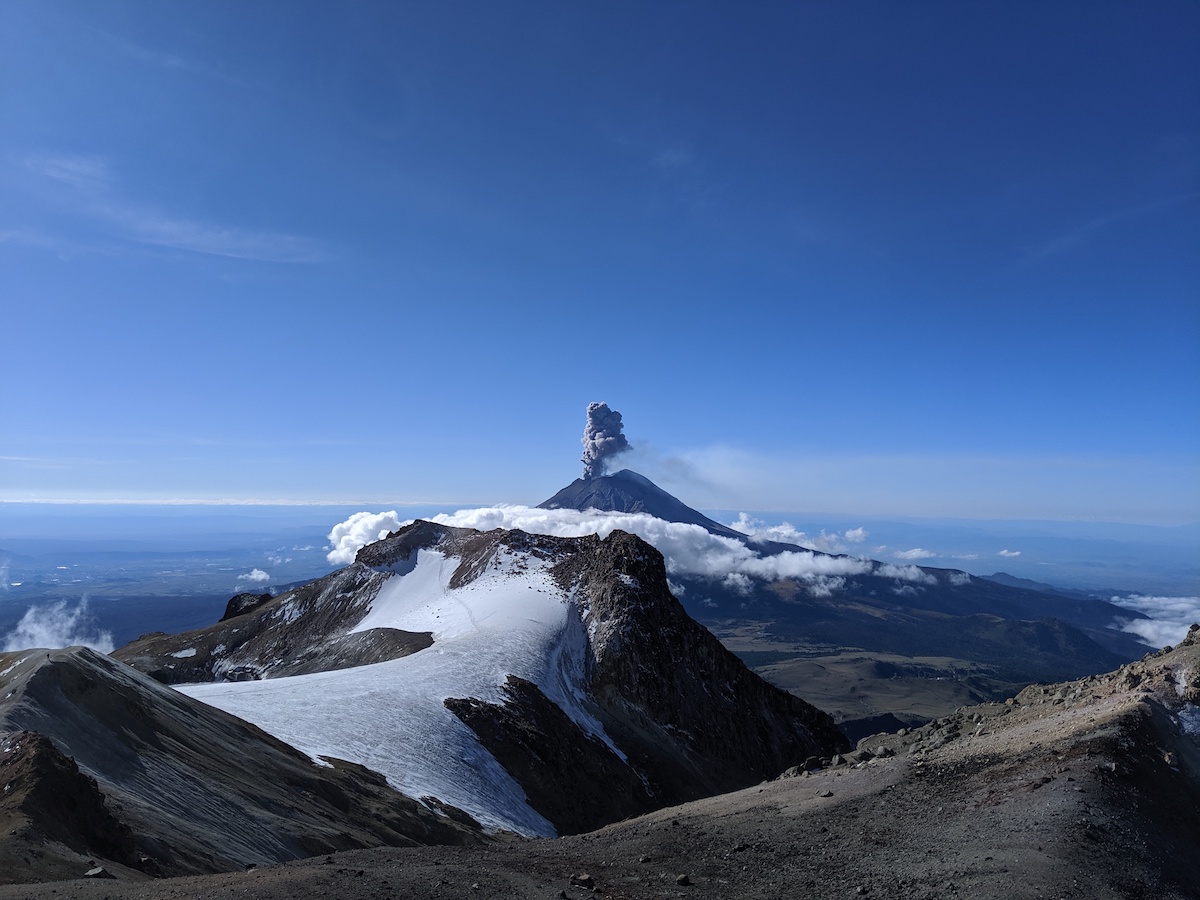
Iztaccíhuatl, 5230 m, is a serious summit in its own right and provides a day above 5000 m before Orizaba. After it the trip includes a descent to Tlachichuca at 2900 m to recover. The final ascent crosses snow and ice sections whose actual condition determines the movement technique and the equipment needed.
Status of the acclimatisation route
Day 3 was originally built around Nevado de Toluca, 4680 m. Since 31 March 2026 CONANP has kept a full temporary ban on visiting this protected area. Until there is an official reopening, Mountain Guide does not sell illegal entry and does not declare another mountain an equivalent substitute without checking. For each departure the name of the permitted mountain, the route, the start and finish elevations, the duration, transport, guides, permits and the location of the next night are confirmed in advance.
Who the trip suits
The trip is designed for physically prepared participants who are ready for several high-altitude days in a row. Mountain trekking experience and previous familiarity with crampons, an ice axe, a helmet and a harness noticeably reduce the number of new tasks on Orizaba. If you have no technical experience, say so before booking.
The age marker on the product card is from 14 years old. It is not automatic clearance for a teenager. The decision is taken after an assessment of experience, physical preparation, the reaction to altitude, the group composition and the conditions of the specific departure.
How this differs from the short Orizaba format
A short trip can suit a participant who arrives with current high-altitude acclimatisation. For everyone else it is not an equivalent substitute for the nine-day scheme. When comparing offers, look at the list of acclimatisation ascents, the sleeping altitudes, the reserve day, transport, accommodation, meals, the language the trip is run in, insurance requirements and personal equipment.
What is fixed before payment
Before booking, a participant receives the current dates, the meeting place and time, the confirmed route for every day, the group composition, the language and working format of the guides, the type of accommodation for each night, the format of the Orizaba base camp, the access rules in force, the full list of included and additional services and the final equipment list. If one of the mountains is closed, the new scheme is agreed in writing and is not disguised as the original route.
Volcanoes of Mexico itinerary, 9 days
Day 1. Arrival in Mexico City.
The trip starts in the Mexican capital. Accommodation and a night in Mexico City at around 2300 m.
Day 2. Ascent of Ajusco, 3900 m.
The first acclimatisation ascent. After the descent the group returns to Mexico City. Night at around 2300 m.
Day 3. Second acclimatisation ascent.
In the original trip this is Nevado de Toluca, 4680 m, followed by the transfer to Cholula. As of 6 August 2026 the area is completely closed by a CONANP decision. This day is run only after an official reopening, or it is replaced by a separate permitted route confirmed in writing. The name of the mountain, the elevations, the transfer, the guides, the permits and the night’s accommodation are stated in the documents for the specific departure.
Day 4. Move to the start point for Iztaccíhuatl.
Transfer and walk to the place where we sleep before the ascent. The original scheme lists huts at around 4000 m. The actual building and the form of accommodation are confirmed against the dates.
Day 5. Ascent of Iztaccíhuatl, 5230 m.
A high-altitude day on Iztaccíhuatl. After the descent, transfer to Tlachichuca at 2900 m and accommodation in a hostel.
Day 6. Recovery and move to Orizaba.
Rest after Iztaccíhuatl, a check of personal and group equipment, preparation for the final climb and the move to the Orizaba start point at around 4200 m. Transport and the form of accommodation for the night are confirmed for the specific departure.
Day 7. Ascent of Pico de Orizaba, 5636 m.
An early start and the summit attempt on the highest mountain in Mexico. The movement technique actually used depends on the state of the snow-and-ice route. After the descent, return to Tlachichuca and a night in the hostel.
Day 8. Reserve day.
The reserve is used at the trip leader’s decision, taking account of the weather, access, the state of the routes and the team. It does not mean a guaranteed second attempt.
Day 9. Return to Mexico City and end of the trip.
Transfer to Mexico City. The finishing time and whether it is possible to fly out the same day are confirmed before air tickets are bought.
What's included
- A guide for groups of four participants or more
- Transport along the route
- Meals in the mountains
- Group equipment — pots, gas, stove, tents and a first-aid kit
- Hotel in Mexico City
- Accommodation as set out in the itinerary
What's not included
- Flights
- Insurance
- Meals in the towns
- Personal equipment
- Any departure from the itinerary
- Any expenses arising from change to the itinerary
Private groups
A closed group can request its own quote for its own dates. The quote sets out separately the size of the group, the working language, the number of guides, transport, accommodation, meals, group equipment, the reserve day and what happens if one of the routes is closed. A private format does not set aside the acclimatisation sequence. Any shortening of the nine-day trip must be treated as a different product and assessed against participants’ current altitude preparation.
Documents you need
- A passport valid for the whole of the trip
- A visa or other entry permit, where one is required for your nationality, your means of entry and your flight routing
- An insurance policy expressly covering mountaineering, search and rescue and evacuation from at least the maximum altitude of the trip
- Air tickets and the documents needed for transit
- Copies of your main documents, to keep separately from the originals
The rules on entry, transit and access to the volcanoes can change. Check them against official sources for your particular dates before paying for anything non-refundable.
Weather, conditions and access
Current official status of Nevado de Toluca. According to CONANP’s notice of 31 March 2026, access to the protected area, the crater, the lakes and all the ascent trails is temporarily closed until further notice. Until it officially reopens, Day 3 cannot be treated as confirmed. Mountain Guide does not offer illegal entry and does not substitute another mountain without agreeing a new route in writing. CONANP’s official notice. Conditions on the four volcanoes differ with altitude and can change within a single day. The higher sections can bring cold, strong wind, precipitation, snow and ice. The state of the snow and ice on Orizaba determines the technique actually used and the equipment needed. Access to individual volcanoes depends not only on the weather but on official restrictions and on volcanic activity. The rules in force are checked before every departure. If a route is closed, any change to the trip is agreed separately and must not be presented as the original plan. A reserve day is built in on day eight. It widens the operational margin, but it does not guarantee a suitable window or a second attempt.
Accommodation and meals
The published route uses a hotel in Mexico City, a night in Cholula, the Iztaccíhuatl huts at 4000 m, a hostel in Tlachichuca and a night at the Orizaba base camp at 4200 m. The exact property, room or bed type and the form the base takes are confirmed in the documents for each departure. Meals in the mountains are included. Meals in the towns are not. If you need a special diet, tell us before the trip is confirmed. The product page states accommodation without tents, while the published list of group equipment includes tents. The actual arrangement for the night at 4200 m must therefore be fixed in writing before payment. The itinerary and contract for the particular departure take precedence over the general description on the page.
Facilities on the route
Town accommodation and the high-altitude nights offer very different levels of comfort. The huts, hostel and base camp exist above all for the route and for recovery. A constant shower, heating, a private room, charging, mobile coverage and internet are not promised on the high-altitude stages unless they are specifically named in the departure documents. You are responsible for your own hygiene, for spare power for your electronics, for protecting your kit from damp and dust, and for being ready for early starts. Group equipment is listed under “What’s included” and personal equipment under “What’s not included”.
Insurance
Show insurance calculator (Russian)
This calculator is provided by an external provider and uses a Russian-language interface.
Equipment for the volcanoes of Mexico
Download PDFThe final list is issued for your dates and the actual state of the routes. Below is the basic set for the published itinerary, with days out to 5636 m and snow and ice sections on Orizaba.
Clothing and footwear
- Broken-in mountaineering boots compatible with crampons
- Trekking footwear for the approaches and the lower volcanoes
- Base layers, an insulating layer and a warm jacket
- Waterproof shell jacket and trousers
- Thin gloves with warm mittens to go over them
- Hat and face protection
- Mountain sunglasses and spare goggles or glasses
Technical and personal equipment
- Crampons that fit your boots
- Ice axe
- Helmet
- Climbing harness and an agreed set of karabiners
- Trekking poles
- Head torch with a spare set of batteries
- A rucksack for the day and summit outings
- A sleeping bag, if the final list specifies one for the accommodation confirmed
- Vacuum flask and your own water containers
- Sun cream and lip protection
- Personal first-aid kit and any medication you take regularly
- Power bank and waterproofing for documents and electronics
New boots, crampons and harness must be tested before you fly. There is more in our piece on equipment for Orizaba and the volcanoes of Mexico.