- Guides
- B2B
-
#19607 (sem título)
-
#15972 (sem título)
- Escalando o Elbrus individualmente
- Escalando o Elbrus do Sul, 9 dias
- Escalando o Elbrus do Sul, 7 dias
- Escalando o Elbrus do Sul com oxigênio
- Escalando o Elbrus do Norte
- Escalando os dois picos do Elbrus
- Escalando o Elbrus, cruzando do Sul ao norte
- Escalando o Elbrus, cruzando de norte a sul
- Escalando o Elbrus no programa “Cruz do Sul”
- Escalando o Elbrus de acordo com o programa”Cruz do Norte”
- Escalada em Kazbek + Elbrus
- Escalando o Elbrus do Oeste
- Elbrus em helicóptero
- Férias em Elbrus, 9 dias
- Férias em Elbrus, 7 dias
- Tinder Tour, escalando o Elbrus
- Elbrus do Sul 9 dias com Sergey Baranov
- #15539 (sem título)
-
#15546 (sem título)
- Escalada do Kilimanjaro pela Rota Marangu
- Escalando o Kilimanjaro pela Rota Lemosho
- Escalada em Ararat
- Escalada em Demavend
- Escalando Kazbek do Sul
- Escalada em Kazbek + Elbrus
- Escalando os vulcões do México
- Escalada Alpamayo
- Escalada no pico de Margaret (Stanley)
- Escalada no Quênia
- Escalada em Dich-Tau
- #15554 (sem título)
- #15565 (sem título)
- #15572 (sem título)
-
#15972 (sem título)
-
#19592 (sem título)
-
See 8000m
- Trekking no acampamento base K2
- Trekking no acampamento base do Everest
- Trekking para o Everest através do lago Gokyo
- Trekking ao Everest em uma semana
- Anel de trekking Annapurna + lago Tilicho
- Anel De Trekking Manaslu
- Trekking no acampamento base Kanchenjunga
- Trekking no acampamento base Kanchenjunga (curto)
- Trekking no acampamento base Kanchenjunga (Índia)
- Trekking no acampamento base Makalu
- Trekking no acampamento base de Annapurna
- South America
- Asia
- Africa
- Russia
- Europe
-
See 8000m
-
Adventures
-
Africa
- Marrocos: o coração do Norte da África
- A escalada de Toubkal e a cultura marroquina
- Excursão à Eritreia: O arquipélago de Dahlak e os nômades de Rashaid
- Excursão A Ruanda: gorilas da montanha e Vulcão Bisoke
- Excursão à Etiópia: paisagens espaciais e tribos do Vale do Omo
- Excursão A Uganda: Parque da Rainha e gorilas da montanha
- Excursão à Tanzânia: safaris em Serengeti, Ngorongoro e Tarangira
- Excursão A Uganda: rinocerontes brancos e gorilas da montanha
- Excursão ao Zimbábue e África do Sul: Victoria Falls, Cidade Do Cabo e cabo da Boa Esperança
- Excursão à Namíbia: Etosha Park e as tribos Himba
- Excursão ao Quênia: Os cinco grandes africanos
- Excursão ao Botswana: Delta do Okavango e Parque Chobe
- South America
- Asia
-
Africa
- Ski-touring
- VIP
- #19722 (sem título)
- About
Escalando o Kilimanjaro pela Rota Machame
2990 $
Почему такая цена?
O Monte Kilimanjaro é a montanha mais alta da África, localizada no norte da Tanzânia. A subida ao Kilimanjaro é uma das mais populares entre alpinistas de todo o mundo. Além de sua grande fama e acessibilidade para qualquer pessoa saudável, a ascensão ao Kilimanjaro faz parte do projeto “Sete Cumes”, que consiste em alcançar os pontos mais altos de todos os continentes.
Existem várias rotas de subida ao Kilimanjaro, cada uma com suas características e níveis de dificuldade. É importante notar que, apesar de sua aparente simplicidade, a ascensão ao Kilimanjaro é um empreendimento sério e exige boa preparação física e adaptação à altitude. O mal de montanha não é raro, considerando que a montanha chega a quase 6000 metros, e economizar na aclimatação não é recomendado, especialmente se for sua primeira experiência em grandes altitudes. Antes de escolher a rota, é essencial consultar um guia profissional e se equipar adequadamente com o equipamento necessário.
*Atente que nossa empresa não atua na compra ou venda de passagens aéreas nem no processamento de vistos, portanto não se responsabiliza por imprevistos relacionados a voos ou passagem de fronteiras.
Na África, há algumas dificuldades na troca de cédulas pequenas, desgastadas ou antigas (emitidas antes de 2009), então tenha isso em mente. Em alguns lugares, pode haver taxa extra ou recusa na troca.
Recomendamos fortemente obter o visto da Tanzânia online antes do voo e levá-lo consigo, pois às vezes é necessário para embarcar.
Atenção! Também oferecemos um tour igualmente emocionante pelo Kilimanjaro seguindo a rota Marangu.
About the tour
From a bird’s-eye view, you can clearly see how seven trails lead to the base of Kibo Peak, each with its own characteristics. For example, only five of them allow an ascent of Kilimanjaro, and the park authorities of Kilimanjaro National Park have restricted descent on most of them, while the Mweka route only permits descent from the volcano summit. The only trail that allows both ascent and return is the Marangu route, also popularly known as the Coca-Cola route. This trail is highly favored not only for its ergonomics but also for providing climbers with certain comforts, including wooden huts, which, for those accustomed to a high level of comfort, are far preferable to standard tents. However, regardless of which route climbers choose for their Kilimanjaro ascent, they will inevitably encounter the Kibo Northern and Southern Circuit. This circuit trail is ring-shaped and connects all seven trails at an altitude of over 4,000 meters above sea level.
If you are energetic, crave adrenaline, and dream of an unforgettable journey, we can help organize your once-in-a-lifetime Kilimanjaro climb, which will be a true explosion of feelings and emotions. You will have the freedom to choose your route: the most famous and popular one or a completely new and unexplored path; easy for those testing their limits or more challenging for the confident climber; more comfortable or as wild as possible. Kilimanjaro can be climbed via the Marangu, Machame, Rongai, Umbwe, Lemosho, or Shira routes. Descent is possible via the Mweka and Marangu trails.
- Machame is a route rapidly gaining popularity, “catching up” with the Marangu route. Machame is renowned for its engaging difficulty and breathtaking landscapes. The maximum immersion in nature—free from civilization and crowds—attracts many climbers even more than the “rival” Marangu route. The ascent follows the western breach, which shortens the trek by one day. The route offers excellent locations and conditions for acclimatization, which is an essential component of a successful Kilimanjaro climb. This route is ideal for both experienced mountaineers and those just beginning to explore the beauty of the mountains.
For more details about which season is best for climbing Kilimanjaro, check out the article on our website.
Itinerary to Climb Kilimanjaro by Machame route.
Day 1. Arrival at Arusha Airport in Tanzania and transfer to a hotel in the city of Moshi. If you arrive at Nairobi Airport in Kenya, you will take an independent bus transfer (local transport) to Arusha or directly to Moshi (if necessary, we can help arrange a private transfer Nairobi-Moshi). Total travel time from Nairobi is approximately 5 hours. Upon arrival, the group will be greeted by our representative. Accommodation in a three-star hotel with amenities in Moshi, dinner provided. The group will receive a detailed briefing on the upcoming ascent, and necessary equipment will be prepared. Overnight at the hotel.
Day 2. Transfer to the Machame Gate (starting point of the climb at 1800 m). Registration of the climbing group on Kilimanjaro, distribution of personal luggage and necessary gear to porters. (Your personal luggage carried by a porter should not exceed 20 kg). Start of the trek, hike to Machame Hut Camp (3000 m). The trail passes through scenic tropical forest, gradually transitioning into a shrub zone (18 km – 7 hours). Accommodation in the Machame Camp (twin tents). Meals: breakfast, lunch, dinner.
Day 3. Trek to Shira Hut Camp (3800 m). The trail passes through the shrub zone, and closer to the camp, alpine meadows covered with giant lobelias appear (9 km – 6 hours). Accommodation in Shira Camp (twin tents). Meals: breakfast, lunch, dinner.
Day 4. Trek to Barranco Hut Camp (3900 m). The trail passes a steeper and rockier slope, rising to 4500 m, then descending (15 km – 7 hours). Accommodation in Barranco Camp (twin tents). Meals: breakfast, lunch, dinner.
Day 5. Trek to the Barafu Hut assault camp (4800 m). The trail passes through a barren and rocky terrain (13 km – 7 hours). Accommodation in Barafu Camp (twin tents). Rest before the summit attempt until midnight. Meals: breakfast, lunch, dinner.
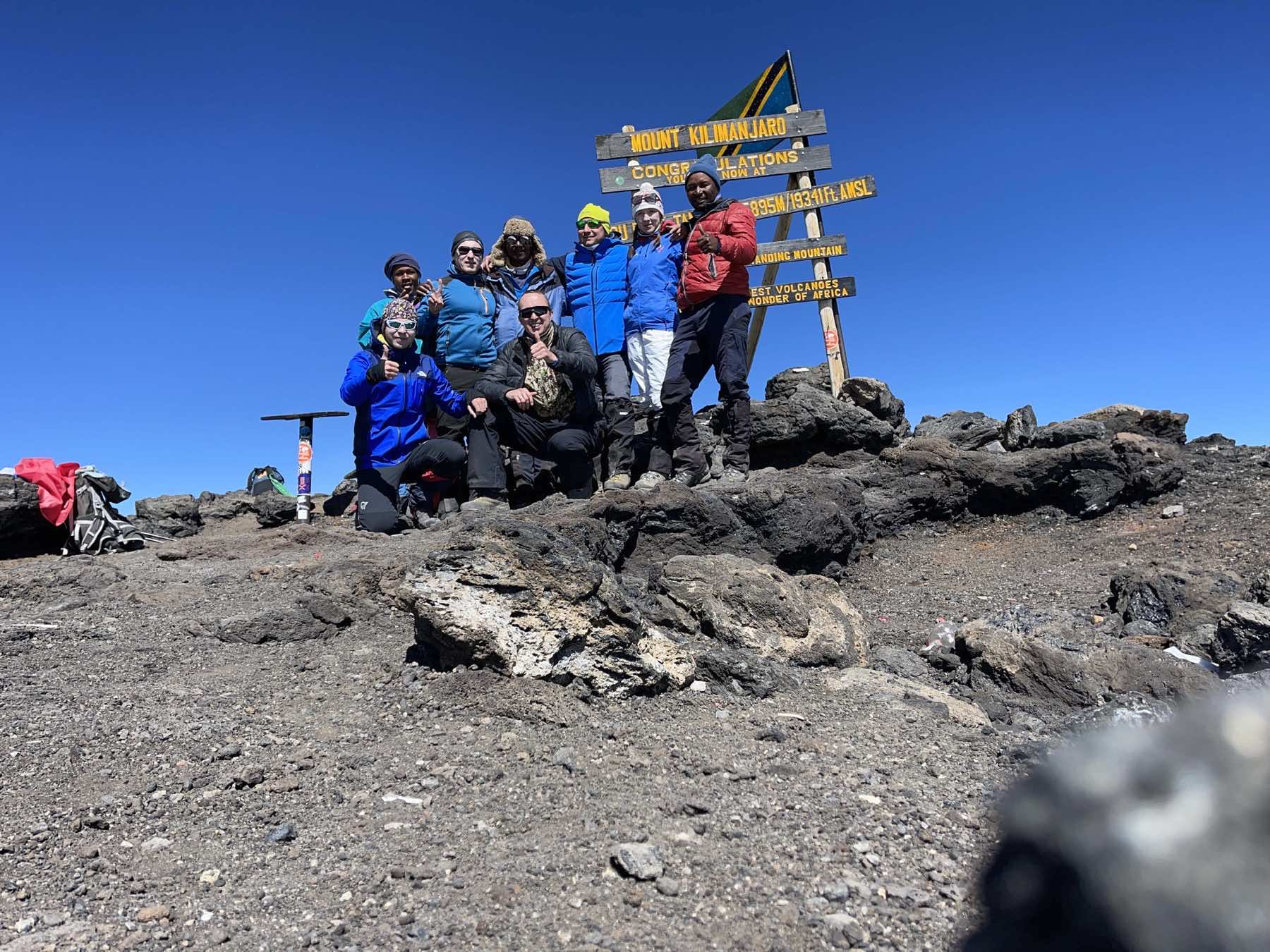
Day 6. Ascent of Kilimanjaro. At 01:00, the summit attempt begins to reach the top of the massive Kilimanjaro crater (average climb time 6–7 hours). Witness sunrise at Uhuru Peak – the highest point in Africa (5895 m). Optionally, you can descend 100 m into the crater or walk to the glaciers. Return to Barafu Hut Camp (4800 m), pack the camp. Descend to Mweka Camp (3700 m – 4–5 hours). Accommodation in Mweka Camp (twin tents). Meals: breakfast, lunch, dinner.
Day 7. Descent to Mweka Village (end point of the Kilimanjaro climb, 1500 m). The trail passes through scenic tropical forest (10 km – 4 hours). Upon exiting, the group (those who reached the summit) receives a well-deserved certificate of ascent to Africa’s highest peak – Uhuru Peak. Farewell to the support staff (tips are customary). Transfer and accommodation in a three-star hotel in Moshi. Free time and rest. Meals: breakfast.
Day 8. Transfer to the airport. Departure. Meals: breakfast.
Included in the cost of expedition to climb Kilimanjaro:
- Experienced trek leader with extensive climbing experience
- Transfer Kilimanjaro Airport – hotel – Kilimanjaro Airport
- Accommodation in a 3* hotel in Moshi (2 nights, double occupancy, breakfast included)
- All transfers according to the program
- Kilimanjaro National Park entry permit / climbing permit
- Services of a local English-speaking guide
- Services of a cook and porters
- Accommodation in tents during the ascent (we use the best tents on the mountain)
- Full board (breakfast, lunch, dinner) during the ascent
Not included in the cost of expedition to climb Kilimanjaro:
- Passagem aérea até Kilimanjaro na Tanzânia
- Voo de helicóptero após a subida (opcional, pode encurtar o tour)
- Transferência Nairobi-Moshi-Nairobi
- Seguro de alpinismo (300-1000 rublos)
- Visto da Tanzânia (50 USD). Recomendamos fortemente solicitar online com antecedência: https://visa.immigration.go.tz/
- Almoços e jantares no hotel antes e depois da subida
- Suplemento para acomodação individual (60 USD por noite por pessoa)
- Gorjetas obrigatórias após a subida (250-300 USD por pessoa)
- Quaisquer despesas relacionadas a alterações no programa
Страхование
НаверхEquipment.
Скачать PDFDocumentos:
- Passaporte internacional
- Passagens aéreas
- Seguro médico
- Certificado de vacinação contra febre amarela em inglês
Equipamento pessoal:
- Mochila 20-30 litros
- Saco de dormir, temperatura de conforto -5°C a -10°C
- Bastões de trekking
Roupas e calçados:
- Botas de trekking
- Tênis (para cidades)
- Camada impermeável – Jaqueta + calça (a indústria oferece uma variedade de produtos, de simples Membran 5000/5000 a Gore-Tex)
- Conjunto de fleece
- Calças leves de trekking
- Roupa térmica superior e inferior
- Camisetas de manga comprida
- Jaqueta de plumas com capuz
- Luvas grossas
- Luvas finas
- Bandana (além da proteção solar, pode ser usada para aquecer o pescoço ou rosto no frio)
- Chapéu
- Meias de trekking quentes para o dia da subida
Diversos:
- Lanterna de cabeça LED com autonomia mínima de 12 horas
- Óculos de sol
- Máscara de esqui (opcional)
- Garrafa térmica – 1 litro, preferencialmente sem botão na tampa
- Garrafa reutilizável
- Saco para bagagem, entregue ao carregador
- Sacolas impermeáveis para roupas e saco de dormir (ou sacos plásticos extras)
- Toalha de viagem
- Máscara de proteção contra vento para o rosto inferior (pode ser substituída por um lenço)
- Gaiters (perneiras)
- Protetor solar, batom protetor
- Repelentes de mosquitos
- Medicamentos antimalária
- Aquecedores químicos (opcional, mas podem ser muito úteis)
- Kit de primeiros socorros pessoal
- Bandagem elástica e/ou suporte ortopédico
- Comprimidos para malária