- Bergführer
- Für Unternehmen
-
#19607 (no title)
-
#15972 (no title)
- Climb Elbrus Individually
- Climb Elbrus from the South, 9 Days
- Climb Elbrus from the South, 7 Days
- Climb Elbrus from the South with Oxygen
- Climb Elbrus from the North, 10 Days
- Two Summits of Elbrus, 9 Days
- Elbrus Traverse from South to North, 9 Days
- Elbrus Traverse from North to South, 10 Days
- Cross of Elbrus, South to North, 9 Days
- Cross of Elbrus, North to South, 10 Days
- Climb Kazbek and Elbrus — 10-Day Two-Summit Expedition
- Climb Elbrus from the West, 11 Days
- Elbrus by Private Helicopter, 3 Days
- Elbrus Region Holiday and Trekking, 9 Days
- Elbrus Region Holiday, 7 Days
- Tinder Tour: Climbing Mount Elbrus, 9 Days
- Climb Elbrus from the South, 9 Days with Sergey Baranov
-
#15539 (no title)
- Climb Carstensz Pyramid, 8 Days with Helicopter Access
- Climb Mont Blanc, 4810 m — 8-Day Guided Ascent
- Climb the Matterhorn, 4478 m — 8-Day Guided Ascent
- Climb Mount Vinson, 15-Day Antarctic Expedition
- Climb Kosciuszko and Travel in Australia, 7 Days
- Climb Fisht, 2868 m — 3-Day Ascent by the 1B Route
- Climb Mount Wilhelm, 6 Days
-
#15546 (no title)
- Climb Kilimanjaro: the Marangu Route
- Climb Kilimanjaro: the Lemosho Route
- Climb Ararat, 5137 m — 7-Day Classic Climb
- Climb Kazbek from the South, 5033 m — 8 Days in Georgia
- Climb Kazbek and Elbrus — 10-Day Two-Summit Expedition
- Climb the Volcanoes of Mexico — Orizaba and Iztaccíhuatl, 9 Days
- Climb Alpamayo — 16-Day Technical Expedition
- Climb Margaret Peak (Stanley), 5109 m
- Climb Mount Kenya: Point Lenana, 4985 m
- Climb Dykh-Tau by the North Ridge, 13 Days
-
#15554 (no title)
- Aconcagua Climb — 17-Day Guided Expedition
- Island Peak Climb — 18-Day Expedition
- Climb Mera Peak, 6476 m — 16-Day Hinku Valley Expedition
- Climb Ama Dablam, 6812 m — 24-Day Expedition with Island Peak
- Climb Island Peak and Mera Peak — 24-Day Two-Summit Expedition
- Aconcagua and Ojos del Salado — 25-Day Combined Expedition
- Ojos del Salado Climb — 15-Day Expedition
- Climb Chimborazo and Cotopaxi — 14-Day Ecuador Expedition
- Climb Huascarán — 8-Day Technical Ascent
- Climb Razdelnaya Peak, 6148 m — 15-Day Pamir Expedition
- Climb Denali by the West Buttress, 23 Days
- #15565 (no title)
- #15572 (no title)
-
#15972 (no title)
-
#19592 (no title)
-
8000-Meter-Gipfel
- K2 Base Camp Trek via the Gondogoro La
- Everest Base Camp Trek — 14 Days
- Everest Base Camp via Gokyo Lakes — 15 Days
- Short Everest Base Camp Trek in 10 Days
- Annapurna Circuit and Tilicho Lake Trek
- Manaslu Circuit Trek
- Kanchenjunga Circuit Trek (XXL)
- Kanchenjunga North Base Camp Trek (Short)
- Kanchenjunga from India: the Goecha La Trek in Sikkim
- Makalu Base Camp Trek
- Annapurna Base Camp Trek
- Südamerika
- Asien
- Afrika
-
Russland
- Elbrus Region Holiday and Trekking, 9 Days
- Elbrus Region Holiday, 7 Days
- Oshten + Kardyvach — 9-Day Western Caucasus Trek
- Lake Kardyvach — 5-Day Base-Camp Trek
- Route 30: Through the Mountains to the Sea, with Oshten — 4 Days
- Trekking in Arkhyz — 7 Days over the Ayulyu Pass
- Gvandra Trek — 7 Days to the Ullu-Kyol Lakes
- Trekking in Dombai — 7 Days with the Murudzhu Lakes
- Europa
-
8000-Meter-Gipfel
-
Abenteuer
-
Afrika
- Marokko-Tour: Das Herz Nordafrikas
- Toubkal-Aufstieg und marokkanische Kultur
- Eritrea: the Dahlak Archipelago and the Rashaida Nomads
- Rwanda: Mountain Gorillas and the Bisoke Volcano
- Ethiopia: Otherworldly Landscapes and the Peoples of the Omo Valley
- Tour nach Uganda: Der Queen Park und die Berggorillas
- Tanzania Safari: Serengeti, Ngorongoro and Tarangire
- Tour nach Uganda: Weiße Nashörner und Berggorillas
- Zimbabwe and South Africa: Victoria Falls, Cape Town and the Cape of Good Hope
- Namibia: Etosha National Park and the Himba
- Kenya Safari: the African Big Five
- Tour nach Botswana: Das Okavango-Delta und der Chobe-Park
- Südamerika
- Asien
-
Afrika
- Skitouren
- VIP
- #19722 (no title)
- Über uns
Climb Huayna Potosí — 10 Days with Acclimatisation
- Height (m)
- 6088
- Duration
- 10 дней
- Difficulty
- High
- Continent
- South America
- Children
- Not suitable for children
- Accommodation
- No nights in tents
- suitable-for-beginners
- No
Тур временно недоступен
The trip is quoted individually once the dates, the group size and the exact list of services have been confirmed.
This ten-day ascent of Huayna Potosí, 6088 m, is a complete trip with acclimatisation, not a short trip to the mountain straight after landing in La Paz. Before the three-day climbing section, participants spend time at altitude by Lake Titicaca, walk the route on Isla del Sol and climb Pico Austria, 5350 m. That sequence lets you check how your body reacts, how you move and how your equipment works before going onto the Huayna Potosí glacier.
The normal route starts from the Zongo pass side. The first mountain day includes glacier training and a night in the lower refuge at around 4750 m. The group then climbs to the upper refuge at around 5300 m and sets out for the summit at night. Crampons, an ice axe, a helmet, a harness and a rope are used on the route; movement is on a crevassed glacier, and the state of the snow and ice changes through the season.
The trip suits physically prepared participants with experience of mountain trekking or climbing. Huayna Potosí can be a first summit above 6000 m and a first serious ice climb, but it should not be a person's first encounter with altitude and sustained effort. On the mountain section a local guide works with a maximum of two participants.
The minimum group size is two people. An escort accompanying the whole trip is included for groups of three participants or more; for two people a private format is available with local English-speaking or Spanish-speaking guides.
Important
- The summit is not guaranteed — the guide decides whether to start and whether to continue, based on the state of the route, the weather and how participants are feeling.
- Medical insurance must cover mountaineering, search and rescue, and evacuation from no lower than 6100 m.
- Each participant carries their own rucksack and must be able to use the issued equipment unaided after the compulsory training.
About the Huayna Potosí climb
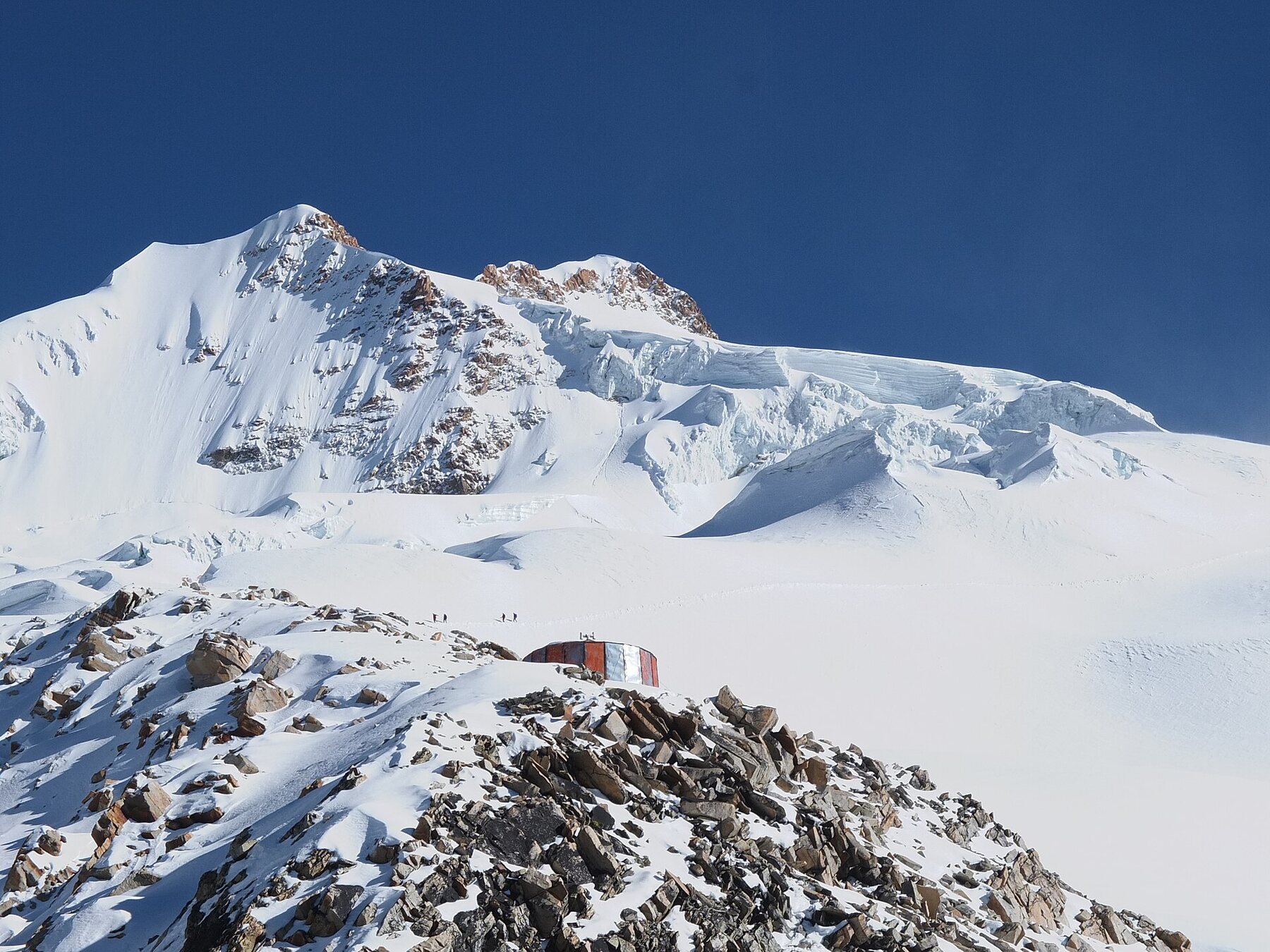
Huayna Potosí stands in the Bolivian Cordillera Real not far from La Paz. Being close to the capital makes the drive to the mountain comparatively short, but the summit itself remains a full mountaineering route at 6088 m. The normal route runs from the Zongo valley side through the glacier and the lower and upper refuges. Convenient road access should not be confused with an easy climb: acclimatisation, cold, the night start, crevasses, the state of the snow and the ability to keep moving on a rope for a long time all remain the decisive factors.
Ten days were chosen for the sake of sequential adaptation. La Paz already sits at considerable altitude, so the first days are not overloaded with a rapid gain. The trip to Titicaca and the walk on Isla del Sol give a moderate day's effort at around 3800 m. After a rest the group climbs Pico Austria, 5350 m, in the Condoriri area. This is not a formality but a check ascent: the guide uses it to assess pace, recovery, clothing and a participant's readiness for three days on Huayna Potosí.
The mountain section takes three days. In the Zongo area there is a practical session on the ice: moving in crampons, working with an ice axe, the rules of the rope and how to act on snow and ice ground. The next stage is the move to the upper refuge at around 5300 m. The summit push starts at night in order to climb the route at the most suitable time and to leave a margin for the descent. The actual line of movement is set by the guide: the position of the crevasses, the snow bridges and the steepness of individual sections all change.
Huayna Potosí is often called one of the most accessible 6000 m summits. That is fair only in terms of road access and a normal route without difficult rock climbing. The altitude, the glacier and the length of summit day make the ascent a serious one. A participant needs regular aerobic training, experience of moving in the mountains for many hours, steadiness on scree and snow, discipline on the rope and a readiness to turn back when the guide decides to.
If the aim is to continue a high-altitude trip in the Andes, compare Huayna Potosí with the Chimborazo and Cotopaxi ascents, with Ojos del Salado, with the 17-day Aconcagua expedition and with the combined Aconcagua and Ojos del Salado trip. These are not interchangeable: each has its own acclimatisation logic, its own technical character and its own requirements for previous experience.
Huayna Potosí climbing itinerary with acclimatisation
Day 1. Arrival in La Paz.
Meeting at the airport at the agreed time and transfer to the hotel. After checking in: rest, a short briefing and an initial check on how everyone is feeling. La Paz lies at considerable altitude, so no intensive effort is planned for the first day. Night in a hotel.
Day 2. Acclimatisation in La Paz.
A quiet day to adapt after the flight. We take a walk at a suitable pace, go over the trip, check personal clothing and confirm the sizes of the technical equipment being issued. The main task of the day is to recover and not to accelerate the build-up of effort. Night in a hotel.
Day 3. La Paz to Copacabana and Lake Titicaca.
Transfer from La Paz to Lake Titicaca. After checking in at Copacabana: a walk around the town and an unhurried climb to a viewpoint. A night at around 3800 m continues the adaptation without a sharp step up to a mountaineering load. Night in a hotel.
Day 4. Isla del Sol and return to La Paz.
Transfer to the jetty, boat to Isla del Sol and a walk across the island of about three and a half hours. This is the first sustained walking day of the trip. After returning to the mainland, transfer to La Paz. Night in a hotel.
Day 5. Rest and preparation.
A recovery day after Titicaca. We check the condition of the participants, complete clothing and personal kit, and pack the rucksacks for the acclimatisation ascent. Night in a hotel.
Day 6. Ascent of Pico Austria, 5350 m.
An early departure to the Condoriri area and the ascent of Pico Austria. The route involves no difficult ice climbing, but it demands a full day of movement at altitude. The ascent is needed to check pace, clothing, nutrition and altitude tolerance before Huayna Potosí. After the descent, return to La Paz. Night in a hotel.
Day 7. Rest and reserve.
A day for recovery, a final equipment check and the meeting with the mountain guides. It also provides a limited reserve in case the weather or the schedule of the previous acclimatisation ascent changes. Night in a hotel.
Day 8. La Paz to Zongo, ice training.
Transfer to the lower Huayna Potosí refuge at around 4750 m. After checking in we go out to the glacier and practise moving in crampons, working with an ice axe, the rules of the rope and the guide's commands. The training is compulsory even for experienced participants: it allows the compatibility of equipment and a single set of group procedures to be checked. Night in the lower refuge.
Day 9. Move to the upper refuge, around 5300 m.
The climb runs over rocky and, depending on the state of the route, partly snowy ground to the upper refuge. The move usually takes about three to four hours. After checking in: rest, an early dinner and the preparation of clothing, water and equipment for the night start. Night in the upper refuge.
Day 10. Ascent of Huayna Potosí, 6088 m — descent and return to La Paz.
The start is at about 01:00. The group moves up the glacier on the rope under the direction of the mountain guides. The climb to the summit usually takes about six to seven hours, but the actual pace and whether it is possible to continue depend on the snow, the crevasses, the wind and the condition of the participants. From the summit, or from the highest point reached, the group descends to the upper and lower refuges, packs up and transfers to La Paz. The trip ends on the return to the city; an additional night and an airport transfer can be included in an custom quote.
What's included
- Meeting at La Paz airport at the agreed time and transfer to the hotel
- Six nights in a hotel in La Paz, twin rooms
- One night in a hotel in Copacabana, twin room
- One night in the lower Huayna Potosí refuge and one night in the upper refuge
- Ground transfers along the published itinerary
- Boat to Isla del Sol and back
- An escort accompanying the whole trip, for groups of three participants or more
- A local guide on the Pico Austria route
- Local mountain guides on Huayna Potosí at a ratio of no more than two participants per guide
- The compulsory glacier training before the climb
- Meals during the Huayna Potosí mountain section
- Breakfasts in the hotels, lunches on the Titicaca days of the trip and a packed lunch on Pico Austria
- Group climbing equipment, including ropes and belay equipment
- Hire of a helmet, harness, crampons, ice axe and gaiters where a suitable size is available and after prior confirmation
- Carriage of group equipment and food on the mountain section
- The compulsory local fees for the routes in the itinerary
What's not included
- International and domestic flights
- Medical insurance, search and rescue, and evacuation
- An additional night in La Paz after returning from the mountain
- Transfer to the airport after the trip ends
- Lunches and dinners in La Paz, other than those stated explicitly in the itinerary
- Personal clothing, trekking boots, rucksack, sleeping bag, headtorch and other personal items
- Mountaineering boots; the hire of a suitable model and size is agreed separately
- A personal porter and the carrying of a personal rucksack
- Single occupancy and hotel upgrades
- Additional excursions and services outside the published itinerary
- Tips for guides and staff
- Costs arising from flight delays, road closures, illness, weather or other causes outside the operator's control
Huayna Potosí for private groups
The trip can be run for two participants on dates of their choosing, with a mountain guide at a ratio of 1:2. For a single participant a separate 1:1 format is quoted. A Russian-speaking companion, single rooms, an extra night after the climb, airport transfers, a longer acclimatisation and additional summits in the Cordillera Real can all be added to a bespoke quote.
Shortening the trip is discussed only with participants whose recent acclimatisation is confirmed. We do not remove days where that would break the logic of adaptation or leave too little time to check skills and equipment. A family format is possible for companions in La Paz and at Titicaca, but the climb itself is not offered to children on this trip.
Documents required for travel to Bolivia
- A valid passport
- A visa, if one is required for your nationality
- Medical insurance covering mountaineering, search and rescue and evacuation from at least 6100 m
- Air tickets and the documents needed for entry and for transit on your chosen flight routing
- We recommend keeping digital copies of your documents on your phone and in cloud storage
Weather and season for the Huayna Potosí climb
The main climbing season on Huayna Potosí falls in the dry months of the Bolivian winter. The most predictable windows are usually sought between May and September, though a dry season does not mean settled good weather. At altitude you can meet strong wind, hard frost, fresh snow and a sudden loss of visibility.
The state of the normal route changes over the course of the season. Crevasses open up, snow bridges weaken, and individual ice sections may call for a different line. Dates are chosen after current conditions have been checked, but the final decision to set out is the guide's, on the spot. On the Titicaca and Condoriri days, warm daytime sun can combine with a cold wind and a sharp drop in temperature after sunset.
Accommodation and meals on the Huayna Potosí trip
In La Paz and Copacabana the trip uses standard twin rooms in hotels. The specific properties are confirmed in the quote for your chosen dates. Single occupancy and an upgrade are quoted separately.
On Huayna Potosí the group sleeps in the lower hut near Zongo and in the upper hut at about 5300 m. Accommodation is shared, in dormitories; you need your own warm sleeping bag. Meals are provided on the mountain section, adapted to the early starts and to what the huts allow. Dietary restrictions, vegetarian meals and allergies must be reported before booking, so that we can confirm whether substitutes are possible.
Day-to-day conditions on the Huayna Potosí route
The hotels in La Paz and Copacabana offer the usual town-level facilities. At Titicaca and on the longer drives, the quality of the mobile signal depends on the particular stretch of the route.
The lower Huayna Potosí hut has beds and washing facilities; whether hot water is actually available depends on how the hut is running. The upper hut is a great deal more basic: accommodation is shared, space is limited, and there is no shower, no reliable internet and no guaranteed charging for devices. Charge your phone and batteries in town beforehand, bring a power bank and keep your electronics warm.
On the glacier participants move roped up and carry their own rucksacks. Water and kit for the night start are prepared the evening before. The guides' communications are there above all for running the group and for emergencies, and are not a substitute for internet access for clients.
Страхование
НаверхEquipment and useful extras for the Huayna Potosí climb
Скачать PDFDocuments
- Passport
- Air tickets
- An insurance policy covering mountaineering and evacuation from at least 6100 m
- We recommend keeping digital copies of your documents on your phone and in cloud storage
Personal equipment
- A rucksack of about 35-40 litres, with the contents protected from rain and snow
- A warm sleeping bag for the nights in the high-altitude huts
- Trekking poles
- Head torch with a spare set of batteries
- Vacuum flask and water containers holding about two litres in total
- Dry bags or light stuff sacks to keep your kit organised
Clothing and footwear
- Broken-in trekking boots for Titicaca, Pico Austria and the approaches
- Warm mountaineering boots compatible with crampons; hire and sizing are confirmed in advance
- Base layers
- An insulating mid layer
- Warm down or synthetic jacket
- Waterproof shell jacket and trousers against wind and precipitation
- Trekking trousers
- Warm hat and neck protection
- Thin gloves with warm mittens to go over them
- Trekking socks and warm socks
Technical equipment
- Helmet
- Climbing harness
- Crampons compatible with your boots
- Ice axe
- Gaiters
- Screwgate karabiner
- The technical equipment in this section is supplied as part of the package once size and compatibility have been checked; you may use your own set after your guide has inspected it
Sun protection and useful extras
- High-protection sunglasses for the glacier
- Spare glasses or ski goggles
- Sun cream and protective lip balm
- A cap or sun hat for the day outings
- Power bank and cables
- A personal first-aid kit; we do not list medicines or treatment regimes
- Toiletries and a small towel