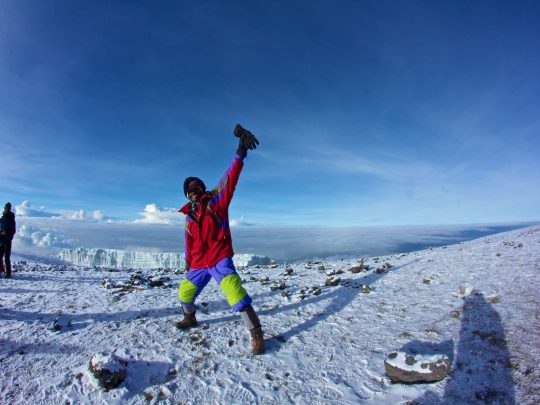
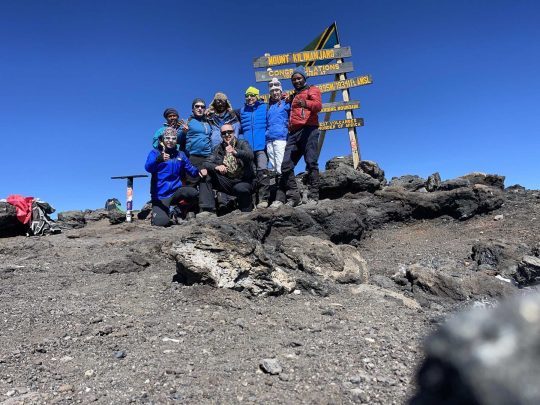
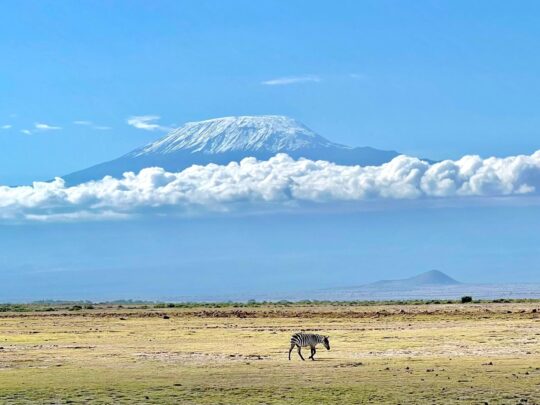
Summit day on Kilimanjaro starts in the night and carries on, after you reach Uhuru Peak at 5895m, with a long descent. The exact start time depends on the route, the weather, the state of the team and the guides‘ decision. It is not one short push but the culmination of several days of acclimatisation.
The main difficulties are the cold, the darkness, the altitude, the lack of sleep and the monotonous, slow gain of height. The effort does not end at the summit: you have to get back to camp safely, pack up and carry on down.
The short answer
- The start is at night, from Barafu, Kibo or another confirmed summit camp
- The pace is set by the guide, not by the fastest person in the group
- Uhuru Peak at 5895m is not guaranteed and does not override a decision to turn back
- Clothing is put together in layers and checked before you sleep
- The most underrated stage is the descent after the summit
Different summit camps
On Lemosho and Machame the standard start is from the Barafu area. On Marangu the group sets off from Kibo. The Northern Circuit may use School Hut. The exact arrangement has to match the programme.
Timings and distances from one route cannot be transferred to another. Even on one path, snow, wind and how busy it is all change how long the day takes.
Getting ready the evening before
Before sleeping, you lay out your base layer, insulation, waterproof shell, gloves, hat, buff, torch, eye protection, water and snack. Batteries and electronics are protected from the cold. In the morning there should be no hunting round the tent for one glove.
Boots are laced so that the foot does not slide on the descent but the circulation is not restricted. The guide checks the critical items and gives the order of departure.
Clothing at the start
At the start there is often an urge to put everything on. Overheating while walking means sweat, and a damp base layer cools you quickly at a stop. Layers are adjusted gradually, without waiting for serious overheating or for shivering.
You need warm gloves or mittens, a thin pair for jobs that need dexterity, a down jacket, a waterproof shell, face protection and dry spares. The final set is checked against the list for the particular date.
A slow pace
Pole pole is not a tourist slogan but a practical way of working. Short steps, even breathing, stops managed by the guide. Trying to overtake in the first few hours often ends in a sharp loss of pace higher up.
The group can split only by an arrangement agreed in advance and with proper escort. Nobody goes on ahead or heads down alone.
Food and water
Altitude and the night reduce your appetite, so you want familiar snacks in small amounts. Food should not freeze or need complicated unwrapping. A flask helps keep water warm.
Drinking follows the team’s advice. Ice-cold water, a frozen hose and an awkward bottle all become problems if they have not been tested in advance.
How you feel, and turning back
The guide assesses coordination, alertness, pace and what people report. A severe headache, confusion, marked breathlessness or an inability to hold a safe pace can all stop the attempt.
Symptoms must not be hidden. Before the trip, read up on the signs of altitude sickness. Turning back protects your health and is not a personal defeat.
The crater rim and Uhuru Peak
The routes come out onto the crater rim at different points and then continue to Uhuru Peak. Reaching an intermediate point does not mean going on is obligatory. How you are doing, and the weather, are assessed again.
Time at the summit is limited by the cold and by the need to descend. Photographs should not hold the group up or get in other people’s way.
The descent
On the way down, fatigue combines with a loss of concentration. Trekking poles, boots laced firmly and a controlled stride all save your knees. There is no need to run down the scree unless you are told to.
Once back at the summit camp, the rest is brief. The team packs up and goes lower, because a night at a lower altitude helps recovery. You need to know in advance that the day does not end at your tent at Barafu or at the Kibo hut.
Typical mistakes
- Starting too fast
- Hidden symptoms
- New boots
- A warm item lost in the kit bag
- A flat torch
- A frozen drinking system with no spare bottle
- Expecting to rest as soon as the summit is reached
How to prepare
Practise long walks, a night start with a torch and descending on tired legs as part of your preparation for the climb. Do not imitate altitude with extreme training and no recovery.
In the day before you set off, do not change your food, your boots or your medication. Stick to the arrangement you have tested and to the team’s decisions.
The logic of a night start
Summit day in fact begins the evening before. Before sleeping you lay your clothing out in the order you will put it on, fill your water containers, tuck batteries inside your insulation and check your torch. In the dark and the cold of the morning there is no time to look for a glove or repack a rucksack. Every action should have been rehearsed beforehand.
After the start, the team gains height slowly on scree or rocky ground. How long the walking takes varies with the route, the state of the path, the weather and the pace of the group. Dawn may find the group below the crater rim or above it, so safety cannot be built around an attractive timetable taken from somebody else’s trip report.
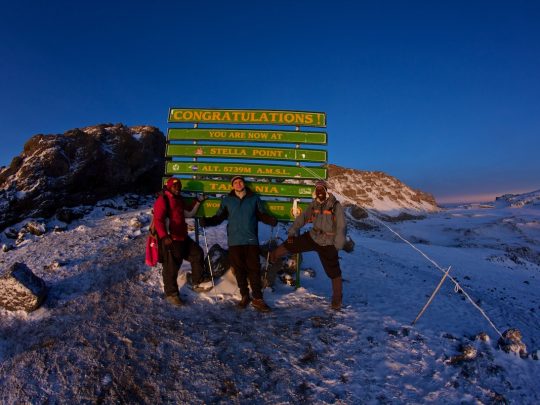
Reaching Stella Point or Gilman’s Point does not mean the day is done: a stretch along the crater rim to Uhuru Peak remains, and after that comes the long descent. The guide judges the time in hand, the weather and each person’s condition not only for going up but for getting back safely.
Managing energy and warmth
Food should be reachable with one hand and still edible in the cold. A large bar or one that freezes solid is better replaced by several familiar small portions. Water is divided between containers and protected from freezing on the guide’s advice. Summit night is no time to experiment with unfamiliar sports nutrition.
- Do not put your whole insulating set on long before the start
- Adjust your layers before you are sweating heavily
- Keep a spare pair of warm gloves dry
- Eat and drink in small amounts at the permitted stops
- Do not step out of the team’s pace for a photograph
- Tell the guide at once if you start to feel worse
Put your clothing together from the Kilimanjaro equipment list, and the physical side from the preparation programme. Even perfect equipment does not suspend the rules on responding to altitude sickness.
After coming back from the summit
The day does not usually end at the summit camp. After a short rest, food and packing, the team carries on down. That is exactly why you cannot spend everything you have on the last few metres to the top. Descending on tired legs takes attention on every step and careful work with the poles.
Do not take all your warm clothing off as soon as the sun is up: wind and temperature change quickly. Adjust your layers gradually, keeping an eye on drinking and eating at the same time. If you develop knee pain, dizziness or unsteadiness, tell the guide before the problem gets worse on the long descent.
Photographs and congratulations are better left until you are somewhere safe. The summit is the middle of a long working day, not its end. The right objective is not only to reach Uhuru Peak at 5895m but to come back down in a manageable state.
Summit day begins before you set off.
At the summit camp you lay your clothing out in the order you will put it on and check your torch, batteries, water, snack and medication. The kit bag stays at camp, and only what you need for the climb and the descent goes into the day sack. Any searching for things at night costs you sleep and leaves you cold.
Supper and a short rest do not always add up to proper sleep. That is an expected part of the schedule. There is no need to make up for a sleepless night with unfamiliar medication. If you feel worse even before the start, say so to the guide.
The first hours in the dark.
The pace feels unusually slow, but that is exactly what saves energy. People walk in single file, keep their spacing and do not overtake unless told to. Stops are short: the body cools quickly, and getting going again takes energy.
Water, a snack and a warm layer should all be reachable without emptying the rucksack. Batteries are kept warm. If the drinking hose freezes, you need a reserve in a bottle or flask. All of this is tested in training.
Clothing is adjusted as you go.
Putting the full set on too early can leave you sweating heavily, and wet layers hold heat less well. Adding insulation too late leaves you shivering. Say when you are cold and change layers at a stop, in agreement with the guide.
Fingers and toes are particularly vulnerable. Boots should not squeeze the foot once thick socks are on. Outer mittens go on before you lose feeling. The down jacket stays as an emergency warm layer in case of a stop.
Dawn does not mean the summit is close.
Light helps psychologically, but the distance to Uhuru Peak depends on where the team happened to be when the sun came up. After coming out onto the crater rim there may still be a long stretch to go. Do not speed up simply because you can see a sign or another group.
On the crater rim the wind and cold can get worse. The guide decides how long to stop. A photograph should not hold up the descent or create a risk for someone who is already exhausted.
Altitude sickness on summit night.
Headache, nausea, unusual weakness, dizziness and worsening coordination are reported immediately. Altered behaviour, unsteadiness or breathlessness at rest call for an emergency decision. How far is left to the summit has no bearing on the medical priority.
Oxygen and medication are used according to the team’s protocol, but they are not permission to carry on at any cost. In a serious case the main task is to lose height safely.
The descent is the second half of the day.
After the summit, attention often drops. On scree the feet slip, the knees take a great deal of load, and everyone wants to get back to camp quickly. Poles, a short stable stride and following instructions all help you stay in control.
Getting back to the summit camp does not always end the day. After food and a short rest the programme may continue lower down. So water, food and energy cannot all be spent on the way up. The summit is a turning point, not a finish line.
How to prepare the body.
Long ascents, stair work, walks with a rucksack and specific descent training all help. Night training is not essential, but one safe outing with a head torch is a good way to check your light, your clothing and how your rucksack is organised.
A few weeks before the trip you want one control day of sustained effort. Afterwards, take stock of your feet, your knees, your nutrition and your recovery. Leave the last week for sleep and easy activity.
What counts as a successful summit day.
The best outcome is the team coming back in good shape. Uhuru Peak at 5895m remains the objective, but it is not an obligation. Turning back for weather or health is a professional decision, not an unfinished service.
After the descent it is worth writing down the start time, what you wore, what you ate and how you felt. That record will help you prepare for your next trip to altitude and understand your own reactions more precisely than a general memory of how hard it was.
How the routes differ on summit night.
Lemosho and Machame usually join before Barafu and go up the southern side of Kibo. Marangu sets off from Kibo through the Gilman’s Point area. Rongai and the Northern Circuit may use a north-eastern arrangement and a different summit camp. Take the exact name of the camp and the order of descent from the programme you have chosen.
Start times and durations from one route cannot be transferred to another. Weather, the state of the path and the team’s pace all change the day even on the same line. So the website describes the mechanics, while the final briefing gives the plan for the day.
A checklist before you sleep.
- The head torch works and a spare power source is to hand
- Water and flask are closed and protected from the cold
- Snacks can be opened with gloves on
- Warm layers are dry and laid out in the order you will put them on
- Eye protection, sun cream and face protection are ready for daylight
- Personal medication has been agreed and is on the person carrying it
- The rucksack is not loaded with things you do not need
Once you have checked, tell the guide how you are feeling. Saying nothing saves no time. A problem in the first hours of the night is safer than a hidden deterioration nearer the crater rim.
Eating after you get back to camp.
Even with no appetite, your body needs fluid and food you can manage. Do not simply lie down in wet clothing and skip getting ready for the rest of the descent. The team will say how long there is to rest and what needs packing.
Alcohol is not the way to celebrate a summit at the assault camp. It gets in the way of recovery and can make dehydration worse. Leave the celebration until the mountain part is over.
If you do not reach the summit.
After turning back, recover first and take stock of your health. Then record the reasons: altitude, weather, pace, equipment, illness or a combination. The conclusion „I lacked willpower“ almost never produces a useful plan.
A second attempt may call for a longer route, different preparation or a medical consultation. It should not be booked in a moment of emotional disappointment, without working out what happened.
Watching out for each other in the group.
People often notice before the guide does that the person next to them has gone quiet, become unsteady or stopped answering as usual. Pass that on calmly and without offering a diagnosis. Do not talk anyone into enduring it for the sake of the team.
In a pair it helps to remind each other about water, gloves and getting at a torch, but the medical decision stays with the guides. Taking someone else’s medication is not acceptable.
An emergency reserve of warmth.
A down jacket and an outer shell are not only needed while you are moving. If you stop because you feel unwell, the body cools quickly. Put the insulation on straight away, without waiting to start shivering properly. Base layers with no bulky insulation are not an adequate emergency plan.
Dry spare gloves, chemical hand warmers if you have them and face protection all help you get through a stop, but they are no substitute for descending. The equipment has to be reachable in your own rucksack.
After the mountain part is over.
At the hotel, keep an eye on how you are. Persistent breathlessness, neurological symptoms, marked weakness or pain all need medical attention. A flight, a safari or Zanzibar should not start automatically if your health has not recovered.
Time at the summit is never fixed in advance. Weather, temperature, how you are doing and the need to clear a narrow section can all cut the stop short. Have the flag, the camera and the phone ready so that the photograph can be taken quickly. If a device has run flat, that is no reason to hold the team up or to take gloves off in the wind.
Once back at camp, report any new symptoms. A fast descent does not rule out dehydration, injury or the after-effects of cold. The decision about further rest and travel is taken on your condition, not simply on the schedule.
The weather can change both the timing and the line to the crater rim itself. Other groups‘ tracks are not permission to walk on your own. Keep the team in sight and do not leave the path for a more striking photograph.
Keep your reserve of attention right down to the lowest camp.
Frequently asked questions
Below are short answers to common questions about summit day on Kilimanjaro. They add to the discussion above but do not replace checking the conditions of a particular departure.
What time does the summit push start
The guide gives the exact time according to the route, the weather and the state of the team. There is no universal time that fits every programme.
How long does the day last
The length depends on the route and the pace. Prepare for many hours of climbing and descending, not for a short push.
Do you need crampons
On the standard routes, usually not — but the final list depends on the actual conditions and on the operator’s decision.
Can you stay longer at the summit
Time is limited by the cold, by how you are and by other groups moving through. The guide decides.
What if I do not get there
Turning back safely is a normal part of a high-altitude climb. The programme sells an attempt, not a guaranteed result.
The next step
Read the programme for your chosen route on the Kilimanjaro page and send us your questions about summit night. We will go through the clothing, the pace and the order of descent for your particular date.
Sources and date checked
This material was checked on 4 August 2026. Entry rules, health requirements, national park conditions and schedules may change. Check the official sources again before you travel.
- TANAPA – routes and infrastructure
- Mountain Guide – altitude sickness
- Mountain Guide – preparing for a climb
Programmes for climbing Kilimanjaro