- Guides
- B2B
-
#19607 (no title)
-
#15972 (no title)
- Climb Elbrus Individually
- Climb Elbrus from the South, 9 Days
- Climb Elbrus from the South, 7 Days
- Climb Elbrus from the South with Oxygen
- Climb Elbrus from the North, 10 Days
- Two Summits of Elbrus, 9 Days
- Elbrus Traverse from South to North, 9 Days
- Elbrus Traverse from North to South, 10 Days
- Cross of Elbrus, South to North, 9 Days
- Cross of Elbrus, North to South, 10 Days
- Climb Kazbek and Elbrus — 10-Day Two-Summit Programme
- Climb Elbrus from the West, 11 Days
- Elbrus by Private Helicopter, 3 Days
- Elbrus Region Holiday and Trekking, 9 Days
- Elbrus Region Holiday, 7 Days
- Tinder Tour: Climbing Mount Elbrus, 9 Days
- Climb Elbrus from the South, 9 Days with Sergey Baranov
-
#15539 (no title)
- Climb Carstensz Pyramid, 8 Days with Helicopter Access
- Climb Mont Blanc, 4810 m — 8-Day Guided Ascent
- Climb the Matterhorn, 4478 m — 8-Day Guided Ascent
- Climb Mount Vinson, 15-Day Antarctic Expedition
- Climb Kosciuszko and Travel in Australia, 7 Days
- Climb Fisht, 2868 m — 3-Day Ascent by the 1B Route
- Climb Mount Wilhelm, 6 Days
-
#15546 (no title)
- Climb Kilimanjaro: the Marangu Route
- Climb Kilimanjaro: the Lemosho Route
- Climb Ararat, 5137 m — 7-Day Classic Programme
- Climb Kazbek from the South, 5033 m — 8 Days in Georgia
- Climb Kazbek and Elbrus — 10-Day Two-Summit Programme
- Climb the Volcanoes of Mexico — Orizaba and Iztaccíhuatl, 9 Days
- Climbing Alpamayo — 16-Day Technical Expedition
- Climbing Margaret Peak (Stanley), 5,109 m
- Climbing Mount Kenya: Point Lenana, 4,985 m
- Climb Dykh-Tau by the North Ridge, 13 Days
-
#15554 (no title)
- Aconcagua Climb — 17-Day Guided Expedition
- Island Peak Climb — 18-Day Expedition
- Climb Mera Peak, 6476 m — 16-Day Hinku Valley Programme
- Climb Ama Dablam, 6812 m — 24-Day Expedition with Island Peak
- Climb Island Peak and Mera Peak — 24-Day Two-Summit Expedition
- Aconcagua and Ojos del Salado — 25-Day Combined Expedition
- Ojos del Salado Climb — 15-Day Expedition
- Climb Chimborazo and Cotopaxi — 14-Day Ecuador Programme
- Climb Huascarán — 8-Day Technical Ascent
- Climb Razdelnaya Peak, 6148 m — 15-Day Pamir Expedition
- Climb Denali by the West Buttress, 23 Days
- #15565 (no title)
- #15572 (no title)
-
#15972 (no title)
-
#19592 (no title)
-
See 8000m
- K2 Base Camp Trek via the Gondogoro La
- Everest Base Camp Trek — 14 Days
- Everest Base Camp via Gokyo Lakes — 15 Days
- Short Everest Base Camp Trek in 10 Days
- Annapurna Circuit and Tilicho Lake Trek
- Manaslu Circuit Trek
- Kanchenjunga Circuit Trek (XXL)
- Kanchenjunga North Base Camp Trek (Short)
- Kanchenjunga from India: the Goecha La Trek in Sikkim
- Makalu Base Camp Trek
- Annapurna Base Camp Trek
- South America
- Asia
- Africa
-
Russia
- Elbrus Region Holiday and Trekking, 9 Days
- Elbrus Region Holiday, 7 Days
- Oshten + Kardyvach — 9-Day Western Caucasus Trek
- Lake Kardyvach — 5-Day Base-Camp Trek
- Route 30: Through the Mountains to the Sea, with Oshten — 4 Days
- Trekking in Arkhyz — 7 Days over the Ayulyu Pass
- Gvandra Trek — 7 Days to the Ullu-Kyol Lakes
- Trekking in Dombai — 7 Days with the Murudzhu Lakes
- Europe
-
See 8000m
-
Adventures
-
Africa
- جولة المغرب: قلب شمال أفريقيا
- تسلق توبقال وثقافة المغرب
- Eritrea: the Dahlak Archipelago and the Rashaida Nomads
- Rwanda: Mountain Gorillas and the Bisoke Volcano
- Ethiopia: Otherworldly Landscapes and the Peoples of the Omo Valley
- جولة أوغندا: كوينز بارك والغوريلا الجبلية
- Tanzania Safari: Serengeti, Ngorongoro and Tarangire
- جولة أوغندا: وحيد القرن الأبيض والغوريلا الجبلية
- Zimbabwe and South Africa: Victoria Falls, Cape Town and the Cape of Good Hope
- Namibia: Etosha National Park and the Himba
- Kenya Safari: the African Big Five
- جولة بوتسوانا: دلتا أوكافانغو وتشوبي بارك
- South America
- Asia
-
Africa
- Ski-touring
- VIP
- #19722 (no title)
- About
Ethiopia: Otherworldly Landscapes and the Peoples of the Omo Valley
- Height (m)
- less than 2000
- Duration
- 9 дней
- Difficulty
- Low
- Continent
- Africa
- Children
- From 6 years old
- Accommodation
- Without tents
4500 $
Почему такая цена?
Тур временно недоступен
This tour of Ethiopia combines the Omo valley and the Danakil Depression, two worlds that are rarely seen on one trip. The first part is devoted to the Dorze, Konso, Hamer, Karo, Dassanech, Arbore, Ari and Mursi communities; the second to the salt flats, Dallol, Erta Ale and the harsh landscapes of the Afar region.
This is an expedition route with domestic flights, four-wheel-drive vehicles, heat, dust and simple overnight stays. Actual access to Danakil and to the volcanic areas depends on permits, on security, on the state of the roads and on the decisions of the local authorities.
With a group of four participants or more a Mountain Guide team leader accompanies the trip. Access to Danakil is confirmed only after security and permits have been checked.
Our company does not buy or sell air tickets and does not arrange visas, and is therefore not responsible for disruption beyond its control involving flights or border crossings.
In some African countries small, worn or pre-2009 US dollar notes may be refused. We recommend bringing recent notes in good condition.
About the Ethiopia tour
Southern Ethiopia is not an open-air museum but a contemporary region where communities maintain their own languages, crafts and social traditions. Meetings take place with local guides and require respect: people may be photographed only with their consent, and the holding of any ceremony is never guaranteed.
After the Omo valley the route changes sharply. Aircraft and four-wheel-drive vehicles move the team into the Afar region, to the salt flats, the Dallol geothermal area, lakes Assale and Afdera and the Erta Ale volcano. Here the journey becomes an expedition: heat, dust, simple camps and no familiar infrastructure.
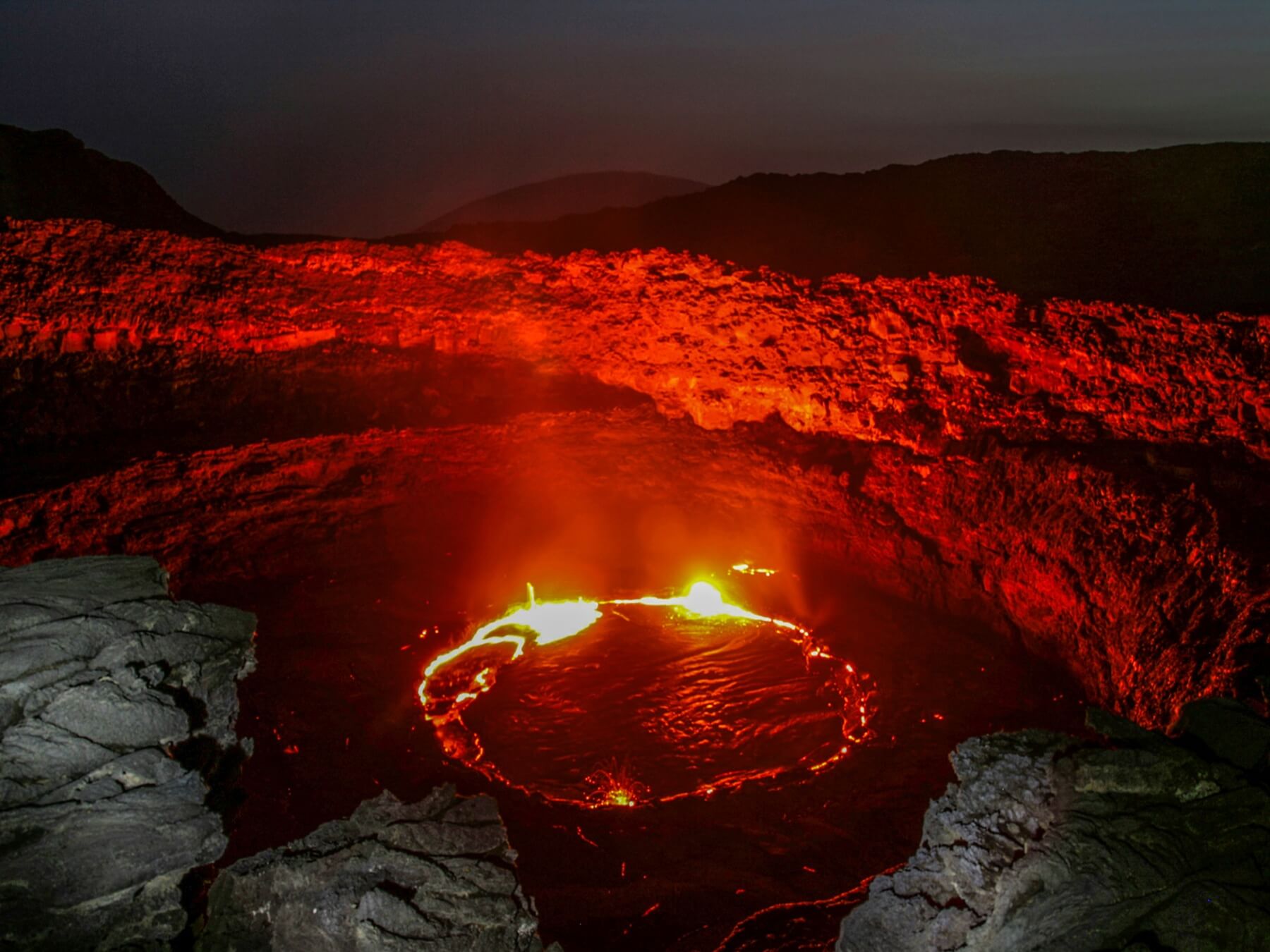
Erta Ale is an active volcano, so the shape of the crater and the visible activity change. The approach is made only to the permitted point and only when conditions are safe. Open lava, any particular view of the crater and access to individual geothermal features are not guaranteed.
Special requirements apply to entry and to internal movement, so the trip is confirmed only after security, permits and air connections have been checked.
Itinerary of the Ethiopia tour
Day 1. Addis Ababa to Arba Minch. The Dorze.
The journey through tribal Ethiopia begins with a morning flight from Addis Ababa to the bright and picturesque town of Arba Minch. On arrival and after checking in at the hotel, the group sets out at once to meet the Dorze, who live in the mountains above Lake Chamo in unusual dwellings of bamboo stalks and palm leaves that resemble huge upturned baskets. The shape of the houses also recalls an elephant’s head, with a thickened trunk-like entrance and side sections that look like ears. Such huts can stand for up to 80 years. But the Dorze are known less for the shape of their huts than for their remarkable weaving. You will see how, using traditional looms and techniques passed down through the generations, the Dorze skilfully create colourful cloth with patterns and zigzags. If you wish, you can try the local food: banana flatbreads, kitfo, chicken in hot spices, and the drink katai, made from the leaves of the khat plant. Night at a hotel in Arba Minch.
Day 2. Arba Minch to Turmi. The Konso. The Hamer.
After breakfast in Arba Minch the group heads for Turmi, a small town known for its colourful markets and handmade goods such as beaded jewellery, leatherwork and souvenirs. On the way to Turmi there is a stop at a Konso village to see the stone terraces that many experts regard as a feat of engineering, and the cultural heritage of the Konso, the most numerous people in Ethiopia. The territory of the Konso villages is inscribed on the UNESCO World Heritage List precisely because of those stone terraces. The village is built as a spiral of stone houses whose coils climb to the top of a hill. You will also see the wooden human figures known as waka, raised in honour of dead chiefs and heroes of the community. After time in this place and photographs with its welcoming people, the group continues to Turmi and spends the rest of the day with the culture and traditions of the Hamer.
The Hamer live in the Omo river valley in East Africa. Hamer women are known for their distinctive appearance. They wear their hair in many small braids coloured with ochre and decorate their heads with woven bands, and they wear leather skirts trimmed with cowrie shells and copper bracelets, sometimes 15 or more on one arm. The most unusual mark of beauty and strength among the Hamer, however, is scarring. Men and women decorate their bodies by burning patterns into the skin and then filling them with ash. Women also receive scars during an initiation rite, when a boy shows that he is ready to become a man: young men strike the backs of unmarried girls and grown women with water-soaked rods. Scars on the back are a mark of a woman’s strength, and the more there are, the more attractive she is held to be within the community. The second stage of a boy’s coming of age is a run across the backs of a row of bulls, which stands for crossing obstacles and overcoming difficulty. Full of impressions, the group returns to Turmi in the evening. Night at a lodge in Turmi.
Day 3. Turmi to Omorate. The Karo. The Dassanech.
Today the route runs to the lands of one of the communities of southern Ethiopia, the Karo, who live along the bank of the Omo river. Their way of life and their appearance leave no one indifferent: the Karo use white clay, chalk, ochre and charcoal to paint their bodies and hair with patterns that range from simple handprints and lines to imitations of animal markings and bird plumage. Intricate braided hairstyles framing the forehead are decorated with pieces of bark and ostrich feathers, which mark a victory over an enemy or a wild animal. Scars are valued among the Karo as highly as among the Hamer: a sign of courage in men and of beauty in women. One of the best known Karo rites involves sacrifice, when young men kill a bull in order to become men and defend their people. The animal’s blood is used to paint bodies and its meat feeds the whole community. These ceremonial contests allow men to show courage and to attract a woman. After this meeting the group returns to Turmi for lunch and then drives almost to the Ethiopian border with Kenya, to the town of Omorate, home of the Dassanech. Local people greet the group and help it cross the Omo river by dugout canoe. Here you enter the genuine atmosphere of a village whose life has been unchanged for many generations. The Dassanech live in traditional communities where decisions are taken on the advice of elders elected for life. They practise transhumant herding and also make baskets, mats and clothing. Ornament matters greatly in Dassanech culture: women wear wide bracelets and necklaces and decorate their hair with feathers, woven bands and even bottle caps. It is the custom to shave the hair very high above the forehead and to leave only a small tuft at the front. The Dassanech have a striking ceremony, Dimi, marking the maturing of girls and their readiness for marriage. It is held in the dry season and lasts more than six weeks, during which a large number of domestic animals are sacrificed. The families of girls aged 10 to 12 dress in animal hides and give themselves to celebration and dancing, while the older village elders bless the young women, who put on leather skirts as a sign of their maturity. After this the group crosses the Omo again and returns to Turmi for the night. Night at a lodge in Turmi.
Day 4. Turmi to Jinka. The Arbore. The Ari.
Past remarkable termite mounds and trees dried by the African sun, the group moves towards the market town of Jinka, but first calls at another notable settlement, the herders of the Arbore. The Arbore live near the drying salt lake of Chew Bahir and are one of the few peoples in Ethiopia still holding to their traditional belief in gods connected with the stars and with nature. The women of this community draw the eye with the striking tone of their skin and their expressive features. The Arbore emphasise their appearance with brightly coloured clothing, intricate copper and iron earrings and vivid necklaces and bracelets that form complex patterns on the body. Unmarried girls shave their heads, which gives them a particular presence. To feel the life of the community fully, the group goes inside the striking round houses built from strong branches, clay and tree bark. The entrance is so low and narrow that a tall person has to squeeze through, and inside there is hot darkness. The Arbore were once considered powerful sorcerers: they were feared and people came to them for help. That is now passing into the past. After the Arbore the group continues to Jinka, where it meets the Ari, who occupy a large territory in the north of Mago National Park, partly in the hills. Arriving in the afternoon, you find yourself in a world without electricity: in remote parts of the country the Ari use kerosene lamps and firewood for light and cooking. The Ari are peaceful farmers and potters who grow sorghum, maize, teff, beans, coffee and the tree with edible leaves known as moringa. Entering the house of a welcoming family, you learn how injera is baked, the pancake of teff dough that is in effect Ethiopian bread. But the most striking Ari skill is pottery: the women skilfully make and sell every kind of clay vessel, from painted coffee pots and huge dishes to finely made jugs. The men work as blacksmiths and sometimes produce real masterpieces. The Ari are highly creative people, as you hear in their traditional songs and in the playing of the krar, the traditional Ethiopian lyre. After a full day the group settles in Jinka, looking ahead to the meeting with the warlike Mursi. Night at a hotel in Jinka.
Day 5. Jinka to Mago National Park. The Mursi. Flight to Addis Ababa.
The group leaves Jinka before full daylight, because the aim is to reach one of the Mursi communities through Mago National Park, and that is not easy. The park is wide green savannah without any trace of modern infrastructure: no mobile signal, no electricity and none of the other things we are used to. The Mursi, also known as the Mun, live in the southern region of the Omo river valley. Here you enter a distinctive world with a great many traditions and remarkable rites. The Mursi are easily recognised by their appearance: shaved heads decorated with animal horns and elaborate arrangements, ritual amulets, numerous patterned scars, and stretched lower lips holding clay plates of considerable size. The Mursi believe in spirits, which is the source of many of their customs, such as painting patterns on their faces and bodies with black and red clay. More striking still is their scarification, in its many variations: on men it records the number of enemies or predators killed, while on women it is simply ornament. Some scars remain from the inoculations that the Mursi make against sleeping sickness, since tsetse flies are abundant in this area. The signature of the Mursi is the large clay plate that women wear in the lower lip. The piercing is made for girls of 12 or 13, after which the opening is gradually stretched by changing the plate. Mursi men are hard and warlike; from childhood boys are raised as future fighters and taught to fight with sticks and to handle firearms. A young man who has come of age must win a ritual stick duel, because only the winner earns the right to marry that year. After the village, the group returns to Jinka and, after a substantial lunch, flies to Addis Ababa to begin the next chapter of the journey from the Ethiopian capital. Dinner is at Yod Abyssinia, the best restaurant of national Ethiopian cuisine, which serves excellent injera, shiro, gomen and other traditional dishes. National dance and live music complete the atmosphere. Night at a hotel in Addis Ababa.
Day 6. Addis Ababa to Semera. Lake Assale.
The natural half of Ethiopia begins with a morning flight to Semera, the regional capital of Afar, where experienced drivers and comfortable air-conditioned four-wheel-drive vehicles are already waiting, together with a team of local guides and professional cooks, a road leader from the tourism authorities, a police escort and all the necessary equipment. From there the route runs straight along the ancient caravan road to the ghost town of Dallol in the Afar basin, an abandoned settlement with the highest average annual temperature in the world, 35 degrees Celsius. It is uninhabited today, but only 50 years ago the people who lived in Dallol worked its ore deposits. By evening the group reaches the huge salt lake of Assale, also called Karum. The lake lies in the northern part of the Danakil desert, 115 metres below sea level, and the concentration of salt in it is higher than in the Dead Sea. Depending on the weather, the lake can look like an endless white sheet or can be covered by a thin film of water that creates the illusion of a mirror. The group watches an extraordinary sunset, when the sun seems to hold above the horizon and its light is reflected in a pink glow from the salt crystals and the surface of the water. After dinner the group settles in the open air at the nomadic settlement of Hamed Ela. Night in camp.
Day 7. The Danakil Depression. Dallol. Erta Ale.
Before dawn the group sets out for the genuinely unearthly landscape of the Danakil Depression to look over the Dallol geothermal field, a place where a palette of vivid colour comes alive. Here you walk along the crater of the lowest land volcano in the world, 48 metres below sea level, where hyperacidic pools with a pH close to zero are unfit even for micro-organisms. Chemical reactions take place directly at your feet, striking in their range of colour. The particular landscape recalls the surface of Io, a moon of Jupiter, which gives the Danakil Depression its special hold. After the cosmic landscapes the group drives to a remarkable mountain cave formed of salt and mud directly beneath the crater of Dallol, and it is like entering another dimension. Lunch is a picnic in a neighbouring cave. After the break the group returns to the wide salt flats of Dallol, where coarse crystalline salt crumbles underfoot, and swims in the cool water of Lake Karum, a perfect contrast to the burning sun. The group calls on the salt miners who, in harsh conditions, cut out slabs of salt by a method refined over centuries of the trade. After a return to Hamed Ela to rest, the route continues in the afternoon to the great feature of the region, the active volcano Erta Ale, the most active in Ethiopia. Erta Ale is an active shield volcano whose relief and visible activity change constantly. With the permission of the local authorities and in safe conditions the team approaches the permitted observation point. Open lava and any particular view of the crater are not guaranteed. At around 20:00 the group returns to camp and settles for the night in the open air. Night in camp.
Day 8. The Danakil Depression. Lake Afdera.
Waking with the first light of the African sun and after a good breakfast from the team’s cook, the group sets out for the town of Afdera, the heart of the production and distribution of Ethiopia’s white gold, salt. As the name of the salt capital suggests, it stands on the shore of the salt lake of Afdera deep in the Danakil basin, 100 metres below sea level, under a merciless sun. After lunch in the town the route continues to the lake itself. The perceived temperatures here are the highest anywhere in the Danakil Depression, yet even in these conditions the Afar people who have settled on its shores extract salt by evaporating water. Unlike Lake Assale, Afdera is deep, with a maximum depth of 80 metres. Because of its proximity to the active Nabro volcano its water has a low pH and contains sulphuric acid. The group walks the endless salt fields, which look like snow, watching the Afar at work, and then returns to Semera to rest in comfort after the journey. Night at a hotel in Semera.
Day 9. Semera to Addis Ababa.
With hearts still full and cameras full of striking images, the group flies from Semera to Addis Ababa. You leave behind this singular world of extraordinary landscapes and remarkable people, and take with you something of the spirit of Ethiopia.
What's included
The composition of services for this temporarily unavailable trip is preliminary and is confirmed before sales open.
- A Mountain Guide team leader accompanying the group
- The work of local guides, drivers and the field team on the published route
- Ground transfers during the trip in four-wheel-drive vehicles
- Accommodation in hotels, lodges and base camps according to the itinerary
- Field catering and group camp equipment during the Danakil section
- Permits and the compulsory local escort for the areas included in the route
What's not included
- International air tickets
- Domestic flights along the route, until they are expressly confirmed on the invoice
- Visa and transit permits
- Medical insurance and emergency evacuation cover
- Single occupancy
- Meals in cities and airports not stated in the confirmation
- Tips
- Personal expenses
- Costs arising from changed flights, requirements of the authorities, security or an individual withdrawal from the itinerary
- Any service not expressly listed in the inclusions
The Ethiopia tour for private groups
The trip can be run privately for a single participant, a family, a group of friends, photographers or a corporate team. Dates, pace, accommodation category and any permitted additions are discussed before booking. A private departure is possible only after a separate check of safety, internal flights, permits and ground logistics along the whole route. A private format does not override national park rules, visa requirements, ranger decisions or carrier restrictions. We confirm the final trip in writing once all the key services are secured.
Documents for the Ethiopia tour
Entry rules depend on your nationality, your country of residence and your transit airports. Before buying non-refundable tickets, check the current requirements of the consulates, immigration services and airlines yourself. The passport details on your tickets, visas and permits must match exactly.
- A passport valid for the whole trip and for the entry requirements in force
- International and domestic air tickets
- Medical insurance valid in every country on the route and covering the planned activities
- Emergency evacuation cover for remote areas, if this is not part of your main insurance policy
- An e-visa or other valid entry permit for Ethiopia
- Copies of your passport details for the internal flights and permits
- A yellow fever vaccination certificate, where one is required because of your country of departure or transit
- Digital and paper copies of your passport, insurance, tickets, visas and emergency contacts
Documents for a child, consent from legal guardians and the requirements for under-18s are checked separately. Keep originals and copies separately.
Weather and seasons on the Ethiopia tour
The heat in the Danakil Depression is usually most bearable in the cooler months, from November to February. Between March and June the temperature can become extreme. The rainy season can damage the roads of the Omo valley and change access to particular areas. The expedition runs only once safety, ground access, internal flights and permits have been confirmed. Dust, heat and abrupt changes to the route are not the exception here but part of the real logistics of a remote region.
Accommodation and meals on the Ethiopia tour
Hotels, lodges and simple guest houses are used in the towns and the Omo valley. The Danakil section uses basic camps, sleeping in the open or under simple shelter. Comfort here is markedly lower than in the towns. On the expedition section a field team does the cooking. Exactly which meals are provided in the towns, on the internal flights and in the Omo valley is set out in your booking confirmation.
Day-to-day conditions on the Ethiopia tour
The Danakil section runs far from any permanent infrastructure. Expect heat, dust, no shower, limited water, the most basic toilet, and a night on a camp bed or a mat. Every participant needs to be able to take that discomfort in their stride. Access to particular areas and the order of travel are set by the local authorities and the accompanying team. Signal is unreliable and plans can change without notice. You must keep your distance from the geothermal features and must not leave the group.
Страхование
НаверхEquipment and useful extras for the Ethiopia tour
Скачать PDFThe final list is confirmed once the season, transport and accommodation are settled. Check everything in advance, and carry medication in its original packaging together with a prescription where one is needed.
Documents and baggage
- Passport, tickets, insurance and permits
- A soft suitcase or holdall that meets the limits for internal flights
- Day pack of 20-30 litres
- Dry bags for documents, electronics and spare clothing
Clothing and footwear
- Broken-in trekking shoes or light boots
- Light, covering, long-sleeved clothing
- Quick-drying trousers and T-shirts
- waterproof shell jacket or a reliable rain jacket
- Fleece top
- Sun hat
- A lightweight sleeping bag or liner, if the host team confirms you need one
- Head torch with spare batteries
- Buff or dust mask
- Covering clothing for the sun and for cultural visits
- Electrolytes and any personal heat protection your doctor recommends
Useful extras
- Sunglasses
- SPF 50 sun cream and lip balm with SPF
- Insect repellent
- Reusable water bottle
- Power bank and charging cables
- Personal first-aid kit and any medication you take regularly
- Hand sanitiser and wet wipes
- Earplugs
- Camera and spare memory cards, if you want them