- Guides
- B2B
-
#19607 (no title)
-
#15972 (no title)
- Climb Elbrus Individually
- Climb Elbrus from the South, 9 Days
- Climb Elbrus from the South, 7 Days
- Climb Elbrus from the South with Oxygen
- Climb Elbrus from the North, 10 Days
- Two Summits of Elbrus, 9 Days
- Elbrus Traverse from South to North, 9 Days
- Elbrus Traverse from North to South, 10 Days
- Cross of Elbrus, South to North, 9 Days
- Cross of Elbrus, North to South, 10 Days
- Climb Kazbek and Elbrus — 10-Day Two-Summit Programme
- Climb Elbrus from the West, 11 Days
- Elbrus by Private Helicopter, 3 Days
- Elbrus Region Holiday and Trekking, 9 Days
- Elbrus Region Holiday, 7 Days
- Tinder Tour: Climbing Mount Elbrus, 9 Days
- Climb Elbrus from the South, 9 Days with Sergey Baranov
-
#15539 (no title)
- Climb Carstensz Pyramid, 8 Days with Helicopter Access
- Climb Mont Blanc, 4810 m — 8-Day Guided Ascent
- Climb the Matterhorn, 4478 m — 8-Day Guided Ascent
- Climb Mount Vinson, 15-Day Antarctic Expedition
- Climb Kosciuszko and Travel in Australia, 7 Days
- Climb Fisht, 2868 m — 3-Day Ascent by the 1B Route
- Climb Mount Wilhelm, 6 Days
-
#15546 (no title)
- Climb Kilimanjaro: the Marangu Route
- Climb Kilimanjaro: the Lemosho Route
- Climb Ararat, 5137 m — 7-Day Classic Programme
- Climb Kazbek from the South, 5033 m — 8 Days in Georgia
- Climb Kazbek and Elbrus — 10-Day Two-Summit Programme
- Climb the Volcanoes of Mexico — Orizaba and Iztaccíhuatl, 9 Days
- Climbing Alpamayo — 16-Day Technical Expedition
- Climbing Margaret Peak (Stanley), 5,109 m
- Climbing Mount Kenya: Point Lenana, 4,985 m
- Climb Dykh-Tau by the North Ridge, 13 Days
-
#15554 (no title)
- Aconcagua Climb — 17-Day Guided Expedition
- Island Peak Climb — 18-Day Expedition
- Climb Mera Peak, 6476 m — 16-Day Hinku Valley Programme
- Climb Ama Dablam, 6812 m — 24-Day Expedition with Island Peak
- Climb Island Peak and Mera Peak — 24-Day Two-Summit Expedition
- Aconcagua and Ojos del Salado — 25-Day Combined Expedition
- Ojos del Salado Climb — 15-Day Expedition
- Climb Chimborazo and Cotopaxi — 14-Day Ecuador Programme
- Climb Huascarán — 8-Day Technical Ascent
- Climb Razdelnaya Peak, 6148 m — 15-Day Pamir Expedition
- Climb Denali by the West Buttress, 23 Days
- #15565 (no title)
- #15572 (no title)
-
#15972 (no title)
-
#19592 (no title)
-
See 8000m
- K2 Base Camp Trek via the Gondogoro La
- Everest Base Camp Trek — 14 Days
- Everest Base Camp via Gokyo Lakes — 15 Days
- Short Everest Base Camp Trek in 10 Days
- Annapurna Circuit and Tilicho Lake Trek
- Manaslu Circuit Trek
- Kanchenjunga Circuit Trek (XXL)
- Kanchenjunga North Base Camp Trek (Short)
- Kanchenjunga from India: the Goecha La Trek in Sikkim
- Makalu Base Camp Trek
- Annapurna Base Camp Trek
- South America
- Asia
- Africa
-
Russia
- Elbrus Region Holiday and Trekking, 9 Days
- Elbrus Region Holiday, 7 Days
- Oshten + Kardyvach — 9-Day Western Caucasus Trek
- Lake Kardyvach — 5-Day Base-Camp Trek
- Route 30: Through the Mountains to the Sea, with Oshten — 4 Days
- Trekking in Arkhyz — 7 Days over the Ayulyu Pass
- Gvandra Trek — 7 Days to the Ullu-Kyol Lakes
- Trekking in Dombai — 7 Days with the Murudzhu Lakes
- Europe
-
See 8000m
-
Adventures
-
Africa
- جولة المغرب: قلب شمال أفريقيا
- تسلق توبقال وثقافة المغرب
- Eritrea: the Dahlak Archipelago and the Rashaida Nomads
- Rwanda: Mountain Gorillas and the Bisoke Volcano
- Ethiopia: Otherworldly Landscapes and the Peoples of the Omo Valley
- جولة أوغندا: كوينز بارك والغوريلا الجبلية
- Tanzania Safari: Serengeti, Ngorongoro and Tarangire
- جولة أوغندا: وحيد القرن الأبيض والغوريلا الجبلية
- Zimbabwe and South Africa: Victoria Falls, Cape Town and the Cape of Good Hope
- Namibia: Etosha National Park and the Himba
- Kenya Safari: the African Big Five
- جولة بوتسوانا: دلتا أوكافانغو وتشوبي بارك
- South America
- Asia
-
Africa
- Ski-touring
- VIP
- #19722 (no title)
- About
Climb Elbrus from the South, 9 Days with Sergey Baranov
- Height (m)
- 5642
- Duration
- 9 дней
- Difficulty
- Low
- Continent
- Europe
- Children
- From 12 years old
- Accommodation
- Without tents
1890 $
Почему такая цена?
Тур временно недоступен
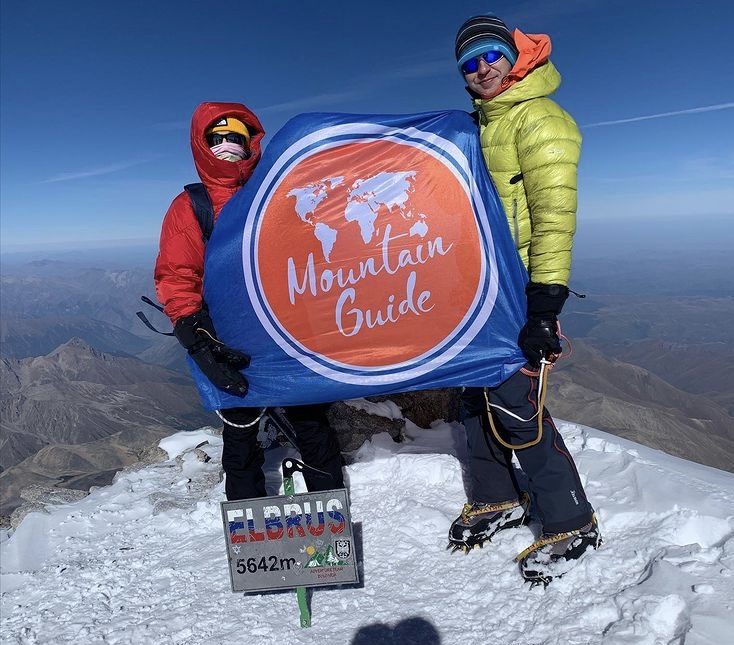
The author-led departure on Elbrus with Sergey Baranov follows the main Mountain Guide nine-day trip from the south: two acclimatisation walks in the valley, four nights in the high-mountain shelter, a hike to the Pastukhov Rocks, a rest day and the ascent of the West summit at 5642 m.
Sergey has worked on Elbrus since 2001 and has made 215 ascents of the summit. Fixed dates for the author-led departures are not published at present; you can register your interest in advance, and Sergey's participation is confirmed individually before booking.
Important
- Participants carry the food for the high-altitude section themselves. This is a standard feature of how ascents of Elbrus from the south are organised. The food travels up by cable car with the group and is moved onwards by snowcat; it only has to be carried by hand over short sections of no more than 20 m.
- Fixed dates are not published at present; Sergey Baranov's participation is confirmed individually before booking.
- The minimum age for the group trip is 14; a child takes part together with a parent.
- If part of the group reaches the summit, the group attempt counts as completed and additional attempts are paid separately.
About climbing Elbrus with Sergey Baranov
The route and the acclimatisation match the main nine-day trip for climbing Elbrus from the south. What sets the author-led format apart is not a different mountain and not a promise of particular weather, but a named leader for the group.
For the first three nights the group stays in the valley and makes hikes on Cheget, to the Devichyi Kosy waterfall and to the high-altitude observatory. Participants then move up to the shelter on the southern slope, hike to the Pastukhov Rocks, rest, and only then set out for the summit. We strongly recommend nine days to beginners: the additional acclimatisation noticeably changes how well prepared you are for summit day.
Sergey runs the introductory reviews, assesses the condition of the group and takes the tactical decisions together with the team of guides. On summit day the ratio is no more than three participants to one guide, and assistant guides join the group where necessary.
Before the trip we recommend studying how to prepare for Elbrus and checking the terms of your insurance policy in advance.
Elbrus itinerary with Sergey Baranov, 9 days
Day 1. Arrival in Mineralnye Vody and transfer to the Elbrus region.
The group meets at Mineralnye Vody airport. Two group transfers are provided on the first day of the trip: the first leaves at 12:00 for participants whose flights are scheduled to land no later than 11:00, and the second leaves at 15:00 for participants whose flights are scheduled to land no later than 14:00. Please allow time for baggage reclaim and for leaving the terminal when booking. If a flight is delayed and you miss the group transfer by more than 30 minutes, we will help you order a private transfer, which the participant pays for separately. Once everyone has gathered and boarded, the groups travel by comfortable coach to the hotel, which stands in a remarkable natural setting at the foot of Elbrus, at the start of the hundred-kilometre valley of the Baksan river. On arrival participants check in and gather for dinner together, to get to know each other and discuss the plans for the days ahead. Night at the hotel.
Day 2. After breakfast participants set out on their first acclimatisation hike, the climb on Cheget.
Cheget reaches a height of 3642 metres. The climb is considered relatively easy and accessible to people with basic physical preparation, but it nevertheless includes a couple of fairly steep sections. On the way it opens views of the surrounding mountains, glaciers and valleys, including what is perhaps the best-known view in these parts, of the Semyorka glacier. During the climb the body begins to get used to altitude, which makes the following days and the ascent itself feel much better. After the hike we descend on foot to the hotel for dinner with Caucasian dishes, and rest. Night at the hotel.
Day 3. After breakfast the group heads for the Devichyi Kosy waterfall at 2700 m, where the cascading water makes a fine sight.
A moving local legend is attached to this place. Long ago a girl lived here, known for her beauty and for braids so long they reached the ground. She loved a young man who was fated to travel to distant lands and never return. When news of his death reached her, she wept bitterly, and her tears mixed with the water of the river to form a waterfall resembling her long braids streaming in the wind. Since then the place has been a symbol of love, and it is said that whoever bathes in the waterfall will soon meet theirs. After a rest at the waterfall the group continues to the observatory at 3100 m, one of the highest in the world. Gaining that altitude adds to the acclimatisation and makes the following days easier. After the walk participants descend for a hot dinner, then pack the duffel bags and collect everything needed from the equipment hire, because tomorrow we move up to the shelter. Night at the hotel.
Day 4. Today the group rides the cable car up to the shelter, where the night will be spent.
After a light snack we make an acclimatisation hike to 4200 metres, which is needed for the body to adapt to greater altitude and improves sleep at night. After the hike we return to the shelter for dinner, carefully prepared by our cook, and rest. Night in the shelter.
Day 5. Today participants face a serious acclimatisation hike to the Pastukhov Rocks at 4700 metres.
This day is an important part of the preparation for the ascent of Elbrus, because it helps the body get used to high-mountain conditions and lets participants understand how they feel above 4000 m. After returning there is lunch and rest. Before bed we recommend a short walk nearby, to take in oxygen before sleeping. Night in the shelter.
Day 6. Rest day before the ascent.
Participants can restore their strength, check equipment and prepare physically and mentally. If the state of the slope is suitable, snow and ice sessions are held: we practise self-arrest with an ice axe and clipping in with lanyards. Night in the shelter.
Day 7. An early start and the beginning of the ascent of Elbrus, the highest point in Europe at 5642 metres.
Depending on the condition of the group and the weather, a snowcat may be used to ease the ascent, at the participants’ choice. Under company rules there are no more than three clients to one guide, which allows a high level of safety and individual attention for every participant. If half the group decides to use the snowcat and the other half prefers to walk, that is no problem — we do not economise on clients, and there are always enough assistant guides on summit day. After the ascent we descend to the shelter, where the snowcat can also be used. Night in the shelter.
Day 8. Reserve day, held for unforeseen circumstances such as the weather.
On this day the group returns to Terskol, to our comfortable hotel, to a hot shower and clean sheets. A celebratory dinner follows, with certificates handed out, impressions exchanged and perhaps even new ascents planned. Night at the hotel.
Day 9. After an early breakfast the transfer arrives at about 07:00 to take participants to Mineralnye Vody airport.
A stop in Pyatigorsk is possible on the way, where you can walk, visit the historic site of Mikhail Lermontov’s duel and try the well-known local ice cream. Luggage can be left in the airport left-luggage office so that you can spend the time before your flight freely.
What's included
- Guides. A leader throughout the trip and assistant guides on summit day, absolutely strictly at a ratio of one guide to three clients, so a group of four clients already has two guides. We place no limit on the number of group summit attempts. However, if part of the group reaches the summit and part does not, the ascent counts as completed and additional attempts are paid separately
- The services of a cook
- Hotel accommodation in twin or triple rooms, for the number of nights set out in the itinerary
- Accommodation in the shelter for the number of nights set out in the itinerary
- All transfers on the trip, including cable cars, from the airport or railway station and back
- Three meals a day throughout the trip, with dinner on the first day and breakfast on the last day
- Group equipment: ropes, ice screws, radios, satellite navigators and a first aid kit
What's not included
- The snowcat on summit day. Where it is used, the stated 2026-season charges are 14,000 RUB up, 8,000 RUB down or 22,000 RUB return
- National park permit, where applicable
- Single occupancy
- Personal equipment
- Any departure from the itinerary
- Any costs connected with change to the itinerary
A private Elbrus climb with Sergey Baranov
The private nine-day trip with Sergey Baranov can be discussed for a family, a group of friends, a club or a corporate group. Whether it can run depends on his schedule and is confirmed separately.
For a private group you can add acclimatisation days, arrange a separate itinerary for accompanying non-climbers and set your own ratio of guides to participants. Changes must not shorten safe acclimatisation.
If Sergey is not confirmed as leader for your dates, we will offer the main nine-day trip with another guide from Mountain Guide, but we will not sell it under his name.
Documents you need for the Elbrus climb with Sergey Baranov
To join this trip you will need:
- A valid passport
- Tickets to Mineralnye Vody and back
- Medical insurance covering mountaineering, an altitude of at least 5642 m, search and rescue and evacuation
- For foreign participants: the documents needed to enter Russia, including a visa where your nationality requires one
- Digital copies of your main documents, saved on your phone and in cloud storage
Where it is needed we give foreign participants visa support. The company arranges the registrations the route requires; any paid national park permit is paid separately, if one is introduced for the dates of the trip.
Weather and season for the signature Elbrus departures
The main season for regular trips from the south runs from late April to the end of September. The signature departures with Sergey Baranov run only on separately published dates, and should not be assumed to be available on every date of the main trip.
In May there is a lot of snow on the slope and conditions are close to wintry; July and August usually give the longest daylight; September is colder and the cable car may close for maintenance. Above 5000 m, frost, strong wind and limited visibility are possible in any month.
The group leader takes the final decision on setting out, based on the forecast, the actual weather, the state of the slope and participants’ readiness. The reserve day widens the tactical options, but it does not guarantee the summit.
Accommodation and meals on the signature Elbrus trip
In the valley participants stay in a hotel in twin or triple rooms, and on the mountain in four-person rooms in the high-altitude refuge, as set out in the itinerary. Single occupancy is possible at the hotel for an extra charge; it does not apply at the refuge.
The price includes three meals a day: dinner on the first day, meals throughout the trip and breakfast on the day you leave. A cook works for the group at the refuge; on summit day participants receive an agreed set of food and drink for the route in advance.
Tell us about dietary restrictions and allergies before the start. Whether a special diet is possible is confirmed in advance.
Day-to-day conditions on the signature climb
The hotel has a shower, electricity and the usual comforts. The high-altitude refuge is more comfortable than a tent, but it is still mountain accommodation: shared rooms, limited personal space, variable temperature, and electricity and water that depend on the conditions at the time.
Mobile coverage on the south side is usually better than on the self-sufficient routes, but constant internet is not guaranteed. Bring a power bank and spare cells for your head torch.
Anything you do not need can be left in the valley or at the refuge, as the guide advises. On summit day you carry only the agreed set of clothing, equipment, water and food.
Страхование
НаверхEquipment and useful extras for the Elbrus climb with Sergey Baranov
Скачать PDFRock and Rent has absolutely everything, all of it good quality, so you can fly in wearing shorts — especially if you reserve it all in advance. We chose every item against one factor only: how well it suits conditions on Elbrus, where we have been leading since 2001. And yes, we put a great deal of care into this list; between them the company’s guides have run several thousand ascents, and we do not think there is anything superfluous in it. Documents:
- Passport
- Air or rail tickets
- Medical insurance
- Voucher (for foreign nationals)
Personal equipment:
- Rucksack, 30-40 litres
- Duffel bag, 80-100 litres
- Sleeping bag with a comfort rating of 0 to +10 °C from June to September inclusive, and -10 to -20 °C from October to May inclusive
- Trekking poles
- Crampons
- Classic ice axe, with 2-3 metres of 5-6 mm accessory cord for clipping to your harness
- Climbing harness
- Helmet
- Three karabiners of them, ideally large ones, which are noticeably easier to handle in mittens
- Cow’s-tail lanyards
Clothing and footwear: Is downhill ski clothing suitable for Elbrus?
- Double or triple mountaineering boots, plastic or leather. Single boots are acceptable if used with an overboot (not to be confused with a gaiter)
- Trekking shoes or trekking boots. In May and early June you can still meet snow on the first acclimatisation days, and boots are then clearly better than trainers. From mid-June to the end of September, though, trainers will do instead — with some risk of turning an ankle — so make sure they are still waterproof
- Waterproof shell: jacket and trousers, with a membrane rated 10,000/10,000 or better
- Fleece top and bottoms
- Base layer, top and bottoms
- A thick, warm down jacket with a hood; one suitable for Elbrus normally weighs upwards of 700 grams
- Warm mittens
- Thick gloves (ski gloves)
- Thin gloves (fleece)
- Bandana (as well as sun protection in the valley, it can keep your throat or face warm in the cold)
- Warm hat
- Warm trekking socks for summit day
- Sun hat
- Trekking trousers and T-shirts (preferably long-sleeved)
- Trekking socks for the trekking days (ideally one pair per day)
Other items:
- LED head torch with at least 12 hours of battery life
- Sunglasses, category 3-4, which must shield the eyes completely from side light
- Ski goggles, lens category 1-2 (for bad weather, not for good)
- Vacuum flask, 1 litre, preferably without a push-button lid
- Windproof face mask for the lower face (a scarf will do at a pinch)
- Branded sun cream, SPF 30-50 (whatever you may read, in practice the difference between 30 and 50 is negligible)
- SPF 15 lip balm
- Personal first-aid kit
- Elastic bandage and/or a support brace
- Gaiters (not compulsory, but they can be needed, especially in May and June)
- Chemical hand warmers (not compulsory, but they can be very useful)