- Guides
- B2B
-
#19607 (no title)
-
#15972 (no title)
- Climb Elbrus Individually
- Climb Elbrus from the South, 9 Days
- Climb Elbrus from the South, 7 Days
- Climb Elbrus from the South with Oxygen
- Climb Elbrus from the North, 10 Days
- Two Summits of Elbrus, 9 Days
- Elbrus Traverse from South to North, 9 Days
- Elbrus Traverse from North to South, 10 Days
- Cross of Elbrus, South to North, 9 Days
- Cross of Elbrus, North to South, 10 Days
- Climb Kazbek and Elbrus — 10-Day Two-Summit Programme
- Climb Elbrus from the West, 11 Days
- Elbrus by Private Helicopter, 3 Days
- Elbrus Region Holiday and Trekking, 9 Days
- Elbrus Region Holiday, 7 Days
- Tinder Tour: Climbing Mount Elbrus, 9 Days
- Climb Elbrus from the South, 9 Days with Sergey Baranov
-
#15539 (no title)
- Climb Carstensz Pyramid, 8 Days with Helicopter Access
- Climb Mont Blanc, 4810 m — 8-Day Guided Ascent
- Climb the Matterhorn, 4478 m — 8-Day Guided Ascent
- Climb Mount Vinson, 15-Day Antarctic Expedition
- Climb Kosciuszko and Travel in Australia, 7 Days
- Climb Fisht, 2868 m — 3-Day Ascent by the 1B Route
- Climb Mount Wilhelm, 6 Days
-
#15546 (no title)
- Climb Kilimanjaro: the Marangu Route
- Climb Kilimanjaro: the Lemosho Route
- Climb Ararat, 5137 m — 7-Day Classic Programme
- Climb Kazbek from the South, 5033 m — 8 Days in Georgia
- Climb Kazbek and Elbrus — 10-Day Two-Summit Programme
- Climb the Volcanoes of Mexico — Orizaba and Iztaccíhuatl, 9 Days
- Climbing Alpamayo — 16-Day Technical Expedition
- Climbing Margaret Peak (Stanley), 5,109 m
- Climbing Mount Kenya: Point Lenana, 4,985 m
- Climb Dykh-Tau by the North Ridge, 13 Days
-
#15554 (no title)
- Aconcagua Climb — 17-Day Guided Expedition
- Island Peak Climb — 18-Day Expedition
- Climb Mera Peak, 6476 m — 16-Day Hinku Valley Programme
- Climb Ama Dablam, 6812 m — 24-Day Expedition with Island Peak
- Climb Island Peak and Mera Peak — 24-Day Two-Summit Expedition
- Aconcagua and Ojos del Salado — 25-Day Combined Expedition
- Ojos del Salado Climb — 15-Day Expedition
- Climb Chimborazo and Cotopaxi — 14-Day Ecuador Programme
- Climb Huascarán — 8-Day Technical Ascent
- Climb Razdelnaya Peak, 6148 m — 15-Day Pamir Expedition
- Climb Denali by the West Buttress, 23 Days
- #15565 (no title)
- #15572 (no title)
-
#15972 (no title)
-
#19592 (no title)
-
See 8000m
- K2 Base Camp Trek via the Gondogoro La
- Everest Base Camp Trek — 14 Days
- Everest Base Camp via Gokyo Lakes — 15 Days
- Short Everest Base Camp Trek in 10 Days
- Annapurna Circuit and Tilicho Lake Trek
- Manaslu Circuit Trek
- Kanchenjunga Circuit Trek (XXL)
- Kanchenjunga North Base Camp Trek (Short)
- Kanchenjunga from India: the Goecha La Trek in Sikkim
- Makalu Base Camp Trek
- Annapurna Base Camp Trek
- South America
- Asia
- Africa
-
Russia
- Elbrus Region Holiday and Trekking, 9 Days
- Elbrus Region Holiday, 7 Days
- Oshten + Kardyvach — 9-Day Western Caucasus Trek
- Lake Kardyvach — 5-Day Base-Camp Trek
- Route 30: Through the Mountains to the Sea, with Oshten — 4 Days
- Trekking in Arkhyz — 7 Days over the Ayulyu Pass
- Gvandra Trek — 7 Days to the Ullu-Kyol Lakes
- Trekking in Dombai — 7 Days with the Murudzhu Lakes
- Europe
-
See 8000m
-
Adventures
-
Africa
- جولة المغرب: قلب شمال أفريقيا
- تسلق توبقال وثقافة المغرب
- Eritrea: the Dahlak Archipelago and the Rashaida Nomads
- Rwanda: Mountain Gorillas and the Bisoke Volcano
- Ethiopia: Otherworldly Landscapes and the Peoples of the Omo Valley
- جولة أوغندا: كوينز بارك والغوريلا الجبلية
- Tanzania Safari: Serengeti, Ngorongoro and Tarangire
- جولة أوغندا: وحيد القرن الأبيض والغوريلا الجبلية
- Zimbabwe and South Africa: Victoria Falls, Cape Town and the Cape of Good Hope
- Namibia: Etosha National Park and the Himba
- Kenya Safari: the African Big Five
- جولة بوتسوانا: دلتا أوكافانغو وتشوبي بارك
- South America
- Asia
-
Africa
- Ski-touring
- VIP
- #19722 (no title)
- About
Patagonia: The Edge of the World — 15 Days
- Height (m)
- less than 2000
- Duration
- 15 дней
- Difficulty
- Low
- Continent
- South America
- Children
- From 6 years old
- Accommodation
- There are tents
3600 $
Почему такая цена?
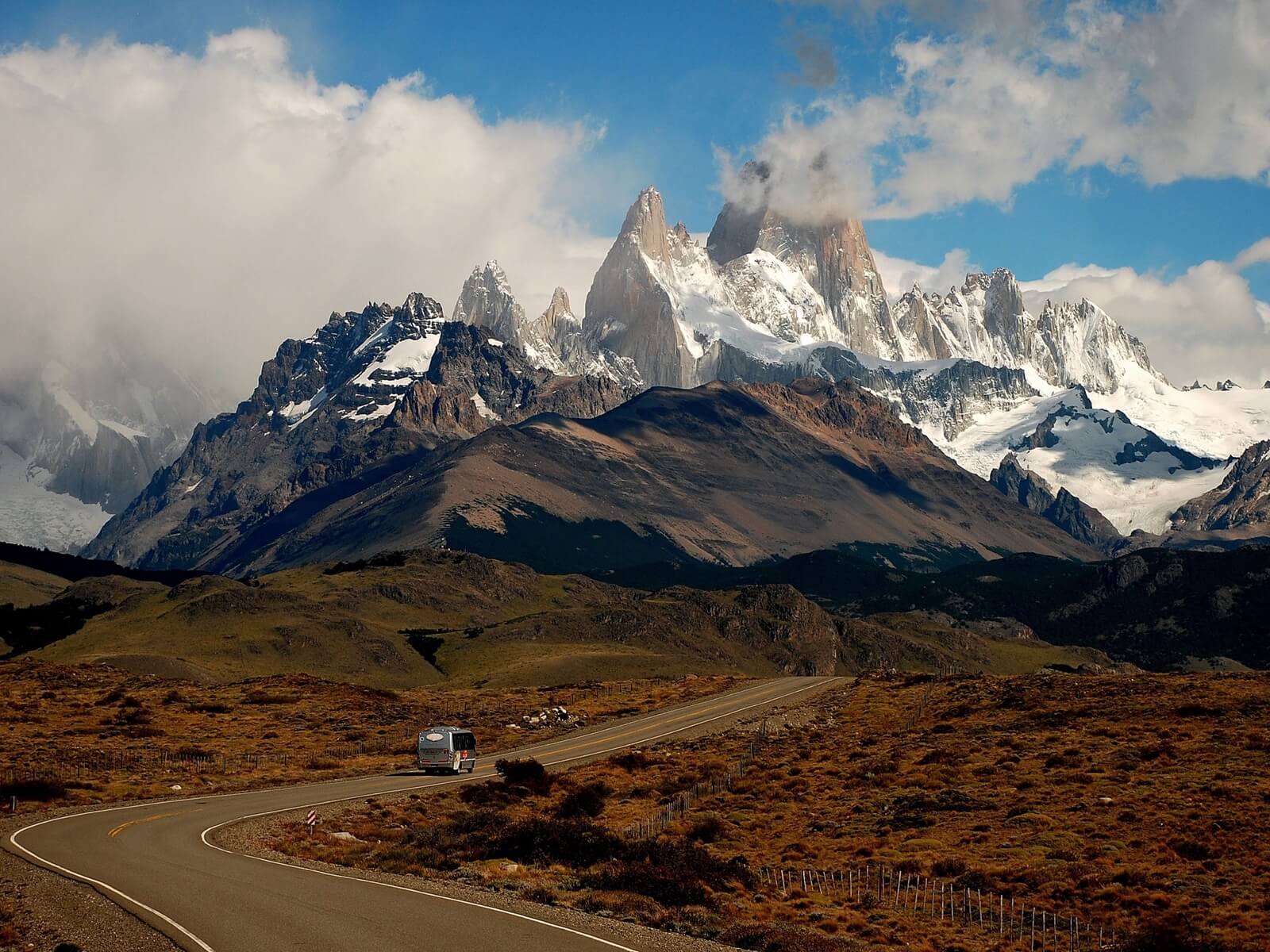
A fifteen-day Patagonia journey that walks the full O circuit in Torres del Paine, adds the classic Fitz Roy day treks from El Chaltén, and finishes at the Perito Moreno glacier and in Ushuaia.
- Torres del Paine, the best known national park in Latin America
- The W trek, the best known trek in Patagonia and in South America as a whole
- The O circuit, the complete trek around the Torres del Paine massif
- A cruise and a walk on Martillo island, home to large colonies of Magellanic and gentoo penguins
- The true end of the world: the city of Ushuaia on one of the islands of the Tierra del Fuego archipelago
- The Perito Moreno glacier, which holds the third largest reserve of fresh water on Earth
The company does not sell air tickets or arrange visas, and cannot accept responsibility for events beyond its control connected with flights and border crossings. We are glad to help you choose flights.
About the Patagonia journey
On this journey you have the chance to see some of the most striking places in Patagonia. We trek the well-known routes of Chile and Argentina and see Fitz Roy, Torres del Paine, Ushuaia and the Perito Moreno glacier. During the trip we sleep in comfortable hotels in the towns and in serviced campsites with showers and toilets.
Note that the W trek is part of the O circuit. We visit every viewpoint and walk every kilometre of both routes.
Patagonia itinerary, 15 days
Day 1. Arrival in Puerto Natales.
This small town in southern Chile is an ideal starting point for trekking. Geography has placed it close to the Torres del Paine national park, where you can see mountain scenery of rare beauty, waterfalls, blue lakes and wild animals. Dinner and a briefing. Night in a hotel.
Day 2. Puerto Natales – Torres del Paine – Serón camp.
12 km of trekking with 260 m of ascent. Today we visit the Las Torres towers. The famous towers gave the national park its name, Torres del Paine, “blue towers”, and have long been regarded as its main symbol. The three needle-shaped granite towers, from 2600 to 2850 m high, stand in the north-east of the Paine massif, with a walking trail leading to them. Trekking poles are useful on this route, because reaching the viewpoint means crossing a section of large boulder scree. Night in tents.
Day 3. Serón camp – Dickson camp.
16 km of trekking with 180 m of ascent. The morning starts with the traverse of the slopes of Cerro Paine, which is no easy task: persistent strong winds and a trail of continual ups and downs. We then reach Lake Paine, where we can rest a little and take in the scenery. Night in tents or huts at Dickson camp, which has one of the finest views in Patagonia.
Day 4. Dickson camp – Los Perros camp.
12 km of trekking with 380 m of ascent. We move into the most remote part of the national park: first along Lake Dickson, where you can see pieces of ice break off the glacier and fall into the lake, and then through ancient lenga forest, home to Magellanic woodpeckers. Night in tents at Los Perros camp.
Day 5. Los Perros camp – Gardner pass – Grey camp.
20 km of trekking with 1200 m of ascent. Today is the most demanding day, and we are rewarded with quite extraordinary views from the Gardner pass. After the pass comes a long descent over rocky ground to the El Paso area. On the final part of the route we cross a couple of suspension bridges and then eat and rest at Grey camp. Night in tents or huts.
Day 6. Grey camp – Paine Grande camp.
11 km of trekking with 800 m of ascent. A relaxed walk along Lake Grey and the Paine Grande massif. In good weather we can kayak on the lake along the glacier. We then continue to Lake Pehoé. Night in tents or huts.
Day 7. Paine Grande camp – Francés camp.
In the morning we walk about 9 km to the Italian camp with no gain in height, leave our packs there and walk about 7 km light to two viewpoints with postcard views of the rock summits of Cerro Aleta de Tiburón, the “shark’s fin”, the White Throne and others. We then collect our things and walk the remaining couple of kilometres to Francés camp. Night in tents or huts.
Day 8. Francés camp – Chileno camp.
In the morning we set out on a stage of about 16 km to Chileno camp, to shorten tomorrow morning’s climb. Our route runs alongside scenic lakes, but there is no time to lose: we need to reach camp early, because tomorrow we have to be at the Torres del Paine towers before dawn. Night in tents.
Day 9. Trek to the Torres del Paine viewpoint for sunrise.
A short trek of about 1 to 1.5 hours to the Torres del Paine viewpoint, in the hope that the weather is kind. Be ready to spend around an hour waiting for the colours of the sunrise, so bring plenty of clothing. This is also a place where you can meet the strongest wind of your life, so take particular care. We leave the park and transfer to Puerto Natales. Night in a hotel.
Day 10. Puerto Natales – El Chaltén.
Today we cross into Argentina, to the small mountain village of El Chaltén in Los Glaciares national park, close to the foot of the spires of Cerro Torre and Cerro Fitz Roy. It is also known as the trekking capital of Argentina. Night in a hotel.
Day 11. El Chaltén – Laguna Torre – El Chaltén.
18 km of trekking with 800 m of ascent. We walk to one of the most scenic places in Argentina, a lake framed by the Torre glaciers, with a view of the spires of Cerro Torre. In the evening we return to the hotel in El Chaltén. Night in a hotel.
Day 12. El Chaltén – Laguna de los Tres – El Chaltén.
One of the most iconic treks in Argentina. The name of the lagoon means “lake of the three”, for the three summits that rise above it: the highest mountain, Fitz Roy, together with Cerro Torre and Cerro Poincenot. In the evening we return to the hotel in El Chaltén. Night in a hotel.
Day 13. El Chaltén – El Calafate – Perito Moreno glacier – El Calafate – Ushuaia.
In the morning we travel to El Calafate, a small resort town in southern Patagonia whose main attraction is the huge Perito Moreno glacier. It is the most popular glacier in the area, and travellers come from all over the world to see it. Perito Moreno holds the third largest reserve of fresh water on Earth. Its tongue is 5 km wide, it covers 250 km² and it rises up to 60 m above the surface of the lake. Perito Moreno draws attention not only for its size but for its distinctive colouring: fresh ice cliffs on its surface play in blue and turquoise. We then fly to Ushuaia, the southernmost city on the planet, on the island of Tierra del Fuego. This harsh land was once home to the Yamana people. Charles Darwin sailed here and recorded his observations. The most dangerous repeat offenders from across Argentina were exiled here. Now travellers come from all over the world to see the end of the world, because beyond it there is only the ice of Antarctica. Local people even have “the end of the world” written in the place-of-birth field of their documents. And this place has plenty to surprise us with: extraordinary natural beauty, unusual museums, refined local cooking and a strikingly beautiful sunrise. Night in a hotel.
Day 14. Beagle Channel and Martillo island.
We take a motorboat along the Beagle Channel to Martillo island, to walk among the penguins and watch them close up, with all the delight of a child. Penguins are endlessly watchable: comical, curious birds that are not in the least afraid of people. On the way back we call in at the maritime museum to learn the history of the settlement of these lands. In the evening there is a celebration dinner to mark the end of a great journey, at which we try the local gaucho cooking: asado, meat roasted on a spit. Night in a hotel.
Day 15. Transfer to Ushuaia airport.
Flight home.
What's included
- An experienced trek leader with extensive climbing experience, for groups of 4 participants or more
- Hotel accommodation, except during the trek in Chile in Torres del Paine
- The tent pitch fee in Torres del Paine national park (you need your own tent, or you can hire one in Puerto Natales, or order one in the park strictly in advance)
- A shower on any day of the trek
- All transfers during the trip
- The boat trip to the Perito Moreno glacier
- The flight to Ushuaia
- The boat trip to see the penguins on Martillo island
- The necessary permits and entrance tickets to the national parks
- An emergency first-aid kit
What's not included
- International flights
- Medical insurance
- Visa and other entry documents where these are required by the participant’s nationality
- Tent hire in Torres del Paine national park for the whole trek, with sleeping bag and mat; tents and sleeping bags are already set up in the camps, so you only need to bring a sleeping bag liner of around 100 g
- Accommodation in the park huts instead of your own tent
- Meals in Torres del Paine national park; all the camps have cooking areas, but you should bring your own stove and gas, and a full-board package of breakfast, packed lunch and dinner for all the trekking days is available
- Kayaking on Lake Grey
- Lunches and dinners in the towns
- Single occupancy
- Personal equipment
- Tips for the team
- Any departure from the itinerary
Private groups
The Patagonia trip can be arranged for a private group, quoted separately. Before payment we fix the dates and the confirmed Torres del Paine camps, whether you walk the O or the W circuit, tents or huts, meals, transfers, the domestic flight, the excursions and the staff accompanying the group. Shortening the circuit, upgrading the accommodation or changing the Argentinian section creates a new route. Availability in the park and transport are checked before confirmation, so a private format does not mean camps can be freely changed once the trip is under way.
Documents you need
- A valid passport
- Visas and transit documents, where these are required for your nationality
- Medical insurance covering multi-day trekking, search and rescue and evacuation
- The documents needed to cross the border between Chile and Argentina
- Tickets and confirmations for the domestic flights on the itinerary
- Digital copies of your documents, stored offline
The rules on entry, on access to Torres del Paine and Los Glaciares, and on booking camps and boat trips are checked before the trip, against your nationality and your dates.
Weather and seasons
The Patagonian route runs in the warmer part of the southern year, when the multi-day trails and the camps are normally open. Even in the main season you can meet strong wind, rain, sleet, a sharp drop in temperature and the closure of individual sections. The weather can differ between Torres del Paine, El Chaltén, El Calafate and Ushuaia. Clear views from the viewpoints are not guaranteed. Your guide will change the pace or the plan for the day according to the actual conditions, but camp and transport bookings limit how far the whole route can be rearranged.
Accommodation and meals
In Puerto Natales, El Chaltén, El Calafate and Ushuaia the trip uses hotels. On the Torres del Paine circuit a tent pitch is included; your own tent, a hired tent, a pitched package and hut accommodation are different options and are confirmed in advance. Meals at the Torres del Paine camps are not part of the basic package; you either cater for yourself or order a separate full-board package. Lunches and dinners in the towns are paid separately. Whether you can cook, and whether lunch and dinner are available, depends on the camp service you choose. Dietary restrictions are to be reported before booking.
Facilities on the route
The Torres del Paine camps have organised places to sleep; under the published itinerary a shower is available on the trekking days. Queues, hot-water hours, electricity, charging, mobile signal and internet are not guaranteed and vary from camp to camp. You organise your own kit and carry either a day pack or a full trekking pack, depending on the service you have chosen. The wind calls for everything to be packed securely and for care when handling the tent. Bring dry bags, a head torch, a power bank and a dry set of clothes to sleep in.
Страхование
НаверхEquipment and useful extras for trekking in Patagonia
Скачать PDFDocuments:
- Passport
- Air tickets
- Medical insurance (there are no helicopters in Patagonia, so there is no need to worry about helicopter cover)
Personal equipment:
- A 30-50 litre rucksack
- A sleeping bag with a comfort rating of -10 °C. Or a sleeping bag liner, if you are hiring one.
- Sleeping mat
- Trekking poles, which must have baskets
- A tent (in Torres del Paine no more than two people may share a tent)
Clothing and footwear:
- Trekking boots, thoroughly treated with a waterproofing product beforehand
- Trainers (for the towns)
- Waterproof membrane shell: jacket and trousers
- Fleece top and bottoms
- Base layer, top and bottoms
- The lightest possible down jacket with a hood (in November and March a mid-weight one will do)
- Thick gloves
- Thin gloves
- Bandana or buff (as well as sun protection in the valley, it can keep your throat or face warm in the cold)
- Warm hat
- Warm trekking socks
Other items:
- LED head torch with at least 12 hours of battery life
- A power bank (not especially necessary if you have bought the hut accommodation package)
- Sunglasses
- Rain jacket
- Rain cover for your rucksack
- A flask, 1 litre (strongly recommended, for hot water)
- Gaiters
- SPF 50 sun cream
- SPF 10-15 lip balm
- Personal first-aid kit
- Elastic bandage and/or a support brace
- Toothpaste, toothbrush, soap, shampoo and flip-flops
- Towel
- Toilet paper