- Guides
- B2B
-
#19607 (no title)
-
#15972 (no title)
- Climb Elbrus Individually
- Climb Elbrus from the South, 9 Days
- Climb Elbrus from the South, 7 Days
- Climb Elbrus from the South with Oxygen
- Climb Elbrus from the North, 10 Days
- Two Summits of Elbrus, 9 Days
- Elbrus Traverse from South to North, 9 Days
- Elbrus Traverse from North to South, 10 Days
- Cross of Elbrus, South to North, 9 Days
- Cross of Elbrus, North to South, 10 Days
- Climb Kazbek and Elbrus — 10-Day Two-Summit Programme
- Climb Elbrus from the West, 11 Days
- Elbrus by Private Helicopter, 3 Days
- Elbrus Region Holiday and Trekking, 9 Days
- Elbrus Region Holiday, 7 Days
- Tinder Tour: Climbing Mount Elbrus, 9 Days
- Climb Elbrus from the South, 9 Days with Sergey Baranov
-
#15539 (no title)
- Climb Carstensz Pyramid, 8 Days with Helicopter Access
- Climb Mont Blanc, 4810 m — 8-Day Guided Ascent
- Climb the Matterhorn, 4478 m — 8-Day Guided Ascent
- Climb Mount Vinson, 15-Day Antarctic Expedition
- Climb Kosciuszko and Travel in Australia, 7 Days
- Climb Fisht, 2868 m — 3-Day Ascent by the 1B Route
- Climb Mount Wilhelm, 6 Days
-
#15546 (no title)
- Climb Kilimanjaro: the Marangu Route
- Climb Kilimanjaro: the Lemosho Route
- Climb Ararat, 5137 m — 7-Day Classic Programme
- Climb Kazbek from the South, 5033 m — 8 Days in Georgia
- Climb Kazbek and Elbrus — 10-Day Two-Summit Programme
- Climb the Volcanoes of Mexico — Orizaba and Iztaccíhuatl, 9 Days
- Climbing Alpamayo — 16-Day Technical Expedition
- Climbing Margaret Peak (Stanley), 5,109 m
- Climbing Mount Kenya: Point Lenana, 4,985 m
- Climb Dykh-Tau by the North Ridge, 13 Days
-
#15554 (no title)
- Aconcagua Climb — 17-Day Guided Expedition
- Island Peak Climb — 18-Day Expedition
- Climb Mera Peak, 6476 m — 16-Day Hinku Valley Programme
- Climb Ama Dablam, 6812 m — 24-Day Expedition with Island Peak
- Climb Island Peak and Mera Peak — 24-Day Two-Summit Expedition
- Aconcagua and Ojos del Salado — 25-Day Combined Expedition
- Ojos del Salado Climb — 15-Day Expedition
- Climb Chimborazo and Cotopaxi — 14-Day Ecuador Programme
- Climb Huascarán — 8-Day Technical Ascent
- Climb Razdelnaya Peak, 6148 m — 15-Day Pamir Expedition
- Climb Denali by the West Buttress, 23 Days
- #15565 (no title)
- #15572 (no title)
-
#15972 (no title)
-
#19592 (no title)
-
See 8000m
- K2 Base Camp Trek via the Gondogoro La
- Everest Base Camp Trek — 14 Days
- Everest Base Camp via Gokyo Lakes — 15 Days
- Short Everest Base Camp Trek in 10 Days
- Annapurna Circuit and Tilicho Lake Trek
- Manaslu Circuit Trek
- Kanchenjunga Circuit Trek (XXL)
- Kanchenjunga North Base Camp Trek (Short)
- Kanchenjunga from India: the Goecha La Trek in Sikkim
- Makalu Base Camp Trek
- Annapurna Base Camp Trek
- South America
- Asia
- Africa
-
Russia
- Elbrus Region Holiday and Trekking, 9 Days
- Elbrus Region Holiday, 7 Days
- Oshten + Kardyvach — 9-Day Western Caucasus Trek
- Lake Kardyvach — 5-Day Base-Camp Trek
- Route 30: Through the Mountains to the Sea, with Oshten — 4 Days
- Trekking in Arkhyz — 7 Days over the Ayulyu Pass
- Gvandra Trek — 7 Days to the Ullu-Kyol Lakes
- Trekking in Dombai — 7 Days with the Murudzhu Lakes
- Europe
-
See 8000m
-
Adventures
-
Africa
- جولة المغرب: قلب شمال أفريقيا
- تسلق توبقال وثقافة المغرب
- Eritrea: the Dahlak Archipelago and the Rashaida Nomads
- Rwanda: Mountain Gorillas and the Bisoke Volcano
- Ethiopia: Otherworldly Landscapes and the Peoples of the Omo Valley
- جولة أوغندا: كوينز بارك والغوريلا الجبلية
- Tanzania Safari: Serengeti, Ngorongoro and Tarangire
- جولة أوغندا: وحيد القرن الأبيض والغوريلا الجبلية
- Zimbabwe and South Africa: Victoria Falls, Cape Town and the Cape of Good Hope
- Namibia: Etosha National Park and the Himba
- Kenya Safari: the African Big Five
- جولة بوتسوانا: دلتا أوكافانغو وتشوبي بارك
- South America
- Asia
-
Africa
- Ski-touring
- VIP
- #19722 (no title)
- About
Namibia: Etosha National Park and the Himba
- Height (m)
- less than 2000
- Duration
- 12 дней
- Difficulty
- Low
- Continent
- Africa
- Children
- From 6 years old
- Accommodation
- Without tents
3540 $
Почему такая цена?
The Namibia tour is a road journey through a country of vast distances and almost improbable light. The route links Windhoek, the quiver tree forest, the desert towns of the south, the dunes of Sossusvlei, the Atlantic coast, Twyfelfontein, the northern districts and a safari.
In Namibia the road is part of the experience: stone plateaux, red sand, dry riverbeds and open savannah pass by the window in turn. You need to be ready for early starts, long transfers and sharp differences in temperature between day and night.
With a group of four participants or more a Mountain Guide team leader accompanies the trip. The dry season is convenient for game viewing, while in the southern-hemisphere summer heat and rain are more likely.
Our company does not buy or sell air tickets and does not arrange visas, and is therefore not responsible for disruption beyond its control involving flights or border crossings.
In some African countries small, worn or pre-2009 US dollar notes may be refused. We recommend bringing recent notes in good condition.
About the Namibia tour
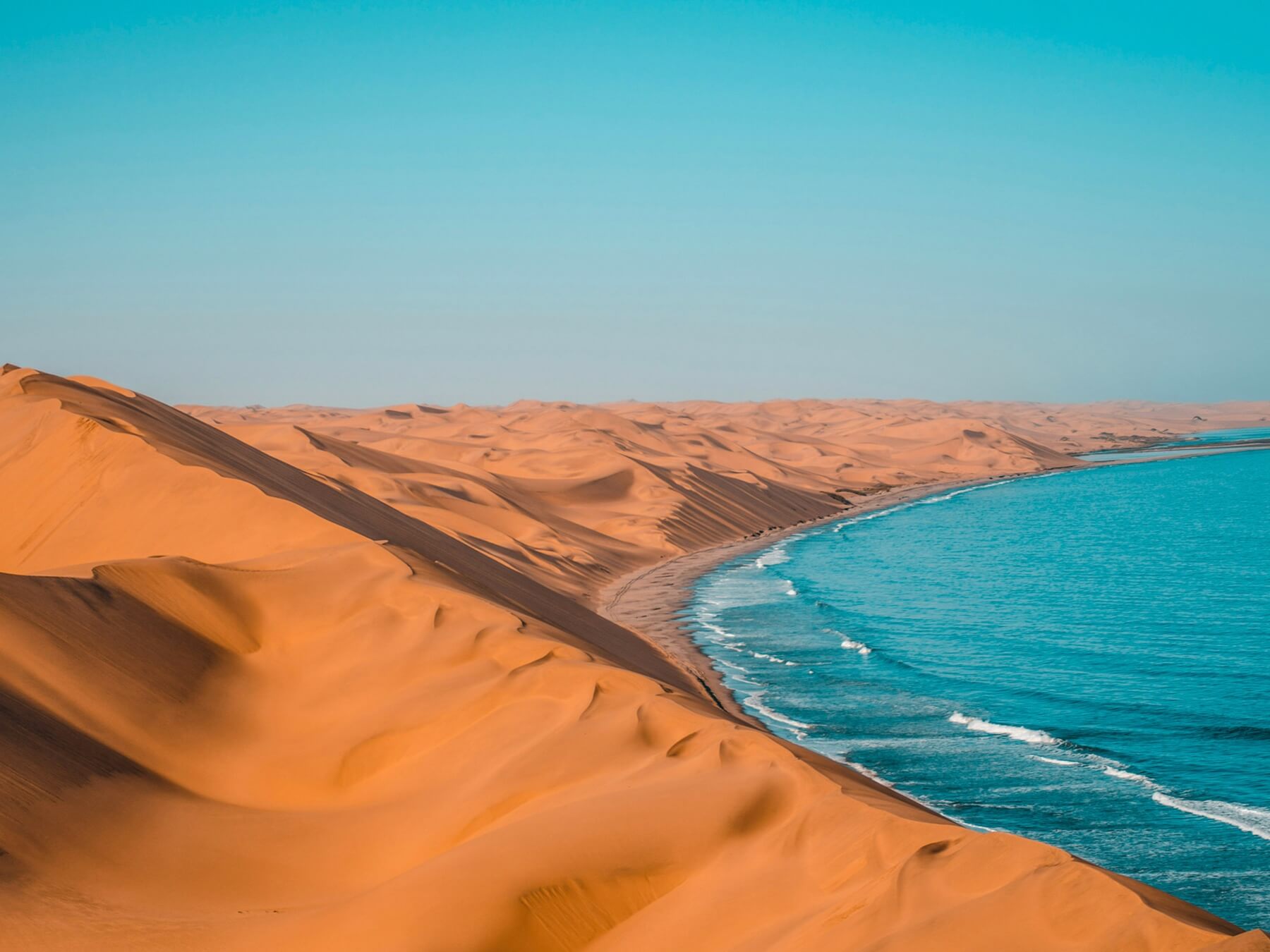
Namibia is made for a long road journey. The stone plains and quiver trees of the south lead to the desert coast, then the road enters the Namib, one of the oldest deserts on the planet, and comes out at the giant dunes of Sossusvlei and the white pan of Deadvlei.
After Swakopmund the route heads north across the open country of Damaraland. Twyfelfontein, the dry river valleys and the settlements of the Himba show how people and animals adapt to a territory where water determines almost everything.
The final part is given to game viewing. In Etosha life gathers at the waterholes, but specific encounters cannot be guaranteed. The route and the times of departure are adjusted according to the state of the roads, the weather and information from the rangers.
Itinerary of the Namibia tour
Day 1. Windhoek.
The journey begins in the heart of Namibia, its capital Windhoek. This comfortable city, set among hills and mountains, combines the modern with colonial architecture to create an atmosphere of its own. The group walks its green streets, visits the historic Christuskirche with its fine stained glass, and sees the Old Fort, where the spirit of the past can still be felt. The name of the city translates as the place where the winds blow, but it is anything but barren: a mild climate and well-kept parks make it a genuine oasis. In the evening there is dinner at one of the restaurants, where you can try game such as oryx or antelope.
Day 2. Windhoek to Keetmanshoop.
After breakfast the group heads for Keetmanshoop, a town surrounded by remarkable natural features. First comes the Giant’s Playground, where enormous basalt boulders look as though fairy-tale giants once played with them. The next stop is the quiver tree forest. These trees, more like sculptures than plants, rise from the ground like giant candles, and at sunset their strange silhouettes become more mysterious still. After a full day the group watches a night sky that in Namibia is startling in its clarity and brightness.
Day 3. To Luderitz.
Today the route runs to Luderitz, a charming little town on the Atlantic coast where the atmosphere of the German colonial period survives. On the way there is a stop at an artificial waterhole that is home to the wild desert horses, remarkable for their resilience in harsh conditions. The group visits the ghost town of Kolmanskop, once a prosperous diamond miners’ settlement and now a strange place being swallowed by the desert; sand fills the abandoned houses and creates an air of the surreal. On arrival in Luderitz there is an evening walk along the ocean and dinner at a restaurant looking out over the waves.
Day 4. To Sossusvlei.
After morning coffee the group sets off towards Sossusvlei, famous for its red dunes. The road runs through remarkable country: desert plains give way to mountains, and beyond them opens the endless sand desert. On arrival at Sossusvlei the group is met by great dunes shading from red into orange. After checking into a comfortable lodge you can enjoy the silence of the desert and listen to the wind touching the sand.
Day 5. The dunes of Sossusvlei, Deadvlei and Sesriem.
Early in the morning, when the first light is only beginning to colour the sky, the group sets out for the dunes of Sossusvlei. This is the magical hour when the landscape shows itself at its best. The group climbs the well-known Dune 45 and looks out over the endless sands. Next comes a walk through Deadvlei, an enigmatic place where ancient trees stand as motionless keepers of time. The day finishes with a visit to Sesriem Canyon, a narrow, deep gorge cut by water over millions of years.
Day 6. To Swakopmund.
After breakfast the group heads for the Atlantic coast and the pleasant resort town of Swakopmund. On the way you may see welwitschia, extraordinary plants that look as though they have come from the distant past. Swakopmund offers walks along the seafront, German architecture and a great many cafes and restaurants serving both African and European food.
Day 7. Walvis Bay.
Today the group travels to Walvis Bay for a sea excursion by catamaran. During the trip you can see dolphins, pelicans and fur seals, which swim up to the boats without hesitation. The excursion ends with a fine lunch with champagne and fresh oysters. After the return to Swakopmund there is time to rest or to take part in additional activities such as quad biking or kayaking.
Day 8. Towards Khorixas. Brandberg and Twyfelfontein.
In the morning the group sets off towards Khorixas. On the way there is a stop at Brandberg, the mountain that seems to burn in the light of the setting sun. Next the group visits Twyfelfontein with its ancient rock engravings, left by hunter-gatherers. You will also see the basalt formations known as the Organ Pipes and the petrified forest, millions of years old. Every corner of this region holds a history that invites endless study.
Day 9. A Himba village and Etosha.
After breakfast the group travels to a Himba village to learn about the way of life of this proud people. Their traditions and their way of living have survived almost intact, and this is a genuine opportunity to come into contact with an ancient culture. Next comes Etosha, one of the best known places in Namibia. From the first game drive you may see elephants, giraffes, lions and many other animals living here in their natural environment.
Day 10. A full day in Etosha.
This day is given to exploring Etosha. A morning game drive offers the chance to see animals coming out in search of water and food. During the day the group watches birds and takes in the landscape, and in the evening it goes out again to observe the park’s night-time life.
Day 11. The Erindi private reserve.
The group heads for the Erindi private reserve, known for the variety of its wildlife. Cheetahs, black rhinos, African wild dogs and many other rare species live here. During the day you can visit a San village and learn about their remarkable traditions. In the evening there is a farewell dinner under the stars, where the group shares its impressions of the journey.
Day 12. Departure.
After breakfast the group travels to Windhoek airport. Namibia leaves impressions that stay with you for many years.
What's included
- A Mountain Guide team leader accompanying the group
- Hotel accommodation in twin rooms, for the number of nights set out in the itinerary
- All the comfortable transfers set out in the itinerary, from the airport or station to the airport
- Breakfasts at the hotels
- All the permits and registrations required to enter the national parks
- A first-aid kit
- Entry tickets to the national parks of Namibia
What's not included
- International flights
- Visa
- Travel insurance
- Single occupancy
- Lunches and dinners in hotels and cities
- Any departure from the itinerary
- Any costs arising from change to the itinerary
- Tips
- Souvenirs
The Namibia tour for private groups
The trip can be run privately for a single participant, a family, a group of friends, photographers or a corporate team. Dates, pace, accommodation category and any permitted additions are discussed before booking.
You can change the standard of the lodges, add game-viewing days or shorten particular drives, as long as the road logistics stay realistic.
A private format does not override national park rules, visa requirements, ranger decisions or carrier restrictions. We confirm the final trip in writing once all the key services are secured.
Documents for the Namibia tour
Entry rules depend on your nationality, your country of residence and your transit airports. Before buying non-refundable tickets, check the current requirements of the consulates, immigration services and airlines yourself. The passport details on your tickets, visas and permits must match exactly.
- A passport valid for the whole trip and for the entry requirements in force
- International and domestic air tickets
- Medical insurance valid in every country on the route and covering the planned activities
- Emergency evacuation cover for remote areas, if this is not part of your main insurance policy
- An entry permit or visa, if one is required for your nationality
- A yellow fever vaccination certificate, where one is required because of your country of departure or transit
- Digital and paper copies of your passport, insurance, tickets, visas and emergency contacts
Documents for a child, consent from legal guardians and the requirements for under-18s are checked separately. Keep originals and copies separately.
Weather and seasons on the Namibia tour
The dry period, roughly May to October, usually brings cool nights, clear skies and good conditions for watching animals at the waterholes. The desert is warm by day, but early morning and night temperatures can fall well below what you might expect of Africa.
November to April is hotter, with a greater chance of thunderstorms. The desert and savannah turn greener, but the unsurfaced roads can change. Cold wind and fog are possible on the Atlantic coast all year round.
Accommodation and meals on the Namibia tour
The tour uses hotels and lodges in twin rooms. Namibia is a country of long distances, so properties are chosen first of all for where they sit on the route. The specific names are confirmed before departure.
Breakfasts are included. Lunches and dinners are paid separately unless your confirmation says otherwise. On some days the only place to eat is the lodge or a stop along the route.
Day-to-day conditions on the Namibia tour
The defining practical feature of Namibia is distance. Some drives take most of the day and run on unsurfaced roads. Always keep water, sun protection, something warm and your own medication in the vehicle.
The lodges usually have electricity and a shower, but internet outside the towns can be weak. Game drives start early, and the daily routine shifts with the weather and with the animals.
Страхование
НаверхEquipment and useful extras for the Namibia tour
Скачать PDFThe final list is confirmed once the season, transport and accommodation are settled. Check everything in advance, and carry medication in its original packaging together with a prescription where one is needed.
Documents and baggage
- Passport, tickets, insurance and permits
- A soft suitcase or holdall that meets the limits for internal flights
- Day pack of 20-30 litres
- Dry bags for documents, electronics and spare clothing
Clothing and footwear
- Broken-in trekking shoes or light boots
- Light, covering, long-sleeved clothing
- Quick-drying trousers and T-shirts
- waterproof shell jacket or a reliable rain jacket
- Fleece top
- Sun hat
- Binoculars for the safari
- A warm jacket and hat for the early starts
- Protection for your camera gear against sand and dust
- Swimming things
Useful extras
- Sunglasses
- SPF 50 sun cream and lip balm with SPF
- Insect repellent
- Reusable water bottle
- Power bank and charging cables
- Personal first-aid kit and any medication you take regularly
- Hand sanitiser and wet wipes
- Earplugs
- Camera and spare memory cards, if you want them