Routes from the south, from the north, traverses and both summits
A first Elbrus, a more self-sufficient expedition or both summits in one push – we will find the programme to match your experience, the time you have and how you feel about comfort.
- On Elbrus since 2001
- RTO 024541
- Guides with 8000 m experience
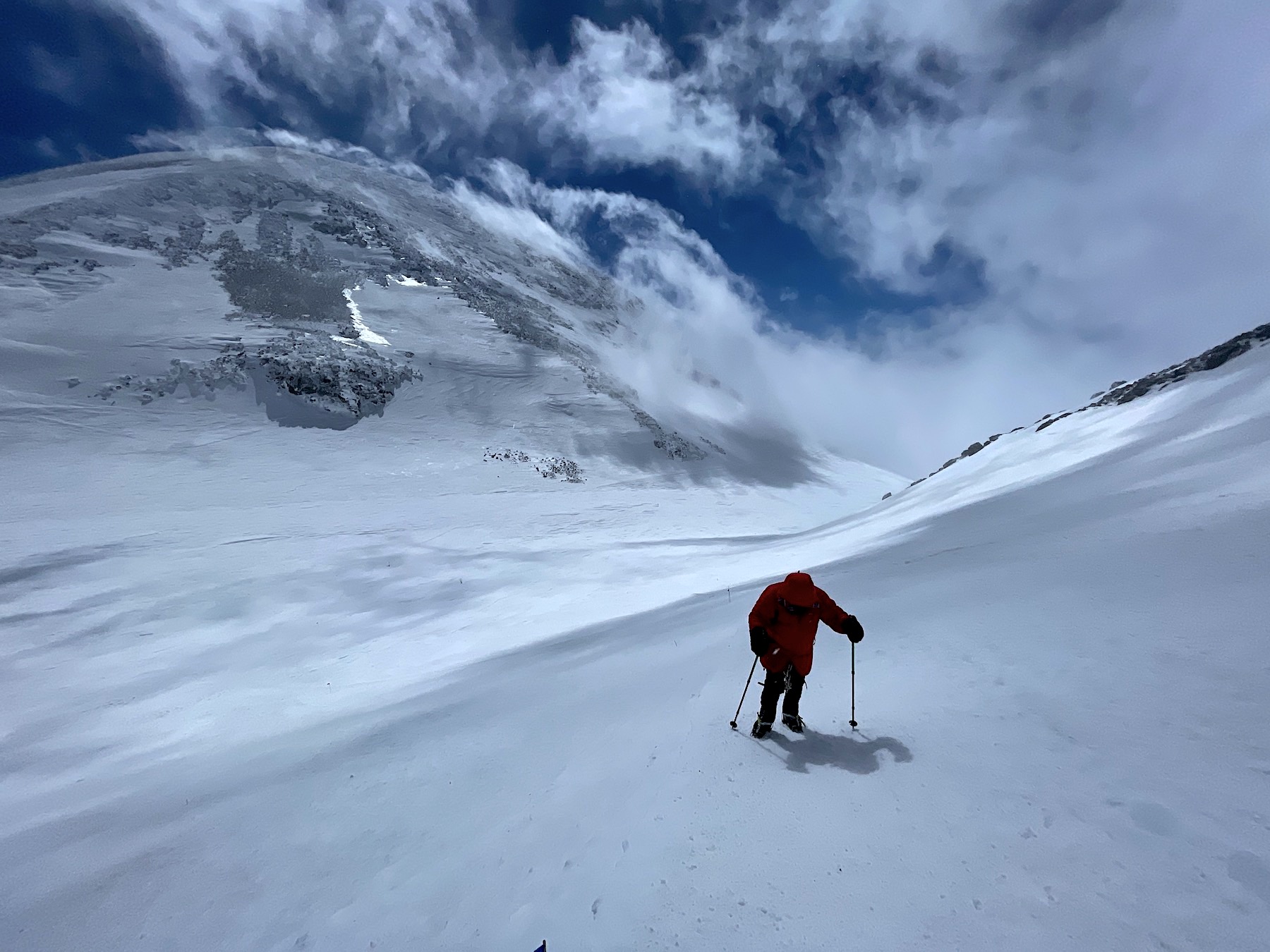
Be honest with yourself and understand why you are making this particular choice. And make that choice gladly.
Can a beginner climb Elbrus?
Yes: the classic route from the south is within reach of someone with no mountaineering experience, provided there are no medical reasons against it, the programme leaves enough time for acclimatisation, and their fitness matches sustained work at altitude. The absence of difficult climbing does not turn Elbrus into a stroll: the summit stands at 5642 m, the weather changes fast, and the thin air slows you down, impairs your co-ordination and affects your decision-making.
For a first Elbrus we recommend the nine-day programme from the south. It does not promise the summit – mountains take a dim view of promises made on the weather’s behalf – but it gives more time for gradual acclimatisation, for teaching and for recovery between the walks. If you are in doubt, start with the article “Elbrus for beginners” or put your question to a guide.
How to choose a programme quickly
- First time above 4000 m: south, 9 days.
- Mountain experience and a hard time limit: south, 7 days.
- You want less resort infrastructure and more self-sufficiency: north, 10 days.
- You have already done the classic Elbrus: both summits, the traverse or the “Cross”.
- You need your own dates, pace and team: a private ascent.
- You do not want the summit yet, but you do want to see Elbrus: trekking and a holiday in the Elbrus region, 9 days.
[mg_elbrus_quiz]
A comparison of the main Elbrus routes
There is no one “right” route on Elbrus. There is the route that suits your experience, the time you have and your goal. The side matters: the south gives you the most infrastructure, the north calls for more self-reliance, and the traverse and both-summits formats markedly increase the length and the effort of the main high-altitude day.
| Programme | Who it suits | Days | Summits and side | The main difference |
|---|---|---|---|---|
| South, 9 days | A first Elbrus | 9 | West summit, up and down from the south | More time for acclimatisation |
| South, 7 days | Prepared participants with limited time | 7 | West summit, up and down from the south | A tighter schedule |
| North | For those ready for self-sufficient mountain living | 10 | West summit, up and down from the north | No cable cars, simpler infrastructure |
| Traverse from south to north | Participants with good endurance | 9 | One summit, two slopes | The descent does not repeat the way up |
| Both summits | Prepared participants after the classic route or comparable experience | 9 | West and East, returning to the south | Both summits in one high-altitude push |
| The “Cross” from south to north | Strong and experienced participants | 9 | Both summits and two slopes | Two summits plus a traverse |
A traverse means climbing one side of the massif and descending the other. The “both summits” programme takes in the West and East summits but returns to the side it started from. The “Cross” joins both of those complications: two summits and a traverse. If those descriptions have started to blur into one long white strip, open the detailed comparison of Elbrus routes.
South or north?
The southern route
The south is the main choice for a first ascent. The cable car simplifies the logistics, there are more huts on the slope and more chances to change the plan, and on summit day a snowcat can be ordered separately. That infrastructure does not cancel out the altitude, the cold or the need to turn back in time, but it does mean a first encounter with Elbrus need not become an expedition with a heavy rucksack.
The northern route
The north is more self-sufficient: there is no cable car, the living conditions are simpler, the approaches are longer, and the logistics cannot be rearranged as quickly as on the south. With an extra acclimatisation day added, our programme takes 10 days. This is not “the same Elbrus without the queue” but a different form of journey, one that calls for steadier fitness and a readiness for simple mountain living.
Why nine days usually suit a beginner better than seven
- The body gets more time to adapt gradually to altitude.
- The effort is spread more evenly, and more recovery is left between the walks.
- The guide has time to see how a participant responds over more than one good day.
- There is more time to check boots, crampons, clothing and movement technique before the night start.
- A reserve day makes the programme more flexible, but it is not a guarantee of the summit.
The seven-day programme is neither bad nor “wrong”. It is simply tighter. It makes sense to choose it if you have previous altitude experience, good preparation or a hard time limit. The decision should not be taken on the principle of “I am sporty”, because good fitness and good acclimatisation are different things. This is examined in detail in the article on acclimatisation on Elbrus.
All the Elbrus climbing programmes
Compare the length, the route, the accommodation and the price. Prices and availability are taken directly from the programme cards, so there is no second hand-built shop window here that could go out of date separately from the catalogue.
Routes and formats of the ascent
Ski touring and downhill programmes
Trekking and holidays without the ascent
Open the full Elbrus programme catalogue
Why Mountain Guide
We do not disguise agency resale with the words “signature tour”. OOO “Gorny Gid” is entered in the Unified Federal Register of Tour Operators under number RTO 024541 in the current register: the company’s registration details and the Ministry of Economic Development order on the original entry in the register are available at these links.
- We have worked on Elbrus since 2001. We do not change that wording every year and we do not make the search engine work out our age.
- Our guides are shown on the site. A participant knows in advance which team they are travelling with, rather than learning the name of an unknown contractor on the day they meet.
- Independent equipment hire from Rock’n’Rent. Equipment can be booked separately before you arrive; the selection, the hire agreement, payment and all correspondence about the hire are handled directly with the hire shop.
- The accommodation is not hidden behind the words “hotel as per the programme”. We show the hotel and mountain huts, in which groups stay.
- There is a cook working on the mountain. Food and recovery are part of the programme, not a domestic detail for a participant to deal with after an acclimatisation walk.
- The guide ratio is written into every programme. On summit day on the classic group programmes it is no more than three participants to one guide; on certain technical routes the ratio may be closer.
- Reserve days really can be used. Until the group has made the ascent, a repeat group attempt within the programme costs nothing extra. If part of the group has reached the summit, additional attempts by the rest are paid for separately – that rule is stated in advance on the tour cards.
Safety without the sugar coating
The main risk on Elbrus is not a lack of courage. People usually have courage in abundance. Insufficient acclimatisation, unsuitable equipment, a poor weather window and an unwillingness to turn back in time are all more dangerous. We do not sell a “guaranteed summit”: the final decision to set out, to keep going or to turn round is taken by the guide, on the actual weather and the state of the route and the participants.
According to Mountain Guide’s internal figures, in different years between 93 and 97% of participants on our Elbrus programmes reached the summit. That range is not a guarantee for any particular person or any particular date. It reflects the result of the chosen programme, the acclimatisation, the team’s work, the weather and the participant’s own readiness. The breakdown by programme and the counting method appear separately, so that the percentage does not look like an advertising figure that turned up in clear weather.
Before choosing a programme, read the articles on preparing for Elbrus, the weather, equipment, insurance and on why a winter ascent of Elbrus is a very bad idea.
Choose your way into Elbrus
- I am a beginner: an honest guide to a first Elbrus.
- I have mountain experience: a comparison of all the routes.
- I want to come with my own group: a private programme.
- I am travelling with the family: a nine-day trek and holiday on the dates of the climbing programme.
- I want to give a climb as a present: Mountain Guide gift certificates.
- I do not understand how much money I will need: the full cost of climbing Elbrus.
Frequently asked questions
Do I need mountaineering experience?
For the classic route from the south – no. What you need is physical preparation, full acclimatisation, suitable equipment and the ability to act on the guide’s decisions. For the west, for the self-sufficient routes, for both summits and for the “Cross”, the requirements are higher.
The details of the route from the west are on the page “Climbing Elbrus from the west”.
How long should I prepare for?
It depends on your starting fitness. Someone who trains regularly may find 8-12 weeks of specific preparation enough; someone with a sedentary way of life would do better to allow six months or more. Preparation improves your ability to keep going for a long time, but it does not replace altitude acclimatisation.
When is the best time to climb?
The main season for most programmes is from June to September. Every month has its own character in terms of snow, temperature, wind and how busy the route is. Have a separate look at the comparison of seasons.
Can I hire all the equipment?
Almost the whole specialist set can be booked in advance at Rock and Rent. You still have to prepare your own personal basics and individual first-aid kit from the list for the programme you have chosen.
What happens in bad weather?
The guide changes the start time, uses the reserve day, shortens the route or turns the group round. The summit is not more important than a safe return. The exact rules on repeat attempts and additional costs are stated on the card of each programme.
Useful articles for choosing a programme
First decide the form of the route, the number of days you have, and the requirements for preparation and insurance. These articles will help you compare the options before booking.
- Elbrus with oxygen or without
- A private or a group ascent
- The traverse, the “Cross” or both summits
- The traverse from south to north or from north to south
- How to prepare for a ski tour
- Kazbek and Elbrus: an ascent or a ski tour
- Trekking in the Elbrus region or an ascent
- How reserve days work
- What to check in your insurance for Elbrus
- The helicopter flight to Elbrus
Cannot decide?
Message a guide on Telegram, telling us what experience you have, when you want to travel, how many days you have and what matters more – comfort, self-sufficiency, both summits, or a first safe experience of altitude. We will not sell one standard Elbrus to everybody.