- Guides
- B2B
-
#19607 (no title)
-
#15972 (no title)
- Climb Elbrus Individually
- Climb Elbrus from the South, 9 Days
- Climb Elbrus from the South, 7 Days
- Climb Elbrus from the South with Oxygen
- Climb Elbrus from the North, 10 Days
- Two Summits of Elbrus, 9 Days
- Elbrus Traverse from South to North, 9 Days
- Elbrus Traverse from North to South, 10 Days
- Cross of Elbrus, South to North, 9 Days
- Cross of Elbrus, North to South, 10 Days
- Climb Kazbek and Elbrus — 10-Day Two-Summit Programme
- Climb Elbrus from the West, 11 Days
- Elbrus by Private Helicopter, 3 Days
- Elbrus Region Holiday and Trekking, 9 Days
- Elbrus Region Holiday, 7 Days
- Tinder Tour: Climbing Mount Elbrus, 9 Days
- Climb Elbrus from the South, 9 Days with Sergey Baranov
-
#15539 (no title)
- Climb Carstensz Pyramid, 8 Days with Helicopter Access
- Climb Mont Blanc, 4810 m — 8-Day Guided Ascent
- Climb the Matterhorn, 4478 m — 8-Day Guided Ascent
- Climb Mount Vinson, 15-Day Antarctic Expedition
- Climb Kosciuszko and Travel in Australia, 7 Days
- Climb Fisht, 2868 m — 3-Day Ascent by the 1B Route
- Climb Mount Wilhelm, 6 Days
-
#15546 (no title)
- Climb Kilimanjaro: the Marangu Route
- Climb Kilimanjaro: the Lemosho Route
- Climb Ararat, 5137 m — 7-Day Classic Programme
- Climb Kazbek from the South, 5033 m — 8 Days in Georgia
- Climb Kazbek and Elbrus — 10-Day Two-Summit Programme
- Climb the Volcanoes of Mexico — Orizaba and Iztaccíhuatl, 9 Days
- Climbing Alpamayo — 16-Day Technical Expedition
- Climbing Margaret Peak (Stanley), 5,109 m
- Climbing Mount Kenya: Point Lenana, 4,985 m
- Climb Dykh-Tau by the North Ridge, 13 Days
-
#15554 (no title)
- Aconcagua Climb — 17-Day Guided Expedition
- Island Peak Climb — 18-Day Expedition
- Climb Mera Peak, 6476 m — 16-Day Hinku Valley Programme
- Climb Ama Dablam, 6812 m — 24-Day Expedition with Island Peak
- Climb Island Peak and Mera Peak — 24-Day Two-Summit Expedition
- Aconcagua and Ojos del Salado — 25-Day Combined Expedition
- Ojos del Salado Climb — 15-Day Expedition
- Climb Chimborazo and Cotopaxi — 14-Day Ecuador Programme
- Climb Huascarán — 8-Day Technical Ascent
- Climb Razdelnaya Peak, 6148 m — 15-Day Pamir Expedition
- Climb Denali by the West Buttress, 23 Days
- #15565 (no title)
- #15572 (no title)
-
#15972 (no title)
-
#19592 (no title)
-
See 8000m
- K2 Base Camp Trek via the Gondogoro La
- Everest Base Camp Trek — 14 Days
- Everest Base Camp via Gokyo Lakes — 15 Days
- Short Everest Base Camp Trek in 10 Days
- Annapurna Circuit and Tilicho Lake Trek
- Manaslu Circuit Trek
- Kanchenjunga Circuit Trek (XXL)
- Kanchenjunga North Base Camp Trek (Short)
- Kanchenjunga from India: the Goecha La Trek in Sikkim
- Makalu Base Camp Trek
- Annapurna Base Camp Trek
- South America
- Asia
- Africa
-
Russia
- Elbrus Region Holiday and Trekking, 9 Days
- Elbrus Region Holiday, 7 Days
- Oshten + Kardyvach — 9-Day Western Caucasus Trek
- Lake Kardyvach — 5-Day Base-Camp Trek
- Route 30: Through the Mountains to the Sea, with Oshten — 4 Days
- Trekking in Arkhyz — 7 Days over the Ayulyu Pass
- Gvandra Trek — 7 Days to the Ullu-Kyol Lakes
- Trekking in Dombai — 7 Days with the Murudzhu Lakes
- Europe
-
See 8000m
-
Adventures
-
Africa
- جولة المغرب: قلب شمال أفريقيا
- تسلق توبقال وثقافة المغرب
- Eritrea: the Dahlak Archipelago and the Rashaida Nomads
- Rwanda: Mountain Gorillas and the Bisoke Volcano
- Ethiopia: Otherworldly Landscapes and the Peoples of the Omo Valley
- جولة أوغندا: كوينز بارك والغوريلا الجبلية
- Tanzania Safari: Serengeti, Ngorongoro and Tarangire
- جولة أوغندا: وحيد القرن الأبيض والغوريلا الجبلية
- Zimbabwe and South Africa: Victoria Falls, Cape Town and the Cape of Good Hope
- Namibia: Etosha National Park and the Himba
- Kenya Safari: the African Big Five
- جولة بوتسوانا: دلتا أوكافانغو وتشوبي بارك
- South America
- Asia
-
Africa
- Ski-touring
- VIP
- #19722 (no title)
- About
Oshten + Kardyvach — 9-Day Western Caucasus Trek
- Height (m)
- 2804
- Duration
- 9 дней
- Difficulty
- Low
- Continent
- Europe
- Children
- From 8 years old
- Accommodation
- There are tents
720 $
Почему такая цена?
Тур временно недоступен
The Oshten — Kardyvach trek is a nine-day trip for people who want more than one fine area and are ready to spend their holiday on a real walking trip. In a single journey participants cover two different parts of the Western Caucasus: first the crossing of the Fisht–Oshten massif on the compact version of Route 30, with an out-and-back ascent of Oshten, 2804 m, then a transfer to Krasnaya Polyana and five days in the Lake Kardyvach area.
The first part starts in Krasnodar. After the drive to Yavorovaya Polyana the group crosses the Guzeripl and Armenian passes, camps near the Fisht shelter, climbs Oshten and leaves over the Belorechensky and Cherkessky passes to Babuk-Aul. Beyond the passes the alpine meadows and karst ground of the Lagonaki plateau give way to the forests of the southern slope of the Caucasus. After the descent the group transfers to Sochi, stays a night in a hotel, showers, dries out kit and prepares for the second part.
The Kardyvach section follows. The group travels by off-road vehicle through Krasnaya Polyana to Engelmanova Polyana and walks in to the lake, where a base camp of tents is set up. The following days are given to out-and-back outings to Upper Kardyvach, the Utayonnye lakes, Sineokoe lake and the Kardyvach pass. The main pack stays in camp, so the high country around it is explored travelling light.
No special mountaineering experience is needed. That said, the word «trek» does not remove the long days, the full pack, the rain, the tent life or the fatigue that accumulates. The trip suits active beginners who have prepared for walking on rough ground in advance and who are not counting on getting fit after they meet the guide.
Families can take part with children from 2 years old. At that age the child is carried in a purpose-made child-carrier pack, and the adult carries both the child and part of the necessary kit. A small child's participation must be agreed before booking: nine days do not become shorter because the passenger is delightful and weighs less than an adult.
Important
- Both parts of the trip run only after the corresponding Caucasus Nature Reserve routes have been officially opened
- The Kardyvach area requires an original passport and, unless the participant falls under the established exemptions, a border-zone permit, which the participant arranges themselves through the Russian state services portal
- The ascent of Oshten, the outings to individual lakes, the Kardyvach pass and the additional climb to Loyub all depend on the weather, the state of the trail and the readiness of the group
- The climb to Loyub is not a guaranteed part of the trip
About the Oshten — Kardyvach trek
What distinguishes this trip is not its length in itself but the combination of two independent mountain areas. It is not a single linear crossing from Oshten to Kardyvach: a road transfer and a hotel night sit between the two routes. That structure makes it possible to walk the most substantial parts of two journeys in nine days, to recover between them and to avoid carrying full trekking loads across connecting ground that adds nothing.
The first walking days are in the Fisht–Oshten massif. The official Route 30 has several variants, so the name «the Thirty» does not describe one fixed line. This trip uses the compact scheme: Yavorovaya Polyana, the Guzeripl and Armenian passes, camp near the Fisht shelter, an out-and-back ascent of Oshten, the Belorechensky and Cherkessky passes, the descent to Babuk-Aul and the transfer to the coast. The full standalone version is sold as its own four-day trip.
The Lagonaki plateau is built of limestone and has pronounced karst relief. The route crosses alpine meadows, sinkholes, snowfields, open passes and forest sections. Even in summer visibility can close down quickly in fog. A waymarked trail and a comparatively modest altitude therefore do not make navigation a formality: the group moves together, and the decision on the Oshten outing rests with the guide.
Oshten, 2804 m, does not require a classic mountaineering ascent on rock or glacier within the stated route. The difficulty comes from the length of the day, the height gained, the changeable weather and the state of the snowfields early in the season. The summit puts Fisht, Pshekha-Su, the Lagonaki plateau and the passes already crossed into a single view, but the safety of the route matters more than the summit. If the outing is cancelled, the trip remains a full crossing of the Fisht–Oshten massif.
After the descent to Babuk-Aul and the transfer to Sochi both the landscape and the logic of the journey change. The hotel night is a practical pause: a shower, charged devices, dry clothes and a repacked rucksack. The next day the group drives to Krasnaya Polyana, changes to an off-road vehicle and heads for Engelmanova Polyana, the start of the walking part of Route 9.
The way to Lake Kardyvach follows the Mzymta valley through forest and alpine zones. The official description notes that numerous streams and small rivers cross the trail, so waterproof footwear and protection for the contents of your pack are not a contingency for a bad forecast but an ordinary part of the preparation. The main camp is set up at Lake Kardyvach, which means tents and most of the equipment stay put: the outings to Upper Kardyvach, the Utayonnye lakes and Sineokoe lake are made with small packs.
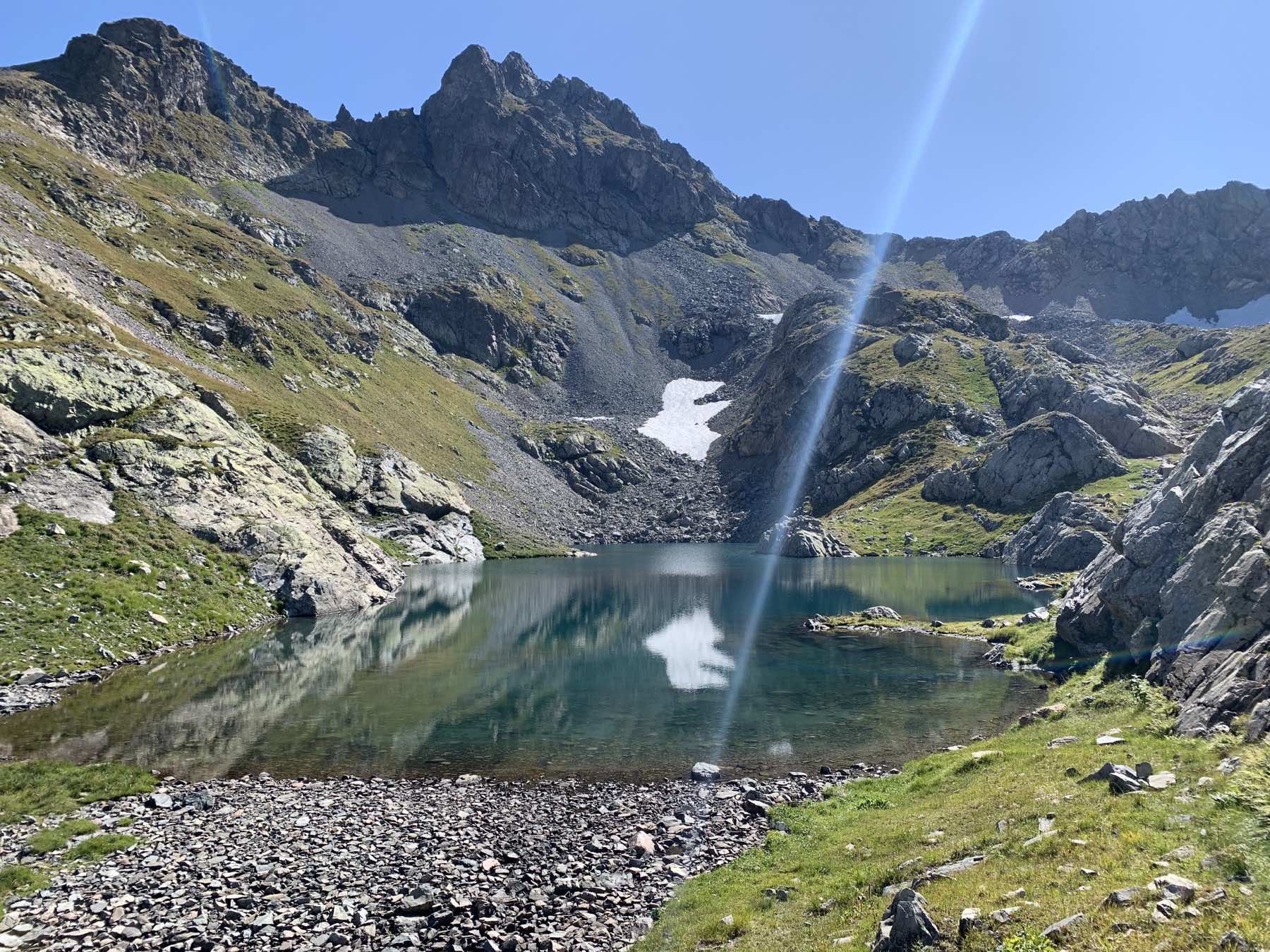
Kardyvach lies at about 1838 m and is ringed by the summits of the Kardyvach group. Above the treeline are lakes of glacial origin, differing in the colour of the water, the shape of their basins and the character of their approaches. The out-and-back days can feel easier because of the light pack, but the ascent and the subsequent descent remain substantial, particularly on the outing to Sineokoe lake and the Kardyvach pass.
The additional climb to Loyub is considered only where there is enough time in hand, the weather is settled and the group is in good condition. It should not be treated as a paid, guaranteed extra summit. If conditions do not allow the climb to continue, the group returns to the main trip. That does not reduce the value of the trip: the principal objectives of this section are Lake Kardyvach itself and the high lake basins around it.
Taking part requires no experience of mountaineering, of rope work or of sleeping at high altitude. It requires other, more down-to-earth qualities: the ability to walk for several hours on uneven ground, to take rain without tragic surprise, to recover in a tent and to hold a working pace for several days in a row. Before the trip it is worth reading our material on guided treks, checking your footwear against our guidance on choosing trekking boots and using the early stages of our mountain training plan.
If the only objective of the trip is Kardyvach and its surroundings, the standalone five-day trek to the lake is the more sensible choice; it is sold as its own trip. This combined trip is for people who want the contrast of two areas, the ascent of Oshten, a crossing of several passes and the feeling of a full nine-day journey.
Oshten — Kardyvach trekking itinerary, 9 days
Day 1. Arrival in Krasnodar and preparation for the route.
Participants make their own way to Krasnodar and check into the hotel in twin or triple rooms. In the evening the group meets the guide, gets acquainted and goes through the nine days ahead. The guide checks the main items of personal equipment, explains how the group will move, how the shared load is distributed and the rules that apply inside the nature reserve. This is the last day on which a missing small item can be replaced calmly, before the self-sufficient part begins. Dinner. Night at the hotel.
Day 2. Yavorovaya Polyana — Guzeripl and Armenian passes — Fisht shelter.
An early departure from Krasnodar for Yavorovaya Polyana. After the shared equipment has been distributed the first walking section begins. The group covers about 10 km over the Guzeripl and Armenian passes to the area of the Fisht shelter. Gentle and steeper sections alternate, and the open ground gives views of the Kamennoye More ridge, the slopes of Oshten, Fisht and the neighbouring summits. Early in the season snowfields may still lie on the trail; in rain the ground and the rocks become slippery. Near the shelter the group chooses a permitted place, pitches the tents and sets up camp. Night in tents.
Day 3. There-and-back ascent of Oshten, 2804 m.
An early rise and a start with small packs; the main camp equipment stays at the shelter. The route crosses alpine slopes and leads out to the pre-summit ridge of Oshten. As height is gained, views open of Fisht, Pshekha-Su, the Belaya river valley and the Lagonaki plateau. The outing requires no stated technical mountaineering experience, but it does require confident walking on a mountain trail and, depending on the season, on remaining snow. The guide decides whether to continue, taking account of visibility, wind, thunderstorm risk, the state of the slope and the pace of the group. After the return there is rest and preparation for the long final stage of the first part. Night in tents.
Day 4. Belorechensky and Cherkessky passes — Babuk-Aul — Sochi.
After breakfast the group strikes camp and leaves the Fisht shelter area. The trail crosses the Belorechensky and Cherkessky passes, after which the well-known steep section that walkers call the «merry descent» begins. Trekking poles, sound footwear and the absence of any attempt to beat the rest of the group by five minutes at the cost of your own knees all matter here. The group then reaches the Babuk-Aul shelter, transfers by truck to Solokh-Aul and changes to a transfer to Sochi or Adler. Hotel accommodation, rest, a shower, a chance to dry kit and prepare for the second part of the trip. Night at the hotel.
Day 5. Sochi — Krasnaya Polyana — Engelmanova Polyana — Lake Kardyvach, about 1838 m.
An early breakfast and the drive to Krasnaya Polyana. Here the group changes to an off-road vehicle and takes the mountain road to Engelmanova Polyana. After the document check, the briefing and the distribution of food and shared equipment, the walking part begins along the Mzymta valley. The trail passes through fir and mixed forest, crosses streams and gradually reaches the alpine zone. Participants carry the full load as far as the base camp. At the lake the group pitches tents on a permitted site and sets up for the days ahead. Night in tents. Distance about 19 km. Ascent about 600 m.
Day 6. There-and-back outing to Upper Kardyvach.
After breakfast the group sets out with small packs, food for the day, water and warm clothing. The route climbs the Upper Mzymta valley along Kardyvach and past the Middle Kardyvach area. As height is gained the forest gives way for good to high mountain ground. There is a rest and lunch at Upper Kardyvach, after which the group returns to base camp by the same line. Where there is enough time in hand, the weather suits and participants are in good condition, the guide may consider an additional climb towards the summit of Loyub, about 2970 m. That climb is not guaranteed and is not an obligatory objective of the day. Night in tents. Distance about 11 km. Ascent about 600 m. Descent about 600 m.
Day 7. There-and-back outing to the Utayonnye lakes.
The group again leaves the main load in camp and walks with small packs. The first part of the way partly follows the previous day’s route, then the trail climbs to the terrace where the Utayonnye lakes lie. The ascent is more noticeable than the distance suggests: about 700 m are gained in a short day. There is rest, lunch and time for photographs at the lakes. The return follows the line of ascent. Whether the full outing is possible depends on the state of the trail and on the access rules in force. Night in tents. Distance about 8 km. Ascent about 700 m. Descent about 700 m.
Day 8. Sineokoe lake and the Kardyvach pass, 2457 m.
One of the fullest out-and-back days of the trip. The way starts near the Sineozyorny stream, passes through fir forest, crooked woodland and alpine meadows, and leads out to Sineokoe lake. Higher up, views open over the valley, Kardyvach and the surrounding summits. In suitable conditions the group continues to the Kardyvach pass. The substantial ascent and descent call for an even pace and for attention on the way back: the descent after a fine viewpoint is still part of the route, not the closing credits. Return to base camp, dinner and packing personal kit before the walk out. Night in tents. Distance about 8.5 km. Ascent about 920 m. Descent about 920 m.
Day 9. Lake Kardyvach — Engelmanova Polyana — Krasnaya Polyana.
After breakfast the group strikes camp completely and returns down the Mzymta valley to Engelmanova Polyana. Packs are a little lighter for the food used, but the stage is still long, so it is worth keeping something in reserve to the last kilometre. An off-road vehicle meets participants at Engelmanova Polyana. Transfer to the railway station in the Krasnaya Polyana area and the end of the trip. Choose return tickets with time in hand for the mountain road, the document check and possible weather delays. Distance about 19 km. Descent about 600 m.
What's included
- The work of the guide throughout the trip
- Hotel accommodation in Krasnodar in twin or triple rooms — 1 night
- Hotel accommodation in Sochi or Adler in twin or triple rooms — 1 night
- Tent accommodation on the mountain part of the trip, as set out in the route
- Transfer Krasnodar — Yavorovaya Polyana
- Transfer Babuk-Aul — Solokh-Aul — Sochi
- Transfer Sochi — Krasnaya Polyana
- Off-road vehicle transfer Krasnaya Polyana — Engelmanova Polyana — Krasnaya Polyana
- Caucasus Nature Reserve permit for the trip
- Dinner on the first day and three trekking-style meals a day from day 2 to day 9
- Group equipment: tents, navigation equipment, group first-aid kit, gas and cooking utensils
What's not included
- Travel from your own region to Krasnodar
- Travel from Krasnaya Polyana or Sochi back to your own region after the trip
- The single-occupancy supplement at the hotels
- Personal equipment
- Arranging your own border-zone permit through the Russian state services portal
- Additional services and costs not provided for in the itinerary
- Costs arising from an individual change to the route or from ending your participation early
The Oshten - Kardyvach trek for private groups
The combined route can be arranged for a family, a group of friends, a walking club or a corporate group on its own dates. When the trip can start depends on more than the availability of a guide and transport: by the start date both parts of the route must be officially open, and participants must have had time to obtain the documents needed for the Kardyvach area.
A private group can discuss an extra night between the two mountain sections, its own transfers, a gentler pace and an extra day at Kardyvach. Changes must not conflict with the permitted campsite scheme, the rules of the Caucasus Nature Reserve or the safe logic of the walking stages. The decision on climbing Oshten, on the outings to the upper lakes and on going up Loyub still rests with the guide, according to the conditions on the day.
A family format is possible with children from the age of 2, but the age given in the listing does not mean a two-year-old is expected to walk the route. A certified backpack carrier is used for the child, and the accompanying adult must be ready to carry the extra weight on the long stages. It matters to share out personal and group kit between the adults in advance: whoever has the carrier should not also be trying to carry a full trekking pack.
Deuter children’s trekking carriers are available from Rock and Rent. Reserve one in advance, try it with your child and adjust it before you set out. For a family we also discuss beforehand how the child will sleep in the tent, warm clothing, protection from rain and sun, the supply of children’s food and whether the group’s pace can be maintained.
For corporate groups we can also discuss a preparatory meeting, splitting participants by pace and an additional trip on the coast after the trek. We will not turn a mountain route into an away-day banquet with Oshten as the backdrop: the trek remains the heart of the trip, and any extra services are built around it.
Documents required for the Oshten - Kardyvach trek
To take part you need to prepare the following in advance:
- A valid passport
- Your original passport, for the checks on the route to Kardyvach
- Tickets to Krasnodar and return tickets from Krasnaya Polyana or Sochi, allowing for the time the trip ends
- Medical insurance covering mountain trekking and the maximum altitude of the trip
- The details the organiser needs to arrange the group visit and the Caucasus Nature Reserve permit
- A border-zone permit, unless you fall under one of the established exemptions; you apply for it yourself through the Gosuslugi portal
- Electronic copies of your documents, saved on your phone and in a cloud service
The Caucasus Nature Reserve permit, the authorisation to pass through Sochi National Park and your personal border-zone permit are three different documents. Which of them you need is checked for your particular dates. The reserve’s requirements, the route description, the permitted campsites and the operating season are published on the page for official Route 9 to Lake Kardyvach. Do not leave the border-zone permit until the last week: having paid for a tour does not make government departments work any faster.
The visiting rules, which sections are open and the list of permitted campsites can all change. The organiser passes on the current requirements before departure, but submitting your own application through Gosuslugi in good time remains your responsibility.
Weather and season for the Oshten - Kardyvach trek
The official opening of Routes 30 and 9 depends on the trails and passes clearing of continuous snow cover. The Caucasus Nature Reserve gives June to October inclusive as the usual operating period, but the exact dates are set each year by separate decisions. A combined trip needs both parts of the route to be open at the same time, so the departure calendar always follows the reserve’s actual opening.
June is the start of the season. Patches of snow can remain on the Lagonaki plateau and the approaches to Oshten, and the trails are often wet after the thaw. Around Kardyvach the streams run higher, and the upper lakes may still be partly in their winter state. June suits well-prepared participants who are ready for wet boots, cool nights and possible changes to the out-and-back outings.
July and August usually give the longest daylight and the most straightforward summer logistics. That said, the Fisht-Oshten massif is one of the wettest parts of the Caucasus: mist, downpours and thunderstorms can arrive quickly. The open passes and the summit of Oshten are particularly exposed in thundery conditions. Outings are planned for early in the day, but an early start is no contract with the weather.
Around Kardyvach, the weather in Krasnaya Polyana is only a rough guide. There is a considerable difference in altitude and terrain between the resort and the base camp. It is cooler at the lake, the wind is felt more keenly on the outings above the treeline, and prolonged rain affects not only your comfort but the state of the trail and the streams.
September often appeals for its clear air and the autumn colours in the forest. At the same time the days grow shorter, the nights colder, and frost and the first snow become possible. Late in the season the reserve administration may close individual sections earlier than expected. October cannot be assumed in advance to be a continuation of summer simply because it is still warm in Sochi.
The reserve opening the route confirms that an official visit is possible, but it does not guarantee climbing Oshten, reaching every lake or going up Loyub on any particular day. The lead guide assesses the visibility, the wind, the risk of thunderstorms, the state of the snowfields and the trail, the water levels, the pace and how the group is feeling. An out-and-back outing may be shortened or cancelled without changing the trip’s main aim – to cross both areas safely and finish the journey as a group.
Accommodation and meals on the Oshten - Kardyvach route
The trip combines two nights in hotels with six nights under canvas. On the first day participants stay in a hotel in Krasnodar, in twin or triple rooms. The second hotel night comes after the Fisht-Oshten section ends, in Sochi or Adler. The particular properties are set by the arrangements for each departure.
The hotel between the two mountain sections is not a token nod to civilisation but a useful part of the route. After crossing the passes you can shower, dry your clothes, charge your devices, check your feet and repack your rucksack. The next morning the group starts the Kardyvach section better recovered than it would be if all the days were run together without a break.
On the first mountain section the tents are pitched near the Fisht hut, at a permitted campsite. On the second section the base camp is by Lake Kardyvach, in accordance with the reserve’s rules. Tents and the main group kitchen equipment are included in the price. Participants help pitch the camp, carry an agreed share of the group load and keep the site tidy.
Dinner is provided on the first day. From the second day to the ninth, three camp-style meals a day are provided. On the walking stages and the out-and-back days, lunch may be given out as a packed meal and snacks that are easy to eat on the move. A hot breakfast and dinner are cooked in the camps.
On the self-sufficient section the food is shared out among participants along with the group equipment. Its weight falls as the route goes on. You are welcome to bring your own sweets, sports nutrition and favourite snacks, but agree the quantity first: a rucksack explains very quickly the difference between a small supply and enough food to see out the apocalypse.
Food allergies, intolerances and a vegetarian or other special diet must be reported before the food is planned and bought. A camp kitchen is limited by weight, storage and what food is available, so not every diet can be reproduced as it would be at home or in a restaurant.
Day-to-day conditions on the Oshten - Kardyvach route
Most of the trip is self-sufficient and under canvas. In Krasnodar and Sochi the usual hotel facilities are available. In the mountains participants live in tents, look after their own kit and help the group with pitching camp, water and cooking.
Around the Fisht hut there are prepared tent pitches, an area for cooking and eating, and visitor toilets. This is the basic infrastructure of a mountain hut, not a hotel: electricity, hot water and the chance to charge your devices should not be treated as guaranteed. Your independence rests on your own power bank, a supply of batteries and careful use of what you have.
In the Kardyvach area, camp is pitched only at the permitted site. There is no permanent shower and none of the sanitary infrastructure of a town. For washing you need wet wipes, a small towel and toiletries that are safe to use in a protected natural area. Washing up or using detergents directly in the lake or the streams is not allowed.
The mobile signal along the route is patchy and unreliable. In the forested valleys, at the hut and around the high lakes there may be no signal at all. It is best to put your phone into power-saving mode beforehand and download maps and any documents you need for offline use. A signal from outside should not be the only place you keep your ticket, your passport details or important medical information.
Drying clothes depends on the weather. In prolonged rain your kit can stay damp for days, so keep the layers you cannot do without, your sleeping bag, your documents and your electronics in dry bags or separate waterproof bags. A single rain cover over the rucksack is no substitute for protecting the contents inside.
On the walking days participants carry their own kit, food and a share of the group equipment. On the out-and-back outings to Oshten and the lakes, the main load stays at camp. If a young child is coming along, how the weight is shared between the adults is discussed separately before the start.
Страхование
НаверхEquipment and useful extras for the Oshten - Kardyvach trek
Скачать PDFSome of the trekking equipment you need can be reserved in advance from Rock and Rent. Collecting the equipment for this trip, and a child carrier, must be arranged before you travel. Try everything on and check it beforehand: a nine-day trek is a poor place to discover the quirks of new boots on the first pass.
Documents
- A valid passport – carry the original with you on the route
- Tickets to Krasnodar and back from Krasnaya Polyana or Sochi
- Medical insurance covering mountain trekking and the maximum altitude of the trip
- A border-zone permit for the Kardyvach area, if one is required for you
- Electronic copies of your documents, saved on your phone and in a cloud service
Personal equipment
- A main rucksack of 50-60 litres with the harness properly adjusted
- A small 15-20 litre rucksack for the out-and-back outings
- A rain cover for your rucksack
- Dry bags or heavy-duty waterproof bags for your sleeping bag, clothing, documents and electronics
- A sleeping bag with a comfort rating of 0 to -7 °C
- Foam sleeping mat
- Trekking poles
- Head torch with at least 12 hours of battery life
- Spare batteries or a rechargeable cell for your torch
- Mug, spoon, bowl and a small knife
- A flask or water bottle
- A vacuum flask of about 1 litre
- Sit mat
Clothing and footwear
- Broken-in waterproof trekking boots with a stable sole
- Light footwear to change into at camp
- A waterproof shell jacket, or another jacket you can rely on to keep the rain out
- Waterproof trousers, or side-zip overtrousers
- Walking trousers
- Fleece jacket
- A light down or synthetic insulated jacket
- Base layers – top and bottom
- T-shirts or thin walking tops, preferably long-sleeved
- Thin gloves
- Warm hat
- A cap, sun hat or other head covering against the sun
- Bandana or buff
- Trekking socks for the walking days
- A separate pair of dry warm socks for sleeping in
- A spare set of underwear
- Gaiters – particularly useful early in the season, in wet grass and on snowfields
Hygiene, safety and electronics
- Sunglasses of protection category 3 or higher
- Sun cream
- Lip balm with SPF
- A personal first-aid kit, without duplicating the group kit
- An elastic bandage or the support you normally use, if you need one
- Toiletries in small containers
- Wet wipes and toilet paper
- A light quick-drying towel
- Power bank and the charging cables you need
- A phone with your documents downloaded for offline use
- Your own bags for rubbish
- Insect repellent, according to the season
Additional items if you are bringing a child
- A Deuter trekking backpack carrier or a similar model, adjusted in advance for both adult and child
- The carrier’s own sun and rain covers
- Warm clothing for the child, allowing for sitting still in the carrier
- A separate waterproof set of children’s clothing
- Food and drink for the child, matched to the length of the walking days
- The child’s toiletries and any medication
- A small insulating mat or another agreed arrangement for camp
Your guide checks the final kit before you set out. Depending on the date, the amount of snow and the forecast, items may be added to this list. Do not leave out the warm or waterproof layer on your own judgement because the forecast for Krasnodar looks good.