- Guides
- B2B
-
#19607 (no title)
-
#15972 (no title)
- Climb Elbrus Individually
- Climb Elbrus from the South, 9 Days
- Climb Elbrus from the South, 7 Days
- Climb Elbrus from the South with Oxygen
- Climb Elbrus from the North, 10 Days
- Two Summits of Elbrus, 9 Days
- Elbrus Traverse from South to North, 9 Days
- Elbrus Traverse from North to South, 10 Days
- Cross of Elbrus, South to North, 9 Days
- Cross of Elbrus, North to South, 10 Days
- Climb Kazbek and Elbrus — 10-Day Two-Summit Programme
- Climb Elbrus from the West, 11 Days
- Elbrus by Private Helicopter, 3 Days
- Elbrus Region Holiday and Trekking, 9 Days
- Elbrus Region Holiday, 7 Days
- Tinder Tour: Climbing Mount Elbrus, 9 Days
- Climb Elbrus from the South, 9 Days with Sergey Baranov
-
#15539 (no title)
- Climb Carstensz Pyramid, 8 Days with Helicopter Access
- Climb Mont Blanc, 4810 m — 8-Day Guided Ascent
- Climb the Matterhorn, 4478 m — 8-Day Guided Ascent
- Climb Mount Vinson, 15-Day Antarctic Expedition
- Climb Kosciuszko and Travel in Australia, 7 Days
- Climb Fisht, 2868 m — 3-Day Ascent by the 1B Route
- Climb Mount Wilhelm, 6 Days
-
#15546 (no title)
- Climb Kilimanjaro: the Marangu Route
- Climb Kilimanjaro: the Lemosho Route
- Climb Ararat, 5137 m — 7-Day Classic Programme
- Climb Kazbek from the South, 5033 m — 8 Days in Georgia
- Climb Kazbek and Elbrus — 10-Day Two-Summit Programme
- Climb the Volcanoes of Mexico — Orizaba and Iztaccíhuatl, 9 Days
- Climbing Alpamayo — 16-Day Technical Expedition
- Climbing Margaret Peak (Stanley), 5,109 m
- Climbing Mount Kenya: Point Lenana, 4,985 m
- Climb Dykh-Tau by the North Ridge, 13 Days
-
#15554 (no title)
- Aconcagua Climb — 17-Day Guided Expedition
- Island Peak Climb — 18-Day Expedition
- Climb Mera Peak, 6476 m — 16-Day Hinku Valley Programme
- Climb Ama Dablam, 6812 m — 24-Day Expedition with Island Peak
- Climb Island Peak and Mera Peak — 24-Day Two-Summit Expedition
- Aconcagua and Ojos del Salado — 25-Day Combined Expedition
- Ojos del Salado Climb — 15-Day Expedition
- Climb Chimborazo and Cotopaxi — 14-Day Ecuador Programme
- Climb Huascarán — 8-Day Technical Ascent
- Climb Razdelnaya Peak, 6148 m — 15-Day Pamir Expedition
- Climb Denali by the West Buttress, 23 Days
- #15565 (no title)
- #15572 (no title)
-
#15972 (no title)
-
#19592 (no title)
-
See 8000m
- K2 Base Camp Trek via the Gondogoro La
- Everest Base Camp Trek — 14 Days
- Everest Base Camp via Gokyo Lakes — 15 Days
- Short Everest Base Camp Trek in 10 Days
- Annapurna Circuit and Tilicho Lake Trek
- Manaslu Circuit Trek
- Kanchenjunga Circuit Trek (XXL)
- Kanchenjunga North Base Camp Trek (Short)
- Kanchenjunga from India: the Goecha La Trek in Sikkim
- Makalu Base Camp Trek
- Annapurna Base Camp Trek
- South America
- Asia
- Africa
-
Russia
- Elbrus Region Holiday and Trekking, 9 Days
- Elbrus Region Holiday, 7 Days
- Oshten + Kardyvach — 9-Day Western Caucasus Trek
- Lake Kardyvach — 5-Day Base-Camp Trek
- Route 30: Through the Mountains to the Sea, with Oshten — 4 Days
- Trekking in Arkhyz — 7 Days over the Ayulyu Pass
- Gvandra Trek — 7 Days to the Ullu-Kyol Lakes
- Trekking in Dombai — 7 Days with the Murudzhu Lakes
- Europe
-
See 8000m
-
Adventures
-
Africa
- मोरक्को टूर: उत्तरी अफ्रीका का दिल
- चढ़ाई टूबकल और मोरक्को की संस्कृति
- Eritrea: the Dahlak Archipelago and the Rashaida Nomads
- Rwanda: Mountain Gorillas and the Bisoke Volcano
- Ethiopia: Otherworldly Landscapes and the Peoples of the Omo Valley
- युगांडा टूर: क्वीन्स पार्क और माउंटेन गोरिल्ला
- Tanzania Safari: Serengeti, Ngorongoro and Tarangire
- युगांडा टूर: सफेद गैंडे और पर्वत गोरिल्ला
- Zimbabwe and South Africa: Victoria Falls, Cape Town and the Cape of Good Hope
- Namibia: Etosha National Park and the Himba
- Kenya Safari: the African Big Five
- बोत्सवाना टूर: ओकावांगो डेल्टा और चोब पार्क
- South America
- Asia
-
Africa
- Ski-touring
- VIP
- #19722 (no title)
- About
Climb Manaslu, 8163 m — 42-Day Himalayan Expedition
- Height (m)
- 8163
- Duration
- 42 дня
- Difficulty
- Above average
- Continent
- Asia
- Children
- No
- Accommodation
- There are tents
19500 $
Почему такая цена?
Тур временно недоступен
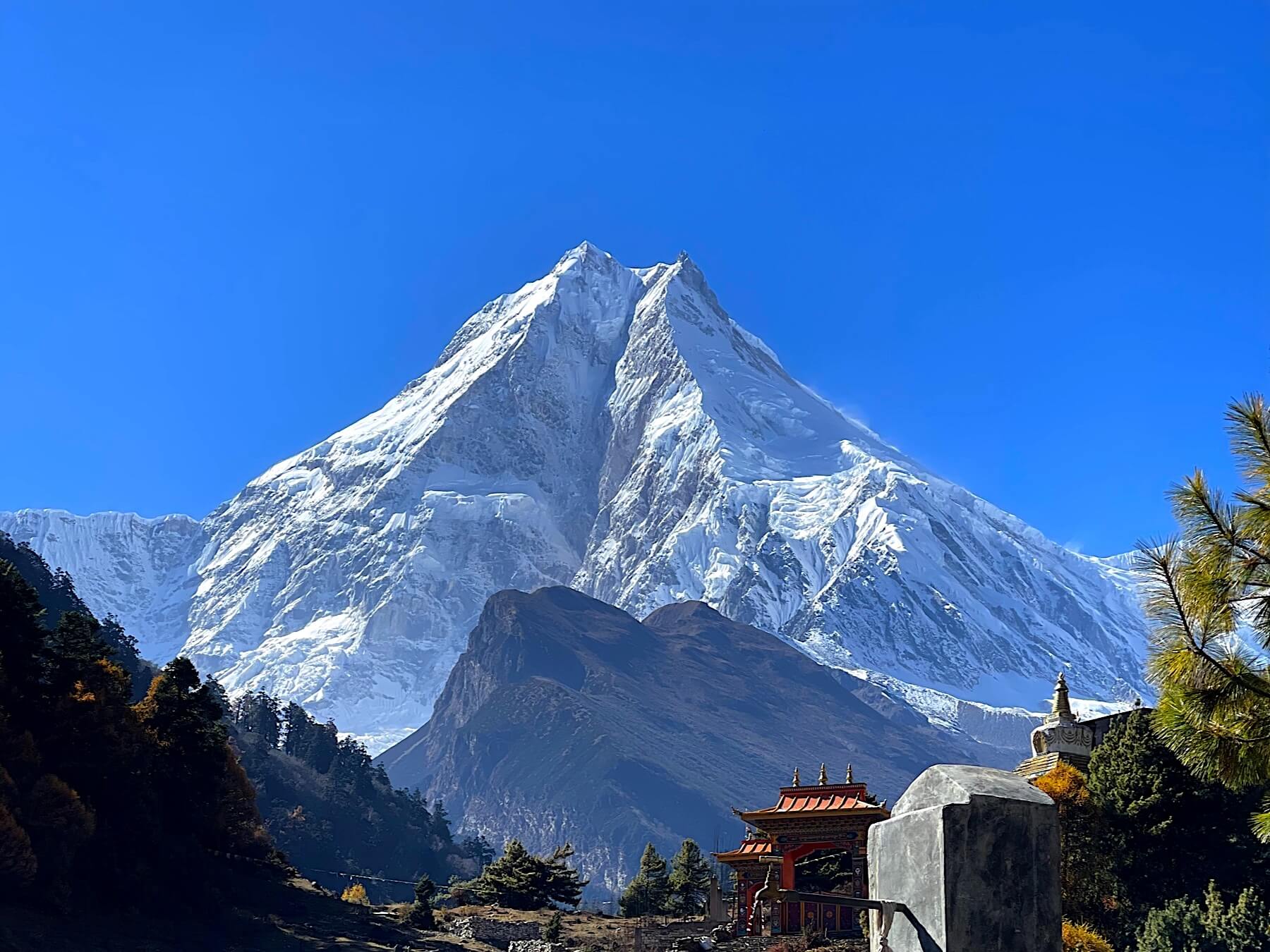
Climbing Manaslu — a 42-day Himalayan expedition on the eighth-highest mountain in the world. The approach through Jagat, Deng, Namrung and Samagaon provides gradual acclimatisation, after which the team works in four high camps and chooses a window for the attempt.
- Manaslu, 8163 m
- The north-east side of the mountain
- Four high camps
- A personal high-altitude Sherpa for every participant
- Support from the top camp to the summit
- Oxygen equipment and four 4-litre cylinders per participant
- Twelve reserve days
- Expedition leader for groups of 3 participants or more
Manaslu is often chosen as a first eight-thousander, but this trip is intended only for mountaineers with serious high-altitude experience. You need confident work in crampons and on fixed ropes, experience of living in high camps, the ability to look after yourself through long hypoxia and the readiness to turn around on the leader's decision.
Important:
- The confirmed approach runs overland through Jagat and Samagaon
- A helicopter transfer to 3900 m, or a jeep variant, is agreed before booking and may change the approach logistics
- The personal Sherpa's summit bonus is paid for separately
- Oxygen beyond the included quantity is paid for separately
- Reaching the summit depends on the weather, acclimatisation, the state of the route and the leader's decision
- Mountain Guide does not sell air tickets and does not process visas
The price is fixed in US dollars.
About the Manaslu expedition
Manaslu, 8163 m, is the eighth-highest mountain in the world and one of the main objectives for a first experience on an eight-thousander. It is not an «easy» route: the expedition demands several weeks at altitude, work in four camps, movement on the glacier and on fixed ropes, the use of oxygen and the ability to make decisions under heavy fatigue.
The confirmed 42-day trip begins the acclimatisation on the approach through Jagat, Deng, Namrung and Samagaon. Over five days the group climbs from 1350 m to Base Camp at 4700 m. Two days spent setting up camp and adapting create a transition into the first high-altitude rotation without an abrupt start to the technical work.
Four camps are established on the north-east side. The route to Camp 1 at 5500 m crosses moraine and a crevassed glacier. The most technical section, up to Camp 2 at 6250 m, requires work on fixed ropes and the passage of ice steps. From Camp 3 the team climbs to Camp 4 at 7450 m; the exact altitude of Camp 3 is not stated in the published itinerary and is not guessed here.
On the summit stage the group crosses snow basins and comes out onto the open ridge beyond the false summit. Every participant has a personal high-altitude Sherpa, and from the top camp the support to the summit is individual. Oxygen is used above 7400 m within the confirmed allocation.
Manaslu suits a next step after successful 7000 m peaks and a settled record of living in high camps. Preparation includes regular endurance work, previous experience of high camps and confident handling of crampons, ascender and fixed ropes. Your climbing record and your personal high-altitude equipment must be agreed with the leader before booking.
Avalanche conditions, crevasses, cold, wind, hypoxia and congestion on the fixed ropes all remain objective risks. Before the trip, work through the standard guidance on preventing altitude illness and on what living at Base Camp altitude involves. A Mountain Guide expedition leader works with groups of 3 participants or more.
Manaslu climbing itinerary, 42 days
Day 1. Arrival in Kathmandu.
Participants make their own way to Kathmandu, where a member of the team meets them and takes them to the hotel. In the evening there is an introduction to the leader, a briefing, a check of documents and a first check of equipment. The day is set aside for recovery and to prepare for the long drive. Night in a hotel.
Day 2. Drive from Kathmandu to Jagat, 1350 m.
The group sets off by jeep for the start of the walking route. The long drive passes through rural districts and gradually leads into the Manaslu valley. On arrival, participants settle in, rest and pack their rucksacks for the first stage. Night in a lodge.
Day 3. Walk from Jagat to Deng, 1880 m.
The stage takes about 7–8 hours. The trail first loses altitude, then climbs through the gorge and continues along the river to Deng. This long first day helps you settle into a working rhythm without an abrupt gain in altitude. Night in a lodge.
Day 4. Walk from Deng to Namrung, 2630 m.
In 5–6 hours the group moves from rice terraces and forest into more mountainous terrain, crosses a suspension bridge and reaches Namrung. The gain in altitude becomes more noticeable, so the guide watches the speed and how everyone is feeling. Night in a lodge.
Day 5. Walk through Lho, 3150 m, to Samagaon, 3560 m.
The trail passes the village of Lho, forest and the Tibetan settlement of Shyala, and then comes out into the broad valley of Samagaon. The views of Manaslu let you take in the scale of the route ahead. A night at 3560 m is an important step before Base Camp. Night in a lodge.
Day 6. Walk to Manaslu Base Camp, 4700 m.
The group climbs from Samagaon to Base Camp and moves from lodges into expedition life. On arrival, participants settle in, take delivery of equipment and begin adapting to the new altitude. Night in tents.
Days 7–8. Setting up Base Camp and acclimatisation.
The team sets up the working infrastructure, distributes the loads and checks the oxygen and personal technical equipment. Acclimatisation walks and rest prepare participants for the first rotation. The leader assesses each climber’s condition before clearing them for the glacier. Nights in tents.
Days 9–17. Establishing the high camps and acclimatisation rotations.
The route to Camp 1 at 5500 m crosses grassy slopes, rock slabs, moraine and a crevassed glacier. The way to Camp 2 at 6250 m includes fixed ropes and short ice steps. Beyond Camp 3 the team climbs to Camp 4 at 7450 m. Through this block participants carry equipment, sleep at altitude and return to Base Camp to recover. The exact sequence is set by the leader.
Days 18–24. Summit attempt and descent to Base Camp.
Once the weather window has been chosen the group climbs through the high camps. The summit push begins long before dawn; the climb takes roughly 6–7 hours. The route crosses snow basins, the false summit and the open ridge. Each participant works with a personal high-altitude Sherpa. From the point reached, the team descends to Base Camp.
Days 25–36. Expedition reserve.
Twelve days are set aside for waiting out a safe weather window, for recovery between departures and for completing the high-altitude section. The reserve does not mean a guaranteed second attempt: the decision depends on the team’s resources, on oxygen and on the state of the route and of the participants.
Day 37. Descent to Samagaon.
Once the expedition is over the team dismantles Base Camp and descends the familiar trail to Samagaon. The substantial loss of altitude makes breathing easier, but after a long spell of work in the camps it is important to stay attentive on the way down. Night in a lodge.
Days 38–40. Trek from Samagaon to Soti Khola.
Over three days the group continues down the valley to the point where vehicles can reach. The daily stages are distributed by the leader according to the condition of the team and of the trail. Nights in lodges.
Day 41. Return to Kathmandu.
The group drives to Kathmandu and checks into the hotel. After the mountain section the day is used for recovery, for checking baggage and for preparing for the international flight. In the evening there may be a group dinner and a presentation of certificates. Night in a hotel.
Day 42. End of the trip.
At the agreed time there is a transfer to the international airport. Participants check in themselves. Choose return tickets for after the full duration of the trip, with a margin for possible high-altitude and road delays. The more detailed sequence of high-altitude departures and the use of the reserve are set by the leader on the spot, according to the weather, the state of the route and the condition of the group.
What's included
- Mountain Guide expedition leader with high-altitude experience, for groups of 3 participants or more
- A personal high-altitude Sherpa for every participant, plus Sherpas for the group equipment
- Individual support for each participant from the top camp to the summit
- Helicopter transfer to 3900 m or the jeep variant — according to the confirmed logistics
- Establishment of the group camps and delivery of the group loads above 6400 m
- Meeting and seeing off at Kathmandu international airport
- Hotel accommodation in Kathmandu — 2 nights
- Lodge accommodation on the trekking section
- Accommodation and meals in tents during the climb
- Porters for the group equipment and food
- A Nepalese liaison officer
- A professional cook and kitchen assistants
- Breakfast, lunch, dinner and snacks on the expedition section
- The Manaslu climbing permit
- The permits and entry fees required for the confirmed trekking route
- The mandatory rubbish fee
- Breakfasts in Kathmandu
- Group equipment — tents, kitchen equipment, gas stoves and ropes
- Radios
- Two oxygen mask and regulator sets for each participant and each accompanying Sherpa — for use only
- Four 4-litre oxygen cylinders per participant, for use above 7400 m
- Two 4-litre oxygen cylinders for each accompanying Sherpa
The confirmed itinerary on this page describes the overland approach through Jagat and Samagaon. If the helicopter transfer is chosen, the amended sequence must be obtained in writing before payment.
What's not included
- International flights
- The Nepal visa — a 90-day visa covers the length of the trip; the fee is set by the Nepalese authorities and paid by the participant
- Mountaineering medical insurance covering climbing to an altitude of at least 8163 m, search and rescue and helicopter evacuation
- Additional yaks for carrying a participant’s personal belongings
- Oxygen cylinders beyond the included quantity
- Meals in Kathmandu other than breakfasts — approximately USD 20–30 a day
- The personal high-altitude Sherpa’s bonus on reaching the summit
- Tips for the expedition staff
- Search, rescue and transportation operations
- Additional nights at the hotel in Kathmandu
- Costs arising from ending your participation early
- Additional costs caused by the weather, the state of the route or a forced change to the itinerary
Private groups: the Manaslu climb
The expedition can be arranged for a closed group of climbers, a club or a corporate team with confirmed altitude experience. Before booking we agree the dates, a Russian-speaking leader, personal Sherpas, the transport option, the amount of oxygen, the accommodation and the reserve. A bespoke itinerary must not shorten the acclimatisation, the rotations to altitude or the reserve without the leader’s assessment. A helicopter approach changes the logic of the whole route and is arranged as a separately confirmed trip, not added to the overland route as a single line. This expedition is not suitable for families with children. Whether a non-climbing companion can come, and their separate logistics, are confirmed before booking, because this depends on permits, accommodation and the make-up of the team.
Documents for the Manaslu climb
Documents for an eight-thousander are prepared well in advance. The permit, the liaison officer’s details, the insurance and the expedition lists are all issued against your passport. Any discrepancy in the spelling of your name can delay the permits. Check the current visa requirements and the passport validity you need on the website of the Nepal Department of Immigration for your own nationality. Mountain Guide does not arrange visas and does not sell air tickets.
Documents
- A passport that meets Nepal’s current requirements
- A tourist visa or another valid entry permit
- International air tickets
- An insurance policy covering mountaineering to at least 8163 m, search and rescue and helicopter evacuation
- Your policy number and the insurer’s 24-hour emergency contact details
- Your booking confirmation and the organisers’ contact details
- Proof of the altitude and technical experience required
- The medical documents requested by the organisers and the insurer
- Digital copies of your passport, visa, tickets and insurance
- Waterproof document wallet
The local team obtains the summit permit and the permissions for the confirmed route. Photographs, document copies and forms must be provided by the stated deadline.
Weather and seasons on the Manaslu climb
The expedition dates are set by the permitted season, by the rope-fixing team’s work and by the period when suitable conditions are expected. The exact dates and the latest arrival time are confirmed before you buy tickets. The approach can bring rain, landslides and transport delays. Above base camp the main factors are snow, avalanche conditions, crevasses, wind, ice and extreme cold. The state of the route changes over the course of the expedition. Twelve reserve days allow you to wait for a weather window, but they do not guarantee the summit. The leader may change a rotation, cancel a move to a higher camp, or end an attempt in order to get everyone back safely.
Accommodation and meals on the Manaslu expedition
Two nights in a hotel in Kathmandu, with breakfast, are included. The specific property and room type are named in the confirmation. Extra nights and meals other than breakfast are paid separately. On the approach the group stays in lodges, and at base camp and the four high camps in tents. A cook and assistants staff the base camp. In the upper camps everyday life is stripped right back and organised around recovery, storing oxygen and safety. Breakfast, lunch, dinner and snacks are included on the expedition section. The catering changes with altitude: in the upper camps the diet is limited by what can be cooked. Tell us about any dietary restrictions in advance.
Day-to-day conditions on the Manaslu expedition
Showers and water. On the approach a hot shower may be available for a charge in some lodges. Whether a shower and heated water are available at base camp depends on how it is actually set up; there is no shower in the high camps.
Toilets. Conditions in the lodges vary from village to village. Base camp uses an expedition toilet set-up, and the upper camps a high-altitude arrangement following the team’s rules.
Power and charging. Charging on the approach may cost extra. What base camp can offer is confirmed before the trip; there are no sockets in the upper camps. You need power banks and spare batteries.
Internet and phone signal. Ordinary internet is unreliable and may be absent above base camp. Radios are used for communication within the team. Whether you may use personal satellite communication is confirmed separately.
Laundry and drying. Proper laundry is not possible above base camp. You need a supply of dry underwear, high-altitude socks and gloves, and dry bags.
Страхование
НаверхEquipment and useful extras for the Manaslu climb
Скачать PDFYou bring all of your own personal equipment. High-altitude boots, crampons, ice axe, harness, ascender, descender, down kit and sleeping bag must be agreed with the leader before you buy tickets. The set is checked again in Kathmandu.
Documents
- Passport
- Air tickets or e-ticket receipts
- Mountaineering medical insurance including helicopter evacuation
- Digital copies of your documents
- Waterproof cover
Personal and technical equipment
- Rucksack of 50-60 litres
- Expedition duffel bag of 120-150 litres
- Sleeping bag with a comfort rating of -20 to -30 °C
- Insulated sleeping mat
- Two trekking poles with baskets at least 70 mm across
- Steel or aluminium crampons, matched to your boots
- Classic ice axe with a steel pick
- Climbing harness
- 5 karabiners
- Cow’s-tail lanyards
- Ascender
- Descender
- Ice screw on its own karabiner
- 5 m of 5-6 mm accessory cord
- Mug, spoon and bowl
Clothing and footwear
- Triple mountaineering boots, 8000 m class
- Broken-in trekking boots
- Light footwear for towns and lodges
- A high-altitude down suit, or a down jacket with a hood plus down trousers
- waterproof shell jacket and waterproof trousers
- Fleece set
- Base layer, top and bottoms
- Warm mittens
- Spare warm mittens
- Thick and thin gloves
- Buff or bandana
- Warm hat
- High-altitude and warm trekking socks
- Gaiters, unless they are built into your boots
Useful extras
- Head torch with at least 12 hours of battery life
- A spare set of batteries or cells
- High-category sunglasses
- Ski goggles
- Vacuum flask, 1 litre, without a push-button lid
- Windproof mask for the lower face
- Sun cream
- Lip balm with sun protection
- Power bank and charging cables
- Chemical hand warmers, optional
- Personal first-aid kit
- Elastic bandage or a personal support brace
Your high-altitude kit must be checked before you fly to Nepal. For a first selection, use our guide to equipment for climbs from Elbrus to Everest, and agree the final list and the compatibility of the technical items with the expedition leader.