- Guides
- B2B
-
#19607 (no title)
-
#15972 (no title)
- Climb Elbrus Individually
- Climb Elbrus from the South, 9 Days
- Climb Elbrus from the South, 7 Days
- Climb Elbrus from the South with Oxygen
- Climb Elbrus from the North, 10 Days
- Two Summits of Elbrus, 9 Days
- Elbrus Traverse from South to North, 9 Days
- Elbrus Traverse from North to South, 10 Days
- Cross of Elbrus, South to North, 9 Days
- Cross of Elbrus, North to South, 10 Days
- Climb Kazbek and Elbrus — 10-Day Two-Summit Programme
- Climb Elbrus from the West, 11 Days
- Elbrus by Private Helicopter, 3 Days
- Elbrus Region Holiday and Trekking, 9 Days
- Elbrus Region Holiday, 7 Days
- Tinder Tour: Climbing Mount Elbrus, 9 Days
- Climb Elbrus from the South, 9 Days with Sergey Baranov
-
#15539 (no title)
- Climb Carstensz Pyramid, 8 Days with Helicopter Access
- Climb Mont Blanc, 4810 m — 8-Day Guided Ascent
- Climb the Matterhorn, 4478 m — 8-Day Guided Ascent
- Climb Mount Vinson, 15-Day Antarctic Expedition
- Climb Kosciuszko and Travel in Australia, 7 Days
- Climb Fisht, 2868 m — 3-Day Ascent by the 1B Route
- Climb Mount Wilhelm, 6 Days
-
#15546 (no title)
- Climb Kilimanjaro: the Marangu Route
- Climb Kilimanjaro: the Lemosho Route
- Climb Ararat, 5137 m — 7-Day Classic Programme
- Climb Kazbek from the South, 5033 m — 8 Days in Georgia
- Climb Kazbek and Elbrus — 10-Day Two-Summit Programme
- Climb the Volcanoes of Mexico — Orizaba and Iztaccíhuatl, 9 Days
- Climbing Alpamayo — 16-Day Technical Expedition
- Climbing Margaret Peak (Stanley), 5,109 m
- Climbing Mount Kenya: Point Lenana, 4,985 m
- Climb Dykh-Tau by the North Ridge, 13 Days
-
#15554 (no title)
- Aconcagua Climb — 17-Day Guided Expedition
- Island Peak Climb — 18-Day Expedition
- Climb Mera Peak, 6476 m — 16-Day Hinku Valley Programme
- Climb Ama Dablam, 6812 m — 24-Day Expedition with Island Peak
- Climb Island Peak and Mera Peak — 24-Day Two-Summit Expedition
- Aconcagua and Ojos del Salado — 25-Day Combined Expedition
- Ojos del Salado Climb — 15-Day Expedition
- Climb Chimborazo and Cotopaxi — 14-Day Ecuador Programme
- Climb Huascarán — 8-Day Technical Ascent
- Climb Razdelnaya Peak, 6148 m — 15-Day Pamir Expedition
- Climb Denali by the West Buttress, 23 Days
- #15565 (no title)
- #15572 (no title)
-
#15972 (no title)
-
#19592 (no title)
-
See 8000m
- K2 Base Camp Trek via the Gondogoro La
- Everest Base Camp Trek — 14 Days
- Everest Base Camp via Gokyo Lakes — 15 Days
- Short Everest Base Camp Trek in 10 Days
- Annapurna Circuit and Tilicho Lake Trek
- Manaslu Circuit Trek
- Kanchenjunga Circuit Trek (XXL)
- Kanchenjunga North Base Camp Trek (Short)
- Kanchenjunga from India: the Goecha La Trek in Sikkim
- Makalu Base Camp Trek
- Annapurna Base Camp Trek
- South America
- Asia
- Africa
-
Russia
- Elbrus Region Holiday and Trekking, 9 Days
- Elbrus Region Holiday, 7 Days
- Oshten + Kardyvach — 9-Day Western Caucasus Trek
- Lake Kardyvach — 5-Day Base-Camp Trek
- Route 30: Through the Mountains to the Sea, with Oshten — 4 Days
- Trekking in Arkhyz — 7 Days over the Ayulyu Pass
- Gvandra Trek — 7 Days to the Ullu-Kyol Lakes
- Trekking in Dombai — 7 Days with the Murudzhu Lakes
- Europe
-
See 8000m
-
Adventures
-
Africa
- मोरक्को टूर: उत्तरी अफ्रीका का दिल
- चढ़ाई टूबकल और मोरक्को की संस्कृति
- Eritrea: the Dahlak Archipelago and the Rashaida Nomads
- Rwanda: Mountain Gorillas and the Bisoke Volcano
- Ethiopia: Otherworldly Landscapes and the Peoples of the Omo Valley
- युगांडा टूर: क्वीन्स पार्क और माउंटेन गोरिल्ला
- Tanzania Safari: Serengeti, Ngorongoro and Tarangire
- युगांडा टूर: सफेद गैंडे और पर्वत गोरिल्ला
- Zimbabwe and South Africa: Victoria Falls, Cape Town and the Cape of Good Hope
- Namibia: Etosha National Park and the Himba
- Kenya Safari: the African Big Five
- बोत्सवाना टूर: ओकावांगो डेल्टा और चोब पार्क
- South America
- Asia
-
Africa
- Ski-touring
- VIP
- #19722 (no title)
- About
Peru: Ancient Inca Culture — 16-Day Trekking Journey
- Height (m)
- 5100
- Duration
- 16 дней
- Difficulty
- Low
- Continent
- South America
- Children
- From 10 years old
- Accommodation
- Hotels only
4200 $
Почему такая цена?
Тур временно недоступен
A sixteen-day cultural trekking journey through Peru, built around a week on foot between two lost Inca cities and continuing to Lake Titicaca, Arequipa and the Nazca Lines.
- We go deep into the world of the ancient Inca community
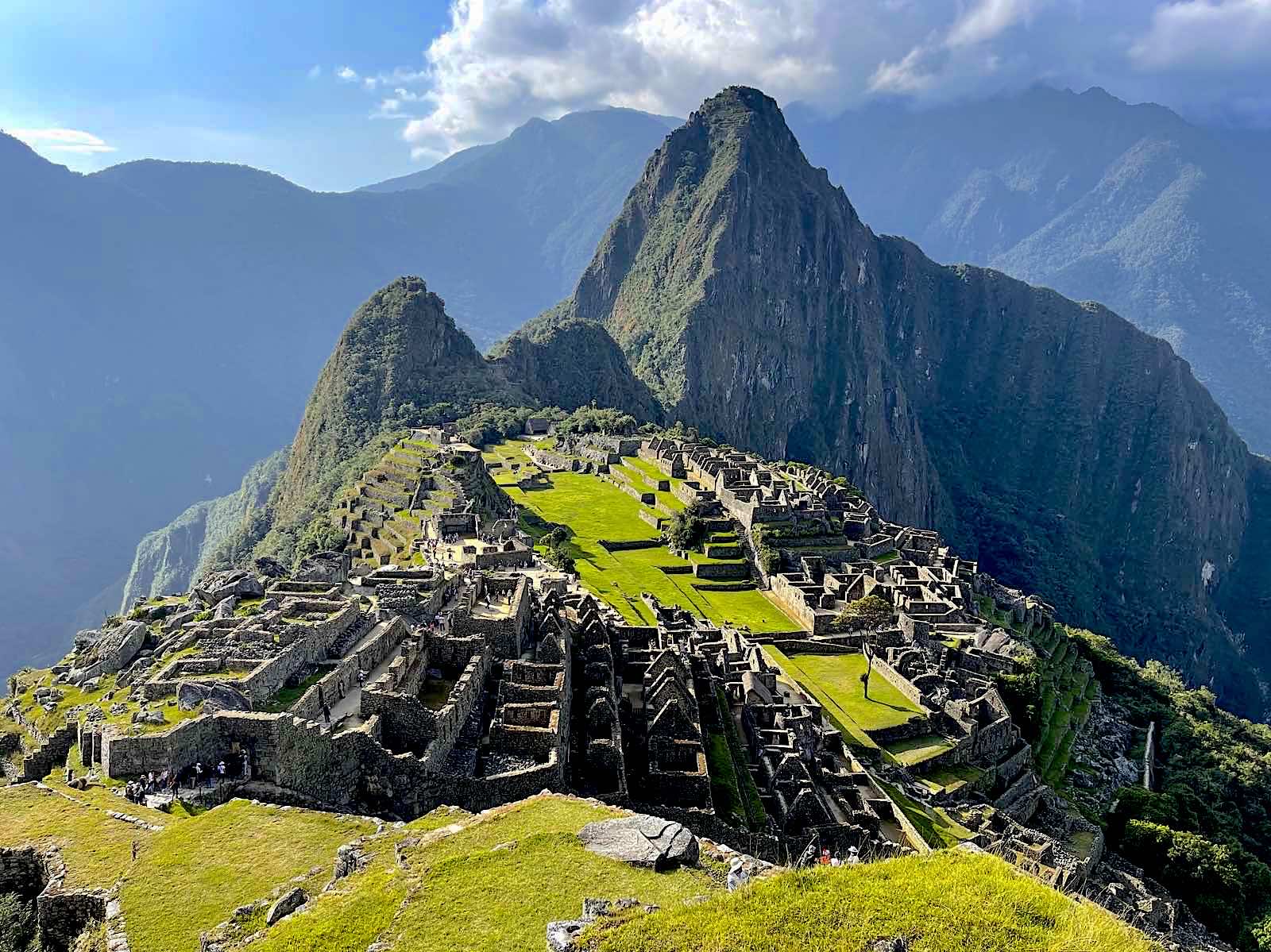
- We trek to two ancient Inca cities lost in the mountains: Machu Picchu and Choquequirao
- We eat llama steak and try other specialities of Peruvian cooking
- We walk through real jungle with a local guide
- We spend a night on the floating Uros islands with the local people
- We climb the Rainbow Mountains
- We explore the shores of Lake Titicaca, where legend places the origin of the Inca civilisation
- We cross the Yanama pass, with its striking view over the Inca valley
- We walk the streets of Arequipa, considered one of the most beautiful cities in Peru
- We finish the journey with a helicopter flight over the Nazca Lines
The company does not sell air tickets or arrange visas, and cannot accept responsibility for events beyond its control connected with flights and border crossings.
About the Peru trekking journey
This journey brings together the main places that make Peru worth travelling to. We visit Machu Picchu and its twin city, Choquequirao. Machu Picchu needs no special introduction, so Choquequirao deserves the longer description. The city is usually overlooked, and unfairly so: the second largest of the Inca civilisation, thoroughly cleared of long-established vegetation, where you can walk every street and enter Inca houses without a time limit or dozens of other visitors around. Only afterwards do we go on to the symbol of Peru, Machu Picchu. For a whole week we walk where the Incas walked, see their defensive works and camp on ancient terraces; the trek follows their way of life. Somewhere on these paths they fought the conquistadors who had come hundreds and thousands of kilometres to subdue an ancient and unique civilisation.
When the trek is over we move on to an equally absorbing part of the journey. We travel to the border of Peru and Bolivia, to the shores of Lake Titicaca, surrounded by the Andes. It lies at almost 4000 m and is the highest navigable lake in the world. Around the lake and on the floating reed islands live Aymara and Quechua communities, and we stay overnight on one of those reed islands.
After that come the Salinas y Aguada Blanca national reserve, the Huacachina oasis and the old city of Arequipa, built of white volcanic stone. The journey ends brightly with a helicopter flight over the Nazca Lines.
Peru: Ancient Inca Culture itinerary, 16 days
Day 1. Arrival in Cusco.
If your flight is early enough we visit the ruins of Sacsayhuaman, look into a couple of museums and walk the streets of the old conquistador city. In any case we dine at a restaurant on the main square of the historic centre, overlooking the cathedral, where you can try the national dish cuy or a llama steak, and the group is briefed. Night in a hotel.
Day 2. Start of the Choquequirao – Machu Picchu trek.
Prepare to travel back hundreds of years, leaving the modern world and its concerns behind, and to imagine a way of life in which the community mattered more, and in which there was a deep love and respect for Mother Nature, Pachamama.
Day 3. Cusco – Capuliyoc – Chiquisca.
We begin the walk in undramatic wooded hills; after a short climb in the heat comes a long descent among giant cacti with surprisingly large flowers. At the bottom of the canyon stands an abandoned camp, which we used to use, but there is no water there now, so today we walk on. After a further climb we reach camp and spend the night in tents on the land of a local family’s house, lost in the jungle.
Day 4. Chiquisca – Playa Rosalina – Santa Rosa – Marampata.
We continue to the deepest part of the valley, from which the climb to the village of Marampata begins, where we set up our next camp. Enjoy the remarkable landscape of this area, slopes we call “vertical ground”: there are no cliffs here, but the slopes are extraordinarily steep, and the local people somehow manage to grow maize and other crops on ground where climbers would already be roping up. Night in tents.
Day 5. Marampata – Choquequirao – Pinchaunuyoc.
We wake early to meet the sunrise and to explore the Inca stronghold of Choquequirao, “cradle of gold” in Spanish, recorded in 1710. Choquequirao is a fifteenth to sixteenth-century settlement connected with the Inca empire, or more precisely with Tawantinsuyu. The site had two main phases of development, explained by the fact that Pachacutec founded Choquequirao and his son Tupac Inca Yupanqui rebuilt and extended it after becoming Sapa Inca. Choquequirao lies in territory regarded as Pachacutec’s domain. At the centre of the city stand typical Inca terraces, its largest structures. Around the central square are a temple, several administrative buildings and the residential quarters of the nobility. On the edges of the city lie the quarters of the commoners, forming a small village. Numerous water channels, aqueducts and springs remain unchanged to this day. Most of the buildings are well preserved and some are being restored. We then walk through cloud forest to the ruins of Pinchaunuyoc. Night in tents.
Day 6. Pinchaunuyoc – Maizal – Minas Victoria – San Juan pass – Yanama.
In the morning we continue to the deepest part of the Blanco river valley to begin the hardest part of the trek. We climb until we reach the San Juan pass, from which we descend to our camp in the abandoned mountain village of Yanama.
Day 7. Yanama – Yanama pass – Totora – Collpapampa.
We cross the Yanama pass, the highest point of the route, with its striking view over the valley. From here you can see the onward continuation of the Inca trail to the third most important city of that civilisation, though we do not go there this time. Along the way we see the life of Peruvian farmers and, at last, the snow-covered summits of the Salkantay range, after which another world-famous route in the footsteps of the Incas is named. Tonight we rest in our own hotel with a mountain view at Collpapampa.
Day 8. Collpapampa – Sahuayaco beach – Hidroeléctrica – Aguas Calientes.
Today we walk through jungle until we reach the hydroelectric station. From there a highly scenic walk leads to Aguas Calientes, although you can also take the train. Dinner in a restaurant and a night in a hotel.
Day 9. Aguas Calientes – Machu Picchu – Ollantaytambo – Maras salt pans – Cusco.
In the morning we explore the historical sanctuary of Machu Picchu. Machu Picchu is an ancient Inca city, regarded as one of the most remarkable and significant archaeological sites in the world and one of the new seven wonders of the world. There are several hypotheses about what Machu Picchu was used for. One of the most widespread is that it was a sacred place and a residence for the Inca ruler. Religious ceremonies and rites may also have been held here. Machu Picchu was also connected with the observation of astronomical phenomena. It draws millions of visitors a year and is the most popular tourist destination in Latin America. The city stands at about 2430 m on a mountain top in the valley of the Urubamba river. Surrounded by high mountains and dense tropical forest, Machu Picchu has an extraordinary natural setting. It was built in stone, without brick or lime. The most important structures include palaces, temples, agricultural terraces and remarkable stone stairways and paths. Many of the structures show outstanding engineering, a striking achievement for the ancient Incas. Having walked the ancient city, we take the train towards midday to Ollantaytambo. Today we also look in at the Maras salt pans, a vast complex of basins where salt is evaporated from the water of a hot spring. Transfer to Cusco in the evening.
Day 10. Trip to the Rainbow Mountains.
You have probably never seen anything more contrasting in nature: it is hard to imagine how so many colours could be mixed into these slopes, which range from pale yellow to dark brown in dozens of alternating layers in every colour of the rainbow. We leave Cusco for the town of Cusipata, a drive of about 2 hours, then walk for 2 to 2.5 hours on easy ground to reach the site. With luck we may also see condors, the largest flying birds of South America. After a short drive we stop for the night. Night in a hotel.
Day 11. Transfer to Puno.
Puno is a city in the south of Peru on the shore of Lake Titicaca, at about 3800 m. It is known for its unusual geographical position and for cultural sites connected with the heritage of ancient civilisations, including archaeological complexes and the burial towers of the indigenous peoples. Night in a hotel.
Day 12. The Uros floating islands and Amantani or Taquile.
We cross to the floating reed islands of Uros, where local families live, and to the island of Amantani or Taquile, where you can watch traditional dances, see family life from the inside and take a trip on a reed boat. Night on the island.
Day 13. Return to Puno, Salinas y Aguada Blanca and Arequipa.
Return to Puno and a drive of 300 km to the Salinas y Aguada Blanca national reserve, then on to Arequipa, deservedly considered one of the most beautiful cities in Peru. It was founded in the eighteenth century and has a great many colonial-style buildings of white volcanic stone. The old part of the city holds its historical and architectural sights, chief among them the old churches and monasteries. Night in a hotel.
Day 14. Drive to Nazca and the flight over the Nazca Lines.
A drive of 564 km along the ocean shore to the town of Nazca, and in the evening the flight over the Nazca Lines. These are giant geoglyphs in the desert: hundreds of huge figures on the surface of the ground, made by ancient peoples between 500 BC and AD 500. The lines form various figures, including geometric shapes, animals and human figures. The striking thing is that the drawings can only be seen whole from the air, and 2000 years ago people did not fly; nor did tools for designing on that scale exist until the twentieth century. One of the most remarkable features of the Nazca Lines is their precision and symmetry. Despite their enormous size the lines are drawn with surprising accuracy, forming geometric shapes such as triangles, squares and spirals, images of animals such as spiders, monkeys, llamas and birds, and human figures. Few people know that a second desert with similar lines, the Palpa desert, lies next to Nazca. We can fly over that as well. The Nazca Lines are inscribed on the UNESCO World Heritage list and recognised as an important archaeological monument. Night in a hotel.
Day 15. Reserve morning, Huacachina and the Paracas Candelabra, then Lima.
The morning is held in reserve in case of bad weather. Then we drive to Lima. On the way we visit the well-known Huacachina oasis and the Andean Candelabra, an enormous geoglyph on the sand dunes of the Paracas peninsula near the town of Pisco in Peru. It shows the outline of an abstract human figure and is around 180 m high and about 70 m wide. The geoglyph is visible from a long way off, because the dunes in this area can reach 50 m. Hotel in Lima, dinner in a well-known restaurant on the ocean front, night in a hotel.
Day 16. Transfer to the airport.
Flight home.
What's included
- An experienced trek leader with extensive climbing experience, for groups of 4 participants or more
- All transfers during the trip
- Helicopter flight over the Nazca Lines
- The necessary permits and entrance tickets to the national parks
- The train from Aguas Calientes to Ollantaytambo
- All accommodation: during the trek, twin occupancy in comfortable, spacious Timberline and Mountain Hardwear tents and in a dome hotel in the middle of the jungle; hotels for the rest of the trip
- Entrance ticket to Choquequirao
- Mules to carry all group and personal equipment (up to 7 kg)
- Entry to the Machu Picchu archaeological site (circuit 2)
- All the necessary group camping equipment (dining and sleeping tents, tables, chairs, kitchen, cooking equipment)
- A portable chemical toilet during the trek
- A trekking duffel for personal belongings (maximum weight 7 kg)
- An emergency first-aid kit
- An inflatable sleeping mat for the nights on trek
- Breakfasts, lunches, dinners and snacks during the trek, and breakfasts only for the rest of the journey
- Drinking water during the trek
- The services of guides and a cook during the trek
What's not included
- International flights
- Medical insurance
- Visa
- Single occupancy
- Lunches and dinners in the towns
- Personal equipment
- Tips for the team
- Any expenses arising from change to the itinerary
- Personal expenses
Private groups
The route can be quoted for a private group on its own dates. The bespoke specification sets out the number of participants, the Russian-speaking and local staff accompanying the group, the hotel standard, the form of the camping accommodation, meals, transfers, the mule baggage allowance, entry tickets and the reserve. Changing the length or leaving out particular regions is re-quoted as a new route. Machu Picchu tickets, the train, the Nazca flight and accommodation all depend on availability for your chosen dates and are confirmed before payment.
Documents you need
- A valid passport
- A visa, if one is required for your nationality
- Medical insurance covering high-altitude trekking, search and rescue and evacuation from the maximum altitude of the trip
- Air tickets and the documents needed for entry and transit on your chosen routing
- Confirmations for the entry tickets, trains and domestic services that are issued to a named participant
- Digital copies of your documents, stored offline
The rules on entry, on visiting Machu Picchu, Choquequirao and the protected areas, and on flights over Nazca are checked before the trip, against your nationality and your dates.
Weather and seasons
The route crosses several climate zones: the high country around Cusco and Titicaca, the hot Apurímac canyon, humid cloud forest, the Pacific coast and the Nazca desert. A single itinerary can bring sun, rain, cold nights, heat on the descents and strong ultraviolet. For a multi-day trek the drier Andean periods are usually chosen, but a dry season is no guarantee against rain or closures. The state of the trails, the train services, the entry time slots and the possibility of flying over Nazca are checked before every departure. Day 15 is left as a limited reserve against changes in the weather at Nazca.
Accommodation and meals
On the trek the group uses two-person tents, a communal mess tent and kitchen equipment; an inflatable mattress is part of the published package. One section of the itinerary lists a dome hotel at Collpapampa. In the towns and after the trek the group stays in hotels, and at Titicaca the itinerary includes a night on the island. On the trekking section, breakfasts, lunches, dinners, snacks and drinking water are included. On the rest of the trip, breakfasts are included; lunches and dinners in the towns are paid separately. Dietary restrictions and allergies must be reported before the menu is confirmed.
Facilities on the route
The camping section is a long way from town comforts. Communal camp equipment and a portable chemical toilet are included, but a shower, electricity, mobile signal and internet are not guaranteed on the trek. Personal luggage carried by the mules is limited to the published 7 kg; you carry your own day pack. The hotels have the usual facilities, though the standard and the specific properties are confirmed for your travel dates. Bring a head torch, a power bank, a dry bag for your documents, your own toiletries and a dry set of clothes to sleep in.
Страхование
НаверхEquipment list for the trek through Peru: Ancient Inca Culture
Скачать PDF- Malaria medication
Documents and baggage
- Passport and digital copies of your documents
- Medical insurance for high-altitude trekking
- Day pack
- A soft holdall for the personal kit carried by the mules, within the 7 kg allowance included
- Dry bags or heavy-duty plastic bags to protect your kit
Clothing and footwear
- Broken-in trekking boots
- Light footwear to change into
- Base layers
- A fleece or other insulating layer
- An insulated jacket
- waterproof shell jacket and trousers
- Trekking trousers and walking T-shirts
- Warm hat, buff, gloves and spare socks
- Sun hat
Personal equipment
- A sleeping bag for the conditions on the high-altitude camping section
- Trekking poles
- Head torch with spare batteries
- Sunglasses
- Sun cream and lip balm
- A flask or water bottles
- Power bank
- A personal first-aid kit; do not self-prescribe prescription medicines
- Toiletries and a quick-drying towel
Malaria prophylaxis and any medication are matters to settle with a doctor, taking account of the actual route and your state of health. Do not start a course of prophylaxis on your own initiative.