- Guides
- B2B
-
#19607 (no title)
-
#15972 (no title)
- Climb Elbrus Individually
- Climb Elbrus from the South, 9 Days
- Climb Elbrus from the South, 7 Days
- Climb Elbrus from the South with Oxygen
- Climb Elbrus from the North, 10 Days
- Two Summits of Elbrus, 9 Days
- Elbrus Traverse from South to North, 9 Days
- Elbrus Traverse from North to South, 10 Days
- Cross of Elbrus, South to North, 9 Days
- Cross of Elbrus, North to South, 10 Days
- Climb Kazbek and Elbrus — 10-Day Two-Summit Programme
- Climb Elbrus from the West, 11 Days
- Elbrus by Private Helicopter, 3 Days
- Elbrus Region Holiday and Trekking, 9 Days
- Elbrus Region Holiday, 7 Days
- Tinder Tour: Climbing Mount Elbrus, 9 Days
- Climb Elbrus from the South, 9 Days with Sergey Baranov
-
#15539 (no title)
- Climb Carstensz Pyramid, 8 Days with Helicopter Access
- Climb Mont Blanc, 4810 m — 8-Day Guided Ascent
- Climb the Matterhorn, 4478 m — 8-Day Guided Ascent
- Climb Mount Vinson, 15-Day Antarctic Expedition
- Climb Kosciuszko and Travel in Australia, 7 Days
- Climb Fisht, 2868 m — 3-Day Ascent by the 1B Route
- Climb Mount Wilhelm, 6 Days
-
#15546 (no title)
- Climb Kilimanjaro: the Marangu Route
- Climb Kilimanjaro: the Lemosho Route
- Climb Ararat, 5137 m — 7-Day Classic Programme
- Climb Kazbek from the South, 5033 m — 8 Days in Georgia
- Climb Kazbek and Elbrus — 10-Day Two-Summit Programme
- Climb the Volcanoes of Mexico — Orizaba and Iztaccíhuatl, 9 Days
- Climbing Alpamayo — 16-Day Technical Expedition
- Climbing Margaret Peak (Stanley), 5,109 m
- Climbing Mount Kenya: Point Lenana, 4,985 m
- Climb Dykh-Tau by the North Ridge, 13 Days
-
#15554 (no title)
- Aconcagua Climb — 17-Day Guided Expedition
- Island Peak Climb — 18-Day Expedition
- Climb Mera Peak, 6476 m — 16-Day Hinku Valley Programme
- Climb Ama Dablam, 6812 m — 24-Day Expedition with Island Peak
- Climb Island Peak and Mera Peak — 24-Day Two-Summit Expedition
- Aconcagua and Ojos del Salado — 25-Day Combined Expedition
- Ojos del Salado Climb — 15-Day Expedition
- Climb Chimborazo and Cotopaxi — 14-Day Ecuador Programme
- Climb Huascarán — 8-Day Technical Ascent
- Climb Razdelnaya Peak, 6148 m — 15-Day Pamir Expedition
- Climb Denali by the West Buttress, 23 Days
- #15565 (no title)
- #15572 (no title)
-
#15972 (no title)
-
#19592 (no title)
-
See 8000m
- K2 Base Camp Trek via the Gondogoro La
- Everest Base Camp Trek — 14 Days
- Everest Base Camp via Gokyo Lakes — 15 Days
- Short Everest Base Camp Trek in 10 Days
- Annapurna Circuit and Tilicho Lake Trek
- Manaslu Circuit Trek
- Kanchenjunga Circuit Trek (XXL)
- Kanchenjunga North Base Camp Trek (Short)
- Kanchenjunga from India: the Goecha La Trek in Sikkim
- Makalu Base Camp Trek
- Annapurna Base Camp Trek
- South America
- Asia
- Africa
-
Russia
- Elbrus Region Holiday and Trekking, 9 Days
- Elbrus Region Holiday, 7 Days
- Oshten + Kardyvach — 9-Day Western Caucasus Trek
- Lake Kardyvach — 5-Day Base-Camp Trek
- Route 30: Through the Mountains to the Sea, with Oshten — 4 Days
- Trekking in Arkhyz — 7 Days over the Ayulyu Pass
- Gvandra Trek — 7 Days to the Ullu-Kyol Lakes
- Trekking in Dombai — 7 Days with the Murudzhu Lakes
- Europe
-
See 8000m
-
Adventures
-
Africa
- मोरक्को टूर: उत्तरी अफ्रीका का दिल
- चढ़ाई टूबकल और मोरक्को की संस्कृति
- Eritrea: the Dahlak Archipelago and the Rashaida Nomads
- Rwanda: Mountain Gorillas and the Bisoke Volcano
- Ethiopia: Otherworldly Landscapes and the Peoples of the Omo Valley
- युगांडा टूर: क्वीन्स पार्क और माउंटेन गोरिल्ला
- Tanzania Safari: Serengeti, Ngorongoro and Tarangire
- युगांडा टूर: सफेद गैंडे और पर्वत गोरिल्ला
- Zimbabwe and South Africa: Victoria Falls, Cape Town and the Cape of Good Hope
- Namibia: Etosha National Park and the Himba
- Kenya Safari: the African Big Five
- बोत्सवाना टूर: ओकावांगो डेल्टा और चोब पार्क
- South America
- Asia
-
Africa
- Ski-touring
- VIP
- #19722 (no title)
- About
Climb Kilimanjaro: the Machame Route
2990 $
Почему такая цена?
Machame begins in dense forest on the southern slope and quickly opens out onto the sky of the Shira plateau. Then come a tower of frozen lava, the giant Barranco Wall, camps among volcanic rock and the night road to the glaciers of Kibo. It is one of those routes on which Kilimanjaro shows a new face every day.
The standard version is built for people who like to move compactly and not stretch a journey out. It is shorter than Lemosho and the Northern Circuit but keeps the main landscapes of the southern circuit. For a first experience of altitude it is more sensible to choose the private version with an extra night at Karanga.
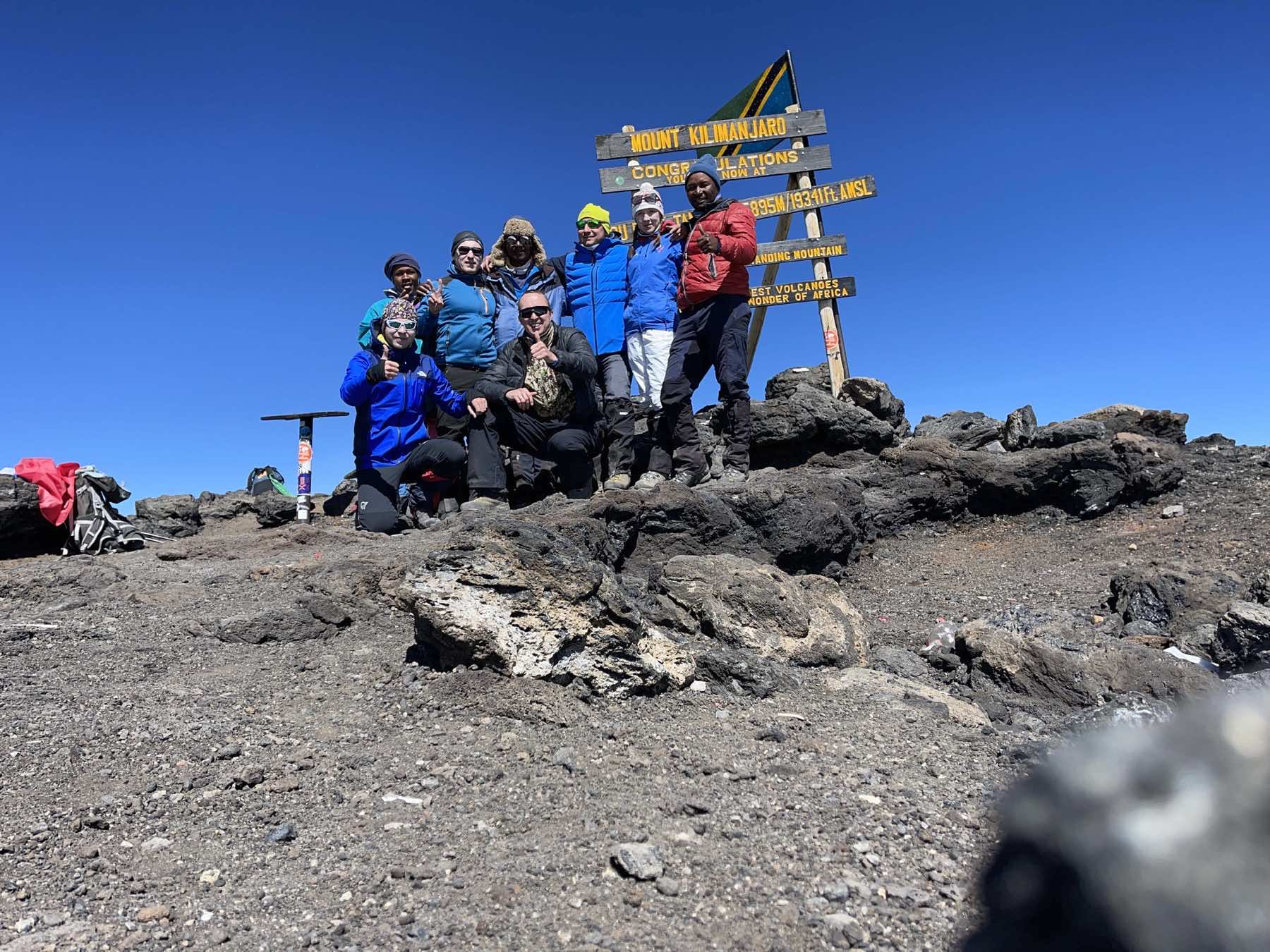
Machame is a dynamic and varied Kilimanjaro route with tented camps, the Shira plateau, the acclimatisation climb to the Lava Tower and the crossing of the Barranco Wall. The culmination of the trip is the night ascent to Uhuru Peak at 5895 m.
The eight-day trip includes a compact six-day mountain section. It suits physically strong participants and experienced trekkers who are ready for a fast gain in altitude. For a first experience of altitude we recommend the private version with an additional acclimatisation day.
With a group of four participants or more the trip is accompanied by a Mountain Guide team leader. A private format is available for any group size against an custom quote.
Climbs are possible all year round. Rain is more likely from March to May and from October to December. In the wet months the trails in the forest and on the Barranco Wall can be wet and slippery, so reliable membrane clothing and waterproof packing are necessary.
After the climb the trip can continue with a safari in Tanzania or a stay on Zanzibar.
Our company does not buy or sell air tickets and does not arrange visas, and is therefore not responsible for disruption beyond its control involving flights or border crossings.
In Tanzania, small, worn or old dollar notes may be refused. We recommend bringing recent notes in good condition.
About climbing Kilimanjaro by the Machame route
Machame starts on the southern side of the massif. The trail climbs through mountain forest to the Machame camp, comes out onto the Shira plateau, crosses high-altitude desert and joins the southern circuit of Kibo.
On the stage to Barranco the team climbs to roughly 4500 m and descends to sleep at about 3900 m. That profile helps acclimatisation, but the compact length of the route still calls for close attention to how everyone is feeling.
The Barranco Wall is the most recognisable section of Machame. It is a steep trail on which hands are used for balance, but it is not technical rock climbing. In rain the rock can be slippery, and your speed depends on the movement of other groups.
From Barranco the route passes through the Karanga area to the Barafu camp. The summit push begins at night, after which the group descends in a different direction through the Mweka camp. The result is a full traverse of the southern part of the massif.
Machame requires no previous technical ascents, but it does require endurance. Follow the guidance on training for the mountains and study the symptoms of altitude sickness in advance.
Machame is often called a dynamic route, and not only because of its schedule. The trail is constantly working with the terrain: climbing onto ridges, dropping into valleys, rounding the southern slopes of Kibo and forcing you to ration your strength. It shows particularly clearly why speed on Kilimanjaro must be dictated by altitude rather than by competitive urge.
After the descent the trip can continue with a safari in Tarangire, Ngorongoro and the Serengeti, or with a flight to the beaches of Zanzibar. Both extensions are arranged so as to leave a proper margin after the mountain part.
Itinerary of the Kilimanjaro climb by the Machame route
Day 1. Arrival in Tanzania.
Meeting at Kilimanjaro International Airport and transfer to Moshi. After check-in there is a briefing, a check of personal equipment and preparation of the duffel bag. Night at the hotel. In the evening participants meet the guide and pack only what will genuinely be needed on a fast-moving route.
Day 2. Moshi to the Machame gate to the Machame camp.
Drive to the Machame gate at about 1800 m, registration and the start of the trek through damp mountain forest. The stage ends at the Machame camp at about 3000 m. Night in tents. The first camp greets the team with the damp air of the forest and evening cloud through which Kibo occasionally appears.
Day 3. Machame camp to the Shira camp.
The trail leaves the forest for the heather moorland and climbs onto the Shira plateau to a camp at about 3800 m. The day continues acclimatisation and opens the first wide view of Kibo. Night in tents. On the Shira plateau the forest is left below, and the tents stand among heather moorland and broad volcanic panoramas.
Day 4. Shira to the Lava Tower to Barranco.
The team gains altitude to roughly 4500 m, then descends to the Barranco camp at about 3900 m. Climbing above the overnight stop helps acclimatisation. Night in tents. The contrast between the Lava Tower and the green Barranco valley makes this one of the most memorable days on the whole of Kilimanjaro.
Day 5. Barranco to Karanga to Barafu.
In the morning the team crosses the Barranco Wall, then continues through the Karanga area to the Barafu assault camp at about 4800 m. After check-in participants prepare for the night departure and go to rest early. Night in tents. Beyond the Barranco Wall the route gathers the main landscapes of the southern circuit into one long and eventful stage.
Day 6. Ascent of Uhuru Peak, 5895 m, and descent to Mweka.
A night departure to the crater rim and Uhuru Peak at 5895 m. The decision to continue is taken by the guide, taking account of the weather, the pace and each participant’s condition. After the summit the group returns to Barafu and continues on a long descent to the Mweka camp at about 3700 m. Night in tents. Darkness gives way gradually to dawn over Mawenzi, and then the equally serious work of a long descent begins.
Day 7. Mweka camp to the Mweka gate to Moshi.
The final descent through forest to the Mweka gate at about 1500 m, completion of the route formalities and transfer to Moshi. Night at the hotel. At the Mweka gate the team returns to warm air, thick vegetation and the first real pause since the summit.
Day 8. End of the trip.
Breakfast and transfer to Kilimanjaro International Airport. The departure time is agreed against the confirmed flight. The rest of the journey can begin immediately with a safari or a flight to Zanzibar.
What's included
- A Mountain Guide team leader with groups of four participants or more
- The services of a local English-speaking mountain guide
- The services of a cook and porters
- Meeting at Kilimanjaro International Airport and transfer to the hotel
- Transfer from the hotel to Kilimanjaro International Airport after the trip
- All the road transfers set out in the itinerary
- Two nights in a three-star hotel in Moshi, twin occupancy, with breakfast
- The Kilimanjaro National Park permit and compulsory fees
- Accommodation in twin tents during the mountain part of the trip
- Full board during the mountain part of the trip – breakfast, lunch and dinner
What's not included
- International flights to Tanzania and back
- The transfer between Nairobi and Moshi, if a participant chooses to fly via Kenya
- Medical insurance covering high-altitude trekking to 5895 m and evacuation – compulsory for participation
- A Tanzanian visa, if the participant requires one for their nationality – $50 for most nationalities; requirements depend on nationality, and a different visa type applies to US citizens
- Lunches and dinners at the hotel before and after the climb
- Single occupancy – the cost is confirmed separately
- Personal equipment and clothing
- Tips for the local mountain team – the recommended amount is confirmed before the trip
- Any costs arising from a departure from the itinerary
The Kilimanjaro climb by the Machame route for private groups
The Kilimanjaro climb by the Machame route can be run privately on your own dates. This format suits a single participant, a family, a group of friends or a corporate team. A Russian-speaking Mountain Guide leader can be added to a private trip for a group of any size, quoted individually. There is more detail on the private Kilimanjaro climbs page. The basic trip is built in a compact form. For newcomers and participants without altitude experience, a day can be added between Barranco and Barafu, with a night at Karanga, giving more time to acclimatise and recover. A private trip can add a safari after Kilimanjaro, or time on Zanzibar. The dates, hotels, internal flights within Tanzania and the final price of any additional sections are confirmed separately before the contract is signed. To receive a quote, write to us through the Contacts page and tell us the make-up of your group, your preferred dates, your altitude experience and whether you need a Russian-speaking guide.
Documents for the Kilimanjaro climb by the Machame route
Entry requirements depend on your nationality and on your flight routing. Before buying tickets, check the rules for Tanzania and for every transit country against official sources. To take part you will need:
- A passport valid for at least six months on the date of entry and with at least one free page
- A return ticket or confirmation of onward travel
- A Tanzanian visa, where one is required; you can apply through the official eVisa system
- Medical insurance covering high-altitude trekking to 5895 m and evacuation
- An international yellow fever vaccination certificate, if you are arriving from a country at risk or have spent at least 12 hours in transit through one
- Your booking confirmation for the trip and the host team’s contact details
We recommend keeping digital copies of your documents on your phone and in cloud storage. Check the current visa and health requirements again before you fly.
Weather and season on the Kilimanjaro climb by the Machame route
Kilimanjaro climbs run all year round. The driest and most popular spells usually fall between January and early March, and from June to October. This does not mean clear weather is guaranteed: cloud, rain, snow, strong wind and a sharp drop in temperature are possible in any month. The main rainy season around Kilimanjaro usually falls between March and May, and above all in April and May. A shorter rainy spell runs from October to December and is often most noticeable in November. Climbing is possible in these months, but the lower trails can be wet and slippery, kit is harder to keep dry, and cloud can limit the views. The southern Machame side gets more moisture than the northern Rongai route. In the wet months the forest trail, the Barranco Wall and the descent via Mweka are the most demanding. It can be warm and humid at the start of the route, while night temperatures in the high camps fall below 0 °C. The coldest stage is the night start for the summit. You need warm layers, protection from wind and rain, and waterproof packing for your sleeping bag, clothing, documents and electronics. A detailed month-by-month comparison is published in our article on the best time to climb Kilimanjaro.
Accommodation and meals on the Kilimanjaro climb by the Machame route
Two nights in a 3-star hotel in Moshi, in twin rooms, are provided before the mountain section and after it finishes. Breakfasts are included. The specific hotel is confirmed before departure. During the climb the group sleeps in two-person tents. The local team moves and pitches the camp. You provide your own sleeping bag and mat, following the equipment list. Full board is provided during the climb. Agree the menu in advance, along with any vegetarian, allergy or other dietary requirements. Lunches and dinners at the hotel before and after the mountain are paid separately.
Day-to-day conditions on the Kilimanjaro climb by the Machame route
Machame is a camping route. toilet and washing facilities in the camps are basic and depend on the infrastructure of each site. There is no proper shower during the mountain section. On the mountain section you cannot count on a shower, mains power, Wi-Fi or regular mobile signal. Signal depends on the camp, the weather and the network, so it should not form part of a work or family communication plan. Charge your phone, camera gear and power bank before the route starts, and protect them from cold and damp. Earplugs are useful for sleeping. In the wet season, damp clothing cannot always be dried out completely before the next stage.
Страхование
НаверхEquipment list for the Kilimanjaro climb by the Machame route
Скачать PDFCheck and test your equipment before the trip. Pay particular attention to broken-in footwear, a warm set for the summit night, and keeping your kit dry. The permitted weight of your duffel bag is confirmed before departure.
Personal equipment
- Day pack of 25-35 litres with a rain cover
- Duffel bag for the items your porter carries
- Sleeping bag with a comfort rating of -5 to -10 °C
- Foam sleeping mat
- Trekking poles
- Dry bags or strong waterproof sacks for your sleeping bag and clothing
Clothing and footwear
- Broken-in trekking boots with good grip
- Light footwear for the hotel and for town
- waterproof shell jacket
- waterproof shell trousers
- Quick-drying trekking trousers
- A set of base layers
- Fleece jacket or another warm mid layer
- Down jacket with a hood
- Warm gloves or mittens
- Thin gloves
- Warm hat
- Buff or balaclava
- Sun hat
- Trekking socks, plus a separate warm pair for summit day
- Gaiters
Other items
- Head torch with spare batteries
- Power bank and charging cables
- Sunglasses
- Ski goggles for wind and snow
- Vacuum flask, 1 litre, without a push-button lid
- Reusable water bottle
- Sun cream and lip balm with SPF
- Insect repellent for the lower part of the route
- Quick-drying towel
- Personal toiletries
- A personal first-aid kit suited to your own medical needs; take medicines only as directed
Discuss malaria risk and prophylaxis with your doctor before the trip. There is background information in our article on avoiding malaria.