- Guides
- B2B
-
#19607 (no title)
-
#15972 (no title)
- Climb Elbrus Individually
- Climb Elbrus from the South, 9 Days
- Climb Elbrus from the South, 7 Days
- Climb Elbrus from the South with Oxygen
- Climb Elbrus from the North, 10 Days
- Two Summits of Elbrus, 9 Days
- Elbrus Traverse from South to North, 9 Days
- Elbrus Traverse from North to South, 10 Days
- Cross of Elbrus, South to North, 9 Days
- “उत्तर से क्रॉस” कार्यक्रम के अनुसार माउंट एल्ब्रस पर चढ़ना
- Climb Kazbek and Elbrus — 10-Day Two-Summit Programme
- Climb Elbrus from the West, 11 Days
- हेलीकॉप्टर द्वारा एल्ब्रस
- Elbrus Region Holiday and Trekking, 9 Days
- Elbrus Region Holiday, 7 Days
- एल्ब्रस क्लाइम्बिंग टिंडर टूर
- Climb Elbrus from the South, 9 Days with Sergey Baranov
- #15539 (no title)
-
#15546 (no title)
- Climb Kilimanjaro: the Marangu Route
- Climb Kilimanjaro: the Lemosho Route
- Climb Ararat, 5137 m — 7-Day Classic Programme
- Climb Kazbek from the South, 5033 m — 8 Days in Georgia
- Climb Kazbek and Elbrus — 10-Day Two-Summit Programme
- मेक्सिको में ज्वालामुखी चढ़ना
- Climbing Alpamayo — 16-Day Technical Expedition
- चढ़ाई मार्गरेट पीक (स्टेनली)
- Climbing Mount Kenya: Point Lenana, 4,985 m
- Climb Dykh-Tau by the North Ridge, 13 Days
-
#15554 (no title)
- Aconcagua Climb — 17-Day Guided Expedition
- Island Peak Climb — 18-Day Expedition
- Climb Mera Peak, 6476 m — 16-Day Hinku Valley Programme
- Climb Ama Dablam, 6812 m — 24-Day Expedition with Island Peak
- Climb Island Peak and Mera Peak — 24-Day Two-Summit Expedition
- Aconcagua and Ojos del Salado — 25-Day Combined Expedition
- Ojos del Salado Climb — 15-Day Expedition
- चढ़ाई चिम्बोराजो, कोटोपैक्सी
- हुस्करन चढ़ाई
- Climb Razdelnaya Peak, 6148 m — 15-Day Pamir Expedition
- Climb Denali by the West Buttress, 23 Days
- #15565 (no title)
- #15572 (no title)
-
#15972 (no title)
-
#19592 (no title)
-
See 8000m
- K2 Base Camp Trek via the Gondogoro La
- Everest Base Camp Trek — 14 Days
- Everest Base Camp via Gokyo Lakes — 15 Days
- एक हफ्ते में एवरेस्ट पर ट्रेकिंग
- Annapurna Circuit and Tilicho Lake Trek
- Manaslu Circuit Trek
- Kanchenjunga Circuit Trek (XXL)
- Kanchenjunga North Base Camp Trek (Short)
- Kanchenjunga from India: the Goecha La Trek in Sikkim
- मकालू बेस कैंप के लिए ट्रेकिंग
- अन्नपूर्णा आधार शिविर ट्रेकिंग
- South America
- Asia
- Africa
-
Russia
- Elbrus Region Holiday and Trekking, 9 Days
- Elbrus Region Holiday, 7 Days
- ट्रेकिंग ओश्टेन + कर्डीवाच
- Lake Kardyvach — 5-Day Base-Camp Trek
- Route 30: Through the Mountains to the Sea, with Oshten — 4 Days
- Trekking in Arkhyz — 7 Days over the Ayulyu Pass
- Gvandra Trek — 7 Days to the Ullu-Kyol Lakes
- Trekking in Dombai — 7 Days with the Murudzhu Lakes
- Europe
-
See 8000m
-
Adventures
-
Africa
- मोरक्को टूर: उत्तरी अफ्रीका का दिल
- चढ़ाई टूबकल और मोरक्को की संस्कृति
- इरिट्रिया टूर: दहलाक द्वीपसमूह और रशीदा खानाबदोश
- रवांडा टूर: माउंटेन गोरिल्ला और बिसोक ज्वालामुखी
- इथियोपिया टूर: कॉस्मिक लैंडस्केप और ओमो वैली ट्राइब्स
- युगांडा टूर: क्वीन्स पार्क और माउंटेन गोरिल्ला
- Tanzania Safari: Serengeti, Ngorongoro and Tarangire
- युगांडा टूर: सफेद गैंडे और पर्वत गोरिल्ला
- जिम्बाब्वे और दक्षिण अफ्रीका दौरा: विक्टोरिया फॉल्स, केप टाउन और केप ऑफ गुड होप
- नामीबिया टूर: इटोशा पार्क और हिम्बा जनजाति
- केन्या दौरे: पांच बड़े अफ्रीका के
- बोत्सवाना टूर: ओकावांगो डेल्टा और चोब पार्क
- South America
- Asia
-
Africa
- Ski-touring
- VIP
- #19722 (no title)
- About
Climbing Mount Everest, 8848 m — 52-Day South Route Expedition
- Height (m)
- 8848
- Duration
- 52 дня
- Difficulty
- Above average
- Continent
- Asia
- Children
- No
- Accommodation
- There are tents
62399 $
Почему такая цена?
Тур временно недоступен
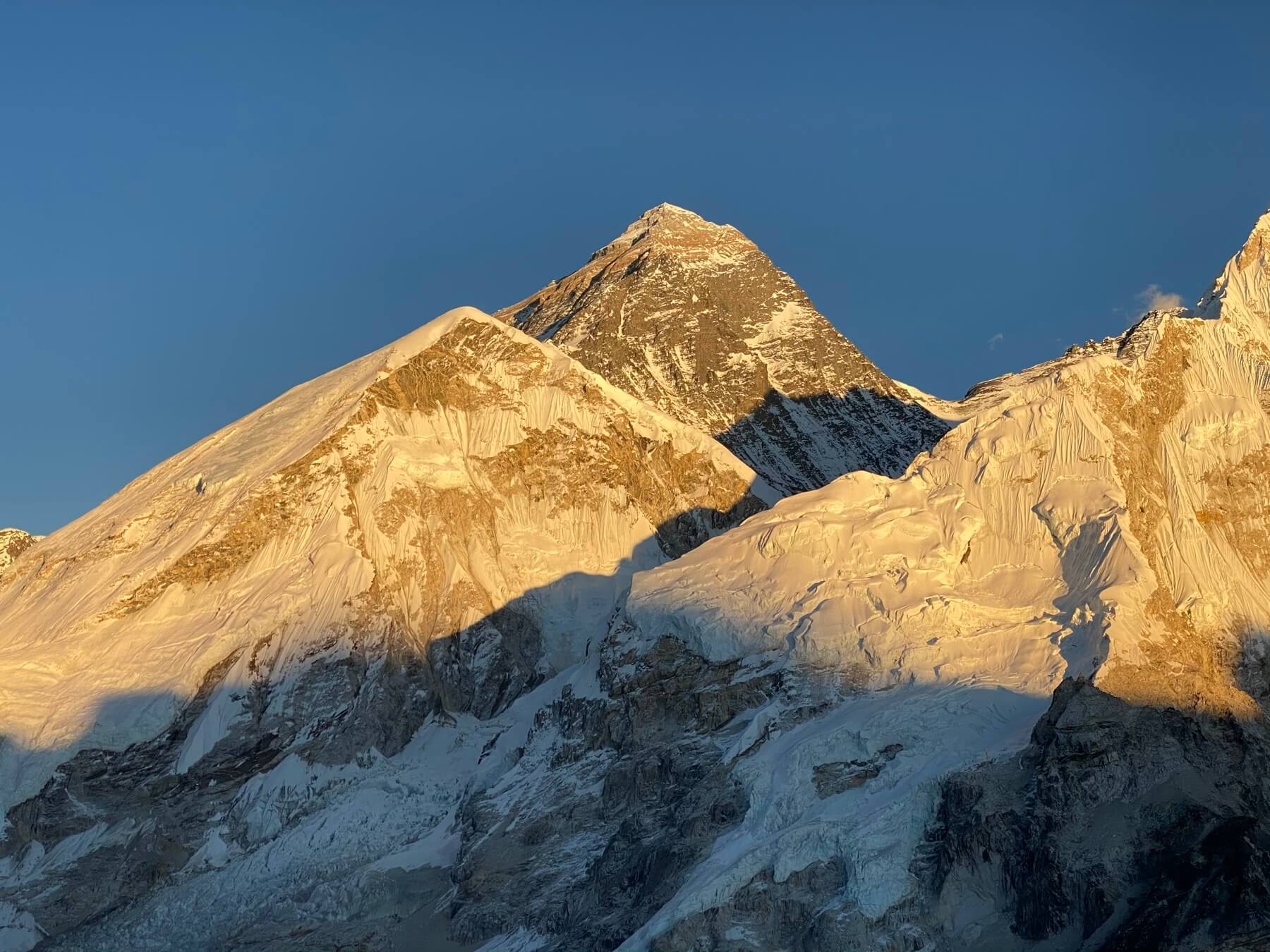
Climbing Everest — a complete 52-day expedition on the south route, through Base Camp in Nepal and the South Col. The programme covers two acclimatisation rotations, four high camps, a personal Sherpa, oxygen and a long reserve for choosing the weather window.
- Everest, 8848 m
- Approach through the Khumbu valley
- Four high camps up to the South Col, 8000 m
- A personal high-altitude Sherpa for every participant
- Individual support from the top camp to the summit
- Five 4-litre oxygen cylinders per participant
- Doctor, liaison officer, cook and expedition staff
- Twelve reserve days
- Expedition leader for groups of 3 participants or more
This is a programme for established high-altitude mountaineers, not a first big mountain. You need a confirmed record of living in high camps, confident work on fixed ropes and in crampons, competence with oxygen equipment, a high degree of self-sufficiency and the readiness to act on the leader's decision to turn around.
The current price, the dates and the individual composition of the expedition team are confirmed before booking.
Important:
- The internal flight to Lukla and the helicopter flight out of Base Camp to Kathmandu are classified in the source tariff neither as included nor as additional services
- The optional helicopter descent to Namche Bazaar for recovery is arranged and paid for separately unless confirmed otherwise
- The personal Sherpa's summit bonus and any additional oxygen are paid for separately
- Reaching the summit is not guaranteed and depends on the weather, the state of the route, acclimatisation and the leader's decision
- Mountain Guide does not sell air tickets and does not process visas
About the Everest expedition
Everest is the highest point on the planet and the final objective of many mountaineering projects that take years to build. The south route from Nepal begins with the approach through the Khumbu valley and passes Base Camp at 5350 m, four high camps and the South Col at 8000 m. Even with organised infrastructure this is one of the longest and most dangerous commercial expeditions there is.
The first ten days are given to the gradual approach through Lukla, Phakding, Namche Bazaar, Tengboche, Dingboche and Lobuche. Two nights in Namche and a separate day in Lobuche help you assess how your body is reacting before Base Camp. Trekking acclimatisation is only the beginning: after it, participants spend several weeks in rotations.
The first rotation includes nights in the camps at 6100 m and 6400 m. On the second, participants climb through those camps again and go up to 7300 m before returning. After a long recovery the team starts the summit cycle: camp at 6100 m, camp at 6400 m, camp at 7300 m, the South Col at 8000 m and the summit attempt.
Every participant has a personal high-altitude Sherpa, and from the top camp the support is individual. The included set consists of two masks with regulators and five four-litre oxygen cylinders per participant, for use above 7400 m. Additional cylinders and the Sherpa’s summit bonus are paid for separately.
Everest should not be a first experience in the zone of extreme altitude. Successful 7000 m peaks, technical self-sufficiency and experience of a long expedition are needed beforehand; final admission is decided after a review of your climbing record. A practical intermediate objective is an 8000 m expedition of shorter duration.
Altitude illness, crevasses, avalanche conditions, cold, wind, frostbite, exhaustion and queues on the fixed sections all remain objective risks. A Mountain Guide expedition leader works with groups of 3 participants or more, but neither a guide nor oxygen can remove the physiological limits of extreme altitude.
Everest climbing programme, 52 days
Day 1. Arrival in Kathmandu.
Participants fly to Kathmandu independently, where a member of the team meets them and takes them to the hotel. In the evening there is an introduction to the leader, the guides and the other participants, a briefing and a first check of documents. The day is needed for recovery and for the start of the expedition preparation. Night in a hotel.
Day 2. Preparation in Kathmandu.
The team checks personal equipment, oxygen components and baggage, obtains anything missing and prepares the documents for the flight. Unsuitable equipment must be replaced before departure. The remaining time is for rest. Night in a hotel.
Day 3. Flight to Lukla, 2800 m, and the walk to Phakding, 2640 m.
Early in the morning the group flies to Lukla from the airport confirmed before the trip. After collecting the baggage the first easy stage to Phakding begins. Sleeping below Lukla lets the acclimatisation start without an unnecessary gain in altitude. Night in a lodge.
Day 4. Walk to Namche Bazaar, 3446 m.
The route follows the Dudh Koshi valley, crosses suspension bridges and climbs to the main settlement of the Khumbu. This is the first serious high-altitude load. The leader watches the pace, the drinking regime and how each participant is feeling. Night in a lodge.
Day 5. Acclimatisation in Namche Bazaar.
The group walks up towards the Everest View area and returns to the same overnight altitude. The purpose of the day is to gain extra altitude without moving camp and to assess the body’s reaction. After the descent, participants rest and prepare for Tengboche. Night in a lodge.
Day 6. Walk to Tengboche, 3867 m.
The trail leads to Tengboche monastery and opens up views of Everest, Lhotse and Ama Dablam. The stage continues the steady gain in altitude. After arrival, recovery and preparation for a night above 4300 m matter. Night in a lodge.
Day 7. Walk to Dingboche, 4340 m, or Pheriche.
The group climbs through high valleys and pastures. Which of the two places is used for the night is set by the programme and by the condition of the team. This stage creates an intermediate acclimatisation step before Lobuche. Night in a lodge.
Day 8. Walk to Lobuche, 4900 m.
The route reaches moraine and glacial terrain. At this altitude recovery slows down, so the pace stays unhurried. On arrival, participants rest and prepare for a second night in Lobuche. Night in a lodge.
Day 9. Acclimatisation in Lobuche.
The group stays at the same altitude and makes an accessible walk with a return to camp. The leader assesses how each participant is feeling and whether they are ready to move to Base Camp. Night in a lodge.
Day 10. Walk to Everest Base Camp, 5350 m.
Participants reach Base Camp and change over to expedition life. After settling in, the team goes through the infrastructure, the radio rules and the daily routine. The first hours are used to rest and adapt to sleeping permanently above 5000 m. Night in tents.
Days 11–13. Rest, training and preparation at Base Camp.
The team runs snow and ice sessions and checks personal technique, oxygen equipment and the procedure for moving on fixed ropes. Acclimatisation walks alternate with recovery. Clearance for the first rotation depends on each participant’s condition and on the quality of their work. Nights in tents.
Day 14. First rotation — climb to the camp at 6100 m.
The group makes its first acclimatisation departure from Base Camp. The task of the day is to cover the route safely to the first high-altitude night, and to check the pace and the handling of equipment. After settling in, participants prepare their kit for the next stage. Night in tents.
Day 15. Climb to the camp at 6400 m.
The team continues to gain altitude and spends the second night of the rotation. The thin air noticeably slows both movement and recovery. The leader assesses the participants’ condition before the descent. Night in tents.
Days 16–19. Descent and recovery at Base Camp.
The group returns to Base Camp, rests, restores its fluid balance and reviews the first rotation. Equipment is serviced and prepared for the next departure. The length of the recovery may be adjusted by the leader. Nights in tents.
Day 20. Second rotation — climb to the camp at 6100 m.
Participants cover the familiar section again. The acclimatisation already gained should improve tolerance of the load, but it does not remove the need to watch the pace and everyone’s condition. Night in tents.
Days 21–22. Acclimatisation at the camp at 6400 m.
The group completes a long high-altitude step and checks its equipment and readiness for a departure above 7000 m. The leader decides who may continue the rotation. Nights in tents.
Day 23. Climb to 7300 m and return to the camp at 6400 m.
Participants climb to the next altitude mark without sleeping there and come back down. This is the key test of acclimatisation before the summit cycle to come. The turnaround time is set in advance and is binding on the whole team. Night in tents.
Day 24. Descent to Base Camp.
After the second rotation the group returns for a long recovery. The leader reviews the speed, the participants’ condition and the resources used, and the team services the equipment. Night in tents.
Days 25–30. Recovery and preparation for the summit cycle.
Participants rest, monitor their health and prepare the oxygen equipment. By choice and where the logistics are confirmed, a paid helicopter descent to Namche Bazaar for recovery is possible; it must not disrupt the return schedule. Where the nights are spent depends on the option chosen.
Day 31. Return to Base Camp.
Participants who went lower come back to Base Camp. The team assembles before the final cycle and checks the forecast, the resources and the readiness of every climber. Night in tents.
Day 32. Final preparation.
Oxygen masks and regulators are checked and cylinders, radios and personal loads distributed. The leader announces the provisional schedule and the turnaround checkpoints. Night in tents.
Day 33. Climb to the camp at 6100 m.
The summit cycle begins. Participants move at the agreed pace and conserve resources for the days that follow. After settling in, the equipment is checked again. Night in tents.
Day 34. Climb to the camp at 6400 m.
The group continues along the familiar section. At this stage food, sleep and faultless handling of equipment are what count. The decision to continue rests with the leader. Night in tents.
Day 35. Climb to the camp at 7300 m.
Participants reach an altitude at which recovery is sharply limited. This is not the South Col yet, but the physiological load is already extreme. After settling in, the team prepares the oxygen and the equipment for the move to 8000 m. Night in tents.
Day 36. Move to the South Col, 8000 m.
The group climbs to the last camp before the summit. Here every extra hour increases exhaustion, so rest, food and the oxygen preparation are organised as quickly as possible. The final decision to set off rests with the leader. Night in tents.
Day 37. Ascent of Everest, 8848 m, and descent to the camp at 6400 m.
The summit push starts at night. Each participant moves with their personal high-altitude Sherpa. The turnaround times are binding however close the summit may be. From the point reached, the group descends by way of the South Col to the camp at 6400 m. This is the longest and most dangerous day of the programme. Night in tents.
Day 38. Descent to Base Camp.
Participants complete the high-altitude section and return to Base Camp. A descent after summit day requires concentration and is not a formality. On arrival there is a medical assessment, food and rest. Night in tents.
Days 39–50. Expedition reserve.
Twelve days are used if the weather changes, if rotations have to be moved or if a different summit window is needed. The reserve does not guarantee a second attempt: whether one is possible depends on oxygen, on the team’s resources and on the state of the route and of the participants. The exact schedule is set by the leader.
Day 51. Helicopter flight from Base Camp to Kathmandu.
In suitable conditions a helicopter flight to Kathmandu is planned. Whether this segment is included and what it costs must be confirmed in writing before booking, because the source tariff does not classify it. On arrival the group checks into the hotel and rests. Night in a hotel.
Day 52. End of the programme.
At the agreed time there is a transfer to the international airport. Participants check in themselves. Choose the international ticket for after the full duration of the programme and allow for possible flight delays. The more detailed sequence of rotations and the use of the reserve days are set by the leader on the spot, according to the weather, the state of the route and the condition of the group.
What the Everest expedition price includes
- Mountain Guide expedition leader with high-altitude experience, for groups of 3 participants or more
- A personal high-altitude Sherpa for every participant, plus Sherpas for the group equipment
- Individual support for each participant from the top camp to the summit
- Meeting and seeing off at Kathmandu international airport
- Hotel accommodation in Kathmandu, for the number of nights set out in the programme
- Lodge accommodation on the trekking section
- Accommodation and meals in tents during the climb
- Porters for the group equipment and food
- A doctor at Base Camp
- A Nepalese liaison officer
- A professional cook and kitchen assistants
- Breakfast, lunch, dinner and snacks on the expedition section
- The Everest climbing permit
- The permits and entry fees required for the confirmed trekking route
- The mandatory rubbish fee
- Breakfasts in Kathmandu
- Group equipment — high-altitude tents, kitchen equipment, gas stoves and ropes
- Rope for preparing the route
- Radios
- Two oxygen mask and regulator sets for each participant and each accompanying Sherpa — for use only
- Five 4-litre oxygen cylinders per participant, for use above 7400 m
- Two 4-litre oxygen cylinders for each accompanying Sherpa
The internal flight to Lukla and the helicopter flight from Base Camp to Kathmandu are not classified in the source list of services. Whether they are included, and at what cost, must be confirmed in writing for the date you choose.
What the Everest expedition price does not include
- International flights
- The Nepal visa — a 90-day visa covers the length of the programme; the fee is set by the Nepalese authorities and paid by the participant
- Mountaineering medical insurance covering climbing to an altitude of at least 8848 m, search and rescue and helicopter evacuation
- Additional yaks for carrying a participant’s personal belongings
- Oxygen cylinders beyond the included quantity
- Personal climbing and trekking equipment, unless otherwise confirmed in the contract
- Meals in Kathmandu other than breakfasts — approximately USD 20–30 a day
- The personal high-altitude Sherpa’s bonus on reaching the summit
- Tips for the expedition staff
- The optional helicopter descent to Namche Bazaar for recovery
- Search, rescue and transportation operations
- Additional nights at the hotel in Kathmandu
- Costs arising from ending your participation early
- Additional costs caused by the weather, the state of the route or a forced change to the programme