Trekking in Nepal is one of the most accessible ways to find yourself among the highest mountains on Earth without turning your holiday into a mountaineering expedition. Here you can walk to Everest Base Camp, see four eight-thousanders from Gokyo Ri, enter the Annapurna amphitheatre, walk round Manaslu and reach the remote valleys of Makalu and Kangchenjunga. Most of these routes need no crampons, no ropes and no experience of technical climbing. What they need is the right choice of programme, physical preparation, acclimatisation in sequence and a readiness to live for several days in genuinely high mountains.
“Seeing 8000” is neither a marketing figure of speech nor a promise of one panorama with all the mountains at once. Eight of the world’s fourteen recognised eight-thousanders are in Nepal: Everest, Kangchenjunga, Lhotse, Makalu, Cho Oyu, Dhaulagiri, Manaslu and Annapurna I. They stand in different parts of the country, so each big massif has its own trek, its own character and its own audience. This page helps you choose not the best-known route but your route.
We will find the route to match your experience, your dates and your dream
Write and tell us how many days you have, where you have already walked, how you coped with altitude and what matters more: Everest, comfortable lodges, a quiet path, a high viewpoint or the fullest possible route. We will narrow the choice to two or three programmes and explain the difference honestly.
The people who opened up these mountains. Before you choose a route, read the story of the great climbers of Nepal – from the Everest team of 1953 to the Sherpa leaders of today.
What “seeing an eight-thousander” means
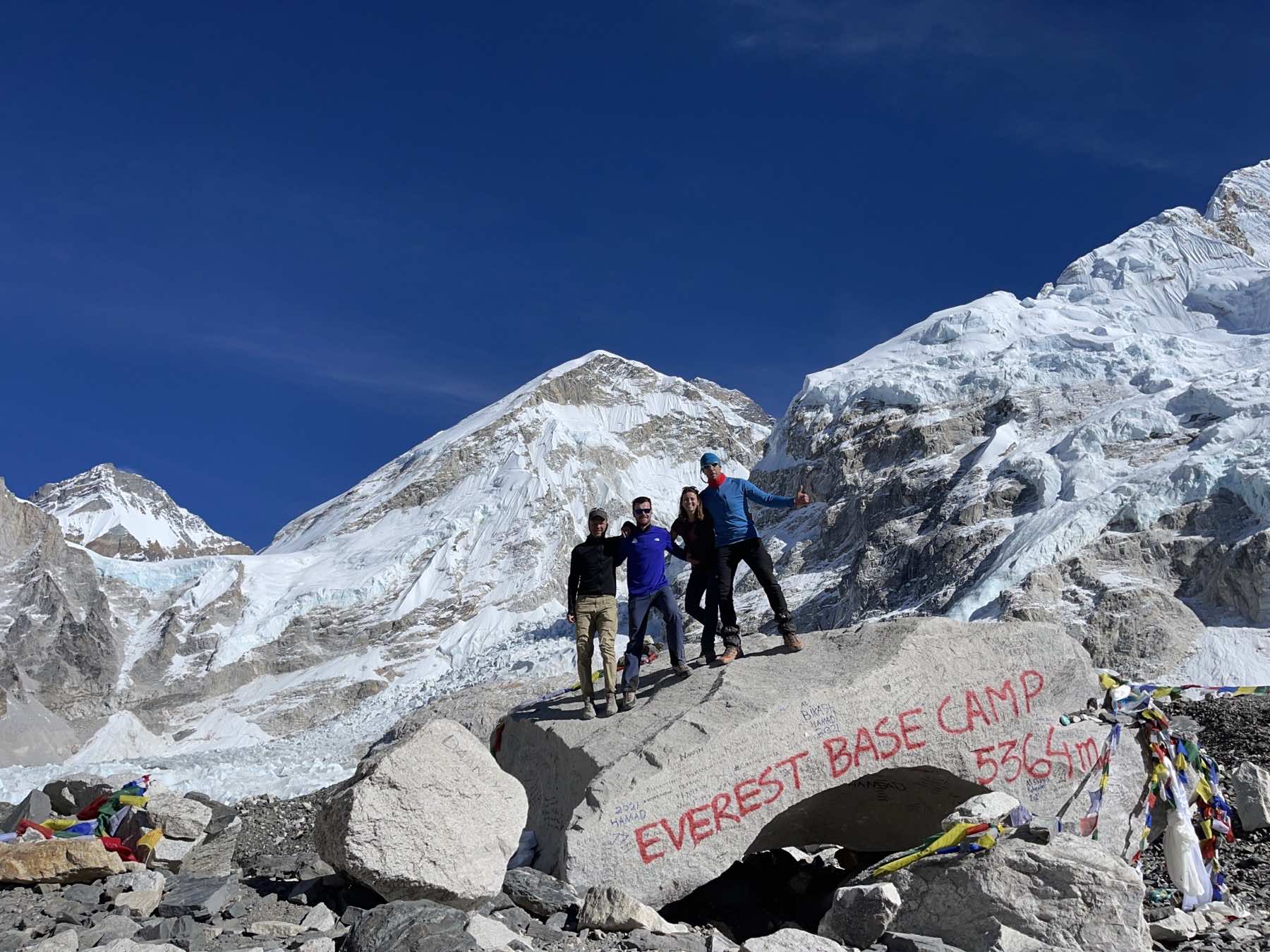
You can see an eight-thousander from a distance, walk up to its glacier, stand in its base camp or climb a viewpoint summit opposite it. Those are four very different experiences. The name of a trek does not always tell you where the best view will be. Everest Base Camp, for instance, matters as a historic and geographical place by the Khumbu icefall, but the classic panorama of the summit itself comes above all from Kala Patthar and from viewpoints along the way. Gokyo Ri is valued for its wide outlook, where in clear weather Everest, Lhotse, Makalu and Cho Oyu all appear in one panorama. At Annapurna Base Camp you are not looking at the massif from a distance – you walk inside a mountain amphitheatre and meet the dawn beneath the walls of Annapurna I and its neighbours.
So the right question is not “which trek leads to an eight-thousander” but “what kind of meeting with a big mountain do I want”. For one person it is the legend of Everest and the road through Namche Bazaar. For another it is the changing natural zones and the great circuit around Annapurna. For a third it is quiet, simple lodges and a sense of remoteness at Makalu or Kangchenjunga. For a fourth it is gathering several eight-thousanders as a visual collection, without their summits as a goal.
The view of any particular summit also depends on cloud, rain and the state of the route. No conscientious organiser can guarantee a cloudless sky at an appointed hour. The job of a good programme is to choose the right season, give the route enough time and not force a participant to skip the key viewpoints because the schedule is too tight.
The eight eight-thousanders of Nepal and the routes to them
The list of eight Nepalese eight-thousanders is often given as a piece of reference, but for a traveller it is more useful to understand the geography. Some of the mountains belong to a single panorama in the Everest region; others need a separate journey right across the country. Annapurna and Dhaulagiri open up in central Nepal; Manaslu has a circuit of its own; Kangchenjunga and Makalu are far to the east. Seeing all eight is no longer one holiday but a fine programme of travel spread over years.
| Eight-thousander | How to get to know the mountain | A suitable Mountain Guide route |
|---|---|---|
| Everest | The classic Khumbu valley, base camp and Kala Patthar; the wider panorama through Gokyo | Everest Base Camp or Everest by way of the Gokyo lakes |
| Lhotse | Everest’s constant neighbour in the upper Khumbu; particularly striking from the viewpoints on the route | The classic Everest trek and the route through Gokyo |
| Makalu | A distant view from Gokyo Ri, or a separate deep expedition up the Barun valley to the foot of the massif | Makalu Base Camp |
| Cho Oyu | One of the main eight-thousanders in the Gokyo Ri panorama | Everest by way of the Gokyo lakes |
| Annapurna I | A close encounter in the high amphitheatre of the Annapurna Sanctuary | Annapurna Base Camp |
| Dhaulagiri | Panoramas of the Annapurna region and of the western part of the routes through Poon Hill, Muktinath and the Kali Gandaki valley | Annapurna Base Camp or the Annapurna Circuit and Tilicho |
| Manaslu | The full crossing around the massif through the Budhi Gandaki valley and over the Larke La | The Manaslu Circuit |
| Kangchenjunga | The long road to the northern side of the massif, or the full route with a crossing to the southern side | The short Kangchenjunga or the long route |
Not every good trek in Nepal has to lead to an eight-thousander. Langtang and the Gosaikunda lakes give you a powerful Himalayan journey at a lower maximum altitude, with no flight to Lukla and no need to choose a route by the loudness of a summit’s name alone. As a first taste of Nepal that is sometimes wiser than going straight to Everest.
How to choose a trek in Nepal: a comparison of the main routes
The difficulty grade on a tour card is a useful guide but not a complete answer. Two routes in the same category can feel entirely different. On one the decisive factor will be altitude, on another the length and the repeated height gains, on a third simple lodges and distance from any road. A short Everest programme does not become easy simply because it takes ten days: the top point is the same and there is less time for the trip. A VIP format does not lower the altitude or remove the need to walk – it changes what is included and how much practical load you carry.
| Route | Days | Key altitude | The main reason to choose it | Who it suits |
|---|---|---|---|---|
| Annapurna Base Camp | 13 | About 4100 m | A mountain amphitheatre, Poon Hill, forests and gentler altitude | A first big trek, if Everest still seems too high |
| Everest Base Camp | 14 | Kala Patthar, 5645 m | The classic road to Everest and the Khumbu glacier | A prepared newcomer with a normal margin of time |
| Everest through Gokyo | 15 | Up to 5645 m | Base camp, the Cho La, the lakes and a panorama of four eight-thousanders | For anyone who wants the most of Khumbu and is ready for the pass |
| Everest in 10 days | 10 | Kala Patthar, 5645 m | The classic way up with the return shortened by helicopter | For a hard holiday limit and good physical condition |
| VIP trekking to Everest | 14 | Kala Patthar, 5645 m | An extended package, meals, a porter and internal logistics | For anyone who wants fewer organisational worries but understands the altitude |
| The Annapurna Circuit and Tilicho | 14 | The Thorong La, 5416 m | The most marked change of landscape, a lake and a big pass | For anyone to whom the journey and its variety matter more than one base camp |
| The Manaslu Circuit | 15 | The Larke La, 5160 m | A less crowded region, long days and a self-reliant character | For those who have already done multi-day routes, or well-prepared newcomers |
| Langtang and Gosaikunda | 14 | About 4361 m | A valley, monasteries, forests and high-mountain lakes, with no Lukla | A first Nepal, moderate altitude, an interest in culture and nature |
| Makalu Base Camp | 16 | About 4870 m | The Barun valley and one of the most remote regions in the country | For those who value quiet above comfort and popularity |
| Kangchenjunga, the short route | 16 | Pangpema and high-altitude day walks | The northern side of the third-highest mountain in the world without the full circuit | For experienced trekkers with limited time |
| Kangchenjunga, the long route | 19 | High passes and base camps | The fullest expedition in remote eastern Nepal | For those who now find the crowded paths too small |
The lengths and the key altitudes are taken from the current Mountain Guide programmes. Before you buy, check the specific date, what is included and the current programme: in the mountains, logistics and the availability of individual sections can change.
The Everest region: the classic, Gokyo, the short and the VIP format
Khumbu is the most recognisable mountain region in Nepal. The route starts with internal logistics to Lukla, runs along the Dudh Koshi, crosses suspension bridges, passes Namche Bazaar and the villages and monasteries of the Sherpa country, then climbs above the treeline into glacial terrain. Everest is not in front of you continuously: the terrain hides the summit and reveals it again, and in the upper valley the panorama is also shaped by Lhotse, Nuptse, Pumori and Ama Dablam.
The classic Everest Base Camp
The best choice when the legendary road itself is what matters: Namche Bazaar, Tengboche, the upper Khumbu valley, base camp and the climb of Kala Patthar. Fourteen days give a more natural structure than trying to fit the same altitude into a short holiday.
Everest by way of the Gokyo lakes
The route for someone who does not want to choose between base camp and the other part of Khumbu. The programme joins Kala Patthar, base camp, the Cho La, the Ngozumpa glacier, the Gokyo lakes and Gokyo Ri. It is fuller than the classic and calls for a more serious attitude to the crossing of the pass.
The short Everest trek
The ten-day programme saves days by using helicopter logistics on the way back, but it does not reduce the altitude of the upper part of the route. This is an option not for an unprepared person but for a participant with a hard time limit, who understands the price of a tight schedule and leaves a margin around the international flight in advance.
VIP trekking
VIP here does not mean a different mountain, and it is not a promise of a Kathmandu-standard hotel at any altitude. It is the classic fourteen-day route in an extended package: the main internal flights, transfers, meals in the mountains and a porter are already gathered into one product. The physical work and the acclimatisation remain entirely real.
If you are hesitating between the four options, start with the detailed comparison of base camp, Gokyo, the short programme and VIP trekking. That article covers not only the names but the logic of each route, its length and the kind of participant each format makes sense for.
Annapurna: base camp or the great circuit
Annapurna is not one trek but two fundamentally different journeys. Base camp leads inside the Annapurna Sanctuary: through villages, forests and a gorge to a high mountain amphitheatre. The circuit goes around the massif, through the Marsyangdi valley, Manang, Lake Tilicho, the Thorong La and Muktinath. Their dramatic shape is different, although one mountain gives its name to both.
Annapurna Base Camp
This is the clearest alternative to Everest for a first big Himalayan trek. A maximum altitude of about 4100 m is markedly gentler than 5645 m on Kala Patthar, but the route does not turn into a stroll: every day still holds ascents and descents, staircases, damp forest sections, changing weather and the load of several days in a row. The reward is dawn on Poon Hill, Machapuchare base camp, a gradual entry into the high mountains and the closeness of the Annapurna walls at the end.
This programme is worth choosing if it is your first trip to Nepal, you want to stay in lodges rather than tents, you are not chasing the highest possible figure and you value the combination of the landscape with Pokhara. For a family with a teenager, or for a group of mixed ability, it is often more realistic, though the decision is still taken on actual health and preparation rather than on age alone.
The Annapurna Circuit and Lake Tilicho
The circuit is a route for people who love not the end point but the great crossing. Over two weeks the climate, the architecture of the villages, the vegetation and the very shape of the mountains all change. An acclimatisation day in Manang prepares you for the upper part; a separate line leads to Tilicho; the Thorong La at 5416 m becomes the main physical and altitude test.
Compared with Everest Base Camp there is less of the feeling of a pilgrimage to one famous goal and more of a complete journey through a country. Compared with Annapurna Base Camp the highest point is higher and the altitude section is harder. If you want to “see several Nepals in one trip”, the circuit is almost always stronger than a short there-and-back route.
Manaslu and Langtang: when you do not want to follow the majority
The Manaslu Circuit
Manaslu is often called an alternative to the old Annapurna Circuit, but it is more accurate to treat it as a route in its own right. The path climbs the Budhi Gandaki valley, passes villages with a strong Tibetan cultural influence, leads to Samagaon and then to the Larke La. The main mountain reveals itself gradually rather than in a single postcard. There is less tourist infrastructure on the route, the lodges are simpler and the days can be longer, and that is exactly what many people consider its advantage.
The Manaslu Circuit suits a participant who already knows they enjoy walking day after day, or a newcomer with convincing preparation and a calm attitude to simple living. If you need maximum comfort, plenty of cafés and the feeling of a busy international trail, Khumbu will make more sense. If you want a complete road around an eight-thousander and a sense of remoteness without a fully tented expedition, Manaslu is the more exact fit.
Langtang and the Gosaikunda lakes
Langtang does not build its appeal around an eight-thousander, and that is its strength. The route joins a Himalayan valley, Kyanjin Gompa, Tamang villages, forests and the sacred Gosaikunda lakes. The maximum altitude of the programme is about 4361 m, so the altitude task remains serious but does not reach the level of Kala Patthar or the Thorong La. The start needs no flight to Lukla, so one of the elements of Everest-region logistics that is most sensitive to weather disappears.
Langtang is worth considering for a first Nepal if you want a more intimate journey, a combination of nature and culture, and less dependence on the loud name of an end point. It is also a good answer for someone who dreams of the Himalaya but is not yet sure they want to go above 5000 m.
Makalu and Kangchenjunga: Nepal for those who have worked out the crowded trails
Remote regions cannot be sold as “the same Everest, only without the people”. Different logistics, simpler lodges, less choice of food, a longer journey to the start of the trek and fewer chances to change the plan quickly make Makalu and Kangchenjunga a class of journey of their own. In exchange, the sense of an expedition is stronger, and the route does not dissolve into a stream of other people’s groups.
Makalu Base Camp
The sixteen-day route runs through eastern Nepal and the Barun valley to the foot of the fifth-highest mountain in the world. Along the way the forests, waterfalls, stony valleys and glacial terrain change one after another. The key altitude of base camp is about 4870 m: a figure lower than Kala Patthar, but the practical and logistical remoteness adds its own difficulty. This is not a route for someone who chooses Nepal from photographs of the cafés in Namche Bazaar. It is for someone to whom quiet and a rarely visited region matter more than predictable comfort.
The short Kangchenjunga route
Sixteen days lead to the northern side of the massif by way of Ghunsa, Kambachen and Lhonak to Pangpema. The programme keeps the main meeting with Kangchenjunga but does not continue over a series of passes to the southern side. It is not a “lighter” option in any practical sense: the region is still remote, the lodges are still simple and the altitude is still real. What is saved is above all time, and part of the distance.
The long route around Kangchenjunga
The nineteen-day programme is one of the most serious trekking expeditions in the catalogue. It joins the northern part, high passes and the approach to the Yalung glacier on the southern side of the massif. This is a route for someone who already knows how they respond to several days of effort, who can live more simply and who does not need daily confirmation that they have chosen a “popular place”. Kangchenjunga here is not a backdrop but the reason to cross a whole region.
Kangchenjunga from the Indian side
Trekking in Sikkim shows the same massif from the south-west and runs in a tented format. This is no longer Nepal, so the route cannot be counted as another variant of a Nepalese trek. It is included in the comparison for anyone who is choosing Kangchenjunga above all and wants to see a different culture, landscape and angle on the great mountain.
The first three cards are routes in Nepal. The fourth is a separate programme in Indian Sikkim: it is added only as an honest comparison of the two sides of Kangchenjunga and is not one of the page’s 11 Nepalese routes.
Altitude, difficulty and acclimatisation
Nepal deceives you visually: in photographs the trail looks simple, because on most of the classic routes there is no rock climbing and no difficult technique. But technical simplicity is not the same as physical ease. At altitude a person recovers more slowly, sleeps worse and reacts more strongly to cold and dehydration. An ordinary flight of steps after several days on the move feels quite unlike the same effort at home.
The main measure is not a record daily distance but the combination of sleeping altitude, height gained, the length of the days, the number of consecutive days and the quality of recovery. That is why comparing treks by their highest point alone is wrong. Annapurna Base Camp is lower, but the route contains numerous descents and ascents. Manaslu does not reach the altitude of Kala Patthar, but the long days, the pass and the simpler living create a different load. The short Everest keeps the same altitude as the classic but leaves less time for the whole trip.
What normal acclimatisation looks like
Acclimatisation is not a day without movement, and not a formal line in a programme. The body adapts gradually to the fall in oxygen pressure, and the route has to give time to watch how a participant responds. On the classic Everest a day around Namche Bazaar matters; on the Annapurna Circuit, adaptation in Manang; on Manaslu, time in Samagaon; on the remote routes, the sequence of sleeping altitudes and day walks. Wanting the process to go faster does not make it go faster.
Good fitness helps you cope more easily with the walking, but it gives no immunity from altitude sickness. An experienced runner may feel the altitude more strongly than someone of moderate fitness who is already familiar with acclimatisation. So an honest history of past trips matters more than a sporting CV: where you slept, what your maximum altitude was, whether your head ached, whether your appetite disappeared, how you slept, whether you had to descend.
How to assess yourself before booking
- You can walk for several hours at a stretch on two consecutive days and still recover normally
- You are ready to train in advance rather than counting on “getting into it on the route”
- You take early starts, cold, dust, rain and simple living in your stride
- You are ready to report how you feel without trying to look stronger than the group
- You leave the guide the right to change the pace and to take the safety decisions
- You understand that the weather can change the internal logistics and the visibility of the mountains
If the answer to several of those is no, it does not mean Nepal is closed to you. Perhaps what you need is Langtang, Annapurna Base Camp, a private pace or a later date after some preparation. Sometimes the best route is the one a person walks with pleasure, not the one whose name impresses their friends more.
When to go trekking in Nepal
The main trekking seasons are tied to the periods before and after the summer monsoon. In spring it grows warmer, the vegetation changes and expedition activity rises on the popular routes. In autumn, after the monsoon, the classic treks are usually chosen for their steady visibility and dry spells. Winter brings cold, short daylight and possible restrictions on the high passes. Summer brings monsoon cloud and rain on many routes, though individual regions and particular objectives need to be considered separately.
You cannot choose a month for “Nepal in general”. The Thorong La, the Cho La and the Larke La are sensitive to snow in a different way from the lower valleys. In remote regions the consequences of weather are harder to make up for logistically. The Everest region depends not only on the state of the trail but on an internal flight. Kangchenjunga and Makalu need a larger margin than a route with quick access to a major tourist centre.
Before choosing a date, read the detailed account of the seasons in Nepal for trekking and climbing. After that, check not an abstract “best month” but the specific programme, its altitude points, its passes and the form of the group.
Why a margin of time is essential
Internal flights, mountain roads and helicopter logistics all depend on the weather. Even a good forecast does not guarantee that an aircraft will leave on schedule. An international ticket, an important event or a work meeting immediately after the trek turns an ordinary delay into an expensive problem. We recommend agreeing international tickets after the programme is confirmed and leaving a margin that matches the route.
Lodges, food, showers, electricity and internet
Most of the Nepalese treks presented here run with lodge accommodation rather than tents. That is one of the reasons Nepal suits someone with no expedition experience. But the word “lodge” covers very different conditions. In the lower villages there may be private rooms, a shower, Wi-Fi and a comfortable common area. Higher up there are colder rooms, simple plumbing, limited hot water and charging you pay for. On the remote routes there is less choice than in Khumbu or the Annapurna region.
Heating in the bedroom cannot be treated as a basic service. The main warm area is often the shared dining room, and at night your comfort comes from a properly chosen sleeping bag and dry clothing. A hot shower and internet may be available for an extra charge, may work unreliably or may disappear on certain sections. A socket by the bed is no guarantee: you need a power bank and a plan for charging.
Food on the popular trails is more varied than many participants expect, but at altitude the menu and the quality of supply both change. The body may take heavy familiar food less well, the appetite falls, and eating and drinking enough remain part of recovery. Vegetarian preferences and dietary restrictions have to be given in advance. If it is a matter of an allergy or a medical restriction, the organiser has to know before the booking, not on the evening of the first lodge.
A detailed practical account is on the page “Lodges in Nepal: accommodation, food and communications”. It is more useful than a handsome photograph of a room, because it explains how the conditions change as you gain height and how a busy route differs from a remote one.
Preparation and equipment for trekking in Nepal
Preparation is built around regularity rather than around one heroic training session. A trek tests your ability to walk at a steady pace for many days in a row, to recover, to put the rucksack back on and to keep your attention on the descent. Walking over broken ground, stairs and hills, long aerobic sessions, moderate strength work for the legs and core, and two days out in a row are all useful.
You should train in the boots and with the rucksack that are going to Nepal. New boots put on for the first time in Lukla can ruin a route before the altitude does. A personal rucksack that is too heavy increases the load on your knees and slows your pace; too thin a warm layer makes every stop miserable. The equipment has to match the specific trek and season, not an abstract list “for the Himalaya”.
A short list of what really determines your comfort
- Broken-in trekking boots that hold the foot properly
- A layering system: base, insulating and protective against wind and rain
- A warm jacket for mornings, evenings and stops at altitude
- A sleeping bag that matches the season and the sleeping altitudes
- Trekking poles, particularly useful on long descents and stone steps
- Sun protection: sunglasses, a hat and clothing that covers the skin
- A small day rucksack that is not overloaded with things you do not need
- A hydration system or bottles that are easy to use on the move
- A power bank and a clear plan for charging your devices
- A personal first-aid kit with no experimental drugs and no one else’s treatment regime
To build a training plan, use the article on preparing for trekking and climbing in Nepal. For choosing particular items, the articles on trekking boots and on trekking poles. Always take the final list from the programme you have chosen: the kit for Annapurna Base Camp and for the Cho La should not be identical on the principle that “Nepal is all the same”.
Documents and insurance
For the trip you need a valid passport, entry documents according to your citizenship, route permits and medical insurance that explicitly covers trekking, the actual maximum altitude of the programme, search and rescue and evacuation. Ordinary travel insurance with a low altitude limit may not match the route, even if it is formally valid in Nepal.
Requirements for visas, TIMS, permits for individual regions and the procedure for obtaining them can change. Do not copy an old note from a forum and do not buy a policy on price alone. Before departure, check the current checklist of documents, visas and insurance for Nepal, and then confirm the details for your own programme and citizenship.
A Russian-speaking leader, a local guide or a private group
The phrase “a tour with a guide” is not enough to understand the product. On one programme the group may be led by a Russian-speaking Mountain Guide leader together with a local team, on another there is a local licensed guide, on a third the format depends on the date and the size of the group. This affects the language of the daily briefings, the support during preparation, the price and the dynamics of the group. You need to see the format in the specific offer rather than assume it from the company’s logo.
A scheduled group with a Russian-speaking leader
Suits those for whom it matters to discuss how they feel, the pace, the practical side and the decisions in Russian. Group dynamics help on a long route, but they mean keeping to a shared schedule. The leaders are confirmed for the specific date; promising the same person on every departure without that confirmation would be wrong.
A programme with a local guide
A local guide knows the region and the operational side of the route well. This format can be more affordable and more flexible on dates, but the participant needs to understand in advance what language will be used, how much support there is before arrival and what is included. If your English is not good enough for a precise conversation about symptoms and decisions, that is a substantial factor rather than a small practical detail.
A private or individual group
A private format lets you choose the dates, the pace and the set of extra services to suit a family, a group of friends or a corporate group. It does not give you the right to cut acclimatisation to a dangerous level and it does not guarantee that you reach the end point. What it does allow is settling in advance the questions of porters, single accommodation where it is genuinely available, extra days in Kathmandu or Pokhara, and a sensible margin.
A comparison of the forms of support is gathered on the page for tours to Nepal with a Russian-speaking guide. You can get to know part of the team in the section “Our guides”.
Can I go with children?
Age on its own does not determine readiness for a high-mountain trek. The catalogue gives minimum age guidelines for particular programmes, but the decision is taken on the child’s experience, health, ability to walk for many days without pressure, response to cold, and the presence of an adult who is ready to change the plan for their sake. Annapurna Base Camp and Langtang carry a lower age threshold than routes above 5000 m, but that is not an automatic permission to take part.
A family trip is better built as a private one: agreeing the pace, the fallback scenarios, the porters, the accommodation and the point at which the accompanying adult can safely end the route. A family’s final goal is a good journey, not a collective obligation to reach a signpost at any cost.
What makes up the price of a trek in Nepal
Two programmes with similar names may differ not in mark-up but in content. The price is affected by internal flights and transfers, the number of nights in Kathmandu or Pokhara, meals on the trek, porter services, the form of guiding, the permits, single or twin accommodation, reserve days and how remote the region is. The VIP Everest programme costs more than the classic not because the mountains become easier but because more of the key services are gathered into the package.
Do not compare the final figure alone. Write out what you will have to pay for daily on the ground: food, water, showers, charging, Wi-Fi, porter services, tips, internal logistics and the cost of delays. Check separately which currency the price is fixed in and how the rouble equivalent is calculated. The cheapest headline sometimes turns into the more expensive trip once the unavoidable costs are added up.
What to ask before you pay
- Exactly who accompanies the group and in what language the briefings are held
- Which internal flights and ground transfers are included
- Whether meals in the mountains and in the towns are included
- Whether a porter is included and what weight of personal load he carries
- Which permits the organiser obtains
- What type of accommodation is provided at each stage
- What happens if an internal flight is delayed or the route changes
- What insurance is required for the altitude and the type of activity
- When you can buy the international ticket
- Which payments the participant will still have to make on the route
If the answers are vague, it is too early to compare programmes on price. First bring the offers to the same content, and then decide which services you are willing to pay for.
Practical reading before the trip
A large landing page should not repeat every note in full. Below are the articles that cover the questions that arise between choosing a route and flying out:
- All tours to Nepal: treks, summits and cultural programmes
- Which Everest trek to choose: classic, Gokyo, short or VIP
- Preparing for trekking and climbing in Nepal
- Seasons in Nepal: when to go to the mountains
- Lodges, food, showers, electricity and communications
- Documents, visas, permits and insurance
- Altitude sickness: symptoms and the right response
- First time in Nepal: the experience of a first trip
- Why the Manaslu Circuit is underrated
- On trekking to Kangchenjunga Base Camp
Continuing the collection: Pakistan, India and the other eight-thousanders
Nepal gives access to eight eight-thousanders, but the whole classic collection consists of fourteen. K2, Broad Peak, Gasherbrum I and Gasherbrum II are in the Karakoram; Nanga Parbat is a massif of its own in Pakistan; Shishapangma is in Tibet. For a trekker, the logical continuation after Nepal is not an attempt to “close the list” in one trip but getting to know a different kind of big mountain.
K2 Base Camp
The trek to K2 Base Camp runs in Pakistan along the Baltoro glacier and belongs to a more self-sufficient class of journey. Here there are tents, a long glacier section and an entirely different way of living. K2 and the other Karakoram eight-thousanders form a severe panorama, but the price of that closeness is an expedition regime that cannot be compared directly with a lodge trek in Nepal.
Nanga Parbat
The route to Nanga Parbat also calls for a separate assessment of the current programme, the logistics and what is included. It is not a “short addition to K2”: the mountain is in another region, and the trip has to be treated as an objective in its own right.
Why Mountain Guide
Our job is not to sell Everest to everybody. Mountain Guide has several routes in one region and different forms of support, so we can compare them by their logic rather than argue that a single product suits everyone. Sometimes the result of a consultation is the classic Everest Base Camp. Sometimes it is Annapurna, because the altitude is gentler. Sometimes it is Manaslu or Makalu, because quiet matters more to the person. Sometimes we recommend preparing first, or choosing a different season.
Before the start we help you check the programme, the documents, the insurance, the equipment and the preparation. On the route, decisions are taken on the weather, the state of the trail and how the participants feel. A guide cannot cancel the altitude or guarantee a clear sky, but he can set the pace, watch how the group is doing, discuss symptoms in good time and avoid turning the end point into an obligation at any cost.
If you have already chosen a region, send us the date, your experience and your questions. If all you have so far is the dream of “seeing Everest” or “being among the eight-thousanders”, that is enough to start with. We will translate the dream into the language of a real route.
Frequently asked questions about trekking in Nepal
Which trek in Nepal is best for a first time?
If the main goal is Everest and you are ready for the altitude, choose the classic fourteen-day programme. If a gentler altitude and a varied landscape matter more, Annapurna Base Camp is often the wiser choice. For moderate altitude, a valley and lakes, Langtang is worth considering. The best first route is determined not by popularity but by experience, the length of your holiday and how you respond to altitude.
Can a beginner reach Everest Base Camp?
Technical mountaineering experience is not necessary, but you need physical preparation and a readiness to walk at altitude for many days. For a beginner it matters more to choose a full programme with acclimatisation than the shortest one. Before booking you need an honest discussion of your health, your past trips to altitude and your training plan.
Can you see Everest from base camp?
Base camp matters as a point by the Khumbu icefall, but the classic wide view of the summit comes from the viewpoints along the route, above all from Kala Patthar. So a good Everest trek is not only reaching base camp but the whole sequence of the Khumbu valley.
Everest or Annapurna: which should I choose?
Everest is stronger as a world legend, higher at its key point and tied to an internal flight to Lukla. Annapurna Base Camp is lower and gives you a close mountain amphitheatre; the Annapurna Circuit is valued for being a large and varied journey with a pass. If the dream is specifically Everest, a substitute will not satisfy it. If the dream is a beautiful Nepal, Annapurna may suit better.
Is Gokyo harder than the classic Everest route?
The route through Gokyo takes in more key points and the high Cho La pass, so it calls for more confident preparation and attention to the conditions on the pass. It is chosen not as “a beautiful addition at no cost” but as a fuller alternative for someone ready for the extra effort.
Is the short Everest trek easier?
No. It is shorter overall thanks to the helicopter shortcut on the way back, but the top point and the altitude load on the way up are unchanged. The short programme solves the holiday problem, not the preparation problem.
Do I need a porter?
A porter reduces the daily load and helps you keep your strength, but he is not responsible for your acclimatisation and does not turn the trek into a trip without walking. The terms and the permitted weight have to be checked in the specific programme. Even with a porter, a participant carries a day rucksack with water, a warm layer, documents and the personal things they need.
Is there internet on the route?
On the popular trails a signal and Wi-Fi are often available, but the quality and availability change with altitude, weather and the particular lodge. On the remote routes the signal is weaker. The internet cannot be used as the only channel for anything critical, and charging has to be planned with a power bank.
When should I buy international tickets?
After the date, the form of the group and the logic of the internal logistics are confirmed. The tickets have to allow for the recommended margin before your commitments at home. It is especially important not to set a non-refundable international departure right up against your return from Lukla or from a remote region.
Can I give a trek in Nepal as a present?
Yes, but it is better not to choose a specific high-altitude programme for someone without a conversation about health, experience and dates. It is safer to give a Mountain Guide certificate, and choose the route and the date together with the recipient.
How to start
Send us four things: the dates you want, the number of days, your experience in the mountains, and the summit or region you want to see. We will suggest two or three routes, compare them without the advertising fog and tell you what needs to be done before the start.