- Guides
- B2B
-
#19607 (no title)
-
#15972 (no title)
- Climb Elbrus Individually
- Climb Elbrus from the South, 9 Days
- Climb Elbrus from the South, 7 Days
- Climb Elbrus from the South with Oxygen
- Climb Elbrus from the North, 10 Days
- Two Summits of Elbrus, 9 Days
- Elbrus Traverse from South to North, 9 Days
- Elbrus Traverse from North to South, 10 Days
- Cross of Elbrus, South to North, 9 Days
- Cross of Elbrus, North to South, 10 Days
- Climb Kazbek and Elbrus — 10-Day Two-Summit Programme
- Climb Elbrus from the West, 11 Days
- Elbrus by Private Helicopter, 3 Days
- Elbrus Region Holiday and Trekking, 9 Days
- Elbrus Region Holiday, 7 Days
- Tinder Tour: Climbing Mount Elbrus, 9 Days
- Climb Elbrus from the South, 9 Days with Sergey Baranov
-
#15539 (no title)
- Climb Carstensz Pyramid, 8 Days with Helicopter Access
- Climb Mont Blanc, 4810 m — 8-Day Guided Ascent
- Climb the Matterhorn, 4478 m — 8-Day Guided Ascent
- Climb Mount Vinson, 15-Day Antarctic Expedition
- Climb Kosciuszko and Travel in Australia, 7 Days
- Climb Fisht, 2868 m — 3-Day Ascent by the 1B Route
- Climb Mount Wilhelm, 6 Days
-
#15546 (no title)
- Climb Kilimanjaro: the Marangu Route
- Climb Kilimanjaro: the Lemosho Route
- Climb Ararat, 5137 m — 7-Day Classic Programme
- Climb Kazbek from the South, 5033 m — 8 Days in Georgia
- Climb Kazbek and Elbrus — 10-Day Two-Summit Programme
- Climb the Volcanoes of Mexico — Orizaba and Iztaccíhuatl, 9 Days
- Climbing Alpamayo — 16-Day Technical Expedition
- Climbing Margaret Peak (Stanley), 5,109 m
- Climbing Mount Kenya: Point Lenana, 4,985 m
- Climb Dykh-Tau by the North Ridge, 13 Days
-
#15554 (no title)
- Aconcagua Climb — 17-Day Guided Expedition
- Island Peak Climb — 18-Day Expedition
- Climb Mera Peak, 6476 m — 16-Day Hinku Valley Programme
- Climb Ama Dablam, 6812 m — 24-Day Expedition with Island Peak
- Climb Island Peak and Mera Peak — 24-Day Two-Summit Expedition
- Aconcagua and Ojos del Salado — 25-Day Combined Expedition
- Ojos del Salado Climb — 15-Day Expedition
- Climb Chimborazo and Cotopaxi — 14-Day Ecuador Programme
- Climb Huascarán — 8-Day Technical Ascent
- Climb Razdelnaya Peak, 6148 m — 15-Day Pamir Expedition
- Climb Denali by the West Buttress, 23 Days
- #15565 (no title)
- #15572 (no title)
-
#15972 (no title)
-
#19592 (no title)
-
See 8000m
- K2 Base Camp Trek via the Gondogoro La
- Everest Base Camp Trek — 14 Days
- Everest Base Camp via Gokyo Lakes — 15 Days
- Short Everest Base Camp Trek in 10 Days
- Annapurna Circuit and Tilicho Lake Trek
- Manaslu Circuit Trek
- Kanchenjunga Circuit Trek (XXL)
- Kanchenjunga North Base Camp Trek (Short)
- Kanchenjunga from India: the Goecha La Trek in Sikkim
- Makalu Base Camp Trek
- Annapurna Base Camp Trek
- South America
- Asia
- Africa
-
Russia
- Elbrus Region Holiday and Trekking, 9 Days
- Elbrus Region Holiday, 7 Days
- Oshten + Kardyvach — 9-Day Western Caucasus Trek
- Lake Kardyvach — 5-Day Base-Camp Trek
- Route 30: Through the Mountains to the Sea, with Oshten — 4 Days
- Trekking in Arkhyz — 7 Days over the Ayulyu Pass
- Gvandra Trek — 7 Days to the Ullu-Kyol Lakes
- Trekking in Dombai — 7 Days with the Murudzhu Lakes
- Europe
-
See 8000m
-
Adventures
-
Africa
- मोरक्को टूर: उत्तरी अफ्रीका का दिल
- चढ़ाई टूबकल और मोरक्को की संस्कृति
- Eritrea: the Dahlak Archipelago and the Rashaida Nomads
- Rwanda: Mountain Gorillas and the Bisoke Volcano
- Ethiopia: Otherworldly Landscapes and the Peoples of the Omo Valley
- युगांडा टूर: क्वीन्स पार्क और माउंटेन गोरिल्ला
- Tanzania Safari: Serengeti, Ngorongoro and Tarangire
- युगांडा टूर: सफेद गैंडे और पर्वत गोरिल्ला
- Zimbabwe and South Africa: Victoria Falls, Cape Town and the Cape of Good Hope
- Namibia: Etosha National Park and the Himba
- Kenya Safari: the African Big Five
- बोत्सवाना टूर: ओकावांगो डेल्टा और चोब पार्क
- South America
- Asia
-
Africa
- Ski-touring
- VIP
- #19722 (no title)
- About
Climb Elbrus from the South, 9 Days
- Height (m)
- 5642
- Duration
- 9 дней
- Difficulty
- Low
- Continent
- Europe
- Children
- From 12 years old
- Accommodation
- Without tents
1760 $
Почему такая цена?
The minimum age for the group trip is 14. A participant under 18 must travel with a parent or legal guardian.
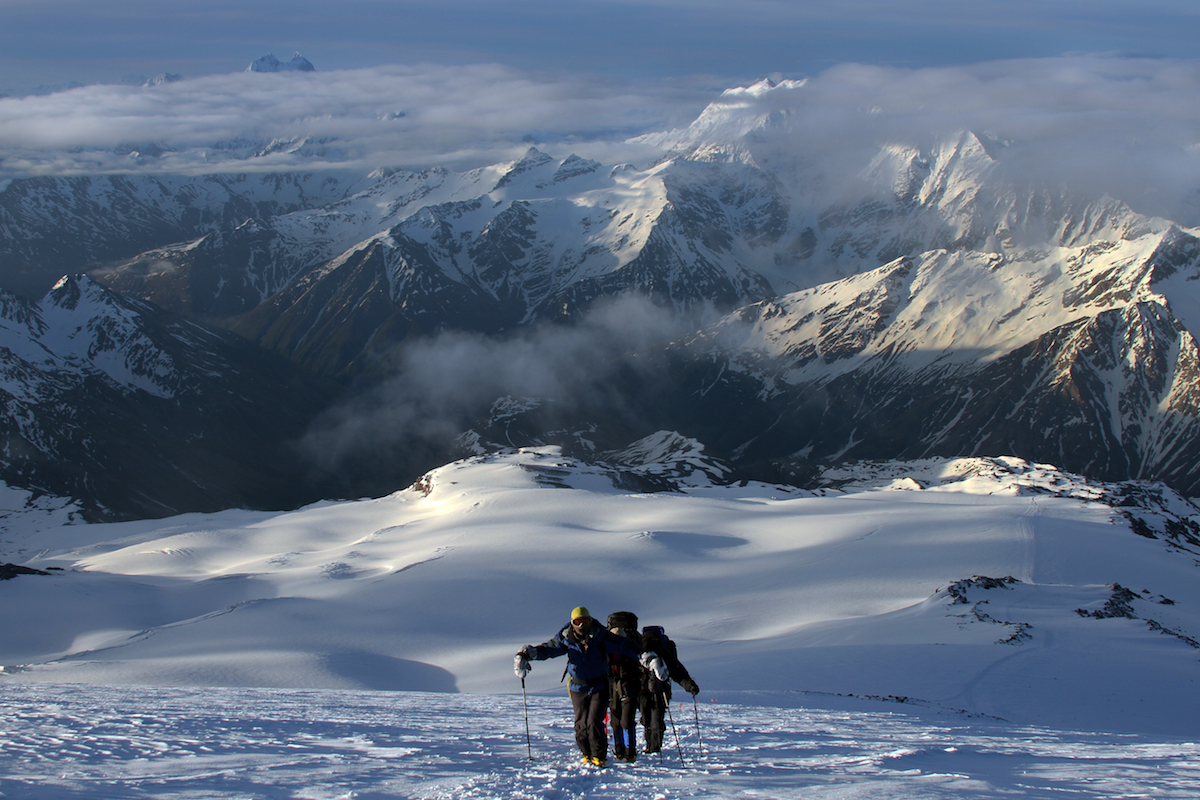
The nine-day south route ascent is the main and most popular Mountain Guide trip on Elbrus. The route follows the classic southern slope to the West summit, 5642 m, and is the best choice for a first high-altitude ascent.
No previous mountaineering experience is required. The trip suits most people with normal physical preparation who are ready to take training, acclimatisation and the guides' advice seriously. Elbrus remains a genuinely big mountain: participants face a night start, long hours of work above 5000 m, low temperatures and the effects of altitude.
The main advantage of the nine-day format is gradual, structured acclimatisation. Participants make several hikes in the valley and on the slope of Elbrus, spend the necessary time at the high-mountain shelter, rest before the summit and keep a reserve day for bad weather. Unlike the shorter trips, there is no need to force the body's adaptation to altitude.
We have worked on Elbrus since 2001. Groups are led by Mountain Guide's guides who know the southern route well, along with the specifics of acclimatisation and the typical mistakes beginners make. On summit day we keep strictly to one guide for every three participants.
The comfort of the trip rests on our hotel in the Elbrus region, a well-equipped high-mountain shelter, full meals and the possibility of selecting the clothing, boots and equipment you need in advance.
All published departures run with a minimum group size of two participants. For partners and accompanying guests we can arrange a separate holiday trip in the Elbrus region while the main group acclimatises and climbs.
Would you prefer to climb with your own group only? We organise private ascents on any dates, with a personal guide and a trip adapted to your experience, pace and objectives.
Important
- Participants carry the food for the high-altitude section themselves. This is a standard feature of how ascents of Elbrus from the south are organised. The food travels up by cable car with the group and is moved onwards by snowcat; it only has to be carried by hand over short sections of no more than 20 m.
- The number of group attempts within the reserve days provided on the trip is not limited.
- If part of the group reaches the summit, the group attempt counts as completed and additional attempts for the remaining participants are paid separately.
- Any departure from the shelter on summit day counts as a summit attempt.
About the nine-day south route ascent
The nine-day south route trip is the main Mountain Guide itinerary for a first ascent of the highest summit in Europe by the classic southern route. It allows participants to adapt to altitude gradually, to gain the full experience of a mountain ascent and to reach the summit push without artificially shortening the acclimatisation.
The route runs up the southern slope of Elbrus to the West summit, 5642 m. No previous mountaineering experience is required: during the trip the guides introduce participants to the necessary equipment, to moving in crampons, to conduct on the route and to the specifics of high-altitude climbing. Normal physical preparation and a responsible attitude to the team’s advice remain essential.
Compared with the seven-day south route trip, this version includes calmer acclimatisation both in the valley and on the mountain. The summit push is planned only after several consecutive days of adaptation, nights at altitude and a rest day. That schedule gives the body more time to get used to thin air and lets the guides judge the condition of each participant more accurately before the ascent.
The nine-day format provides the time needed for sequential acclimatisation, for rest before the summit and for keeping a reserve day in case of bad weather. If the main weather window turns out to be unfavourable, the group can still move the ascent on the trip instead of ending the trip after a single unsuccessful attempt.
The southern route of Elbrus is considered the most suitable for beginners because of its developed infrastructure. Cable cars shorten the approach to the high-altitude section, shelter accommodation lets participants rest and recover between hikes, and where necessary a snowcat can be used on the initial part of the ascent. Infrastructure does not make Elbrus an easy mountain, but it gives more options for organising the trip and for reacting to changes in the weather or in how participants feel.
The altitude of 5642 m remains the main factor of difficulty. Even on the classic route participants face an early night start, cold, wind, long periods of walking in crampons and several hours of work above 5000 m. Elbrus for beginners should therefore not be as short as possible but properly planned. Our task is not simply to bring the group to the summit, but to help participants meet altitude safely, gain the right first experience and keep the appetite for travelling in big mountains.
We have worked on Elbrus since 2001 and know the typical mistakes people make when they first find themselves at this altitude. Beginners often overestimate their speed, underestimate recovery or try to keep going despite feeling worse. On the route it matters not only to be physically strong but to keep discipline, control the pace and follow the guides’ decisions.
Participants who are not yet ready for the ascent but want to get to know the area and walk part of the acclimatisation routes with the group can join the separate holiday trip in the Elbrus region instead. Treks and straightforward high-altitude ascents also make good preliminary preparation, because they let you judge in advance how your body reacts to long efforts and thin air.
Experienced participants can make the classic southern route harder. The Mountain Guide catalogue also contains the ascent of both summits of Elbrus, the traverse of Elbrus from south to north and the Cross of Elbrus trip from south to north. For a first ascent, however, where time is not tightly constrained, the nine-day south route trip remains the most balanced option in terms of acclimatisation, comfort and organisation.
Guided Elbrus south route itinerary, 9 days
Day 1. Arrival in Mineralnye Vody and transfer to the Elbrus region.
The group meets at Mineralnye Vody airport. Two group transfers are provided on the first day of the trip: the first leaves at 12:00 for participants whose flights are scheduled to land no later than 11:00, and the second leaves at 15:00 for participants whose flights are scheduled to land no later than 14:00. Please allow time for baggage reclaim and for leaving the terminal when booking. If a flight is delayed and you miss the group transfer by more than 30 minutes, we will help you order a private transfer, which the participant pays for separately. The drive to the Elbrus region takes about three hours and covers roughly 200 km. After checking into the hotel participants meet the guide, discuss the acclimatisation plan, the specifics of the classic southern route and how the group will work, and check clothing, boots and mountaineering equipment. Anything missing or the wrong size has to be sorted out before the high-altitude section begins. The rest of the day is for recovering from the journey, preparing kit and getting a proper night’s sleep before the first hike. There is no physical load on this day. Night at the hotel in the Elbrus region.
Day 2. First acclimatisation hike on Cheget, 3000 m.
After breakfast the group sets out on an unhurried trekking route on the slopes of Cheget to about 3000 m. The aim of the day is to spend several hours above the valley, to settle into a steady pace and to test trekking boots, clothing, rucksack and poles in movement. This is still the valley stage of the trip: rubbing points, uncomfortable clothing or mistakes in packing can still be corrected before the move up to the shelter. The guide watches the condition of the participants and explains how to manage effort, adjust clothing and keep drinking. Any noticeable deterioration must be reported to the guide at once. After reaching the planned altitude the group descends and returns to the hotel. Night at the hotel in the Elbrus region. High point about 3000 m, ascent about 1100 m, distance about 11 km.
Day 3. Acclimatisation hike to the Devichyi Kosy waterfall and the observatory, 3100 m.
The second acclimatisation route goes to the Devichyi Kosy waterfall at about 2700 m and on to the observatory at about 3100 m. Participants gain altitude again and spend several hours moving before the transfer to the high-mountain shelter. The southern slope of Elbrus is visible from the route, and the guide can point out the line of the coming ascent and the position of the high-altitude zone. It is important to move evenly rather than compete on speed; conserving strength and understanding how the body reacts to a second consecutive day of effort matters more. Headache, nausea, unusual weakness and any other change in how you feel must be reported to the guide immediately. After the hike the group returns to the hotel and packs for the high-altitude part of the trip. Night at the hotel in the Elbrus region. High point about 3100 m, ascent about 1200 m, distance about 13 km.
Day 4. Move up to the high-mountain shelter and acclimatisation hike to 4200 m.
After breakfast the group transfers to the Azau meadow and rides the cable car up the southern slope of Elbrus.
In September the cable car may be closed for scheduled maintenance. If the cable car cannot be used, the guide decides the onward logistics according to the actual situation; a vehicle is hired for the ascent if necessary. If the cost of the vehicle exceeds the price of a cable car ticket, participants pay the difference. The high-mountain shelter stands at 3888 m. After settling in, participants prepare their equipment and hike up to about 4200 m. The guides check the fit of boots and crampons, whether clothing matches conditions and how everyone feels after gaining altitude quickly by cable car. This short hike is not a speed session but a first encounter with the altitude of the shelter and a check of equipment in real conditions. For most participants this is the first night at almost 4000 m, so a steady pace, rest and close attention to how the body responds all matter. Night at the high-mountain shelter. High point about 4200 m, ascent during the hike about 312 m, distance about 2 km.
Day 5. Acclimatisation hike to the Pastukhov Rocks, 4700 m.
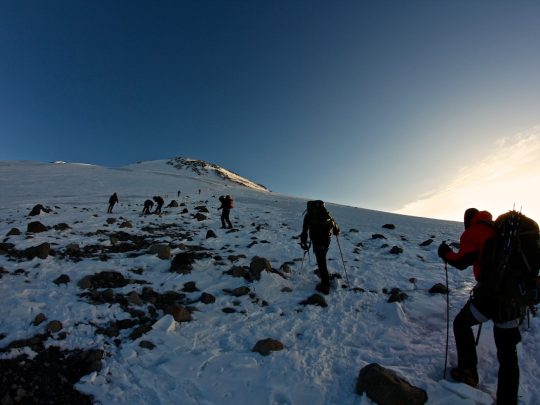
The group climbs to the Pastukhov Rocks at about 4700 m, the main acclimatisation hike before the ascent. Participants walk in mountaineering boots and crampons on part of the future summit route. The guides help set the pace, explain the technique of moving on a snow slope and assess the condition, coordination and readiness of each participant for work above 4000 m. This hike lets you see the night section of the route in daylight and shows how the body copes with a long effort at altitude. Reaching the set point is not a competition: if a participant feels worse, the guide may adjust the height of the hike. After the planned point the group descends to the shelter, rests and reviews how everyone is. Night at the high-mountain shelter. High point about 4700 m, ascent about 812 m, distance about 6 km.
Day 6. Rest and preparation for the ascent.
The day is spent at the high-mountain shelter at 3888 m. Participants recover from the acclimatisation hikes and prepare clothing, crampons, headtorches, flasks and the rest of their personal equipment in advance. The guides check the kit once more and give a detailed briefing: the order of the night start, the sequence of sections along the route, the pace, the stops, protection against cold and the signs of deterioration that must be reported immediately. Depending on the weather and the state of the slope there may be a short practical session on moving in crampons. The final decision to set out is taken by the lead guide on the basis of the forecast and the condition of the route and the participants. The group goes to rest early. Night at the high-mountain shelter.
Day 7. Ascent of the West summit of Elbrus, 5642 m.
The summit push on the classic southern route starts at night, usually between 02:00 and 04:00; the exact time is set by the lead guide according to the weather, the state of the snow and the expected pace of the group. Depending on the condition of the participants and on conditions, part of the initial climb may be shortened using a snowcat. The route then passes the Pastukhov Rocks, the Traverse and the saddle between the summits, from where the final climb to the West summit begins. Participants follow the guide and report headache, nausea, loss of coordination, sudden weakness or any other unusual change immediately. On summit day the ratio is one guide to three participants, so the group can be divided if necessary. The decision to continue or turn back is taken by the guide. After a short stop on the summit the group descends by the same route to the shelter. Night at the high-mountain shelter. High point 5642 m, ascent up to 1754 m, distance about 14 km.
Day 8. Reserve day and descent to the Elbrus region.
If the whole group was unable to begin the summit attempt the day before because of conditions on the mountain, the reserve day is used for a repeat group attempt at no extra charge. If part of the group has already reached the summit, the attempt counts as completed and further departures for the remaining participants are paid separately. The start time and the possibility of a repeat attempt are decided by the lead guide after assessing the forecast, the route and the condition of the participants. If the main ascent took place, the group packs, descends by cable car to the Azau meadow and checks into the hotel. If the reserve day is used for a repeat attempt, the descent schedule depends on the time of return and on the cable car’s operating hours; the lead guide decides. In the normal case the night is spent at the hotel in the Elbrus region.
Day 9. Departure to the airport.
The group transfer to Mineralnye Vody airport leaves at 07:00 — please take this into account when choosing your return flight. If your flight is in the evening, you can leave your luggage in the airport left-luggage office and travel independently by taxi to Pyatigorsk. In the town you can visit the site of Mikhail Lermontov’s duel, the Proval cave and the viewpoint, which in clear weather looks out over Pyatigorsk and Elbrus.
What's included
- Mountain Guide’s guides throughout the trip. On summit day the ratio of guides to participants strictly does not exceed one to three
- An unlimited number of group summit attempts within the reserve days provided on the trip. If part of the group reaches the summit, the attempt counts as completed and further departures for the remaining participants are arranged for a separate charge
- The services of a cook
- Hotel accommodation in the Elbrus region in twin rooms as set out in the itinerary
- Accommodation in the high-mountain shelter as set out in the itinerary
- All transfers on the trip from Mineralnye Vody airport or railway station and back
- All cable car ascents and descents provided on the trip
- Three meals a day throughout the trip, including dinner on the day of arrival and breakfast on the day of departure
- All necessary group equipment: ropes, ice screws, radios, satellite navigators and a group first aid kit
- Hire of a duffel bag for carrying personal and rented equipment for the duration of the ascent
What's not included
- The snowcat on summit day. Where it is used, the stated 2026-season charges are 14,000 RUB up, 8,000 RUB down or 22,000 RUB return
- National park permit, if one has to be issued
- Single occupancy
- Early check-in or late check-out at the hotel before the start or after the end of the trip. We always try to agree additional benefits for our guests with our partners, and early check-in or late check-out is often provided free of charge
- Personal equipment and the hire of it
- Any costs connected with departure from the itinerary or with changes to it
- The supplement for an alternative ascent by vehicle if the cable car is closed for maintenance in September and the cost of the vehicle exceeds the price of a cable car ticket
Climbing Elbrus from the south for private groups
Climbing Elbrus from the south for private groups
The Elbrus climb from the south can be arranged privately for a family, a group of friends, a climbing club, a corporate team or an organised group of any size. We can change the dates and length, the acclimatisation schedule, the number of reserve days, the standard of accommodation, the guiding team and other details, according to participants’ experience, fitness and preferences. Where useful, the trip can be extended with training sessions, excursions and extra rest days in the Elbrus region. Small groups can take a private Elbrus climb with a personal guide, at their own pace and on dates that suit them. For corporate clients, clubs and large organised groups we design separate trips with basic mountaineering instruction, team-building elements and a cultural activities. If some of your party are not going to the summit, we can arrange a separate itinerary for them in the Elbrus region, with walks, excursions and easy trekking routes. The companions’ dates can be matched to the main group’s schedule. Get in touch and we will prepare a private Elbrus climb from the south for your group.
Documents you need for the 9-day Elbrus climb from the south
To join this trip you will need:
- A valid passport
- Medical insurance valid in the area of the trip and covering mountaineering, ascents to at least 6000 m, search and rescue, casualty transport and medical evacuation
- Tickets to Mineralnye Vody and back
For foreign nationals:
Depending on your nationality, you may need a visa to enter the Russian Federation. Where it is needed, Mountain Guide provides the documents for a visa application and gives visa support.
We also recommend that you:
- Check the terms of your policy in advance and make sure that climbing Elbrus to 5642 m, mountaineering, search and rescue and evacuation are all expressly covered
- Keep digital copies of your passport, insurance policy, tickets and visa documents on your phone and in cloud storage, in case you lose the originals
- Note your policy number and your insurer’s 24-hour telephone number separately from your main documents
Weather and seasons for the 9-day Elbrus climb from the south
Weather and season for the Elbrus climb from the south
The main season for climbing Elbrus from the south runs from May to September. During this period the infrastructure of the classic southern route is working, the cable cars and high-altitude refuges are open, and the weather is usually best suited to running regular group trips. When choosing a date, consider not only the temperature but the amount of snow, the state of the route, the likelihood of strong wind and your own tolerance of heat or cold. Mountain Guide
May and June suit those who prefer a snowier Elbrus and comparatively few people on the route. The valleys of the Elbrus region come into flower at this time, while the high-altitude part of the route usually stays under snow. Early in the season there can be lower temperatures, fresh snowfall and difficult visibility, so warm clothing, proper acclimatisation and a reserve day matter especially. July is the most popular month for climbing Elbrus from the south. It usually offers a good combination of long daylight, comparatively comfortable temperatures and suitable route conditions. It is also the busiest period: there may be more people on the cable cars, in the refuges and on the classic southern route. August and early September suit those who want to combine the climb with warm weather and walks in the valleys of the Elbrus region. By late summer there is less snow on the slopes and hard firn or ice is exposed in places, so well-fitted crampons and following the guides’ advice closely matter especially. In September the days shorten and night temperatures fall steadily. No month guarantees good weather or a successful climb. Even in summer, above 5000 m there can be strong wind, snowfall, mist, poor visibility and a considerable drop in temperature. The weather on the summit of Elbrus can differ markedly from conditions in the valley, so the lead guide takes the final decision on setting out, on the start time and on continuing, based on the actual state of the route and the safety of the group. Mountain Guide
The 9-day trip includes a reserve day, which allows the summit attempt to be moved if conditions are unfavourable. It is this combination of steady acclimatisation, rest before the summit and an extra weather window that makes this the most balanced way to climb Elbrus from the south for newcomers. There is more on choosing a month in our article on the best time to climb Elbrus, current conditions on our Elbrus weather page, and a detailed account of the route, acclimatisation and preparation in guide Sergey Baranov’s lecture on Elbrus.
Accommodation and meals on the Elbrus climb from the south
On the 9-day trip participants stay in our hotel in the Elbrus region and in a high-altitude refuge on the south side of Elbrus. That combination lets you rest comfortably while acclimatising in the valley, and then spend the necessary nights at almost 4000 m before climbing Elbrus West. In the Elbrus region participants stay in twin rooms, as set out in the itinerary. The hotel sits in the Baksan valley, close to the main acclimatisation routes and the area’s tourist infrastructure. After the days on Cheget and up to the observatory you can rest properly, shower, recover and prepare your equipment for the high-altitude section. Single occupancy is possible at extra cost, subject to availability. For the high-altitude section the group stays in the refuge on the south side of Elbrus at 3888 m. The refuge is there for acclimatisation, for resting between days out and for preparing for the climb. Participants spend several nights here, go up to 4200 m and to the Pastukhov Rocks, rest before the summit and, if needed, use the reserve day. Conditions in the high-altitude refuge are simpler than in a hotel, but you can stay warm, eat hot food, dry some of your equipment and recover after the effort. The price includes three meals a day throughout the route: dinner on the day you arrive, meals on the acclimatisation and high-altitude days, and breakfast on the day you leave. In the valley meals are arranged as part of the trip, and at altitude a cook prepares food for the group. The diet is planned around the physical effort and the need to recover at altitude. The menu includes hot dishes, soups, meat or other protein, side dishes, vegetables, fruit, hot drinks and food that is easy to eat while acclimatising and preparing for the climb. On summit day participants receive food and drinks appropriate to how the route is run. Tell us at the time of booking about food allergies, medical restrictions, a vegetarian diet or any other dietary requirements. We will do our best to accommodate them, but whether particular dishes can be prepared depends on the food available and on how the high-altitude refuge operates. Special medical diets and strict individual regimes must be agreed in advance.
Day-to-day conditions on the Elbrus climb from the south
The southern route is the most comfortable and best served way to climb Elbrus. In the valley there are hotels, cafes, shops, equipment hire, pharmacies, mobile coverage, internet and cable cars. Once you move up to the high-altitude refuge, however, conditions become considerably simpler, as befits living at almost 4000 m. The hotel in the Elbrus region has electricity, hot water, a shower, mobile coverage and internet access. Here you can rest properly after the acclimatisation days, dry clothing, charge devices and prepare your equipment for the high-altitude section. On the south side of Elbrus the group stays in a high-altitude refuge at 3888 m. Conditions here are simpler than a hotel’s: personal space is limited, and the usual town comforts depend on the technical arrangements, on how many people are staying and on the weather. The refuge exists first of all for acclimatisation, for resting between days out and for preparing for the climb. Electricity is normally available in the refuge, but neither its presence nor its reliability is guaranteed. We recommend a power bank of sufficient capacity for your phone, watch, head torch, camera and any other devices. Charge every battery fully at the hotel before moving up to the high-altitude section. Mobile signal and internet on the route are unreliable. The strongest signal is usually in the valley and around the cable car stations, but at the refuge and on parts of the classic southern route the quality depends on the network, the weather and where the group is. Warn family and colleagues in advance that you may be out of range for a time during the climb. Water, food, fuel and other supplies are carried up at additional cost, so please use them sparingly. Please treat the refuge’s equipment with care, keep the shared rooms tidy and follow the house rules. Good infrastructure makes climbing Elbrus from the south more convenient, but it does not turn it into an ordinary holiday. Several nights at almost 4000 m, limited facilities, cold, wind and the effects of altitude all call for a willingness to give up your usual comforts for a while.
Страхование
НаверхEquipment and useful extras for the 9-day Elbrus climb from the south
Скачать PDFRock and Rent stocks all the good-quality equipment you need to climb Elbrus. You can fly in wearing shorts, and that is not a joke. The main thing is to reserve the set you need in advance, and we will have it ready for your arrival. We chose this kit against one criterion only: how well it suits conditions on Elbrus, where our guides have been leading groups since 2001. Participants on Mountain Guide trips get a 15% discount on equipment hire at Rock and Rent. If you already have ski clothing and are not sure whether it will do for an Elbrus climb, we recommend reading “Is downhill ski clothing suitable for Elbrus?”. You may already own some of what you need. This list is built on the experience of the Mountain Guide’s guides: between them the team has run several thousand Elbrus climbs, so it reflects real conditions on the classic southern route.
Documents:
- Passport
- Air or rail tickets
- Medical insurance
- Voucher (for foreign participants)
Personal equipment:
- Rucksack, 30-40 litres
- Duffel bag, 80-100 litres
- Sleeping bag with a comfort rating of 0 to +10 °C from June to September inclusive, and -20 to -10 °C from October to May inclusive
- Trekking poles with baskets at least 70 mm across
- Crampons
- Classic ice axe with 2-3 m of 5-6 mm accessory cord for clipping to your harness
- Climbing harness
- Helmet
- Three karabiners. Large ones are preferable, as they are easier to handle in mittens
- Cow’s-tail lanyards
Clothing and footwear:
- Is downhill ski clothing suitable for Elbrus?
- Double or triple mountaineering boots, plastic or leather. Single-layer boots are possible only with warm overboots (not to be confused with gaiters)
- Trekking boots or waterproof trekking shoes. There can be snow on the acclimatisation days in May and early June, so boots are preferable. From mid-June to the end of September trainers are acceptable, but they protect the ankle less well
- Waterproof shell: jacket and trousers. The recommended membrane rating is 10,000/10,000 or better
- Fleece top and bottoms
- Base layer, top and bottoms
- A thick, warm down jacket with a hood. A down jacket suitable for Elbrus normally weighs upwards of about 700 g
- Warm mittens
- Thick gloves (ski gloves, for example)
- Thin fleece gloves
- Bandana — for sun protection in the valley and to keep your face or neck warm in the cold
- Warm hat
- Warm trekking socks for summit day
- Sun hat
- Trekking trousers and T-shirts, preferably long-sleeved
- Trekking socks for the acclimatisation and trekking days
Other items:
- LED head torch with at least 12 hours of battery life
- Category 3-4 sunglasses with full protection from side light
- Category 1-2 ski goggles for bad weather, wind and snowfall
- Vacuum flask of 1 litre, preferably without a push-button lid
- Windproof mask for the lower face (a scarf will partly do the same job)
- SPF 30-50 sun cream
- SPF 15 lip balm
- Personal first-aid kit
- Elastic bandage and/or a support brace
- Gaiters — not compulsory, but they can be useful, especially in May and June
- Chemical hand warmers — not compulsory, but they can be useful
For the 9-day Elbrus climb from the south there is no need to buy all your equipment specially for one trip. Most of it can be hired from Rock and Rent, and the guides will help you check the set before you go onto the route.
Вам также будет интересно:
-
 6,650 $
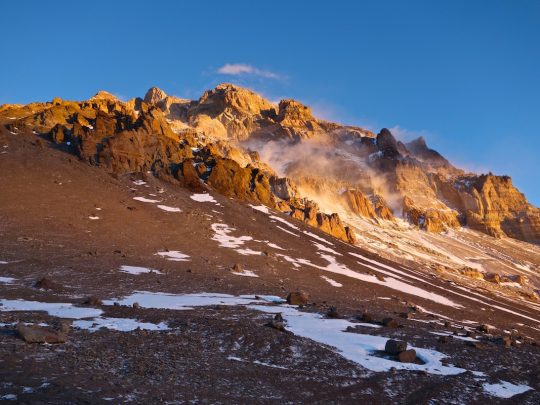
Aconcagua Climb — 17-Day Guided Expedition
- Height (m)
- 6962
- Duration
- 17 дней
- Difficulty
- Moderate
- Continent
- South America
- Children
- From 14 years old
- Accommodation
- There are tents
-
 1,960 $
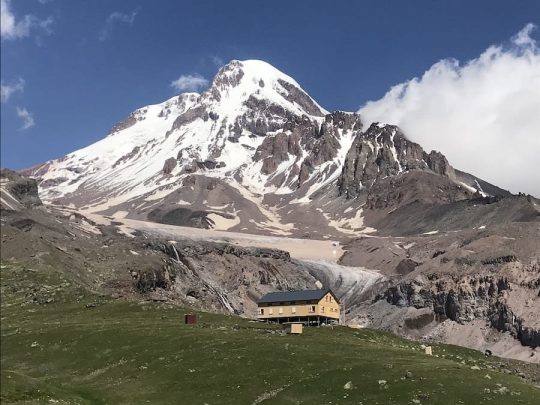
Climb Kazbek from the South, 5033 m — 8 Days in Georgia
-
 3,200 $
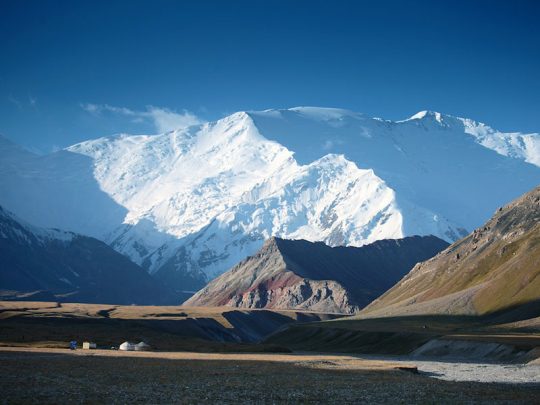
Climb Lenin Peak, 7135 m — 21-Day Pamir Expedition
-
 2,050 $
Elbrus Traverse from South to North, 9 Days
- Height (m)
- 5642
- Duration
- 9 дней
- Difficulty
- Low
- Continent
- Europe
- Children
- From 14 years old
- Accommodation
- Without tents