- Guides
- B2B
-
#19607 (no title)
-
#15972 (no title)
- Climb Elbrus Individually
- Climb Elbrus from the South, 9 Days
- Climb Elbrus from the South, 7 Days
- Climb Elbrus from the South with Oxygen
- Climb Elbrus from the North, 10 Days
- Two Summits of Elbrus, 9 Days
- Elbrus Traverse from South to North, 9 Days
- Elbrus Traverse from North to South, 10 Days
- Cross of Elbrus, South to North, 9 Days
- 「北からの十字架」プログラムに従ってエルブルス山を登る
- Climb Kazbek and Elbrus — 10-Day Two-Summit Programme
- Climb Elbrus from the West, 11 Days
- エルブルス山 ヘリコプター登頂
- Elbrus Region Holiday and Trekking, 9 Days
- Elbrus Region Holiday, 7 Days
- Elbrus登Tinderツアー
- Climb Elbrus from the South, 9 Days with Sergey Baranov
- #15539 (no title)
-
#15546 (no title)
- Climb Kilimanjaro: the Marangu Route
- Climb Kilimanjaro: the Lemosho Route
- Climb Ararat, 5137 m — 7-Day Classic Programme
- Climb Kazbek from the South, 5033 m — 8 Days in Georgia
- Climb Kazbek and Elbrus — 10-Day Two-Summit Programme
- メキシコで火山を登る
- Climbing Alpamayo — 16-Day Technical Expedition
- マーガレットピークを登る(スタンレー)
- Climbing Mount Kenya: Point Lenana, 4,985 m
- Climb Dykh-Tau by the North Ridge, 13 Days
-
#15554 (no title)
- Aconcagua Climb — 17-Day Guided Expedition
- Island Peak Climb — 18-Day Expedition
- Climb Mera Peak, 6476 m — 16-Day Hinku Valley Programme
- Climb Ama Dablam, 6812 m — 24-Day Expedition with Island Peak
- Climb Island Peak and Mera Peak — 24-Day Two-Summit Expedition
- Aconcagua and Ojos del Salado — 25-Day Combined Expedition
- Ojos del Salado Climb — 15-Day Expedition
- クライミングチンボラゾ、コトパクシ
- ワスカランクライミング
- Climb Razdelnaya Peak, 6148 m — 15-Day Pamir Expedition
- Climb Denali by the West Buttress, 23 Days
- #15565 (no title)
- #15572 (no title)
-
#15972 (no title)
-
#19592 (no title)
-
See 8000m
- K2 Base Camp Trek via the Gondogoro La
- Everest Base Camp Trek — 14 Days
- Everest Base Camp via Gokyo Lakes — 15 Days
- 一週間でエベレストへのトレッキング
- Annapurna Circuit and Tilicho Lake Trek
- Manaslu Circuit Trek
- Kanchenjunga Circuit Trek (XXL)
- Kanchenjunga North Base Camp Trek (Short)
- Kanchenjunga from India: the Goecha La Trek in Sikkim
- マカルベースキャンプへのトレッキング
- アンナプルナベースキャンプトレッキング
- South America
- Asia
- Africa
-
Russia
- Elbrus Region Holiday and Trekking, 9 Days
- Elbrus Region Holiday, 7 Days
- トレッキングオシュテン+カルディヴァッハ
- Lake Kardyvach — 5-Day Base-Camp Trek
- Route 30: Through the Mountains to the Sea, with Oshten — 4 Days
- Trekking in Arkhyz — 7 Days over the Ayulyu Pass
- Gvandra Trek — 7 Days to the Ullu-Kyol Lakes
- Trekking in Dombai — 7 Days with the Murudzhu Lakes
- Europe
-
See 8000m
-
Adventures
-
Africa
- モロッコツアー:北アフリカの中心
- トゥブカルの登山とモロッコの文化
- エリトリアツアー:ダラク諸島とラシャイダ遊牧民
- ルワンダツアー:マウンテンゴリラとビソーク火山
- エチオピアツアー:宇宙の風景とオモ渓谷の部族
- ウガンダツアー:クイーンズパークとマウンテンゴリラ
- Tanzania Safari: Serengeti, Ngorongoro and Tarangire
- ウガンダツアー:ホワイトサイとマウンテンゴリラ
- ジンバブエと南アフリカツアー:ビクトリアフォールズ、ケープタウン、ケープオブグッドホープ
- ナミビアツアー:エトーシャパークとヒンバ族
- ケニアツアー:アフリカのビッグファイブ
- ボツワナツアー:オカバンゴデルタとチョベ公園
- South America
- Asia
-
Africa
- Ski-touring
- VIP
- #19722 (no title)
- About
Climb Elbrus Individually
- Height (m)
- 5642
- Difficulty
- Low
- Continent
- Europe
- Children
- From 10 years old
- Accommodation
- Without tents
2820 $
Why to go with us?
The base version of a private ascent of Elbrus is a nine-day programme on the classic southern route to the West summit, 5642 m. It includes staged acclimatisation, accommodation at a hotel and in the high-mountain shelter, a rest day before the ascent and a reserve day.
The programme suits a single participant, an adult family, a group of friends or a closed group who want to move at their own pace and receive the full attention of a personal guide. Previous mountaineering experience is not required for the base southern route, but physical preparation and a readiness to follow the guide's decisions are.
In the private format you can agree the dates subject to guide availability, choose the guiding team to match the size and preparation of the group, extend the acclimatisation or the number of reserve days, change the standard of accommodation and the set of additional services, and arrange a separate programme for accompanying guests. A different Elbrus route is considered only by separate agreement.
Changes to the programme must not shorten the necessary acclimatisation or break the safety logic of the route. The final tactics, the pace and whether the ascent can continue are decided by the lead guide, taking account of the weather, the state of the route and how participants feel.
The clothing, boots and mountaineering equipment you need can be booked from an equipment-hire supplier in advance.
Important
- Participants carry the food for the high-altitude section themselves. This is a standard feature of how ascents of Elbrus from the south are organised. The food travels up by cable car with the group and is moved onwards by snowcat; it only has to be carried by hand over short sections of no more than 20 m.
- The base duration of the programme is 9 days.
- The base route runs from the south to the West summit of Elbrus.
- A different route and any substantial changes to the programme are agreed separately.
About a private ascent of Elbrus
A private ascent of Elbrus is the chance to adapt the programme completely to your objectives, your experience, your physical preparation and the time you have. Climbing Elbrus with your own group means travelling the route with your own company or family, or accompanied by a personal guide, without joining a mixed group.
The format suits those who want to choose convenient dates, move at their own pace, receive the full attention of the guide and build the programme around their own aims.
In a private arrangement almost every element of the ascent can be configured:
- Any start date, subject to guide availability
- Any number of participants, from one person to a private group
- A personal guide on Elbrus, or the number of guides your group needs
- Any Elbrus route: the southern, northern or western slope, the traverses, the Cross programmes and other variants
- An individual acclimatisation programme
- A personal pace during the acclimatisation and the ascent
- The number of reserve days
- The choice of hotels, shelters and standard of comfort
- Additional services, excursions and a recreation programme for accompanying guests
Depending on the experience of the participants you can choose the classic ascent of Elbrus from the south, the more self-supported route from the north, the technically harder ascent from the west or other ways of climbing the mountain. It is equally possible to arrange a first encounter with Elbrus or a serious preparatory programme before higher summits.
A private ascent is particularly convenient for families, small groups of friends, experienced mountaineers and participants with unusual objectives. The driver meets only your group at the airport, the transfers are built around your schedule, and the personal guide is focused entirely on your team during the acclimatisation and the ascent.
The Elbrus region offers many options for individual preparation. You can add extra days for acclimatisation, include an excursion programme, choose comfortable accommodation or, on the contrary, build a more self-supported expedition with tented camps.
We organise private ascents of Elbrus on the basis of many years of team experience. We have worked on Elbrus since 2001, and our guides have extensive high-altitude experience and are among the most experienced specialists working on this mountain. We do not simply organise a route: we pass on the practical experience accumulated over thousands of ascents.
Why choose us for a private ascent of Elbrus:
- The Mountain Guide team, whom you can get to know on a separate page
- Extensive experience of running individual and private ascents of Elbrus
- No limit on the number of summit attempts within the programme — participants can use the reserve days according to the format chosen
- Good food at the hotel and at the shelter
- A hotel with comfortable rooms and conditions for recovery
- Mountain shelters along the programme, with the conditions needed for rest on the route
- Any missing equipment can be hired separately; the selection, the hire agreement, the payment and the correspondence are handled directly with the hire company
We can also arrange a separate recreation programme in the Elbrus region for accompanying guests and family members, so that they can spend the time comfortably while you are on the mountain.
A private ascent of Elbrus allows almost any element of the programme to be changed, from the dates and the route to the logistics, the accommodation and the composition of the guiding team. Safety nevertheless remains the first priority: the final tactics of the ascent are set by the lead guide, taking account of the participants’ preparation, the weather and the state of the route.
Private Elbrus ascent programme
Day 1. Meeting in Mineralnye Vody and transfer to the Elbrus region.
The base private programme is built on the nine-day southern route. The driver meets your group at the airport or the railway station, after which participants travel to the hotel in the Elbrus region. The time of the private transfer is agreed around the group’s arrival. After checking in there is an introduction to the guide and a review of the programme, clothing, boots and mountaineering equipment. If any kit is unsuitable, it has to be sorted out before the move into the high-altitude section. Overnight at the hotel.
Day 2. Acclimatisation hike on Cheget to 3000 m.
The first hike is made at your own pace on the slopes of Cheget. The aim of the day is to begin adapting to altitude, to spend several hours above the valley and to test trekking boots, clothing, rucksack and poles in movement. The guide watches how participants feel and adjusts the pace where necessary. After reaching the planned altitude the group descends to the hotel. High point about 3000 m, ascent about 1100 m, distance about 11 km. Overnight at the hotel.
Day 3. Hike to the Devichyi Kosy waterfall and the observatory, 3100 m.
The second acclimatisation day goes to the Devichyi Kosy waterfall and on to the observatory. A consecutive altitude gain shows how well the group has recovered after Cheget and adds several more hours of movement before the move up to the shelter. The private format makes it possible to settle on a steady pace for the group, but the altitude and the state of the route remain shared constraints. High point about 3100 m, ascent about 1200 m, distance about 13 km. After the descent participants pack for the high-altitude section. Overnight at the hotel.
Day 4. Move up to the shelter and hike to 4200 m.
The group transfers to the Azau meadow and rides the cable car up the southern slope of Elbrus.
In September the cable car may be closed for scheduled maintenance. If the cable car cannot be used, the guide decides the onward logistics according to the actual situation; a vehicle is hired for the ascent if necessary. If the cost of the vehicle exceeds the price of a cable car ticket, participants pay the difference. After settling into the shelter at 3888 m there is a short hike up to about 4200 m. The guide checks the fit of mountaineering boots and crampons, whether the warm clothing matches conditions and how participants react to a rapid altitude gain. High point about 4200 m, ascent during the hike about 312 m, distance about 2 km. Overnight in the shelter.
Day 5. Acclimatisation hike to the Pastukhov Rocks, 4700 m.
This is the main high-altitude hike before the ascent. Participants climb part of the future route in mountaineering boots and crampons, practise even movement and test their ability to work for a long period above 4000 m. The personal guide monitors the condition of each participant; if anyone feels worse, the high point of the hike can be reduced. High point about 4700 m, ascent about 812 m, distance about 6 km. After the descent the group rests in the shelter.
Day 6. Rest and preparation for the ascent.
The day is for recovery and for preparing for the night start. Participants get their clothing, crampons, headtorches, flasks and personal equipment ready in advance. The guide briefs the group on the route, the pace, the stops, protection against cold and what to do if the weather or how someone feels deteriorates. Depending on the state of the slope there may be a short practical session. The final decision to set out is taken on the actual conditions. Overnight in the shelter.
Day 7. Ascent of the West summit of Elbrus, 5642 m.
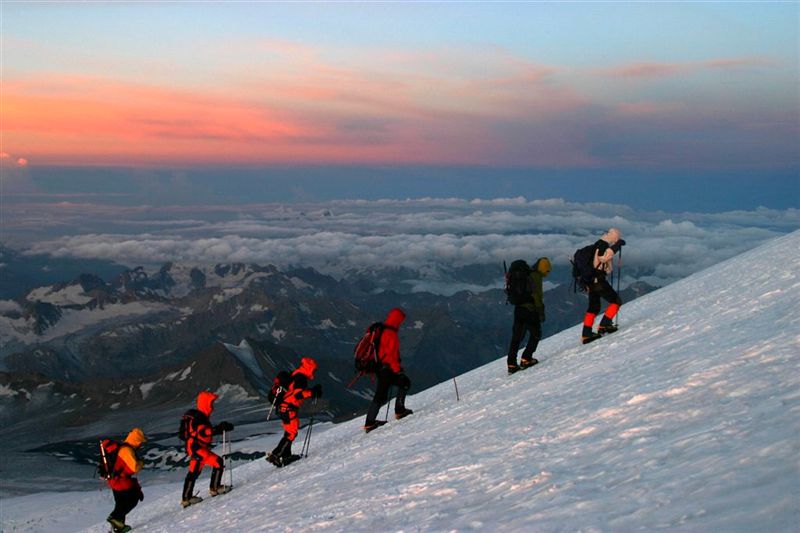
The departure on the classic southern route begins at night, usually between 02:00 and 04:00; the exact time is set by the guide. Depending on the condition of the participants and on conditions, part of the initial climb may be shortened using a snowcat. The route then passes the Pastukhov Rocks, the Traverse and the saddle to the West summit. On summit day the ratio of no more than three participants to one guide is maintained. The decision to continue or turn back is taken by the guide. After the summit the group descends by the same route to the shelter. High point 5642 m, ascent up to 1754 m, distance about 14 km. Overnight in the shelter.
Day 8. Reserve day and descent to the Elbrus region.
If the whole group was unable to begin an attempt because of conditions on the mountain, the reserve day is used for a repeat group attempt at no extra charge. If part of the group has already reached the summit, the attempt counts as completed and further departures for the remaining participants are paid separately. If the main ascent went to plan, the group packs, descends by cable car and returns to the hotel. If the reserve day is used, the guide decides the order of the subsequent descent, taking account of the time of return and the cable car’s operating hours. In the normal case the night is spent at the hotel.
Day 9. End of the programme.
After breakfast a private transfer takes the group to the airport or the railway station in Mineralnye Vody. The departure time is agreed in advance around the return tickets. This completes the base nine-day programme. A different route, additional days or a higher standard of comfort are quoted separately before booking.
What a private Elbrus ascent includes
The content of a private programme is put together around the chosen route, the dates, the number of participants, the standard of comfort and the budget. Before booking you receive a detailed programme and a final quotation. Once it is agreed, every service listed in it is part of the price with no hidden extras.
A private programme can include:
- A personal guide on Elbrus, or the number of guides your group needs
- The design of the route and the acclimatisation programme around the experience, physical preparation and objectives of the participants
- Private transfers from the airport or the railway station and back
- All necessary transfers and transport along the route
- Accommodation in the chosen hotels, mountain shelters or tented camps
- Single occupancy and separate rooms where that is possible
- Meals according to the format of the programme and the participants’ wishes
- The services of a cook where required
- Cable cars and the snowcat, where the chosen route provides for them
- Group mountaineering equipment: ropes, ice screws, radios, navigation equipment, a first aid kit and other necessary items
- Hire of personal equipment
- The necessary permits, registrations and passes
- Additional acclimatisation and reserve days
- Individual training sessions before the ascent
- An excursion programme and a stay in the Elbrus region for participants and accompanying guests
- Other services agreed in advance
A private ascent of Elbrus can be arranged either in a high-comfort format or as a sporting, self-supported expedition. Once we have discussed your objectives we prepare the route, the exact list of included services and the final price of the programme.
What a private Elbrus ascent does not include
This is an individual project, so preferences are normally already accounted for.
Insurance
НаверхList of equipment for climbing mount Elbrus from the West
Скачать PDFショーツで到着しても大丈夫です!冗談ではありません!
Rock-and-Rent のレンタルショップには、エルブルス登山に必要な装備がすべて揃っており、品質は非常に高いレベルです。事前にすべてを予約しておけば、本当にショーツだけで来ることも可能です。私たちは2001年からエルブルスへ登山を行っており、装備はただ一つの基準 ― エルブルスの環境に最大限適していること ― のみで厳選してきました。
そして、このリストは非常に慎重に作成されています。会社のガイドたちは合計で数千回の登頂を経験しており、この中に不要なものが一つもないと断言できます。
書類:
- パスポート
- 航空券/鉄道チケット
- 医療保険
- バウチャー(外国籍の方)
個人装備:
- バックパック(30~40リットル)
- ダッフルバッグ(80~100リットル)
- 寝袋:快適使用温度 0℃~+10℃(6月~9月を含む)、-20℃~-10℃(10月~5月を含む)
- トレッキングポール
- アイゼン
- クラシックタイプのピッケル(ハーネスに装着するための直径5~6mmの補助ロープ付き、長さ2~3m)
- クライミングハーネス
- ヘルメット
- カラビナ 3個(大きめのものがおすすめ。厚手の手袋でも扱いやすい)
- セルフビレイ用ランヤード
衣類・靴:
- エルブルスにスキーウェアは使えますか?
- ダブルまたはトリプル構造の高山用登山靴(プラスチック製または革製)。シングルブーツの場合は必ずオーバーブーツを使用すること(ゲイターとは別物です)
- トレッキングシューズまたはトレッキングブーツ。5月~6月初旬の順応登山では雪が残っている場合があり、その際はブーツの方が明らかに有利です。6月中旬以降~9月末まではスニーカーでも代用可能ですが、足首を捻るリスクがあります。必ず防水性が保たれていることを確認してください
- 防水レイヤー(ジャケット+パンツ)。推奨される防水透湿性能は10,000/10,000以上
- フリース上下
- 保温下着(上・下)
- フード付きダウンジャケット(厚手で保温性の高いもの。エルブルス用として適切な重量は700g以上が目安)
- 防寒用ミトン
- 厚手の手袋(スキー用)
- 薄手の手袋(フリース)
- バンダナ(谷では日除けとして使用でき、寒冷時には首や顔の防寒にも使用可能)
- ニット帽
- 登頂日に使用する保温性の高いトレッキングソックス
- 日除け用の帽子
- トレッキングパンツおよびTシャツ(できれば長袖)
- トレッキング用ソックス(トレッキング日数分あるのが望ましい)
その他:
- ヘッドランプ(点灯時間12時間以上)
- サングラス(UVカットカテゴリー3~4、横からの光も完全に遮るもの)
- スキーゴーグル(カテゴリー1~2、悪天候用。晴天用ではありません)
- 保温ボトル 1リットル(フタにボタンのないタイプが望ましい)
- 防風フェイスマスク(ある程度はマフラーで代用可能)
- 日焼け止めクリーム(ブランド品、SPF30~50。実際の使用では30と50の差はほとんどありません)
- リップクリーム SPF15
- 個人用救急セット
- 伸縮包帯および/またはサポーター
- ゲイター(必須ではありませんが、特に5~6月には役立つことがあります)
- 使い捨てカイロ(必須ではありませんが、非常に役立つ場合があります)