- Guides
- B2B
-
#19607 (no title)
-
#15972 (no title)
- Climb Elbrus Individually
- Climb Elbrus from the South, 9 Days
- Climb Elbrus from the South, 7 Days
- Climb Elbrus from the South with Oxygen
- Climb Elbrus from the North, 10 Days
- Two Summits of Elbrus, 9 Days
- Elbrus Traverse from South to North, 9 Days
- Elbrus Traverse from North to South, 10 Days
- Cross of Elbrus, South to North, 9 Days
- 「北からの十字架」プログラムに従ってエルブルス山を登る
- Climb Kazbek and Elbrus — 10-Day Two-Summit Programme
- Climb Elbrus from the West, 11 Days
- エルブルス山 ヘリコプター登頂
- Elbrus Region Holiday and Trekking, 9 Days
- Elbrus Region Holiday, 7 Days
- Elbrus登Tinderツアー
- Climb Elbrus from the South, 9 Days with Sergey Baranov
- #15539 (no title)
-
#15546 (no title)
- Climb Kilimanjaro: the Marangu Route
- Climb Kilimanjaro: the Lemosho Route
- Climb Ararat, 5137 m — 7-Day Classic Programme
- Climb Kazbek from the South, 5033 m — 8 Days in Georgia
- Climb Kazbek and Elbrus — 10-Day Two-Summit Programme
- メキシコで火山を登る
- Climbing Alpamayo — 16-Day Technical Expedition
- マーガレットピークを登る(スタンレー)
- Climbing Mount Kenya: Point Lenana, 4,985 m
- Climb Dykh-Tau by the North Ridge, 13 Days
-
#15554 (no title)
- Aconcagua Climb — 17-Day Guided Expedition
- Island Peak Climb — 18-Day Expedition
- Climb Mera Peak, 6476 m — 16-Day Hinku Valley Programme
- Climb Ama Dablam, 6812 m — 24-Day Expedition with Island Peak
- Climb Island Peak and Mera Peak — 24-Day Two-Summit Expedition
- Aconcagua and Ojos del Salado — 25-Day Combined Expedition
- Ojos del Salado Climb — 15-Day Expedition
- クライミングチンボラゾ、コトパクシ
- ワスカランクライミング
- Climb Razdelnaya Peak, 6148 m — 15-Day Pamir Expedition
- Climb Denali by the West Buttress, 23 Days
- #15565 (no title)
- #15572 (no title)
-
#15972 (no title)
-
#19592 (no title)
-
See 8000m
- K2 Base Camp Trek via the Gondogoro La
- Everest Base Camp Trek — 14 Days
- Everest Base Camp via Gokyo Lakes — 15 Days
- 一週間でエベレストへのトレッキング
- Annapurna Circuit and Tilicho Lake Trek
- Manaslu Circuit Trek
- Kanchenjunga Circuit Trek (XXL)
- Kanchenjunga North Base Camp Trek (Short)
- Kanchenjunga from India: the Goecha La Trek in Sikkim
- マカルベースキャンプへのトレッキング
- アンナプルナベースキャンプトレッキング
- South America
- Asia
- Africa
-
Russia
- Elbrus Region Holiday and Trekking, 9 Days
- Elbrus Region Holiday, 7 Days
- トレッキングオシュテン+カルディヴァッハ
- Lake Kardyvach — 5-Day Base-Camp Trek
- Route 30: Through the Mountains to the Sea, with Oshten — 4 Days
- Trekking in Arkhyz — 7 Days over the Ayulyu Pass
- Gvandra Trek — 7 Days to the Ullu-Kyol Lakes
- Trekking in Dombai — 7 Days with the Murudzhu Lakes
- Europe
-
See 8000m
-
Adventures
-
Africa
- モロッコツアー:北アフリカの中心
- トゥブカルの登山とモロッコの文化
- エリトリアツアー:ダラク諸島とラシャイダ遊牧民
- ルワンダツアー:マウンテンゴリラとビソーク火山
- エチオピアツアー:宇宙の風景とオモ渓谷の部族
- ウガンダツアー:クイーンズパークとマウンテンゴリラ
- Tanzania Safari: Serengeti, Ngorongoro and Tarangire
- ウガンダツアー:ホワイトサイとマウンテンゴリラ
- ジンバブエと南アフリカツアー:ビクトリアフォールズ、ケープタウン、ケープオブグッドホープ
- ナミビアツアー:エトーシャパークとヒンバ族
- ケニアツアー:アフリカのビッグファイブ
- ボツワナツアー:オカバンゴデルタとチョベ公園
- South America
- Asia
-
Africa
- Ski-touring
- VIP
- #19722 (no title)
- About
Climb Elbrus from the South, 9 Days with Sergey Baranov
- Height (m)
- 5642
- Duration
- 9 days
- Difficulty
- Low
- Continent
- Europe
- Children
- From 12 years old
- Accommodation
- Without tents
1880 $
Why to go with us?
Temporarily unavailable
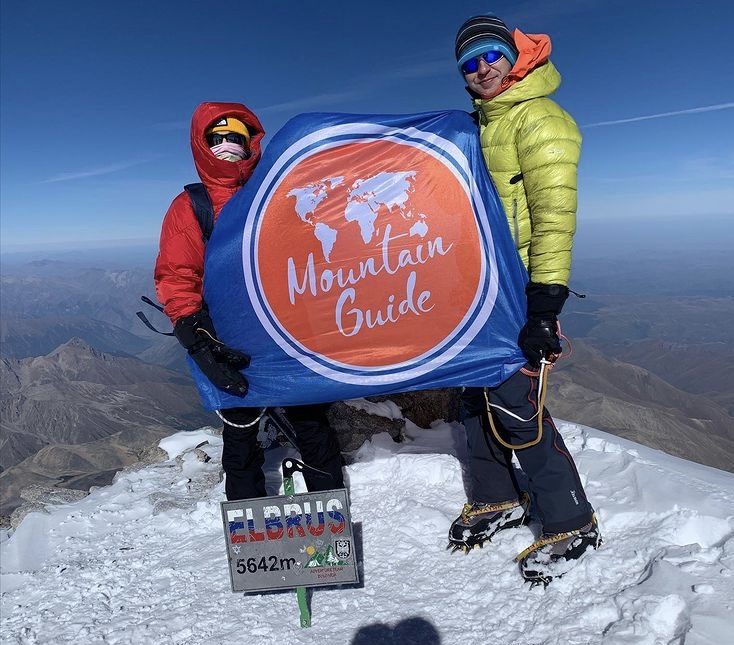
The author-led departure on Elbrus with Sergey Baranov follows the main Mountain Guide nine-day programme from the south: two acclimatisation walks in the valley, four nights in the high-mountain shelter, a hike to the Pastukhov Rocks, a rest day and the ascent of the West summit at 5642 m.
Programme price — $1 880.
Sergey has worked on Elbrus since 2001 and has made 215 ascents of the summit. Fixed dates for the author-led departures are not published at present; you can register your interest in advance, and Sergey's participation is confirmed individually before booking.
Important
- Participants carry the food for the high-altitude section themselves. This is a standard feature of how ascents of Elbrus from the south are organised. The food travels up by cable car with the group and is moved onwards by snowcat; it only has to be carried by hand over short sections of no more than 20 m.
- Fixed dates are not published at present; Sergey Baranov's participation is confirmed individually before booking.
- The minimum age for the group programme is 14; a child takes part together with a parent.
- If part of the group reaches the summit, the group attempt counts as completed and additional attempts are paid separately.
About climbing Elbrus with Sergey Baranov
The route and the acclimatisation match the main nine-day programme for climbing Elbrus from the south. What sets the author-led format apart is not a different mountain and not a promise of particular weather, but a named leader for the group.
For the first three nights the group stays in the valley and makes hikes on Cheget, to the Devichyi Kosy waterfall and to the high-altitude observatory. Participants then move up to the shelter on the southern slope, hike to the Pastukhov Rocks, rest, and only then set out for the summit. We strongly recommend nine days to beginners: the additional acclimatisation noticeably changes how well prepared you are for summit day.
Sergey runs the introductory reviews, assesses the condition of the group and takes the tactical decisions together with the team of guides. On summit day the ratio is no more than three participants to one guide, and assistant guides join the group where necessary.
Before the trip we recommend studying how to prepare for Elbrus and checking the terms of your insurance policy in advance.
Elbrus programme with Sergey Baranov, 9 days
Day 1. Arrival in Mineralnye Vody and transfer to the Elbrus region.
The group meets at Mineralnye Vody airport. Two group transfers are provided on the first day of the programme: the first leaves at 12:00 for participants whose flights are scheduled to land no later than 11:00, and the second leaves at 15:00 for participants whose flights are scheduled to land no later than 14:00. Please allow time for baggage reclaim and for leaving the terminal when booking. If a flight is delayed and you miss the group transfer by more than 30 minutes, we will help you order a private transfer, which the participant pays for separately. Once everyone has gathered and boarded, the groups travel by comfortable coach to the hotel, which stands in a remarkable natural setting at the foot of Elbrus, at the start of the hundred-kilometre valley of the Baksan river. On arrival participants check in and gather for dinner together, to get to know each other and discuss the plans for the days ahead. Overnight at the hotel.
Day 2. After breakfast participants set out on their first acclimatisation hike, the climb on Cheget.
Cheget reaches a height of 3642 metres. The climb is considered relatively easy and accessible to people with basic physical preparation, but it nevertheless includes a couple of fairly steep sections. On the way it opens views of the surrounding mountains, glaciers and valleys, including what is perhaps the best-known view in these parts, of the Semyorka glacier. During the climb the body begins to get used to altitude, which makes the following days and the ascent itself feel much better. After the hike we descend on foot to the hotel for dinner with Caucasian dishes, and rest. Overnight at the hotel.
Day 3. After breakfast the group heads for the Devichyi Kosy waterfall at 2700 m, where the cascading water makes a fine sight.
A moving local legend is attached to this place. Long ago a girl lived here, known for her beauty and for braids so long they reached the ground. She loved a young man who was fated to travel to distant lands and never return. When news of his death reached her, she wept bitterly, and her tears mixed with the water of the river to form a waterfall resembling her long braids streaming in the wind. Since then the place has been a symbol of love, and it is said that whoever bathes in the waterfall will soon meet theirs. After a rest at the waterfall the group continues to the observatory at 3100 m, one of the highest in the world. Gaining that altitude adds to the acclimatisation and makes the following days easier. After the walk participants descend for a hot dinner, then pack the duffel bags and collect everything needed from the equipment hire, because tomorrow we move up to the shelter. Overnight at the hotel.
Day 4. Today the group rides the cable car up to the shelter, where the night will be spent.
After a light snack we make an acclimatisation hike to 4200 metres, which is needed for the body to adapt to greater altitude and improves sleep at night. After the hike we return to the shelter for dinner, carefully prepared by our cook, and rest. Overnight in the shelter.
Day 5. Today participants face a serious acclimatisation hike to the Pastukhov Rocks at 4700 metres.
This day is an important part of the preparation for the ascent of Elbrus, because it helps the body get used to high-mountain conditions and lets participants understand how they feel above 4000 m. After returning there is lunch and rest. Before bed we recommend a short walk nearby, to take in oxygen before sleeping. Overnight in the shelter.
Day 6. Rest day before the ascent.
Participants can restore their strength, check equipment and prepare physically and mentally. If the state of the slope is suitable, snow and ice sessions are held: we practise self-arrest with an ice axe and clipping in with lanyards. Overnight in the shelter.
Day 7. An early start and the beginning of the ascent of Elbrus, the highest point in Europe at 5642 metres.
Depending on the condition of the group and the weather, a snowcat may be used to ease the ascent, at the participants’ choice. Under company rules there are no more than three clients to one guide, which allows a high level of safety and individual attention for every participant. If half the group decides to use the snowcat and the other half prefers to walk, that is no problem — we do not economise on clients, and there are always enough assistant guides on summit day. After the ascent we descend to the shelter, where the snowcat can also be used. Overnight in the shelter.
Day 8. Reserve day, held for unforeseen circumstances such as the weather.
On this day the group returns to Terskol, to our comfortable hotel, to a hot shower and clean sheets. A celebratory dinner follows, with certificates handed out, impressions exchanged and perhaps even new ascents planned. Overnight at the hotel.
Day 9. After an early breakfast the transfer arrives at about 07:00 to take participants to Mineralnye Vody airport.
A stop in Pyatigorsk is possible on the way, where you can walk, visit the historic site of Mikhail Lermontov’s duel and try the well-known local ice cream. Luggage can be left in the airport left-luggage office so that you can spend the time before your flight freely.
What the ascent with Sergey Baranov includes
- Guides. A leader throughout the programme and assistant guides on summit day, absolutely strictly at a ratio of one guide to three clients, so a group of four clients already has two guides. We place no limit on the number of group summit attempts. However, if part of the group reaches the summit and part does not, the ascent counts as completed and additional attempts are paid separately
- The services of a cook
- Hotel accommodation in twin or triple rooms, for the number of nights set out in the programme
- Accommodation in the shelter for the number of nights set out in the programme
- All transfers within the programme, including cable cars, from the airport or railway station and back
- Three meals a day throughout the programme, with dinner on the first day and breakfast on the last day
- Group equipment: ropes, ice screws, radios, satellite navigators and a first aid kit
What the ascent with Sergey Baranov does not include
- The snowcat on summit day. Where it is used, the stated 2026-season charges are 14,000 RUB up, 8,000 RUB down or 22,000 RUB return
- National park permit, where applicable
- Single occupancy
- Personal equipment
- Any deviations from the programme
- Any costs connected with changes to the programme
Insurance
НаверхList of equipment for climbing mount Elbrus from the South.
Скачать PDFRock-and-Rent のレンタルには、高品質で信頼性の高い装備がすべて揃っています。事前にすべて予約していただければ、ショートパンツ姿で来ていただいても問題ありません(特に事前予約の場合)。私たちは2001年からエルブルスへご案内しており、装備選定の基準はただ一つ――エルブルスの環境条件に最大限適合していることです。
そして、このリストは非常に慎重に作成されています。会社のガイドたちは合計で数千回の登頂を経験しており、この中に無駄なものは一つもないと考えています。
書類:
- パスポート
- 航空券/鉄道チケット
- 医療保険
- バウチャー(外国籍の方)
個人装備:
- バックパック 30〜40リットル
- ダッフルバッグ 80〜100リットル
- 寝袋(快適使用温度 0℃〜+10℃:6月〜9月、−20℃〜−10℃:10月〜5月)
- トレッキングポール
- アイゼン
- クラシックタイプのアイスアックス(ハーネスに固定するための直径5〜6mmの補助ロープ付き、長さ2〜3m)
- クライミングハーネス
- ヘルメット
- カラビナ 3個(大きめ推奨。ミトン着用時に操作しやすい)
- セルフビレイ用ランヤード
服装・靴:
- エルブルスではスキーウェアは使えますか?
- ダブルまたはトリプル構造のアルパインブーツ(プラスチック製または革製)。シングルブーツの場合はオーバーブーツ使用時のみ可(ゲイターとは別物)
- トレッキングシューズまたはトレッキングブーツ。5月〜6月初旬の順応登山では雪が残ることがあり、その場合はブーツが有利。ただし6月中旬〜9月末まではスニーカーでも可能(ただし捻挫のリスクあり)。防水性が保たれていることを必ず確認してください
- 防水ウェア(ジャケット+パンツ)。推奨防水透湿性能は10,000/10,000以上
- フリース上下
- 保温インナー上下
- フード付きダウンジャケット(厚手で非常に暖かいもの。エルブルス向けの標準的な重量は700g以上)
- 防寒ミトン
- 厚手グローブ(スキー用)
- 薄手グローブ(フリース)
- バンダナ(谷では日差し対策、防寒時は首や顔の保温にも使用可)
- ニット帽
- 登頂当日用の暖かいトレッキングソックス
- 日よけ用帽子
- トレッキングパンツとシャツ(できれば長袖)
- トレッキング用ソックス(トレッキング日数分あると望ましい)
その他:
- ヘッドランプ(連続点灯時間12時間以上)
- サングラス(遮光カテゴリー3〜4、横からの光も完全に遮るもの)
- スキーゴーグル(遮光カテゴリー1〜2、悪天候用)
- サーモス 1リットル(フタにボタンのないもの推奨)
- 下半分の顔用防風マスク(スカーフで代用可)
- 日焼け止め(ブランド品、SPF30〜50。実際には30と50の差はほとんどありません)
- リップクリーム SPF15
- 個人用救急セット
- 弾性包帯および/またはサポーター
- ゲイター(必須ではありませんが、特に5〜6月には役立つ場合あり)
- 化学カイロ(必須ではありませんが、非常に役立つことがあります)