- Guides
- B2B
-
#19607 (no title)
-
#15972 (no title)
- Climb Elbrus Individually
- Climb Elbrus from the South, 9 Days
- Climb Elbrus from the South, 7 Days
- Climb Elbrus from the South with Oxygen
- Climb Elbrus from the North, 10 Days
- Two Summits of Elbrus, 9 Days
- Elbrus Traverse from South to North, 9 Days
- Elbrus Traverse from North to South, 10 Days
- Cross of Elbrus, South to North, 9 Days
- Cross of Elbrus, North to South, 10 Days
- Climb Kazbek and Elbrus — 10-Day Two-Summit Expedition
- Climb Elbrus from the West, 11 Days
- Elbrus by Private Helicopter, 3 Days
- Elbrus Region Holiday and Trekking, 9 Days
- Elbrus Region Holiday, 7 Days
- Elbrus Dating
- Climb Elbrus from the South, 9 Days with Sergey Baranov
-
#15539 (no title)
- Climb Carstensz Pyramid, 8 Days with Helicopter Access
- Climb Mont Blanc, 4810 m — 8-Day Guided Ascent
- Climb the Matterhorn, 4478 m — 8-Day Guided Ascent
- Climb Mount Vinson, 15-Day Antarctic Expedition
- Climb Kosciuszko and Travel in Australia, 7 Days
- Climb Fisht, 2868 m — 3-Day Ascent by the 1B Route
- Climb Mount Wilhelm, 6 Days
-
#15546 (no title)
- Climb Kilimanjaro: the Marangu Route
- Climb Kilimanjaro: the Lemosho Route
- Climb Ararat, 5137 m — 7-Day Classic Climb
- Climb Kazbek from the South, 5033 m — 8 Days in Georgia
- Climb Kazbek and Elbrus — 10-Day Two-Summit Expedition
- Climb the Volcanoes of Mexico — Orizaba and Iztaccíhuatl, 9 Days
- Climb Alpamayo — 16-Day Technical Expedition
- Climb Margaret Peak (Stanley), 5109 m
- Climb Mount Kenya: Point Lenana, 4985 m
- Climb Dykh-Tau by the North Ridge, 13 Days
-
#15554 (no title)
- Aconcagua Climb — 17-Day Guided Expedition
- Island Peak Climb — 18-Day Expedition
- Climb Mera Peak, 6476 m — 16-Day Hinku Valley Expedition
- Climb Ama Dablam, 6812 m — 24-Day Expedition with Island Peak
- Climb Island Peak and Mera Peak — 24-Day Two-Summit Expedition
- Aconcagua and Ojos del Salado — 25-Day Combined Expedition
- Ojos del Salado Climb — 15-Day Expedition
- Climb Chimborazo and Cotopaxi — 14-Day Ecuador Expedition
- Climb Huascarán — 8-Day Technical Ascent
- Climb Razdelnaya Peak, 6148 m — 15-Day Pamir Expedition
- Climb Denali by the West Buttress, 23 Days
- #15565 (no title)
- #15572 (no title)
-
#15972 (no title)
-
#19592 (no title)
-
Trekking in Nepal: routes to the eight-thousanders
- K2 Base Camp Trek via the Gondogoro La
- Everest Base Camp Trek — 14 Days
- Everest Base Camp via Gokyo Lakes — 15 Days
- Short Everest Base Camp Trek in 10 Days
- Annapurna Circuit and Tilicho Lake Trek
- Manaslu Circuit Trek
- Kanchenjunga Circuit Trek (XXL)
- Kanchenjunga North Base Camp Trek (Short)
- Kanchenjunga from India: the Goecha La Trek in Sikkim
- Makalu Base Camp Trek
- Annapurna Base Camp Trek
- Trekking in South America
- Asia
- Trekking in Africa
-
Trekking in Russia
- Elbrus Region Holiday and Trekking, 9 Days
- Elbrus Region Holiday, 7 Days
- Oshten + Kardyvach — 9-Day Western Caucasus Trek
- Lake Kardyvach — 5-Day Base-Camp Trek
- Route 30: Through the Mountains to the Sea, with Oshten — 4 Days
- Trekking in Arkhyz — 7 Days over the Ayulyu Pass
- Gvandra Trek — 7 Days to the Ullu-Kyol Lakes
- Trekking in Dombai — 7 Days with the Murudzhu Lakes
- Europe
-
Trekking in Nepal: routes to the eight-thousanders
-
Adventure expeditions
-
Trekking in Africa
- モロッコツアー:北アフリカの中心
- トゥブカルの登山とモロッコの文化
- Eritrea: the Dahlak Archipelago and the Rashaida Nomads
- Rwanda: Mountain Gorillas and the Bisoke Volcano
- Ethiopia: Otherworldly Landscapes and the Peoples of the Omo Valley
- ウガンダツアー:クイーンズパークとマウンテンゴリラ
- Tanzania Safari: Serengeti, Ngorongoro and Tarangire
- ウガンダツアー:ホワイトサイとマウンテンゴリラ
- Zimbabwe and South Africa: Victoria Falls, Cape Town and the Cape of Good Hope
- Namibia: Etosha National Park and the Himba
- Kenya Safari: the African Big Five
- ボツワナツアー:オカバンゴデルタとチョベ公園
- Trekking in South America
- Asia
-
Trekking in Africa
- Ski touring and ski mountaineering: chasing freedom in the mountains
- VIP tours
- #19722 (no title)
- About
Ski Touring on Elbrus from the South, 9 Days
- Height (m)
- 5642
- Duration
- 9 days
- Difficulty
- Low
- Continent
- Europe
- Children
- Ages 12+
- Accommodation
- No nights in tents
2100 $
Why to go with us?
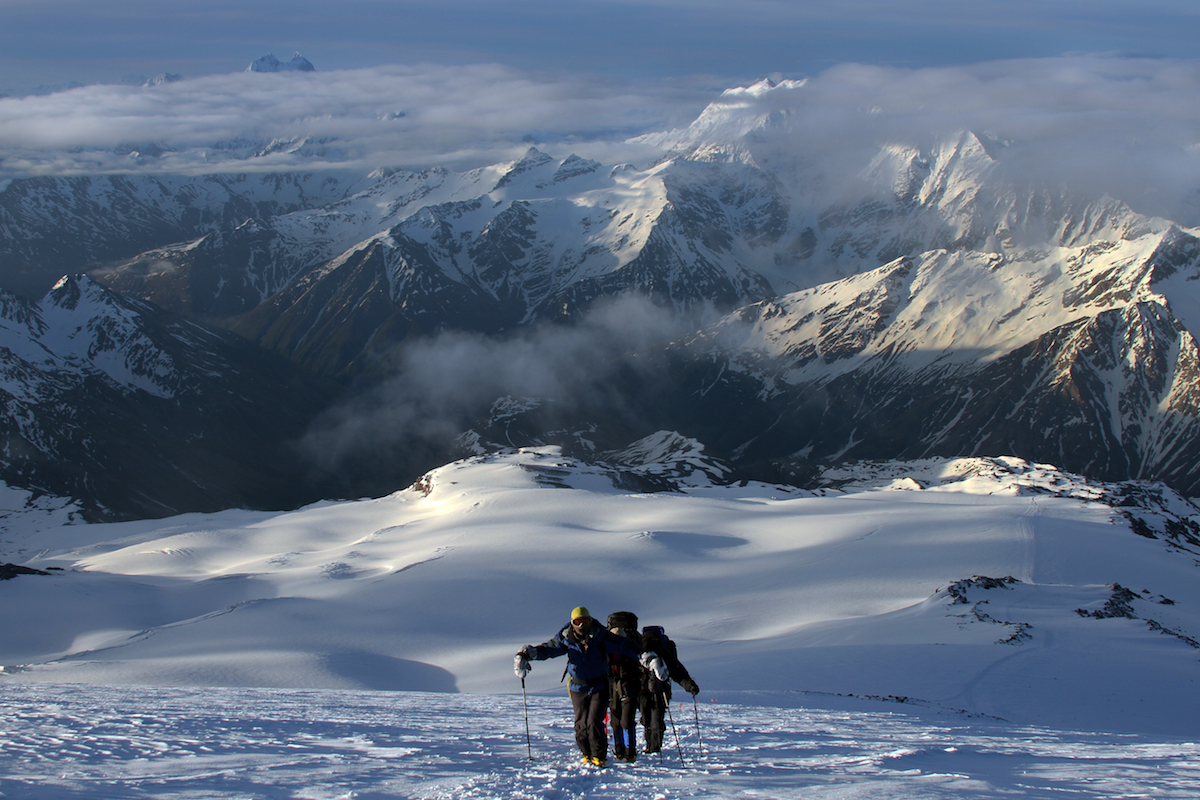
The 9-day ski tour on Elbrus from the south combines an ascent of the West summit of Elbrus, 5642 m, with climbing and descending on skis wherever the actual conditions allow. The main advantage of the trip is a staged acclimatisation in the valley and on the slopes of Elbrus, accommodation in a mountain refuge before the ascent and a reserve day in case of bad weather.
Programme price — $2 100.
The trip suits participants with previous ski-touring experience, a confident and controlled descent off prepared pistes and enough endurance for sustained work at altitude. It is not a course for learning from scratch: before booking it is important to assess your technique, your physical condition and your recent ski-touring experience honestly.
Mountain Guide arranges the route from the meeting at Mineralnye Vody to the return to the airport: transfers, hotel and refuge accommodation, meals, cable cars, permits, group equipment and the work of the guiding team. On summit day the ratio is no more than three participants to one guide.
The aim of the trip is the summit of Elbrus, but safety comes before an unbroken ski descent. The state of the snow, the weather and the situation on the route determine how far the group can climb and ski, and where ski crampons, ordinary crampons, an ice axe or a rope must be used.
Important
- Participants carry the food for the high-altitude part up themselves. This is a standard feature of how ascents of Elbrus from the south are organised. The food travels up by cable car with the group and is moved on by snowcat; it has to be carried by hand only over short sections of no more than 20 m.
- The trip is built for participants with ski-touring experience, a confident controlled off-piste descent and the endurance for a day at altitude
- An avalanche transceiver, probe and shovel are compulsory for every participant; the set is not shared across the group
- The state of the snow and the highest point that can be climbed and skied change through the season; the way the group moves and the equipment required are set by the guide according to actual conditions
- There is no limit on the number of group attempts within the reserve days the trip provides
- If part of the group reaches the summit, the ascent counts as completed and additional attempts for the remaining participants are paid separately
- Any departure from the refuge on summit day counts as an attempt
- Mountain Guide does not buy or sell air tickets and does not arrange visas, and accepts no responsibility for disruption beyond its control involving flights and border crossings
About the Elbrus south ski tour
The 9-day ski tour on Elbrus from the south is a chance to enjoy the mountains while making the ascent on skis, at a comfortable rhythm. The trip is built for participants with previous ski-touring experience, a confident and controlled descent off prepared pistes and enough endurance for sustained work at altitude. It is not a basic course: before booking you must tell the guide about your experience and your most recent ski-touring days.
The trip includes additional acclimatisation days, one in the valley and a second on the slopes of Elbrus. That approach lets you take in the surroundings and prepares the body for the ascent. The ascent itself is planned for the seventh day, which gives good conditions for acclimatisation.
The trip is designed for those who want a comfortable and safe ascent without unnecessary stress. If you do not yet have enough ski-touring experience and a controlled off-piste descent, take separate training first and build practice on lower routes. Elbrus should be the start of your mountain path rather than its limit. You can test yourself on other summits; the emphasis in this trip is on comfort, safety and enjoyment.
Ski mountaineering on Elbrus demands a high degree of preparation and a careful approach to acclimatisation. Including ski touring in the itinerary lets participants feel the freedom of movement on the slopes and the spirit of adventure that sets this activity apart.
Climbing Elbrus in ski-touring format is not only a test of your skills but an absorbing journey into the heart of the Caucasus.
The state of the snow on Elbrus changes through the spring: whether it is possible to climb and descend on skis is decided by the guide according to actual conditions.
Ski-touring skis, boots, bindings, skins and ski crampons are not available for hire, so each participant brings their own compatible ski set.
Elbrus south ski tour itinerary, 9 days
Day 1. Arrival at Mineralnye Vody and transfer to the Elbrus region. The group meets at Mineralnye Vody airport. Two group transfers are provided on the first day of the trip: the first leaves at 12:00 and is for participants whose flights are scheduled to arrive no later than 11:00; the second leaves at 15:00 and is for participants whose flights are scheduled to arrive no later than 14:00. We recommend buying tickets that allow time to collect baggage and leave the terminal. If a flight is delayed and you miss the group transfer by more than 30 minutes, we will help you order an individual transfer, which the participant pays for separately. The drive to the foot of Elbrus takes about three hours over roughly 200 km. We stay in a hotel at the start of the Baksan river valley, rest after the journey and meet over dinner. Participants get to know the guide and the group, receive the trip briefing and check their personal equipment. This day exists so that you can settle into the rhythm of the trip and resolve any practical arrangements before the first outing. Night in a hotel.
Day 2. Acclimatisation outing to Cheget, 3000 m. After breakfast we set out along mountain paths and alpine meadows towards Cheget. Depending on the weather and the state of the route, the guide may choose another acclimatisation outing with a comparable purpose. This first gain in altitude allows the guide to assess how the participants feel, the working pace of the group and the readiness for the days ahead on Elbrus. After the descent we return to the valley, have lunch and recover. This outing does not replace the altitude acclimatisation of the following days, but it lays its foundation without an abrupt move to sleeping in the refuge. Height gain 1100 m. Distance about 11 km. Night in a hotel.
Day 3. Acclimatisation and skiing on the slopes of Elbrus, 3500 m. After breakfast we take the cable car up to about 3500 m. We spend time on the slope, acclimatising and skiing, gradually getting used to the altitude, the snow and the terrain of Elbrus. The day helps you check how your personal ski-touring set works before the move up to the refuge and gives another chance to assess your controlled descent technique. The intensity and the specific plan are set by the guide according to the weather, the state of the snow and how the group feels. After the outing we take the cable car down and return to the hotel: sleeping lower helps recovery before the high-altitude part of the trip. Night in a hotel.
Day 4. Move up to the refuge, 3888 m, and acclimatisation outing to 4200 m. We take the cable car up to the refuge at 3888 m, settle in and prepare for several days on the mountain. After something to eat we make an unhurried acclimatisation outing to about 4200 m. Its purpose is to continue adapting, to check how the body responds to the first night at almost four thousand metres and to keep strength in reserve for the higher outing the next day. On the route it is important to tell the guide about any change in how you feel and not to speed up on your own. After returning we rest and prepare our equipment. Height gain 312 m. Distance about 2 km. Night in the refuge.
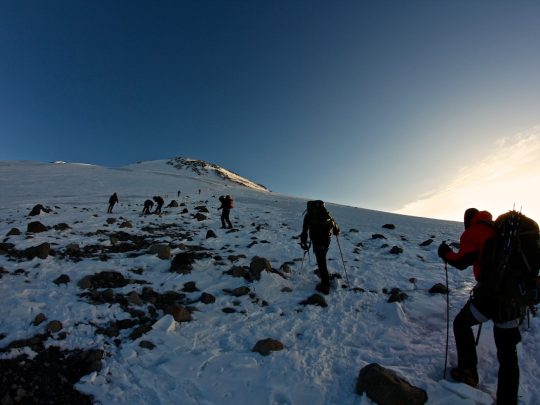
Day 5. Ski mountaineering outing to the Pastukhov Rocks, 4700 m. We climb towards the Pastukhov Rocks to about 4700 m. This is the main acclimatisation and training outing before the ascent: participants spend a long period above the refuge, work on an even pace at altitude and prepare for changes in the way they move. Depending on the state of the snow, part of the route may be covered on skis, and on some sections the guide may direct the group to move in mountaineering boots and crampons. Particular attention is paid to breathing, to conserving strength and to handling personal equipment. After reaching the planned point we descend to the refuge, rest and monitor recovery. Height gain 812 m. Distance about 6 km. Night in the refuge.
Day 6. Rest and preparation for the ascent. After two high outings the body needs a day of recovery. We rest in the refuge and check skis, skins, boots, crampons, the avalanche kit, clothing and personal items for the early start. The guide confirms the order of travel, how participants are grouped, the forecast and the possible ways equipment will be used on different sections. If the weather and the state of the slope allow, there is a session on movement technique on snow and ice terrain; its length must not interfere with recovery. It is important to eat in good time, prepare water and go to bed earlier than usual, because the start is planned for the night. Night in the refuge.
Day 7. Ascent of the West summit of Elbrus, 5642 m. We leave the refuge early in the morning, roughly between 2:00 and 4:00. By prior decision, part of the way can be covered by snowcat to conserve strength for the upper section. On summit day no more than three participants work with one guide. The group moves at a pace that allows everyone’s condition to be monitored and a safe return from altitude. The decision to continue the ascent, the turnaround time and the way the group moves are taken by the guide, taking account of the weather, the snow, the visibility and how the participants feel. A full ascent and an unbroken descent from the summit entirely on skis are not guaranteed: where necessary, ski crampons, ordinary crampons, an ice axe and a rope are used. After the summit we descend to the refuge, have dinner and rest. Height gain 1754 m. Distance about 14 km. Night in the refuge.
Day 8. Reserve day or descent to the valley. If the weather or the condition of the participants did not allow the summit attempt on day 7, we use this day as a reserve for a group attempt. Whether the group sets out, and the plan for the ascent, are decided by the guide according to the actual situation. If the ascent has already taken place, we pack, take the cable car down and return to the hotel. The remaining time can be given over to rest, the local market, the banya, a cafe or a quiet walk. This order preserves the weather reserve while giving participants time to recover before the journey after a successful ascent. Night in a hotel.
Day 9. Return to Mineralnye Vody. We leave the hotel at 7:00 and head for the airport or railway station at Mineralnye Vody. If the schedule and the time before departure allow, a stop in Pyatigorsk for a walk and lunch is possible on the way. When choosing your return flight it is important to allow for the time of the group transfer and a margin for the journey. The trip ends in Mineralnye Vody. Flight or journey home.
What's included
- Mountain Guide’s guides: a lead guide throughout the trip and assistant guides on summit day, strictly at a ratio of one guide to three participants. There is no limit on the number of group attempts within the reserve days; if part of the group reaches the summit, the ascent counts as completed and additional attempts for the remaining participants are paid separately
- Cook services
- Hotel accommodation in twin rooms, for the number of nights set out in the itinerary
- Accommodation in the mountain refuge, for the number of nights set out in the itinerary
- All transfers according to the itinerary, including the cable cars, from the airport or railway station and back
- Three meals a day throughout the trip, with dinner on the first day and breakfast on the last
- All the necessary permits and registrations
- Group equipment: ropes, ice screws, radios, satellite navigators and a first-aid kit
- Hire of a duffel bag for rented and personal equipment for the duration of the ascent
What's not included
- The snowcat on summit day
- The national park permit, where applicable
- Single occupancy
- Early check-in or late check-out at the hotel before or after the trip (we always try to agree additional benefits for our guests with our partners, and early check-in or late check-out is often granted at no charge)
- Personal equipment
- Any departure from the itinerary
- Any costs connected with change to the itinerary
The Elbrus ski tour from the south for private groups
The nine-day Elbrus ski tour from the south can be run for a private group on dates agreed individually, provided a guiding team is free and the snow and ice conditions allow the route to be attempted safely. It is based on the published itinerary, with gradual acclimatisation, nights in the hotel and the hut, the ascent of the West summit and a reserve day.
The format suits groups of friends, ski touring clubs, corporate teams and family groups of adults with comparable experience. The trip is not intended for children and is not a ski touring course for beginners. Before confirming a place we establish each person’s previous ski touring experience, their technique for controlled descent off-piste, their fitness and their experience of moving on snow and ice.
A private group can discuss the length of the trip, additional acclimatisation or reserve days, the accommodation, private transfers and other extra services. Changes to the route and to the level of difficulty are considered only together with the guide: they must not shorten the acclimatisation needed, reduce safety or alter the essential idea of a high-altitude ski tour. The size of the guiding team is calculated from the number of participants and what summit day requires.
All changes, the availability of services and the price are confirmed before booking. Contact Mountain Guide for a quote for a private trip.
Documents required for the Elbrus ski tour from the south
To join the ski tour you need to prepare:
- A valid passport
- Tickets to Mineralnye Vody and back
- Medical insurance valid in Russia and covering ski touring, off-piste skiing, mountaineering to at least 6000 m, search and rescue, transport and medical evacuation
- For participants from abroad, a visa and any other entry documents required for your nationality
Before the trip, check not only the maximum altitude on the policy but also that it excludes neither ski mountaineering, nor travel off-piste, nor the use of mountaineering equipment. We recommend keeping electronic copies of your passport, insurance, tickets and visa documents separately from the originals.
Weather and seasons for the Elbrus ski tour from the south
In practice the season for ski touring on Elbrus from the south runs through the spring, from late March to mid-June. The most settled combination of snow low on the route and a workable temperature is most often found in April and May, though no period in the calendar guarantees any particular state of the slope.
Early in the season, winter cold, fresh snow and a heightened avalanche risk are more likely. By late May and in June the snow lower down becomes patchy, while the upper part of Elbrus may still be skiable on the ascent. Strong wind can strip the snow and expose hard névé or ice even in the main season.
An ascent and descent entirely on skis cannot be guaranteed. According to the actual state of the snow, your guide may change the acclimatisation route, move an outing, leave the skis behind, switch the group to ordinary crampons and an ice axe, or turn everyone back. On the summit you can meet hard frost, wind and almost no visibility at all.
The final decision on the line, on skis or crampons, on the start time and on whether to continue the attempt rests with the lead guide, in the light of the weather, the avalanche conditions, the state of the glacier and the group’s readiness.
Before you travel, compare the forecast with the actual readings on our “Weather on Elbrus” page.
Accommodation and meals on the Elbrus ski tour from the south
During the trip participants stay in a hotel in the Elbrus region and in a high-altitude hut on the southern slope of Elbrus. The number of nights matches the itinerary.
In the valley the accommodation is in twin rooms. Single occupancy is possible on request, subject to a room being free and to an extra charge. On the high-altitude section the group stays in a shared mountain hut at almost 4000 m; conditions there are simpler than in a hotel and are built above all around sleeping, eating, drying equipment and preparing for the outings.
The price includes three meals a day: dinner on the day you arrive, meals on the acclimatisation and high-altitude days, and breakfast on the day you leave. A cook works for the group on the mountain. On summit day participants prepare their flask, water and the snacks agreed with their guide in advance.
Food allergies, medical restrictions and any special dietary requirements must be reported before booking. Whether separate meals are possible depends on what food is available and on the conditions at the high-altitude hut.
Day-to-day conditions on the Elbrus ski tour from the south
The hotel in the Elbrus region has the usual facilities: a shower, hot water, electricity, mobile signal and internet. This is a good place to check your equipment, dry your clothes and charge your devices fully before the high-altitude section.
In the mountain hut there is less personal space, and electricity, water, phone coverage and the chance to dry things depend on how busy it is, on the weather and on the state of the building. We recommend bringing a power bank, spare batteries for your head torch and dry bags for documents and electronics.
Ski touring equipment should be stowed compactly and never left in the passageways. Before each outing you check for yourself that your boots, bindings, skins, ski crampons and ordinary crampons are compatible; your guide makes the final check.
At altitude, do not count on continuous mobile internet or on the comforts of a hotel. The priorities are sleep, hot food, keeping your equipment dry and being ready for an early start.
Insurance
НаверхEquipment list for ski touring on Elbrus from the south
Скачать PDFThis is a separate list for a high-altitude ski tour, not for an ordinary summer ascent. Every participant must have a full set of ski touring, avalanche and glacier equipment. Avalanche equipment can be reserved in advance from Rock and Rent. Touring skis, boots, bindings, skins and ski crampons are not available for hire: each participant brings their own complete, compatible ski set-up.
Ski-touring and avalanche kit
- Ski-touring skis with bindings that have a walk mode
- Skins, trimmed to your own skis
- Ski crampons compatible with your bindings
- Warm touring boots with a walk mode, compatible with your bindings and with mountaineering crampons
- Adjustable ski poles with winter baskets
- Avalanche transceiver
- Avalanche probe
- Avalanche shovel
- Ski or climbing helmet
- A 30-40 litre rucksack with a ski carry system
Glacier and climbing equipment
- Mountaineering crampons compatible with ski-touring boots
- Classic ice axe
- Climbing harness
- Three screwgate karabiners
- Two prusik loops, or accessory cord, prepared as your guide advises
- Cow’s-tail lanyard
- One personal ice screw on its own karabiner
- Head torch and a spare set of batteries
Clothing and footwear
- Base layer, top and bottoms
- A fleece or another warm mid layer
- Softshell jacket and trousers for walking
- Waterproof shell jacket with a hood
- Waterproof shell trousers that can be pulled on over your boots
- Warm down or synthetic jacket with a hood
- Thin gloves for the ascent
- Warm ski gloves
- High-altitude mittens
- Warm hat and a buff or balaclava
- Warm ski-touring socks
- Light footwear for the valley
Personal items
- A sleeping bag with a comfort rating of -20 to -10 °C for the spring trip
- Category 3-4 mountain sunglasses
- Ski goggles for wind and poor visibility
- Vacuum flask, 1 litre, without a push-button lid
- SPF 30-50 sun cream and lip balm with SPF
- Personal first-aid kit and any medication you take
- A power bank and waterproof packing for electronics
You may also like
-
 6,650 $
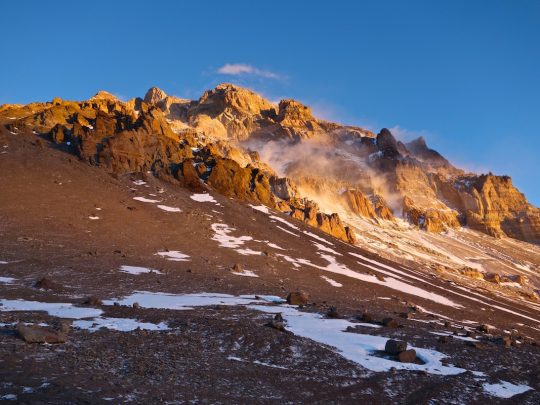
Aconcagua Climb — 17-Day Guided Expedition
- Height (m)
- 6962
- Duration
- 17 days
- Difficulty
- Moderate
- Continent
- South America
- Children
- Ages 14+
- Accommodation
- Some nights in tents
-
 1,960 $
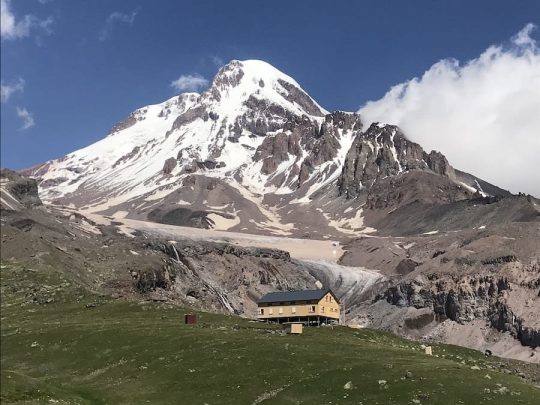
Climb Kazbek from the South, 5033 m — 8 Days in Georgia
- Height (m)
- 5642
- Duration
- 8 days
- Difficulty
- Moderate
- Continent
- Europe
- Children
- Not suitable for children
- Accommodation
- No nights in tents
-
 3,200 $
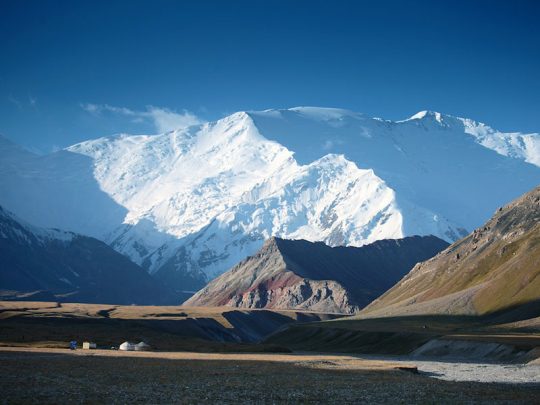
Climb Lenin Peak, 7135 m — 21-Day Pamir Expedition
- Height (m)
- 7135
- Duration
- 21 day
- Difficulty
- Moderate
- Continent
- Asia
- Children
- Not suitable for children
- Accommodation
- Some nights in tents
-
 2,410 $
Elbrus Traverse from South to North, 9 Days