- Guides
- B2B
-
#19607 (no title)
-
#15972 (no title)
- Climb Elbrus Individually
- Climb Elbrus from the South, 9 Days
- Climb Elbrus from the South, 7 Days
- Climb Elbrus from the South with Oxygen
- Climb Elbrus from the North, 10 Days
- Two Summits of Elbrus, 9 Days
- Elbrus Traverse from South to North, 9 Days
- Elbrus Traverse from North to South, 10 Days
- Cross of Elbrus, South to North, 9 Days
- 「北からの十字架」プログラムに従ってエルブルス山を登る
- Climb Kazbek and Elbrus — 10-Day Two-Summit Programme
- Climb Elbrus from the West, 11 Days
- エルブルス山 ヘリコプター登頂
- Elbrus Region Holiday and Trekking, 9 Days
- Elbrus Region Holiday, 7 Days
- Elbrus登Tinderツアー
- Climb Elbrus from the South, 9 Days with Sergey Baranov
- #15539 (no title)
-
#15546 (no title)
- Climb Kilimanjaro: the Marangu Route
- Climb Kilimanjaro: the Lemosho Route
- Climb Ararat, 5137 m — 7-Day Classic Programme
- Climb Kazbek from the South, 5033 m — 8 Days in Georgia
- Climb Kazbek and Elbrus — 10-Day Two-Summit Programme
- メキシコで火山を登る
- Climbing Alpamayo — 16-Day Technical Expedition
- マーガレットピークを登る(スタンレー)
- Climbing Mount Kenya: Point Lenana, 4,985 m
- Climb Dykh-Tau by the North Ridge, 13 Days
-
#15554 (no title)
- Aconcagua Climb — 17-Day Guided Expedition
- Island Peak Climb — 18-Day Expedition
- Climb Mera Peak, 6476 m — 16-Day Hinku Valley Programme
- Climb Ama Dablam, 6812 m — 24-Day Expedition with Island Peak
- Climb Island Peak and Mera Peak — 24-Day Two-Summit Expedition
- Aconcagua and Ojos del Salado — 25-Day Combined Expedition
- Ojos del Salado Climb — 15-Day Expedition
- クライミングチンボラゾ、コトパクシ
- ワスカランクライミング
- Climb Razdelnaya Peak, 6148 m — 15-Day Pamir Expedition
- Climb Denali by the West Buttress, 23 Days
- #15565 (no title)
- #15572 (no title)
-
#15972 (no title)
-
#19592 (no title)
-
See 8000m
- K2 Base Camp Trek via the Gondogoro La
- Everest Base Camp Trek — 14 Days
- Everest Base Camp via Gokyo Lakes — 15 Days
- 一週間でエベレストへのトレッキング
- Annapurna Circuit and Tilicho Lake Trek
- Manaslu Circuit Trek
- Kanchenjunga Circuit Trek (XXL)
- Kanchenjunga North Base Camp Trek (Short)
- Kanchenjunga from India: the Goecha La Trek in Sikkim
- マカルベースキャンプへのトレッキング
- アンナプルナベースキャンプトレッキング
- South America
- Asia
- Africa
-
Russia
- Elbrus Region Holiday and Trekking, 9 Days
- Elbrus Region Holiday, 7 Days
- トレッキングオシュテン+カルディヴァッハ
- Lake Kardyvach — 5-Day Base-Camp Trek
- Route 30: Through the Mountains to the Sea, with Oshten — 4 Days
- Trekking in Arkhyz — 7 Days over the Ayulyu Pass
- Gvandra Trek — 7 Days to the Ullu-Kyol Lakes
- Trekking in Dombai — 7 Days with the Murudzhu Lakes
- Europe
-
See 8000m
-
Adventures
-
Africa
- モロッコツアー:北アフリカの中心
- トゥブカルの登山とモロッコの文化
- エリトリアツアー:ダラク諸島とラシャイダ遊牧民
- ルワンダツアー:マウンテンゴリラとビソーク火山
- エチオピアツアー:宇宙の風景とオモ渓谷の部族
- ウガンダツアー:クイーンズパークとマウンテンゴリラ
- Tanzania Safari: Serengeti, Ngorongoro and Tarangire
- ウガンダツアー:ホワイトサイとマウンテンゴリラ
- ジンバブエと南アフリカツアー:ビクトリアフォールズ、ケープタウン、ケープオブグッドホープ
- ナミビアツアー:エトーシャパークとヒンバ族
- ケニアツアー:アフリカのビッグファイブ
- ボツワナツアー:オカバンゴデルタとチョベ公園
- South America
- Asia
-
Africa
- Ski-touring
- VIP
- #19722 (no title)
- About
Ski Touring on Kazbek and Elbrus, 9 Days
- Height (m)
- 5642
- Duration
- 11 days
- Difficulty
- Moderate
- Continent
- Europe
- Children
- From 14 years old
- Accommodation
- Without tents
1900 $
Why to go with us?
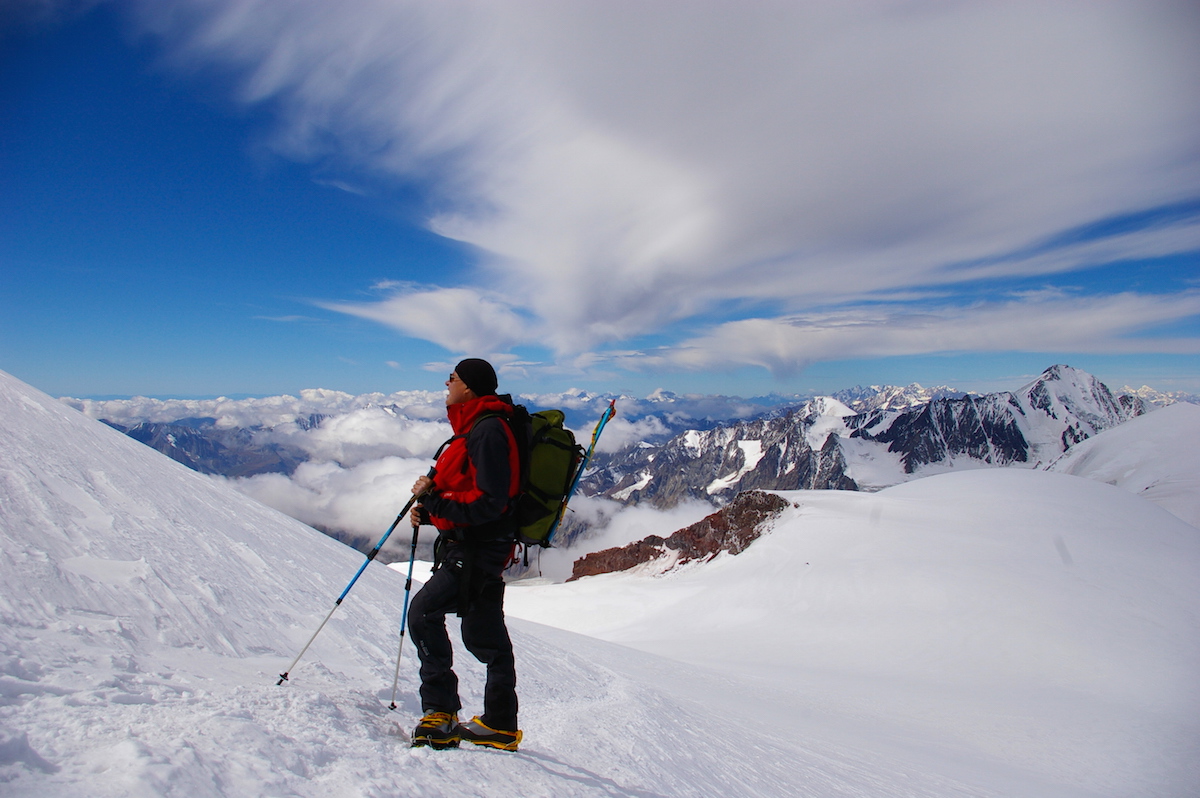
The 9-day ski tour on Kazbek and Elbrus brings two high-altitude ski ascents together in one trip. The group first covers the more self-supported glacier route on Kazbek from the south, then travels from Georgia to the Elbrus region and climbs the West summit of Elbrus by the southern route.
The main advantage of the programme is the chance to compare two different mountains and to use the acclimatisation gained on Kazbek for the next altitude stage. There is no separate second acclimatisation cycle on Elbrus, so participants need good endurance, steady recovery and experience of several consecutive days in the mountains.
The programme suits only participants with previous ski-touring experience, a confident and controlled descent off prepared pistes and the skills to move in crampons and on a rope team. It is not an introductory course. A full ascent and an unbroken ski descent from either summit are not guaranteed: the way the group moves on each section is set by the guide according to the snow, the state of the glacier, the weather and the readiness of the group.
Mountain Guide arranges the guides, the accommodation, the meals, the group transfers and the high-altitude logistics of both stages. Participants need to prepare a compatible personal ski-touring, avalanche and glacier kit in advance and to check the requirements for crossing the border between Georgia and Russia.
Important
- Participants carry the food for the high-altitude part up themselves. This is a standard feature of how ascents of Elbrus from the south are organised. The food travels up by cable car with the group and is moved on by snowcat; it has to be carried by hand only over short sections of no more than 20 m.
- Tents beside the Meteo Station are used only as a reserve option when there is no space in the building
- Any departure from the refuge on summit day counts as an attempt
- In spring, horses carry loads at most as far as the Saberce Pass; in deep snow the unloading point may be lower and participants cover the whole snow-covered part of the approach on skis
- The programme is built for participants with ski-touring experience, a confident controlled off-piste descent and the endurance for two altitude stages
- An avalanche transceiver, probe and shovel are compulsory for every participant; the set is not shared across the group
- A full ascent and an unbroken ski descent from either summit are not guaranteed; the decision to use skis, crampons, an ice axe or a rope is taken by the guide according to actual conditions
- The programme runs in Georgia and Russia; entry and border-crossing requirements must be checked against your nationality before tickets are bought
About the Kazbek and Elbrus ski tour
This combined 9-day ski tour brings together two consecutive altitude stages: Kazbek, 5033 m, from the south and the West summit of Elbrus, 5642 m, from the south. The programme starts in Kazbegi in Georgia and, after the Kazbek ascent, continues in the Elbrus region.
On Kazbek the group acclimatises at the Gergeti Trinity church, climbs by way of the Saberce Pass to the Meteo Station and makes an outing to 4000 m. The main accommodation on the mountain is the Meteo Station; tents beside it are used only as a reserve when there is no space, and this is agreed with participants in advance.
The altitude stage on Kazbek creates the acclimatisation base for Elbrus, but it does not remove the effect of altitude, weather and accumulated fatigue. After descending to Kazbegi the group travels from Georgia to Russia and takes the cable car up to the refuge at 3888 m. There is no separate second acclimatisation cycle on Elbrus in this short programme.
The programme is built for participants with previous ski-touring experience, a confident and controlled descent off prepared pistes, sufficient endurance and the skills to move in crampons and on a rope team. This is not an introductory ski-touring course.
An unbroken ascent and descent of both summits entirely on skis are not guaranteed. The state of the snow, the glacier, the snow bridges and the avalanche situation can differ between the two mountains. The decision to use skis, ski crampons, mountaineering crampons, an ice axe or a rope on each section is taken by the guide.
Ski-touring skis, boots, bindings, skins and ski crampons are not available for hire, so each participant brings their own compatible ski set.
Kazbek and Elbrus ski tour programme, 9 days
Day 1. The group meets in Kazbegi. The programme starts in Kazbegi. Participants check into a guest house or hotel and meet the guides. In the evening the group goes through the two consecutive altitude stages, the border-crossing rules and the plan if the weather changes. Skis, bindings, skins, ski crampons, the avalanche kit and glacier equipment are checked separately. Any incompatibility, or any missing compulsory item, must be resolved before the group sets out for the Meteo Station. Night in Kazbegi.
Day 2. Acclimatisation outing to the Gergeti Trinity church, 2170 m. This unhurried outing helps acclimatisation begin without a sharp gain in altitude and lets the guide assess the pace of the group. Participants check their clothing, their rucksack and their recovery after the journey. After returning, personal loads and equipment are finally prepared for the climb to the Meteo Station. The guides confirm the order of travel on the snow-covered section and the sharing out of group glacier equipment. Night in Kazbegi.
Day 3. Climb to the Meteo Station, 3600 m, by way of the Saberce Pass, 3000 m. The climb takes roughly 7 to 9 hours and is the main gain in altitude before the acclimatisation outing. The group covers the snow-covered part of the approach on skis. In spring, horses carry the agreed load up to 20 kg per participant at most as far as the Saberce Pass; in deep snow the unloading point may be lower. The main option for the night is the Meteo Station building. Tents beside it are used only as a previously agreed reserve option. After settling in, the group recovers and checks its equipment. Night at the Meteo Station.
Day 4. Acclimatisation and training outing to 4000 m. The group climbs above the Meteo Station without the aim of reaching the summit. The outing gives the body an additional altitude stimulus and allows travel on skins, the use of ski crampons, the changeover to mountaineering crampons and roped work to be checked. The guide chooses the section and the way of moving according to the actual state of the snow and the glacier. After returning, participants prepare clothing, food and equipment for an early start. Night at the Meteo Station.
Day 5. Summit attempt on Kazbek, 5033 m. The start is early. The climb crosses the glacier on a rope team; on firn, ice and the upper section, mountaineering crampons and an ice axe are used. Every participant must have a personal ice screw on its own karabiner. An unbroken ascent and descent from the summit entirely on skis are not guaranteed: the place where the group changes to crampons, the turnaround time and the point at which the ski descent begins are all set by the guide. The decision depends on the weather, the state of the snow bridges and the glacier, and the readiness of the group. After the attempt, participants return to the Meteo Station. Night at the Meteo Station.
Day 6. Reserve day or descent to Kazbegi. If conditions did not allow an attempt the day before, the day may be used for a second outing at the guide’s decision. If the ascent took place, the group begins the descent to Kazbegi. The way of moving and the arrangements for carrying loads depend on the state of the snow; in spring horses come up at most as far as the Saberce Pass, and the actual unloading point may be lower. Once the mountain part is over, participants check into a guest house or hotel and prepare their documents and belongings for the border crossing. Night in Kazbegi if the group has descended as planned.
Day 7. Transfer from Kazbegi to the Elbrus region. The group travels from Georgia to Russia and continues the programme on Elbrus. On arrival, participants take the cable car up to the mountain refuge at 3888 m. There is no separate second acclimatisation cycle on Elbrus: the programme uses the altitude adaptation gained on Kazbek. The remaining time is for recovery after the journey, for checking ski and mountaineering equipment and for preparing for an early start. Night in the refuge.
Day 8. Summit attempt on the West summit of Elbrus, 5642 m. The start is early in the morning and the day may take 8 to 12 hours. A snowcat may be used on the lower part of the route for a separate charge. The way of moving is chosen according to actual conditions: wind can expose hard firn and ice, so skis, ski crampons, mountaineering crampons, an ice axe and a rope are all used on different sections. An unbroken ski descent from the summit is not guaranteed. The turnaround time and the decision to continue are taken by the guide. After the attempt the group returns to the refuge. Night in the refuge.
Day 9. Reserve day and the end of the programme. If the weather did not allow the group to set out on Elbrus the day before, the reserve day may be used for a second attempt at the guide’s decision. If the ascent took place, the group descends by cable car to the valley and travels to the airport. The standard transfer is planned for 15:00, so flights no earlier than 19:30 are recommended. If the reserve day is used, the onward logistics depend on the time of return and on the cable car’s operating hours.
What the Kazbek and Elbrus ski tour includes
- Mountain Guide guides: a lead guide throughout the programme
- Assistant guides on the Kazbek summit day; no more than three participants to one guide
- Assistant guides on the Elbrus summit day; no more than three participants to one guide
- Main accommodation on Kazbek in the Meteo Station building
- Tents beside the Meteo Station only as a previously agreed reserve option
- Horses to carry the agreed load up to 20 kg per participant, at most as far as the Saberce Pass; the actual unloading point may be lower depending on the state of the snow
- Meals on the mountain part of the route
- Breakfasts during the hotel stay
- Accommodation in Kazbegi in a guest house or hotel in twin rooms, for the number of nights set out in the programme
- Accommodation in the refuge on Elbrus, for the number of nights set out in the programme
- All transfers according to the programme, from Kazbegi to the airport or railway station after the Elbrus stage, including the journey between the two mountain stages and the cable cars
- The necessary permits and registrations
- Group glacier and rescue equipment and a group first-aid kit
What the Kazbek and Elbrus ski tour does not include
- International flights
- The transfer from Tbilisi or another city to Kazbegi on the day the programme starts; arranged on prior request only
- Personal porters for personal baggage
- Personal equipment
- Lunches and dinners in Kazbegi
- Additional costs arising from a departure from the programme
- Medical insurance and costs connected with evacuation in the event of an accident
- Personal expenses (drinks, internet, telephone calls and so on)
- Visas and other border-crossing documents where these are required by the participant’s nationality
- The snowcat on the Elbrus summit day
- Single occupancy
- Any costs connected with changes to the programme
Insurance
НаверхEquipment
Скачать PDFDocuments:
- Passport
- international passport
- Airplane / Train Tickets
- Medical insurance
ScrewPersonal equipment:
- Backpack. 50-60 liter.
- Sleeping bag, comfort temperature from 0°C to + 10°C (from June to September inclusive), from -20°C to 0°C (from October to May inclusive).
- Sleeping mattress.
- Trekking poles be sure to have rings of at least 70 mm
- Crampons
- Ice axe. Classical.
- Harness.
- Carabiners – 2 pcs.
- Mountaineering Lanyard
- Helmet
- Ice screw on a separate carbine
- Personal dishes
Clothes and shoes:
- Climbing boots single-layer or double. Double – plastic or leather. Of plastic, we recommend Scarpa Vega – perhaps the warmest of all double boots.
- Sneakers trekking or boots trekking. In May and early June, you can still see snow at the first acclimatization exits, in which case the advantage of shoes over sneakers is undeniable. However, after mid-June and until the end of September they can be replaced with sneakers.
- Waterproof layer – Jacket + pants. The industry offers a range of products from simple membranes 5000/5000 to products from Gore-Tex.
- Fleece pants and jacket.
- Thermo underwear top + bottom.
- Down jacket. Thick and warm.
- Mittens are warm.
- Thick.gloves.
- Thin gloves.
- Bandana (in addition to sun protection in the valley, it can be used to warm your throat or face in the cold)
- Hat warm.
- Warm trekking socks for climbing day
Miscellaneous:
- LED headlamp
- Sunglasses.
- Ski goggles.
- Thermos – 1 liter. Better without a button in the lid.
- Windproof mask on the lower part of the face (you can replace it with a scarf with some success).
- Gaiters.
- Sunblock and lip balm.
- Chemical heating pads (not necessary, but can be very useful).
- Personal medical kit.
- Knee supports.