Kit for Kilimanjaro has to work across several climate zones at once. Low down it is warm and humid, and rain is possible. Higher up it becomes drier, colder and windier. Summit night is spent at temperatures below 0°C, and after dawn a long descent follows. One warm down jacket is therefore no substitute for a layering system and reliable waterproofing.
The final list is confirmed against the route, the season and the operator’s conditions. What follows is a structure that makes it easy to check your kit before you fly. It does not promise that any given model will be accepted on a particular programme.
The short answer
- The main priorities are broken-in footwear, a dry sleeping bag and a warm summit set
- All critical items are packed watertight inside the duffel bag and the daypack
- The tented routes and Marangu differ in the camp equipment they need
- New kit has to be tested in training
- The exact permitted baggage weight is confirmed before the trip
Two pieces of baggage
You walk with a daypack and hand the agreed part of your personal kit to a porter in a duffel bag. The daypack keeps water, a warm layer, waterproofs, documents, sun protection, personal medicines, snacks and anything you cannot get through the day without.
You must not hand the porter everything warm and waterproof: the duffel bag travels to camp separately, and the weather changes on the way. The permitted weight and the requirements for the duffel are confirmed for your own programme.
- A daypack of 25-35 litres
- A rain cover
- A robust duffel bag
- Dry bags, or heavy-duty waterproof liners
- A small bag for documents and money
Footwear
The main footwear is a pair of broken-in trekking boots with a stable sole and protection against moisture. They have to hold the foot on rock, in mud and on a long descent. New, heavy mountaineering boots are usually excessive, and light trainers do not give enough protection.
Take several tried pairs of trekking socks, a separate warm pair for the summit and a dry set for sleeping. Gaiters help against mud, rain and fine volcanic grit.
The layering system
The base layer wicks moisture, the mid layer holds warmth, the down layer is for stops and for the summit, and the shell protects against wind and precipitation. Each element has to work with the others, leave you free to move and fit under the next one.
Cotton dries slowly and feels unpleasant in the cold. For walking clothes, synthetics or a suitable wool are better. The spare dry set for sleeping is stored separately and is not used on a wet stage.
- Quick-drying T-shirts or shirts
- Thermal base layer, top and bottom
- Fleece jacket
- Down jacket with a hood
- Waterproof shell jacket
- Waterproof shell trousers
- Trekking trousers
- Warm gloves and liner gloves
- Hat, neck gaiter and sun headwear
Sleeping bag and nights on the mountain
The tented routes call for a warm sleeping bag and, where the programme says so, a sleeping mat. The bag needs a genuine comfort temperature, not just an extreme figure from the marketing. It is packed watertight, separately from wet clothing.
On Marangu participants sleep in shared mountain huts, but a sleeping bag is still compulsory. A hut keeps the rain off; it does not turn into a heated hotel.
Water and food on the move
You need refillable containers that let you carry the volume the programme specifies, plus a flask of about 1 litre without a complicated push-button mechanism. On summit night the tube of an ordinary hydration system can freeze.
Agree your personal snacks with the overall catering arrangement. Take familiar food that you have already used on long training days. Altitude often reduces appetite, so the summit is no place to experiment.
Light, electronics and communications
The head torch has to last the whole summit night. Test it with gloves on, and take spare batteries or a confirmed way of recharging. Keep your phone and power bank close to your body in the cold.
On the mountain you cannot count on mains electricity, Wi-Fi or a stable mobile signal. A power bank is chosen to match the length of the programme, though the extra weight counts too.
Sun, rain and dust
You need sunglasses, sun cream, lip balm, headwear and protection for the neck. A poncho can supplement a shell on the lower stages, but it does not replace a windproof jacket higher up.
From March to May and from October to December, waterproofing matters especially. For more on the weather trade-offs, read our breakdown of the seasons.
Personal first-aid kit and hygiene
A personal first-aid kit holds the medicines you take regularly and anything agreed with your doctor. Mountain Guide does not prescribe drugs for altitude sickness or for malaria. Tell the guide about significant conditions and allergies in advance.
Antiseptic, wet wipes, toilet paper, a quick-drying towel, a toothbrush and a minimal wash kit are all useful. There is usually no proper shower on the mountain section.
Hire or buy
Boots, base layers and personal toiletries are better owned. A sleeping bag, a down jacket or poles can sometimes be hired, but availability, model, size, condition and price are confirmed in advance.
Photograph a hired item when you collect it, and check the zips, the sole and the seams, and that nothing is missing. Do not treat hire as guaranteed simply because another operator offers it.
The final check
Lay the whole set out at home, tick every item against the list and pack the duffel and the daypack. Then go out with the daypack for a training session in the rain or in cool weather. That is how you find chafing, awkward zips and the impossibility of getting at the layer you need quickly.
Full route-by-route lists are on the pages for Lemosho, Machame and Marangu. The list sent out before a specific departure is the one that counts as final.
How to split your kit between duffel and daypack
The duffel is carried by the team, so during the walking day you usually have no access to it. The daypack should hold water, food for the stage, shell jacket and trousers, an insulating layer, gloves, headwear, sun protection, head torch, personal first-aid kit and documents, unless the guide gives other instructions. Critical medicines are never sent separately from the participant.
Inside the duffel, items are sorted further into dry bags. A single cover on the outside does not protect the contents through prolonged rain and handling. Sleeping bag, dry sleeping set, down clothing and electronics each need independent waterproofing. Label the bags, so that you are not going through all your baggage in a cold tent in the evening.
Weight limits for the duffel cannot be guessed from someone else’s account. They are confirmed for the specific programme before departure. Excess baggage does not become safer because another person carries it, and spare items make packing and the daily camp move harder.
Field-testing the kit
Put the full set on at home and on a training day, in the order in which it will be used on the mountain. Check whether the insulation fits under the shell jacket, whether you can work the zips in warm gloves, whether the boots pinch with a summit sock on, and whether your glasses steam up when you wear a neck gaiter. Tanzania is too late to be trying new boots and a new layering system for the first time.
- Weigh the daypack and the duffel separately
- Pack the daypack with the dry bags closed and put the rain layer on
- Walk for at least two hours in the boots and the summit socks
- Test the head torch with gloves on and take spare power
- Label the medicines and keep the instructions for taking them
- Draw up a list of hired items and the terms for returning them
Requirements can differ for Lemosho, Machame, Marangu and for a private departure. The final list is always confirmed by the operator of the specific date, taking account of the overnight stops, the season and the actual conditions.
Kit is chosen by function, not by the number of items.
Every important item has to solve a specific problem: keep you dry, hold warmth, protect you from the sun, light the path or let you drink on the move. Duplicates are only needed for critical functions. Spare socks and gloves are useful, for instance, whereas two heavy town coats do not replace one working shell and an insulating layer.
Before buying, split the set into three groups. The first is always in the daypack. The second goes into the porter’s duffel and is available only in camp. The third stays at the hotel. A mistake in that split is more dangerous than a few extra grams: down jacket, waterproofs, water, medicines and torch must not end up away from the participant at the moment the weather turns.
A working clothing system, stage by stage.
In the forest, ventilation and rain protection matter. You warm up quickly on the climb, so clothing that is too warm becomes wet from the inside. The base layer wicks moisture, light walking clothes protect the skin, and the shell set sits at the top of the daypack. Once you stop, a damp layer must not be your only insulation.
On the open plateaus, sun and wind both increase. Here headwear, glasses, cream, a neck gaiter and light gloves do the work. The temperature can change quickly, so put insulation on before you are visibly chilled. At rest stops, do not wait for your body to cool: a dry fleece or insulated jacket preserves energy better than trying to warm up by speeding up.
On summit night the system goes on in full: base layer, mid insulation, down jacket, windproof outer layer, warm trousers or a combination of them, two pairs of gloves, a hat and a neck gaiter. The exact set depends on the season and the forecast. Check every zip and pocket with gloves on before you sleep, not on a dark slope.
Boots and feet.
The main footwear has to hold the foot on rock and scree, stay dry after the first rain and leave room for a warm sock. A boot that is too tight restricts the circulation and presses on the toes during the descent. One that is too loose creates friction. Try boots on in the evening, with your working socks and, where possible, on a slope.
Socks are part of the footwear system. Several tried pairs are better than a large collection of random models. The spare dry pair is stored watertight. If a hot spot appears, deal with it straight away rather than waiting for a blister. Plasters and your own foot-care items go in the daypack.
Crampons and an ice axe are not automatically part of the standard trekking kit for Kilimanjaro. Whether extra equipment is needed is decided by the actual conditions and by the operator’s instructions. There is no need to add heavy mountaineering hardware on your own initiative “just in case”, but nor should you ignore the updated list issued before departure.
Keeping the sleeping bag dry.
The sleeping bag is packed in more than its own compression sack. Inside the duffel it needs a reliable watertight layer, because a rain cover does not protect against water from every side. Dry sleeping clothes are sealed separately. That set is not used during the day and stays as the last reserve after a wet stage.
Read the temperature rating by the comfort figure, not by the extreme limit. Take the specific requirement from the list for the programme you have chosen. A warm liner can add hygiene and a little comfort, but it does not turn a summer bag into a winter one. If you feel the cold more than most, allow for that in advance.
Water, flask and protection against freezing.
For a walking day you need a container that matches the team’s instructions. On the lower sections a hydration system is convenient, but in the cold the tube can freeze. For the summit push, bottles and a flask are more reliable, placed so that the water does not cool too quickly. A push-button flask mechanism is harder to use in gloves and more sensitive to dirt.
How drinking water is provided, and how it is treated, has to be written into the specific programme. A participant should not assume that any water in camp is already fit to drink. Label your own bottle, clean it regularly and do not pass it to other people.
Electronics and power.
The head torch has to be tested for extended running in the cold. Keep the main and the reserve power sources apart. Carry your phone and power bank close to the body or in an insulated pocket. Carriers have their own rules for batteries in air baggage, so check them before you pack.
Do not count on charging in the mountain camps unless it is explicitly offered. Put the phone into power-saving mode, turn off unnecessary apps and download your documents in advance. Camera gear must not hold up the group: arrange access to the camera so that you are not unpacking the rucksack at every stop.
Four compulsory trials before you fly.
- Walk a full day in the boots and socks and with the daypack
- Spend a night in the sleeping bag and check how warm it actually feels
- Put on the summit layers and carry out simple tasks in gloves
- Pack the duffel and the daypack within the stated weight limit
After the trials, adjust the list. Boots that rub, awkward straps and a weak torch cannot be left “until we get there”. Hire is agreed in advance and in writing: the right size being available in Moshi is not guaranteed simply because a hire shop exists. Critical personal items are better familiar and tested.
Final packing.
Photograph the contents of the duffel and the daypack. Label charging cables, bottles and bags. Carry documents, medicines, one warm layer and a minimum set for a delay in your hand luggage. If your checked baggage does not arrive with you, the team still has a chance of solving the problem before the start.
The final Mountain Guide list takes precedence over any general material. Route, season and the form the overnight stops take all change the detail. This article helps you understand the logic of the kit, but before you fly every item is checked against the current briefing note for your programme.
Hand luggage in case the baggage is delayed.
In your hand luggage it makes sense to carry documents, medicines, glasses, electronics, chargers, one working set of clothing and the personal items that are hardest to replace. Trekking poles, liquids, knives and some tools may fall under airline and security restrictions. Check the rules for each leg of the flight.
A full mountain kit will not usually fit into the cabin, but a well-chosen minimum lets you get through the briefing and buys time if the checked baggage is late. The team has to hear about the problem as soon as you land. Buying or hiring a replacement is not possible for every model and size, so it cannot be counted on in advance.
Hiring does not remove the need to try things on.
Before booking hire, ask for the model or class of item, the size range, the condition, the cost, the deposit and the collection point. Boots, sleeping bag and down jacket call for particularly careful checking. Inspect and try on what you are given before you set off for the park gate, leaving time for an exchange.
Toiletries, and anything whose fit you rely on, are more convenient to own. Socks, base layers, gloves and head torch should be familiar to the participant. Even expensive hire does not make up for an incompatible size or a lack of practice.
A tested, well-packed set reduces the number of everyday mistakes, keeps you warm and lets the participant concentrate on pace, on how they feel and on the team’s decisions.
Common questions
Below are short answers to common questions on the subject “Equipment for climbing Kilimanjaro”. They add to the main breakdown but do not replace checking the conditions of a specific departure.
Do you need crampons and an ice axe
On the standard Lemosho, Machame and Marangu routes they are not usually needed. The final decision depends on the actual conditions and on the confirmed list.
Can you walk in trainers
They are useful in town and in camp, but the main route calls for broken-in trekking boots with a stable sole.
Which sleeping bag do you need
Go by the comfort temperature given in the route list, and check the model’s real rating. The extreme temperature is not the same as comfort.
Do you need a sleeping mat on Marangu
Marangu uses huts, so the requirements differ from the tented routes. Follow the final list for the specific programme.
Can you buy everything in Moshi
Some kit can be found locally, but size, quality and availability are not guaranteed. Critical personal items are better prepared in advance.
Next step
Choose a route on the Kilimanjaro page and send us your current kit list. We will mark what works, what needs replacing and which items to confirm with the operator.
Sources and date checked
This material was checked on 4 August 2026. Entry rules, health requirements, national park conditions and timetables can change. Check the official sources again before you travel.
- TANAPA — official map and infrastructure
- Tanzania Meteorological Authority — climate seasons
- Mountain Guide — malaria and prevention
Programmes for climbing Kilimanjaro
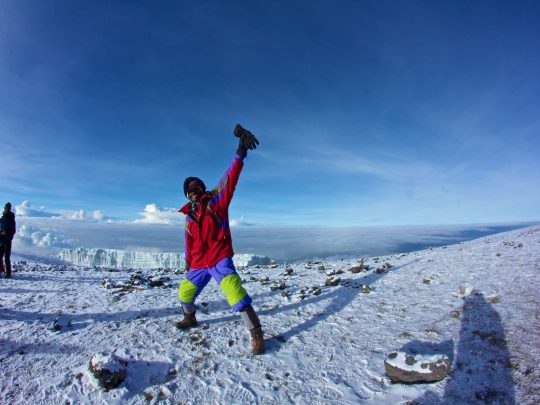
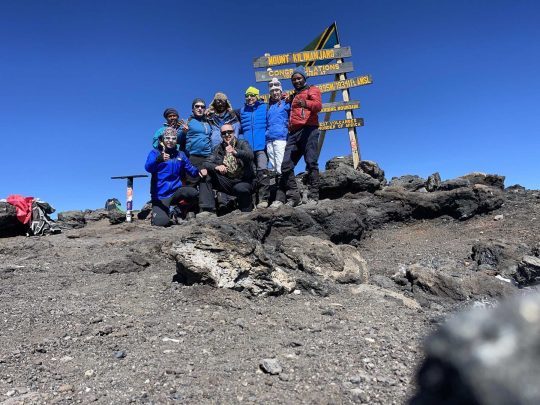
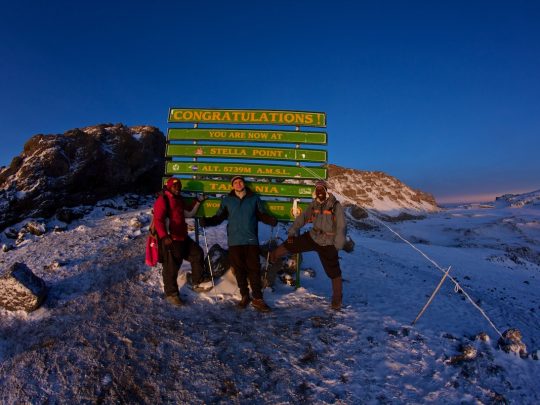
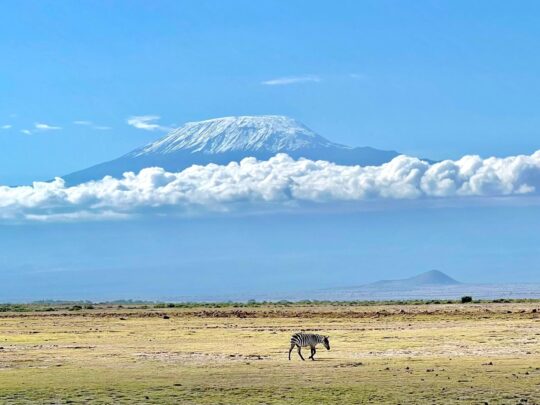
Putting your kit together? Open the full contents guide to mountain equipment: clothing, footwear, technical items, hire and route-by-route lists.