- Guides
- B2B
-
#19607 (no title)
-
#15972 (no title)
- Climb Elbrus Individually
- Climb Elbrus from the South, 9 Days
- Climb Elbrus from the South, 7 Days
- Climb Elbrus from the South with Oxygen
- Climb Elbrus from the North, 10 Days
- Two Summits of Elbrus, 9 Days
- Elbrus Traverse from South to North, 9 Days
- Elbrus Traverse from North to South, 10 Days
- Cross of Elbrus, South to North, 9 Days
- 根据”来自北方的十字架”计划攀登厄尔布鲁士山
- Climb Kazbek and Elbrus — 10-Day Two-Summit Programme
- Climb Elbrus from the West, 11 Days
- 厄尔布鲁士乘坐直升机
- Elbrus Region Holiday and Trekking, 9 Days
- Elbrus Region Holiday, 7 Days
- Tinder 之旅,攀登厄尔布鲁士峰
- Climb Elbrus from the South, 9 Days with Sergey Baranov
-
#15539 (no title)
- Climb Carstensz Pyramid, 8 Days with Helicopter Access
- Climb Mont Blanc, 4810 m — 8-Day Guided Ascent
- Climb the Matterhorn, 4478 m — 8-Day Guided Ascent
- Climb Mount Vinson, 15-Day Antarctic Expedition
- Climb Kosciuszko and Travel in Australia, 7 Days
- Climb Fisht, 2868 m — 3-Day Ascent by the 1B Route
- Climb Mount Wilhelm, 6 Days
-
#15546 (no title)
- Climb Kilimanjaro: the Marangu Route
- Climb Kilimanjaro: the Lemosho Route
- Climb Ararat, 5137 m — 7-Day Classic Programme
- Climb Kazbek from the South, 5033 m — 8 Days in Georgia
- Climb Kazbek and Elbrus — 10-Day Two-Summit Programme
- 攀登火山在墨西哥
- Climbing Alpamayo — 16-Day Technical Expedition
- 攀登玛格丽特峰(斯坦利)
- Climbing Mount Kenya: Point Lenana, 4,985 m
- Climb Dykh-Tau by the North Ridge, 13 Days
-
#15554 (no title)
- Aconcagua Climb — 17-Day Guided Expedition
- Island Peak Climb — 18-Day Expedition
- Climb Mera Peak, 6476 m — 16-Day Hinku Valley Programme
- Climb Ama Dablam, 6812 m — 24-Day Expedition with Island Peak
- Climb Island Peak and Mera Peak — 24-Day Two-Summit Expedition
- Aconcagua and Ojos del Salado — 25-Day Combined Expedition
- Ojos del Salado Climb — 15-Day Expedition
- Climb Chimborazo and Cotopaxi — 14-Day Ecuador Programme
- 瓦斯卡兰攀岩
- Climb Razdelnaya Peak, 6148 m — 15-Day Pamir Expedition
- Climb Denali by the West Buttress, 23 Days
- #15565 (no title)
- #15572 (no title)
-
#15972 (no title)
-
#19592 (no title)
-
See 8000m
- K2 Base Camp Trek via the Gondogoro La
- Everest Base Camp Trek — 14 Days
- Everest Base Camp via Gokyo Lakes — 15 Days
- 一周内徒步前往珠穆朗玛峰
- Annapurna Circuit and Tilicho Lake Trek
- Manaslu Circuit Trek
- Kanchenjunga Circuit Trek (XXL)
- Kanchenjunga North Base Camp Trek (Short)
- Kanchenjunga from India: the Goecha La Trek in Sikkim
- 徒步前往马卡鲁大本营
- 徒步前往安纳布尔纳峰大本营
- South America
- Asia
- Africa
-
Russia
- Elbrus Region Holiday and Trekking, 9 Days
- Elbrus Region Holiday, 7 Days
- 徒步奥什滕 + 卡德瓦赫
- Lake Kardyvach — 5-Day Base-Camp Trek
- Route 30: Through the Mountains to the Sea, with Oshten — 4 Days
- Trekking in Arkhyz — 7 Days over the Ayulyu Pass
- Gvandra Trek — 7 Days to the Ullu-Kyol Lakes
- Trekking in Dombai — 7 Days with the Murudzhu Lakes
- Europe
-
See 8000m
- Adventures
- Ski-touring
- VIP
- #19722 (no title)
- About
Trekking in Uganda: the Rwenzori Mountains
- Height (m)
- 4430
- Duration
- 10 дней
- Difficulty
- Low
- Continent
- Africa
- Children
- From 10 years old
- Accommodation
- Without tents
2500 $
Почему такая цена?
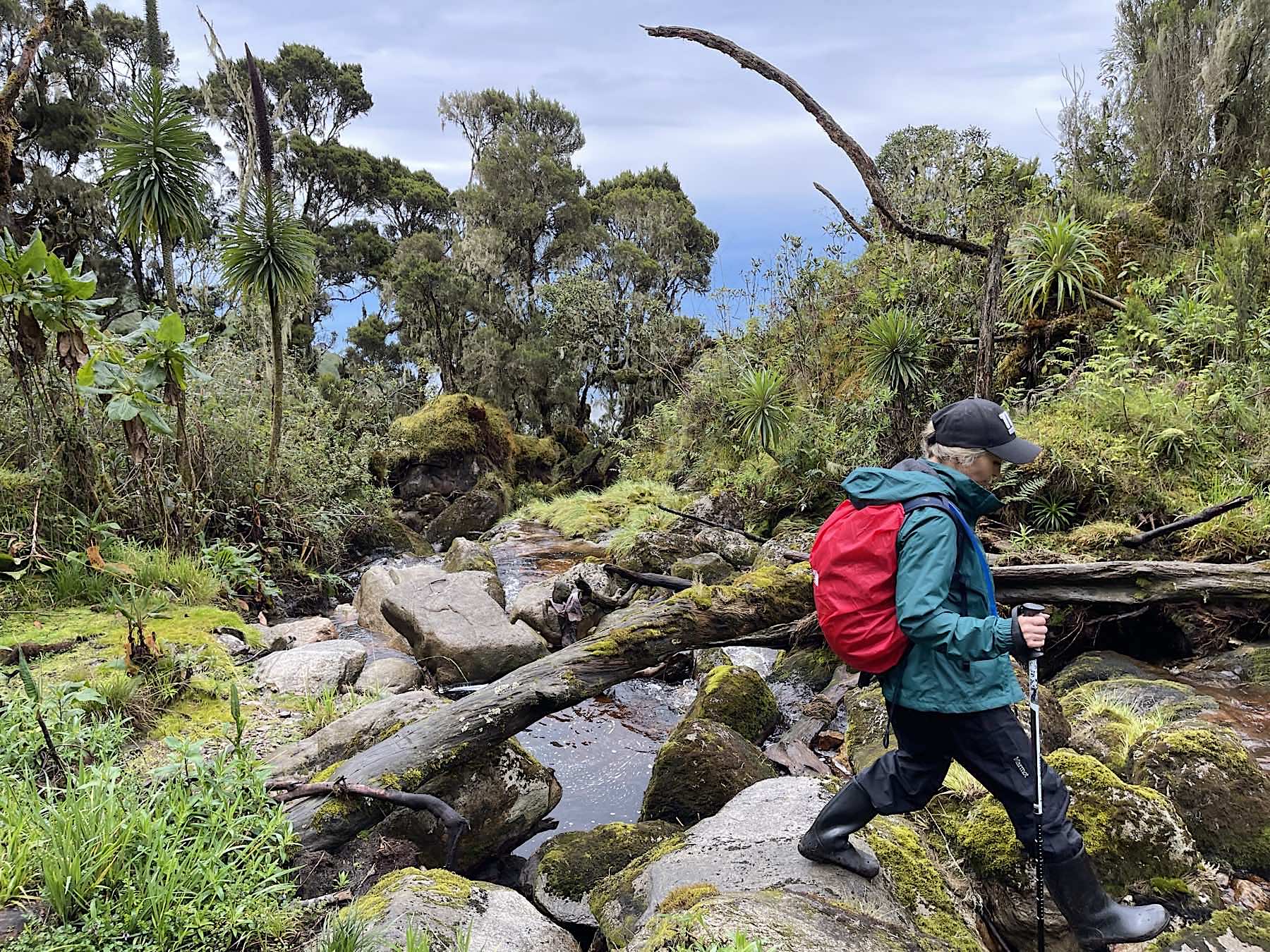
A ten-day trek through the Rwenzori, the Mountains of the Moon, in western Uganda. The route crosses rainforest, alpine valleys and glacial landscapes and reaches the Margaret base camp at 4460 m by way of the Scott Elliot Pass, with nights in mountain huts throughout. It is a walking route: it does not include a glacier ascent.
Please note that our company does not buy or sell air tickets and does not arrange visas, and is therefore not responsible for disruption beyond its control involving flights or border crossings.
In Africa there are a number of difficulties exchanging small, worn and old US dollar notes issued before 2009. Please bear this in mind: in some places it means an extra commission, in others a refusal to exchange.
About trekking in Uganda in the Rwenzori mountains
Uganda was described by Winston Churchill as the Pearl of Africa, and with good reason. It is rich in volcanic mountains, valleys and lakes, rich in wildlife and with a green, cosmopolitan capital, all within a very small country. Despite a difficult political past, the spirit of its people and its natural wealth have allowed Uganda to rise above it, offering a safe and rewarding destination.
We set out on an adventure through rainforest, alpine valleys and glacial landscapes in the remote Rwenzori mountains, the Mountains of the Moon. After the trek you can enjoy a safari in Queen Elizabeth National Park, home to elephants, lions, leopards, hippos and many other animals; watch rhinos in the wild on a walk through the Ziwa Rhino Sanctuary; and see the majestic African wilderness on a cruise to the foot of Murchison Falls, where the Nile flows through a narrow gorge and sweeps spectacularly around the wall of the rift valley.
Choose your dates and start planning your unforgettable adventure in Uganda.
Itinerary of the Rwenzori trek in Uganda
Day 1. Arrival in Entebbe and transfer to Kasese.
Arrival at Entebbe International Airport, where the guide meets you. Transfer to the town of Kasese, 110 km away and at an altitude of 1778 m. On arrival, check-in at the hotel, time to rest and an evening briefing on the route. Dinner at the hotel, where you can try the local food and prepare for the days ahead. Night at the hotel.
Day 2. Kyanjuki to Sine Camp.
An early breakfast and the drive to the village of Kyanjuki at 1450 m, the starting point of the route. After about an hour on the road there is a stop at the office of the Uganda Wildlife Authority to complete the formalities. The trek then begins. On this day the trail crosses meadows and stands of ferns full of a variety of exotic birds, whose song accompanies you the whole way to Sine Camp at 2596 m, where the night is spent in a comfortable hut surrounded by forest.
Day 3. Sine Camp to Mutinda Camp.
After breakfast the route continues to Mutinda Camp at 3688 m. The first part is a steep climb through the bamboo zone with high steps. In rain, gaiters or rubber boots are useful. The route follows the ridge across streams, with descents and climbs, and past waterfalls covered in moss. The group arrives at camp during the day, where you can rest or make an additional climb to a viewpoint, an hour and a half upwards. Night in a hut surrounded by striking scenery.
Day 4. Mutinda Camp to Bugata Camp.
The crossing to Bugata Camp at 4062 m. Today the route takes you into the alpine zone. The group crosses the Mutinda valley and reaches the Namusangi valley at 3840 m, with its remarkable waterfalls and views of the Mutinda peaks. Bugata Camp stands in a fine position overlooking Lake Kopello and Weismann Peak. The group rests here in a hut, taking in the views of the surrounding mountains.
Day 5. Bugata Camp to the Margaret base camp.
The hardest day of the trek, with about nine hours on the move. The route heads for the Margaret base camp at 4460 m, passing the Kitandara lakes and crossing the Scott Elliot Pass at 4335 m, which opens out imposing views. The camp stands on a wind-sheltered flat area surrounded by rock. Night in a hut at altitude.
Day 6. Descent to Hunwick Camp.
In the morning the descent begins to Hunwick Camp at 3974 m. The route passes through fine alpine country with views of the Rwenzori that are found nowhere else. The day combines easy walking with rest at camp. Night in a hut.
Day 7. Descent to Kiharo Camp.
The descent continues to Kiharo Camp at 3518 m by a new route that differs from the way up. The group passes the surroundings of Bugata and looks out over Lake Bugata and the Kopello river. The trail leads through the Nyamwamba valley with its dense undergrowth, mosses and the remains of ancient glaciers in the form of huge boulders. The evening is spent in a hut at Kiharo Camp.
Day 8. Descent to Samalira Camp.
The descent to Samalira Camp at 3170 m. On the way there are valleys, streams and thickets where exotic birds and chameleons can be seen. The route opens out fine views of Lake Edward and Queen Elizabeth National Park. The camp stands in a secluded valley at the top of a waterfall. Night in a hut.
Day 9. The final descent to Kasese.
The final descent follows a long ridge through bamboo forest to the ranger post at Kasese. After the trek ends there is a transfer to the hotel, where the completion of the route can be celebrated. Dinner and night at the hotel.
Day 10. Kasese to Entebbe. End of the trip.
In the morning there is a walk round the local shops for souvenirs. After lunch, transfer to Entebbe International Airport for the flight home, or to continue the journey elsewhere in Uganda.
What's included
- A Mountain Guide team leader with groups of four participants or more
- A local guide
- Group equipment
- Transfers to and from the airport
- Accommodation and meals at the hotel, for the number of nights set out in the itinerary
- National park entry
- Accommodation and meals in the mountain huts, for the number of nights set out in the itinerary
What's not included
- International flights
- Visa
- Medical insurance
- Personal equipment
- Compulsory tips after the climb, 250 to 300 USD per person
- Any departure from the itinerary
- Any costs arising from change to the itinerary
The Rwenzori trek in Uganda for private groups
The Rwenzori trek can be arranged for a private group on your own dates, once the local team, national park entry, hut accommodation and ground logistics are confirmed. A private format suits groups of friends, closed corporate groups and anyone who wants to agree the pace and the team in advance. The basic trip follows the Kilembe route and climbs to Margherita Camp at 4460 m, without the technical push to the summit. The order of the stages and overnight stops is kept: the mountain section cannot be shortened at the expense of acclimatisation and safety. A technical ascent of Margherita Peak is a separate trip and calls for different preparation and equipment. Extra days in Uganda and a safari extension are quoted separately. Whether under-18s can join is assessed case by case, taking account of age, fitness and the national park rules in force.
Documents for the Rwenzori trek in Uganda
Entry requirements depend on your nationality and on your flight routing. Nationals of countries that need a visa apply through Uganda’s official electronic portal. We provide visa support and the documents needed for the application.
- A passport valid for at least 6 months on the date of entry
- A visa or other entry permit for Uganda, where required
- Return air tickets
- Medical insurance covering high-altitude trekking to 4460 m, search and rescue, and evacuation from a remote area
- An international yellow fever vaccination certificate
- Copies of your itinerary and accommodation confirmation, and the host’s contact details
We recommend keeping digital copies of your documents on your phone and in cloud storage. Before taking out a policy, read our guidance on insurance for climbs and treks. Discuss prophylaxis with your doctor in advance; there is general information in our article on avoiding malaria.
Weather and seasons on the Rwenzori trek in Uganda
The Rwenzori are among the wettest mountain areas in Africa. The Uganda Wildlife Authority treats January and June to July as the driest periods. The heaviest rain more often falls between March and May and between August and December, but rain, mist and wet ground are possible in any month. The weather changes quickly at altitude. The average daytime temperature in the high zone is around 10 °C, and at night it can drop below 0 °C. The trail runs through wet forest, boggy sections, a bamboo zone and open high ground, so waterproofing your clothing, footwear, sleeping bag and electronics is essential whatever the date. The final dates are confirmed against the state of the route, the availability of the huts and the park’s operations. You can compare this route with others in the region in our overview of trekking in Africa.
Accommodation and meals on the Rwenzori trek in Uganda
Before and after the mountain section, participants stay in a hotel in the Kasese area. On the route you sleep in mountain huts at the camps named in the itinerary. This is functional accommodation in a remote national park, not a hotel. How places are allocated is confirmed before the trip. Accommodation and meals at the hotel and in the mountain huts are included to the extent set out in the itinerary. On the mountain section the menu depends on what food is available and on self-sufficient logistics. Tell us before booking about dietary restrictions, allergies and any vegetarian or vegan diet, so that a suitable menu can be confirmed in advance.
Day-to-day conditions on the Rwenzori trek in Uganda
The mountain section is self-sufficient. Expect simple shared accommodation in the huts, with limited facilities. There is no regular hot shower, heating, laundry, Wi-Fi or reliable mobile signal on the route. What each hut actually has can change and is checked before departure. You need your own power bank to charge your phone, camera and head torch. Pack your sleeping bag, mat, spare dry clothing and electronics in dry bags. Humidity is high and clothing may not dry overnight, so a separate dry set to sleep in is genuinely useful. Toilets and washing places on the mountain section are basic. You must follow the national park rules, use water sparingly and carry your own non-organic rubbish off the route.
Страхование
НаверхEquipment list for the Rwenzori trek in Uganda
Скачать PDFDocuments:
- Passport
- Air tickets
- Medical insurance
- A yellow fever vaccination certificate in English
Personal equipment:
- Rucksack. 40-50 litres
- Sleeping bag with a comfort rating from 0 °C.
- Sleeping mat
- Trekking poles
Clothing and footwear:
- Trekking boots
- Trainers (for the towns)
- Waterproof shell: jacket and trousers. The market runs from simple 5,000/5,000 membranes through to Gore-Tex garments
- Fleece top and bottoms
- Base layer, top and bottoms
- Down jacket with a hood
- Thick gloves
- Thin gloves
- Bandana (as well as sun protection in the valley, it can keep your throat or face warm in the cold)
- Warm hat
- Warm trekking socks for summit day
Other items:
- LED head torch with at least 12 hours of battery life
- Sunglasses
- Ski goggles
- Vacuum flask, 1 litre. Preferably without a push-button lid
- Reusable bottle
- A duffel bag for the items you hand to your porter
- Dry bags for your kit and sleeping bag (or plenty of plastic bags)
- Travel towel
- Windproof face mask for the lower face (a scarf will do at a pinch)
- Gaiters
- Sun cream and lip balm
- Mosquito repellent
- Malaria medication
- Chemical hand warmers (not compulsory, but they can be very useful)
- Personal first-aid kit
- Elastic bandage and/or a support brace.
- Malaria tablets
- Insect repellent