- Guides
- B2B
-
#19607 (no title)
-
#15972 (no title)
- Climb Elbrus Individually
- Climb Elbrus from the South, 9 Days
- Climb Elbrus from the South, 7 Days
- Climb Elbrus from the South with Oxygen
- Climb Elbrus from the North, 10 Days
- Two Summits of Elbrus, 9 Days
- Elbrus Traverse from South to North, 9 Days
- Elbrus Traverse from North to South, 10 Days
- Cross of Elbrus, South to North, 9 Days
- 根据”来自北方的十字架”计划攀登厄尔布鲁士山
- Climb Kazbek and Elbrus — 10-Day Two-Summit Programme
- Climb Elbrus from the West, 11 Days
- 厄尔布鲁士乘坐直升机
- Elbrus Region Holiday and Trekking, 9 Days
- Elbrus Region Holiday, 7 Days
- Tinder 之旅,攀登厄尔布鲁士峰
- Climb Elbrus from the South, 9 Days with Sergey Baranov
-
#15539 (no title)
- Climb Carstensz Pyramid, 8 Days with Helicopter Access
- Climb Mont Blanc, 4810 m — 8-Day Guided Ascent
- Climb the Matterhorn, 4478 m — 8-Day Guided Ascent
- Climb Mount Vinson, 15-Day Antarctic Expedition
- Climb Kosciuszko and Travel in Australia, 7 Days
- Climb Fisht, 2868 m — 3-Day Ascent by the 1B Route
- Climb Mount Wilhelm, 6 Days
-
#15546 (no title)
- Climb Kilimanjaro: the Marangu Route
- Climb Kilimanjaro: the Lemosho Route
- Climb Ararat, 5137 m — 7-Day Classic Programme
- Climb Kazbek from the South, 5033 m — 8 Days in Georgia
- Climb Kazbek and Elbrus — 10-Day Two-Summit Programme
- 攀登火山在墨西哥
- Climbing Alpamayo — 16-Day Technical Expedition
- 攀登玛格丽特峰(斯坦利)
- Climbing Mount Kenya: Point Lenana, 4,985 m
- Climb Dykh-Tau by the North Ridge, 13 Days
-
#15554 (no title)
- Aconcagua Climb — 17-Day Guided Expedition
- Island Peak Climb — 18-Day Expedition
- Climb Mera Peak, 6476 m — 16-Day Hinku Valley Programme
- Climb Ama Dablam, 6812 m — 24-Day Expedition with Island Peak
- Climb Island Peak and Mera Peak — 24-Day Two-Summit Expedition
- Aconcagua and Ojos del Salado — 25-Day Combined Expedition
- Ojos del Salado Climb — 15-Day Expedition
- Climb Chimborazo and Cotopaxi — 14-Day Ecuador Programme
- 瓦斯卡兰攀岩
- Climb Razdelnaya Peak, 6148 m — 15-Day Pamir Expedition
- Climb Denali by the West Buttress, 23 Days
- #15565 (no title)
- #15572 (no title)
-
#15972 (no title)
-
#19592 (no title)
-
See 8000m
- K2 Base Camp Trek via the Gondogoro La
- Everest Base Camp Trek — 14 Days
- Everest Base Camp via Gokyo Lakes — 15 Days
- 一周内徒步前往珠穆朗玛峰
- Annapurna Circuit and Tilicho Lake Trek
- Manaslu Circuit Trek
- Kanchenjunga Circuit Trek (XXL)
- Kanchenjunga North Base Camp Trek (Short)
- Kanchenjunga from India: the Goecha La Trek in Sikkim
- 徒步前往马卡鲁大本营
- 徒步前往安纳布尔纳峰大本营
- South America
- Asia
- Africa
-
Russia
- Elbrus Region Holiday and Trekking, 9 Days
- Elbrus Region Holiday, 7 Days
- 徒步奥什滕 + 卡德瓦赫
- Lake Kardyvach — 5-Day Base-Camp Trek
- Route 30: Through the Mountains to the Sea, with Oshten — 4 Days
- Trekking in Arkhyz — 7 Days over the Ayulyu Pass
- Gvandra Trek — 7 Days to the Ullu-Kyol Lakes
- Trekking in Dombai — 7 Days with the Murudzhu Lakes
- Europe
-
See 8000m
- Adventures
- Ski-touring
- VIP
- #19722 (no title)
- About
Ski Touring on Kazbek and Elbrus, 9 Days
- Height (m)
- 5642
- Duration
- 11 дней
- Difficulty
- Moderate
- Continent
- Europe
- Children
- From 14 years old
- Accommodation
- Without tents
1900 $
Почему такая цена?
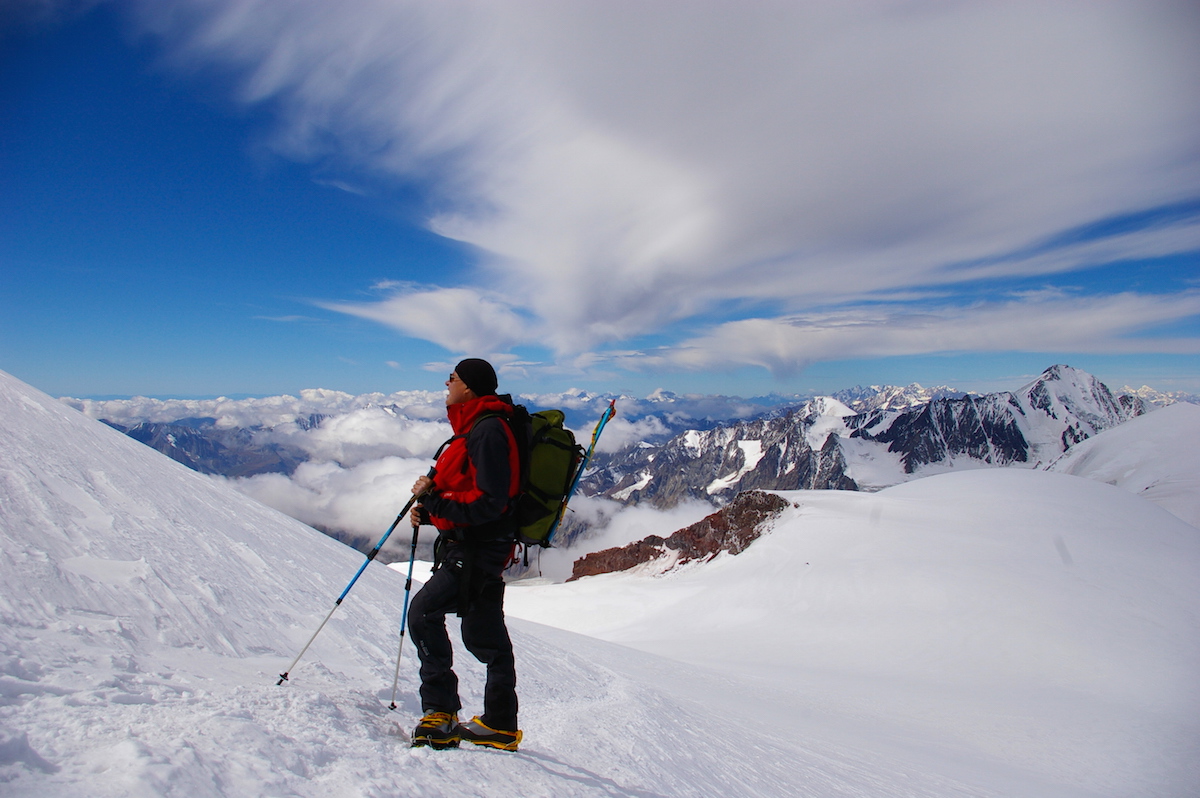
The 9-day ski tour on Kazbek and Elbrus brings two high-altitude ski ascents together in one trip. The group first covers the more self-supported glacier route on Kazbek from the south, then travels from Georgia to the Elbrus region and climbs the West summit of Elbrus by the southern route.
The main advantage of the trip is the chance to compare two different mountains and to use the acclimatisation gained on Kazbek for the next altitude stage. There is no separate second acclimatisation cycle on Elbrus, so participants need good endurance, steady recovery and experience of several consecutive days in the mountains.
The trip suits only participants with previous ski-touring experience, a confident and controlled descent off prepared pistes and the skills to move in crampons and on a rope team. It is not an introductory course. A full ascent and an unbroken ski descent from either summit are not guaranteed: the way the group moves on each section is set by the guide according to the snow, the state of the glacier, the weather and the readiness of the group.
Mountain Guide arranges the guides, the accommodation, the meals, the group transfers and the high-altitude logistics of both stages. Participants need to prepare a compatible personal ski-touring, avalanche and glacier kit in advance and to check the requirements for crossing the border between Georgia and Russia.
Important
- Participants carry the food for the high-altitude part up themselves. This is a standard feature of how ascents of Elbrus from the south are organised. The food travels up by cable car with the group and is moved on by snowcat; it has to be carried by hand only over short sections of no more than 20 m.
- Tents beside the Meteo Station are used only as a reserve option when there is no space in the building
- Any departure from the refuge on summit day counts as an attempt
- In spring, horses carry loads at most as far as the Saberce Pass; in deep snow the unloading point may be lower and participants cover the whole snow-covered part of the approach on skis
- The trip is built for participants with ski-touring experience, a confident controlled off-piste descent and the endurance for two altitude stages
- An avalanche transceiver, probe and shovel are compulsory for every participant; the set is not shared across the group
- A full ascent and an unbroken ski descent from either summit are not guaranteed; the decision to use skis, crampons, an ice axe or a rope is taken by the guide according to actual conditions
- The trip runs in Georgia and Russia; entry and border-crossing requirements must be checked against your nationality before tickets are bought
About the Kazbek and Elbrus ski tour
This combined 9-day ski tour brings together two consecutive altitude stages: Kazbek, 5033 m, from the south and the West summit of Elbrus, 5642 m, from the south. The trip starts in Kazbegi in Georgia and, after the Kazbek ascent, continues in the Elbrus region.
On Kazbek the group acclimatises at the Gergeti Trinity church, climbs by way of the Saberce Pass to the Meteo Station and makes an outing to 4000 m. The main accommodation on the mountain is the Meteo Station; tents beside it are used only as a reserve when there is no space, and this is agreed with participants in advance.
The altitude stage on Kazbek creates the acclimatisation base for Elbrus, but it does not remove the effect of altitude, weather and accumulated fatigue. After descending to Kazbegi the group travels from Georgia to Russia and takes the cable car up to the refuge at 3888 m. There is no separate second acclimatisation cycle on Elbrus in this short trip.
The trip is built for participants with previous ski-touring experience, a confident and controlled descent off prepared pistes, sufficient endurance and the skills to move in crampons and on a rope team. This is not an introductory ski-touring course.
An unbroken ascent and descent of both summits entirely on skis are not guaranteed. The state of the snow, the glacier, the snow bridges and the avalanche situation can differ between the two mountains. The decision to use skis, ski crampons, mountaineering crampons, an ice axe or a rope on each section is taken by the guide.
Ski-touring skis, boots, bindings, skins and ski crampons are not available for hire, so each participant brings their own compatible ski set.
Kazbek and Elbrus ski tour itinerary, 9 days
Day 1. The group meets in Kazbegi. The trip starts in Kazbegi. Participants check into a guest house or hotel and meet the guides. In the evening the group goes through the two consecutive altitude stages, the border-crossing rules and the plan if the weather changes. Skis, bindings, skins, ski crampons, the avalanche kit and glacier equipment are checked separately. Any incompatibility, or any missing compulsory item, must be resolved before the group sets out for the Meteo Station. Night in Kazbegi.
Day 2. Acclimatisation outing to the Gergeti Trinity church, 2170 m. This unhurried outing helps acclimatisation begin without a sharp gain in altitude and lets the guide assess the pace of the group. Participants check their clothing, their rucksack and their recovery after the journey. After returning, personal loads and equipment are finally prepared for the climb to the Meteo Station. The guides confirm the order of travel on the snow-covered section and the sharing out of group glacier equipment. Night in Kazbegi.
Day 3. Climb to the Meteo Station, 3600 m, by way of the Saberce Pass, 3000 m. The climb takes roughly 7 to 9 hours and is the main gain in altitude before the acclimatisation outing. The group covers the snow-covered part of the approach on skis. In spring, horses carry the agreed load up to 20 kg per participant at most as far as the Saberce Pass; in deep snow the unloading point may be lower. The main option for the night is the Meteo Station building. Tents beside it are used only as a previously agreed reserve option. After settling in, the group recovers and checks its equipment. Night at the Meteo Station.
Day 4. Acclimatisation and training outing to 4000 m. The group climbs above the Meteo Station without the aim of reaching the summit. The outing gives the body an additional altitude stimulus and allows travel on skins, the use of ski crampons, the changeover to mountaineering crampons and roped work to be checked. The guide chooses the section and the way of moving according to the actual state of the snow and the glacier. After returning, participants prepare clothing, food and equipment for an early start. Night at the Meteo Station.
Day 5. Summit attempt on Kazbek, 5033 m. The start is early. The climb crosses the glacier on a rope team; on firn, ice and the upper section, mountaineering crampons and an ice axe are used. Every participant must have a personal ice screw on its own karabiner. An unbroken ascent and descent from the summit entirely on skis are not guaranteed: the place where the group changes to crampons, the turnaround time and the point at which the ski descent begins are all set by the guide. The decision depends on the weather, the state of the snow bridges and the glacier, and the readiness of the group. After the attempt, participants return to the Meteo Station. Night at the Meteo Station.
Day 6. Reserve day or descent to Kazbegi. If conditions did not allow an attempt the day before, the day may be used for a second outing at the guide’s decision. If the ascent took place, the group begins the descent to Kazbegi. The way of moving and the arrangements for carrying loads depend on the state of the snow; in spring horses come up at most as far as the Saberce Pass, and the actual unloading point may be lower. Once the mountain part is over, participants check into a guest house or hotel and prepare their documents and belongings for the border crossing. Night in Kazbegi if the group has descended as planned.
Day 7. Transfer from Kazbegi to the Elbrus region. The group travels from Georgia to Russia and continues the trip on Elbrus. On arrival, participants take the cable car up to the mountain refuge at 3888 m. There is no separate second acclimatisation cycle on Elbrus: the trip uses the altitude adaptation gained on Kazbek. The remaining time is for recovery after the journey, for checking ski and mountaineering equipment and for preparing for an early start. Night in the refuge.
Day 8. Summit attempt on the West summit of Elbrus, 5642 m. The start is early in the morning and the day may take 8 to 12 hours. A snowcat may be used on the lower part of the route for a separate charge. The way of moving is chosen according to actual conditions: wind can expose hard firn and ice, so skis, ski crampons, mountaineering crampons, an ice axe and a rope are all used on different sections. An unbroken ski descent from the summit is not guaranteed. The turnaround time and the decision to continue are taken by the guide. After the attempt the group returns to the refuge. Night in the refuge.
Day 9. Reserve day and the end of the trip. If the weather did not allow the group to set out on Elbrus the day before, the reserve day may be used for a second attempt at the guide’s decision. If the ascent took place, the group descends by cable car to the valley and travels to the airport. The standard transfer is planned for 15:00, so flights no earlier than 19:30 are recommended. If the reserve day is used, the onward logistics depend on the time of return and on the cable car’s operating hours.
What's included
- Mountain Guide’s guides: a lead guide throughout the trip
- Assistant guides on the Kazbek summit day; no more than three participants to one guide
- Assistant guides on the Elbrus summit day; no more than three participants to one guide
- Main accommodation on Kazbek in the Meteo Station building
- Tents beside the Meteo Station only as a previously agreed reserve option
- Horses to carry the agreed load up to 20 kg per participant, at most as far as the Saberce Pass; the actual unloading point may be lower depending on the state of the snow
- Meals on the mountain part of the route
- Breakfasts during the hotel stay
- Accommodation in Kazbegi in a guest house or hotel in twin rooms, for the number of nights set out in the itinerary
- Accommodation in the refuge on Elbrus, for the number of nights set out in the itinerary
- All transfers according to the itinerary, from Kazbegi to the airport or railway station after the Elbrus stage, including the journey between the two mountain stages and the cable cars
- The necessary permits and registrations
- Group glacier and rescue equipment and a group first-aid kit
What's not included
- International flights
- The transfer from Tbilisi or another city to Kazbegi on the day the trip starts; arranged on prior request only
- Personal porters for personal baggage
- Personal equipment
- Lunches and dinners in Kazbegi
- Additional costs arising from a departure from the itinerary
- Medical insurance and costs connected with evacuation in the event of an accident
- Personal expenses (drinks, internet, telephone calls and so on)
- Visas and other border-crossing documents where these are required by the participant’s nationality
- The snowcat on the Elbrus summit day
- Single occupancy
- Any costs connected with change to the itinerary
The Kazbek and Elbrus ski tour for private groups
The Kazbek and Elbrus ski tour can be arranged for a private group on agreed dates, subject to guides being free, suitable conditions on both mountains and the cross-border journey being safely possible. The format suits groups of friends, climbing clubs and corporate teams of comparable ability.
Before confirming the trip we establish each participant’s previous ski touring and high-altitude experience, their technique for controlled descent off-piste, their fitness and their skills in crampons and on a rope. A family format is possible for adults who meet these requirements; the trip is not intended for children.
The dates, the length, reserve days, accommodation, baggage transport, additional services and the guiding team are all discussed individually. Changes must not shorten the acclimatisation needed or reduce the safety of the route. The requirements for entering Georgia and Russia are checked before tickets are bought. Get in touch for a quote.
Documents required for the Kazbek and Elbrus ski tour
To join the combined ski tour you need to prepare:
- A passport valid for travel to Georgia and Russia
- Tickets to the start of the trip and back
- Visas and any other documents needed for entry and for crossing the border, where these are required for your nationality
- Medical insurance valid in Georgia and Russia and covering ski touring, off-piste skiing, mountaineering to at least 6000 m, search and rescue, transport and medical evacuation
Check the entry requirements before you buy non-refundable tickets. The policy must not exclude ski mountaineering, glacier routes or travel off-piste. We recommend keeping digital copies of your passport, insurance, tickets and visa documents on your phone and in cloud storage, separately from the originals.
Weather and seasons for the Kazbek and Elbrus ski tour
A combined ski tour depends on two different routes being in condition at the same time. The main spring window usually falls in April and May, but conditions on Kazbek and Elbrus can differ markedly even on the same dates.
On Kazbek the route crosses a glacier. The state of the snow bridges, the avalanche conditions, the wind and any icing determine how far it is possible to go on skis. The upper section may call for a switch to ordinary crampons, an ice axe and a rope. On Elbrus, strong wind can expose hard névé or ice, and in late spring the snow lower down the route becomes patchy.
An unbroken ski ascent and descent of both summits cannot be guaranteed. Your guide may change the line, move the attempt to the reserve day, leave the skis below a dangerous or icy section, or call off the ascent. Even in spring you can meet hard frost, gale-force wind and poor visibility at altitude.
The decision to undertake each stage is taken separately, according to the actual weather, the state of the snow and the glacier, the avalanche conditions and the group’s readiness.
Before the Elbrus stage, check the current conditions on our “Weather on Elbrus” page.
Accommodation and meals on the Kazbek and Elbrus ski tour
The trip combines three kinds of accommodation: a guest house or hotel in Kazbegi, the Meteo Station below Kazbek, and a high-altitude hut on the southern slope of Elbrus. The number of nights follows the day-by-day itinerary.
In Kazbegi participants stay in twin rooms. On Kazbek the main option is accommodation inside the Meteo Station building. Tents beside it are used only as a fallback if there is no space, and are agreed with participants in advance. On Elbrus the group stays in an equipped mountain hut.
The price includes breakfasts during the stay in Kazbegi and all meals on the mountain sections. Lunches and dinners in Kazbegi are at your own expense. At altitude the meals are arranged around early starts and long days on the mountain; participants prepare their own water, flask and snacks as their guides advise.
Food allergies and any special dietary requirements must be reported in advance. Whether separate meals are possible depends on the conditions at the mountain huts and on what food is available.
Day-to-day conditions on the Kazbek and Elbrus ski tour
Kazbegi offers hotel facilities, electricity, a shower and phone coverage. At the Meteo Station, and in the tented fallback, life is a great deal simpler: accommodation is shared, personal space is limited, and electricity, device charging and internet may be absent or unreliable.
In spring the horses reach the Saberce pass at most; with deep snow the unloading point may be lower. Above the pass the group continues on skis, and you should be ready either to carry some of your own kit or to arrange an extra porter in advance. Your rucksack and ski carry system must let you cover the remaining section safely.
On Elbrus the group stays in a high-altitude hut. Whether you can dry clothing or charge devices, and how good the signal is, depend on how busy the hut is and on the weather. You need a power bank, spare batteries and waterproof packing for documents and electronics.
Keep your passport and border-crossing documents with you. The ski touring and mountaineering equipment is checked before each mountain stage; boots, bindings, skins, ski crampons and ordinary crampons must all be compatible.
Страхование
НаверхEquipment and useful extras for ski touring on Kazbek and Elbrus
Скачать PDFTwo high-altitude stages call for a full set of ski touring, avalanche and glacier equipment. Avalanche equipment can be reserved in advance from Rock and Rent. Touring skis, boots, bindings, skins and ski crampons are not available for hire: each participant brings their own complete, compatible ski set-up.
Ski-touring and avalanche kit
- Ski-touring skis with bindings that have a walk mode
- Skins, trimmed to your own skis
- Ski crampons compatible with your bindings
- Warm touring boots with a walk mode, compatible with your bindings and with mountaineering crampons
- Adjustable ski poles with winter baskets
- Avalanche transceiver
- Avalanche probe
- Avalanche shovel
- Ski or climbing helmet
- A 50-60 litre rucksack with a ski carry system
- An 80-100 litre transport holdall
Glacier and climbing equipment
- Mountaineering crampons compatible with ski-touring boots
- Classic ice axe
- Climbing harness
- Four karabiners, at least two of them screwgate
- Two prusik loops, or accessory cord, prepared as your guide advises
- Cow’s-tail lanyard
- One personal ice screw on its own karabiner
- Head torch and a spare set of batteries
Overnight equipment
- A sleeping bag with a comfort rating of -15 °C or lower
- For early spring dates, a sleeping bag rated to -20 °C, agreed with your guide
- An insulating sleeping mat, for the tented fallback option
- Your own eating utensils
Clothing and footwear
- Base layer, top and bottoms
- A fleece or another warm mid layer
- Softshell jacket and trousers for walking
- waterproof shell jacket with a hood
- waterproof shell trousers that can be pulled on over your boots
- Warm down or synthetic jacket with a hood
- Thin gloves for the ascent
- Warm ski gloves
- High-altitude mittens
- Warm hat and a buff or balaclava
- Warm ski-touring socks
- Light footwear for Kazbegi and the road journeys
Personal items
- Category 3-4 mountain sunglasses
- Ski goggles for wind and poor visibility
- Vacuum flask, 1 litre, without a push-button lid
- SPF 30-50 sun cream and lip balm with SPF
- Personal first-aid kit and any medication you take
- Power bank, and waterproof packing for documents and electronics