- Guides
- B2B
-
#19607 (no title)
-
#15972 (no title)
- Climb Elbrus Individually
- Climb Elbrus from the South, 9 Days
- Climb Elbrus from the South, 7 Days
- Climb Elbrus from the South with Oxygen
- Climb Elbrus from the North, 10 Days
- Two Summits of Elbrus, 9 Days
- Elbrus Traverse from South to North, 9 Days
- Elbrus Traverse from North to South, 10 Days
- Cross of Elbrus, South to North, 9 Days
- 根据”来自北方的十字架”计划攀登厄尔布鲁士山
- Climb Kazbek and Elbrus — 10-Day Two-Summit Programme
- Climb Elbrus from the West, 11 Days
- 厄尔布鲁士乘坐直升机
- Elbrus Region Holiday and Trekking, 9 Days
- Elbrus Region Holiday, 7 Days
- Tinder 之旅,攀登厄尔布鲁士峰
- Climb Elbrus from the South, 9 Days with Sergey Baranov
-
#15539 (no title)
- Climb Carstensz Pyramid, 8 Days with Helicopter Access
- Climb Mont Blanc, 4810 m — 8-Day Guided Ascent
- Climb the Matterhorn, 4478 m — 8-Day Guided Ascent
- Climb Mount Vinson, 15-Day Antarctic Expedition
- Climb Kosciuszko and Travel in Australia, 7 Days
- Climb Fisht, 2868 m — 3-Day Ascent by the 1B Route
- Climb Mount Wilhelm, 6 Days
-
#15546 (no title)
- Climb Kilimanjaro: the Marangu Route
- Climb Kilimanjaro: the Lemosho Route
- Climb Ararat, 5137 m — 7-Day Classic Programme
- Climb Kazbek from the South, 5033 m — 8 Days in Georgia
- Climb Kazbek and Elbrus — 10-Day Two-Summit Programme
- 攀登火山在墨西哥
- Climbing Alpamayo — 16-Day Technical Expedition
- 攀登玛格丽特峰(斯坦利)
- Climbing Mount Kenya: Point Lenana, 4,985 m
- Climb Dykh-Tau by the North Ridge, 13 Days
-
#15554 (no title)
- Aconcagua Climb — 17-Day Guided Expedition
- Island Peak Climb — 18-Day Expedition
- Climb Mera Peak, 6476 m — 16-Day Hinku Valley Programme
- Climb Ama Dablam, 6812 m — 24-Day Expedition with Island Peak
- Climb Island Peak and Mera Peak — 24-Day Two-Summit Expedition
- Aconcagua and Ojos del Salado — 25-Day Combined Expedition
- Ojos del Salado Climb — 15-Day Expedition
- Climb Chimborazo and Cotopaxi — 14-Day Ecuador Programme
- 瓦斯卡兰攀岩
- Climb Razdelnaya Peak, 6148 m — 15-Day Pamir Expedition
- Climb Denali by the West Buttress, 23 Days
- #15565 (no title)
- #15572 (no title)
-
#15972 (no title)
-
#19592 (no title)
-
See 8000m
- K2 Base Camp Trek via the Gondogoro La
- Everest Base Camp Trek — 14 Days
- Everest Base Camp via Gokyo Lakes — 15 Days
- 一周内徒步前往珠穆朗玛峰
- Annapurna Circuit and Tilicho Lake Trek
- Manaslu Circuit Trek
- Kanchenjunga Circuit Trek (XXL)
- Kanchenjunga North Base Camp Trek (Short)
- Kanchenjunga from India: the Goecha La Trek in Sikkim
- 徒步前往马卡鲁大本营
- 徒步前往安纳布尔纳峰大本营
- South America
- Asia
- Africa
-
Russia
- Elbrus Region Holiday and Trekking, 9 Days
- Elbrus Region Holiday, 7 Days
- 徒步奥什滕 + 卡德瓦赫
- Lake Kardyvach — 5-Day Base-Camp Trek
- Route 30: Through the Mountains to the Sea, with Oshten — 4 Days
- Trekking in Arkhyz — 7 Days over the Ayulyu Pass
- Gvandra Trek — 7 Days to the Ullu-Kyol Lakes
- Trekking in Dombai — 7 Days with the Murudzhu Lakes
- Europe
-
See 8000m
- Adventures
- Ski-touring
- VIP
- #19722 (no title)
- About
Climb Huascarán — 8-Day Technical Ascent
- Height (m)
- 6768
- Duration
- 8 дней
- Difficulty
- Above average
- Continent
- South America
- Children
- No
- Accommodation
- There are tents
7200 $
Почему такая цена?
Тур временно недоступен
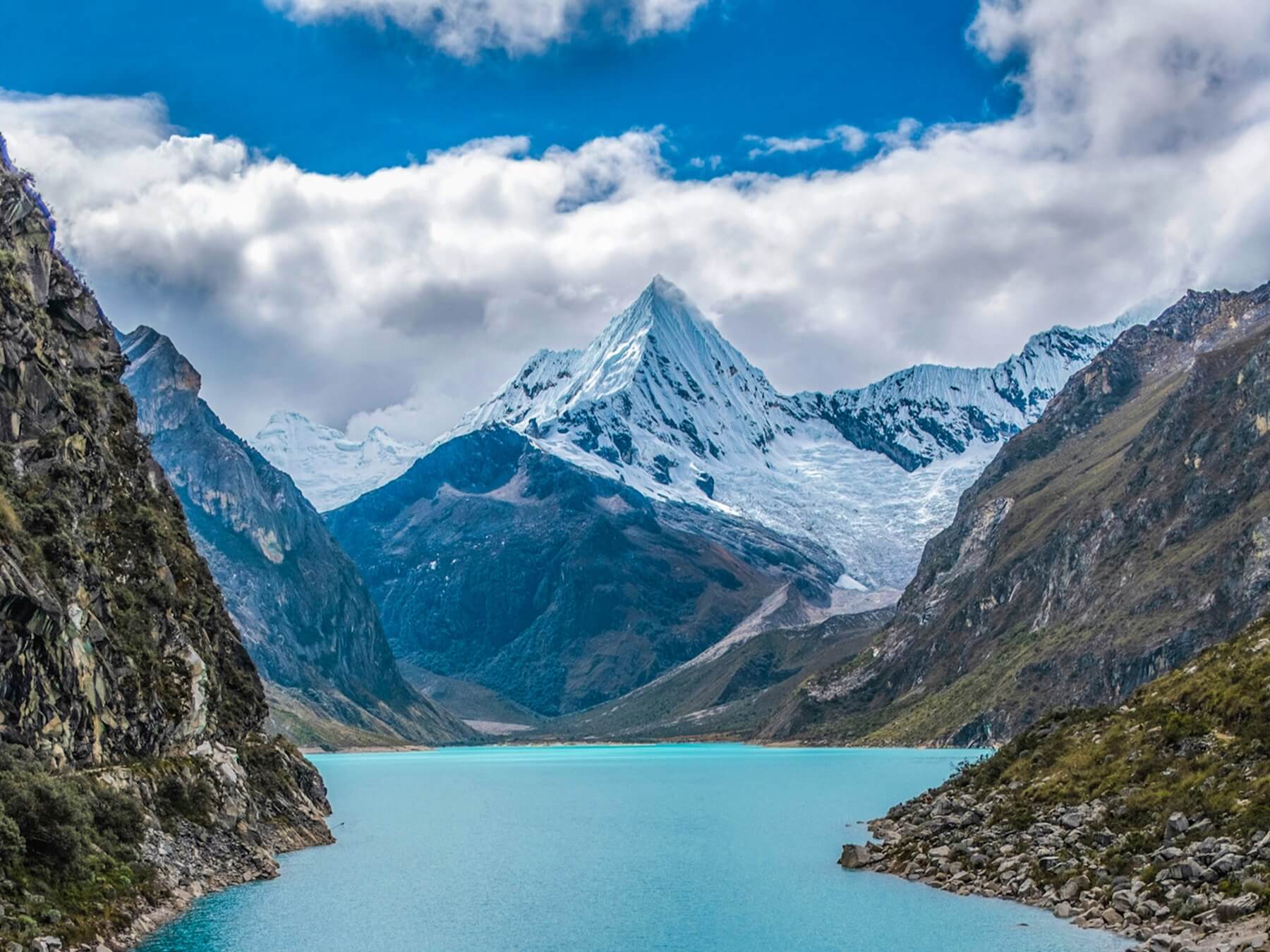
Huascarán, 6768 m, is the highest point in Peru and the highest summit in the tropical Andes. This eight-day trip starts in Huaraz and works through Musho, base camp, the ice camps and the technical sections to an attempt on the south summit.
The short format is designed only for climbers who arrive already acclimatised and who have experience of moving on a closed glacier, working on a rope and climbing steep snow and ice. It is not a trip for beginners. The state of the glacier and of the key sections changes, so the final tactics are set by the guide on the ground.
The price covers guiding for groups of four participants or more, the stated transfers and hotels, tented accommodation and meals in the mountains, group equipment, the preparation of the permit paperwork, and the services of porters and pack animals.
Important
- Altitude and technical experience must be confirmed before booking.
- The route lies inside a national park and is serviced through an authorised operator.
Eight days is a mountain module, not a full trip cycle with its own acclimatisation. Before arriving in Huaraz a participant must already know how they react to altitude and hold recent experience on a glaciated route. Crevasses, seracs and steep snow and ice call for precise work on the rope even when you are tired.
Applications are assessed on the climbing résumé. A maximum altitude on its own, with no description of routes and technical skills, is not enough: what matters for Huascarán is crampons, ice axe, harness, ascending and descending a rope, and experience of several consecutive camps.
About the Huascarán climb
The trip follows the standard line with the approach from Musho. Above base camp the route moves onto the glacier, climbs to Camp I and then continues through steeper ice sections to the camp below the Garganta. Summit day starts at night and runs among crevasses and seracs, after which the group descends by the line of ascent.
Ice conditions on Huascarán are not constant. The angle and the state of the Canaleta, the crevasses and the avalanche-prone sections are assessed immediately before they are climbed. The elevations and the sequence set out in the itinerary are kept, but the specific line of movement and the place where the team sleeps after the attempt depend on the actual conditions.
The eight-day schedule does not contain a full acclimatisation block in Peru. A participant must arrive in Huaraz already adapted to altitude. The guide checks technical skills and equipment before the team leaves the town.
Huascarán National Park requires work through authorised operators. The preparation of the necessary permit paperwork is included in the published list of services for this trip.
What makes the route technical
After the approach from Musho, pack animals can work only as far as the part of the route that is accessible to them. On the glacier the team continues with porters and on the rope. The crevasses, the steep sections and the zone below the Garganta change from season to season, so the published sequence of days is not a promise of an unchanging line across the glacier.
The guide assesses snow bridges, seracs, the angle, the avalanche situation and the state of the key passages. If the standard line has become dangerous, it cannot be kept simply because the website describes it. A change of tactics, moving a camp, abandoning the attempt or an early descent are all possible.
Prior acclimatisation is mandatory
The route climbs quickly from Huaraz to base camp and the ice camps. Within the eight days there is no separate series of out-and-back ascents to get to know the altitude. A participant must arrive after a suitable trip in the Cordillera Blanca or after other high-altitude acclimatisation, whose timing and profile are confirmed before booking.
What the guide checks before departure
- the compatibility of boots and crampons;
- work with an ice axe and a harness;
- movement on the rope and the response to a command to stop;
- ascending and descending a fixed rope;
- the state of personal equipment and the ability to carry a day pack;
- altitude experience, current condition and recovery after acclimatisation.
Porters and pack animals reduce part of the carrying load, but they do not release a participant from personal equipment, camp duties or moving unaided over technical ground. The summit is not guaranteed, and a safe descent remains part of the climb.
Huascarán climbing itinerary, 8 days
Day 1. The Huascarán climbing trip starts in Huaraz, where a company representative meets you at the airport and takes you to the hotel.
There you can rest and recover after the long flight. In the evening you meet the other participants and the guide, who gives a short briefing on the climb ahead. Night in a hotel.
Day 2. We set out towards Yungay, pass the village of Mancos and reach Musho.
Our route begins here at 3000 m. On foot we cross a small cemetery beside a picturesque eucalyptus forest. The eucalyptus gradually gives way to queñual trees, now rare in South America. At 4100 m we reach a vegetation-free zone, well suited for a camp, and pitch our tents. Pack animals help us over this 1000 m of ascent. Higher up, in the rocky and icy sections, the mules are replaced by porters, because movement becomes impossible for the animals. Night in tents.
Day 3. Today we gain another 1000 m, but fortunately without carrying the loads.
The route crosses panoramic high plateaus with interesting vegetation. We approach the lower edge of the glacier and put on crampons for the first time. The glacier has a maximum angle of 30 degrees, and the crevasses require roped movement under the guide’s control. Our camp stands at 5100 m on a flat ice platform. Night in tents.
Day 4. We leave the Huascarán camp early in the morning, because today’s section is steeper — the ice reaches 40 degrees at the start.
We reach the key section of the route, the so-called Canaleta, an ice couloir at 70 degrees. Our mountain guide secures the section by belaying from above. After that the steep ground gives way to easier but crevassed terrain. We then cross an avalanche-prone zone. Having completed this stage, we set up camp below the broad ice wall of the Garganta. The camp lies at 5900 m in a spot relatively sheltered from the wind. From here we start the summit climb tomorrow. Night in tents.
Day 5. The most important day begins: at 2 a.m. we set out for the highest summit in Peru, Huascarán.
First we climb the Garganta, where the angle is 45 degrees. Huge seracs rise around us and we pick a line between them. The angle then eases and we soon reach the summit. From here there is a striking view over the Santa valley and the endless icy peaks of the Cordillera Blanca. We cannot stay long because of the cold. We descend by the same route we climbed. We sleep at Camp I or at the moraine camp. Night in tents.
Day 6. Depending on how far we got the day before, today we can allow ourselves to slow down and enjoy the mountain surroundings.
We descend to Huascarán base camp at 4250 m, where a more comfortable climate awaits us for a rest. Night in tents.
Day 7. There is no need to get up early today, as there is plenty of time for the 1100 m descent.
We return along the line of ascent through fine mountain forest and old shepherds’ paths. Transport waits for us in Musho to take us back to Huaraz. In the evening the whole team has a celebration dinner. Night in a hotel.
Day 8. Transfer to the airport, flight home.
What's included
- An experienced Mountain Guide team leader, for groups of 4 participants or more
- Airport meeting and send-off
- transfers during the trip
- Hotel accommodation, twin rooms, the number of nights set out in the itinerary
- Tented accommodation and meals during the climb
- Group climbing equipment (high-altitude tents, gas, stoves, ropes and so on)
- Preparation of all the permit paperwork required for the climb
- The services of porters and pack animals
What's not included
- International flights
- Visa and other entry documents where these are required by the participant’s nationality
- Medical insurance covering the stated type of activity and the maximum altitude of the trip
- Single occupancy
- Early check-in, late check-out and additional nights before or after the trip
- Lunches and dinners in the towns
- Charges for transporting personal luggage, where required
- Tips
- Any departure from the itinerary
- Any expenses arising from change to the itinerary
Private groups
A private expedition lets you choose the dates and the ratio of guides to participants, and add acclimatisation and reserve days. The technical difficulty of the route is not reduced by this. Before quoting we check the team’s experience, the state of the route and the availability of an authorised operator, guides, porters and pack animals.
Documents you need
- A valid passport
- Medical insurance covering the stated activity and the maximum altitude of the trip
- The details and documents the authorised operator needs to register you with the national park
- Depending on your nationality, a visa may be required
- We recommend keeping digital copies of your documents on your phone and in cloud storage
Entry requirements for Peru and for the route are checked before the trip, against your nationality and the rules in force.
Weather and seasons
The officially recommended season for visiting Huascarán National Park is May to October, when the weather is mainly dry and cold. The rainy season runs from October to April. On the glacier, conditions change faster than the calendar boundaries of the season. Fresh snow, wind and the state of the crevasses, seracs and the Canaleta can all change the tactics or close the route. The eight-day trip has no separate reserve day.
Accommodation and meals
The first and second-to-last nights of the trip are spent in a hotel in Huaraz, in twin rooms. From base camp up, the group lives in tents. Tented accommodation and meals during the climb are included in the price. Lunches and dinners in the towns, single occupancy and extra hotel nights are not included. Tell us about dietary restrictions and allergies before booking.
Facilities on the route
The hotel in Huaraz has a shower, electricity and town-level coverage. From base camp onwards the trip is self-sufficient. The tented and ice camps have no guaranteed shower, electricity, internet or mobile signal. Charge your devices in town and bring a power bank, spare batteries, a head torch and your own toiletries. Do your laundry and other practical tasks before leaving Huaraz.
Страхование
НаверхEquipment and useful extras for the Huascarán climb
Скачать PDF- Passport
- Air tickets
- Medical insurance covering mountaineering
- Rucksack, 50-60 litres
- Sleeping bag with a comfort rating of -20 to -10 °C
- Sleeping mat (self-inflating or foam)
- Trekking poles with wide baskets
- Crampons (steel or aluminium, compatible with your boots)
- Ice axe (classic, with a leash)
- Helmet
- Climbing harness (sit harness)
- Cow’s-tail lanyards with karabiners (screwgate or auto-locking preferred)
- Karabiners (at least 4, two of which must be screwgates)
- Accessory cord (6-7 mm, 2-3 m long, for a prusik knot)
- Ascender
- Descender (a figure of eight or similar)
- Mug, spoon and bowl
- Double or triple mountaineering boots
- Trekking footwear (boots or shoes)
- Waterproof jacket and trousers (membrane rated at least 5,000/5,000, Gore-Tex preferred)
- Fleece jacket and trousers
- Base layer, top and bottoms
- Down jacket with a hood. Thick and warm
- Warm mittens
- Thick gloves
- Thin working gloves
- Bandana or buff
- Warm hat
- Trekking socks (several pairs, including warm ones for the climb)
- Head torch with at least 12 hours of battery life, plus spare batteries
- Sunglasses (category 3-4)
- Ski goggles (for wind protection)
- Vacuum flask (1 litre, preferably with a secure lid)
- Windproof mask or scarf
- Gaiters, to keep snow out
- Sun cream (SPF 50+)
- Lip balm
- Personal first-aid kit
- Elastic bandage and/or a support brace
- Chemical hand warmers (optional)