- Guides
- B2B
-
#19607 (no title)
-
#15972 (no title)
- Climb Elbrus Individually
- Climb Elbrus from the South, 9 Days
- Climb Elbrus from the South, 7 Days
- Climb Elbrus from the South with Oxygen
- Climb Elbrus from the North, 10 Days
- Two Summits of Elbrus, 9 Days
- Elbrus Traverse from South to North, 9 Days
- Elbrus Traverse from North to South, 10 Days
- Cross of Elbrus, South to North, 9 Days
- 根据”来自北方的十字架”计划攀登厄尔布鲁士山
- Climb Kazbek and Elbrus — 10-Day Two-Summit Programme
- Climb Elbrus from the West, 11 Days
- 厄尔布鲁士乘坐直升机
- Elbrus Region Holiday and Trekking, 9 Days
- Elbrus Region Holiday, 7 Days
- Tinder 之旅,攀登厄尔布鲁士峰
- Climb Elbrus from the South, 9 Days with Sergey Baranov
-
#15539 (no title)
- Climb Carstensz Pyramid, 8 Days with Helicopter Access
- Climb Mont Blanc, 4810 m — 8-Day Guided Ascent
- Climb the Matterhorn, 4478 m — 8-Day Guided Ascent
- Climb Mount Vinson, 15-Day Antarctic Expedition
- Climb Kosciuszko and Travel in Australia, 7 Days
- Climb Fisht, 2868 m — 3-Day Ascent by the 1B Route
- Climb Mount Wilhelm, 6 Days
-
#15546 (no title)
- Climb Kilimanjaro: the Marangu Route
- Climb Kilimanjaro: the Lemosho Route
- Climb Ararat, 5137 m — 7-Day Classic Programme
- Climb Kazbek from the South, 5033 m — 8 Days in Georgia
- Climb Kazbek and Elbrus — 10-Day Two-Summit Programme
- 攀登火山在墨西哥
- Climbing Alpamayo — 16-Day Technical Expedition
- 攀登玛格丽特峰(斯坦利)
- Climbing Mount Kenya: Point Lenana, 4,985 m
- Climb Dykh-Tau by the North Ridge, 13 Days
-
#15554 (no title)
- Aconcagua Climb — 17-Day Guided Expedition
- Island Peak Climb — 18-Day Expedition
- Climb Mera Peak, 6476 m — 16-Day Hinku Valley Programme
- Climb Ama Dablam, 6812 m — 24-Day Expedition with Island Peak
- Climb Island Peak and Mera Peak — 24-Day Two-Summit Expedition
- Aconcagua and Ojos del Salado — 25-Day Combined Expedition
- Ojos del Salado Climb — 15-Day Expedition
- Climb Chimborazo and Cotopaxi — 14-Day Ecuador Programme
- 瓦斯卡兰攀岩
- Climb Razdelnaya Peak, 6148 m — 15-Day Pamir Expedition
- Climb Denali by the West Buttress, 23 Days
- #15565 (no title)
- #15572 (no title)
-
#15972 (no title)
-
#19592 (no title)
-
See 8000m
- K2 Base Camp Trek via the Gondogoro La
- Everest Base Camp Trek — 14 Days
- Everest Base Camp via Gokyo Lakes — 15 Days
- 一周内徒步前往珠穆朗玛峰
- Annapurna Circuit and Tilicho Lake Trek
- Manaslu Circuit Trek
- Kanchenjunga Circuit Trek (XXL)
- Kanchenjunga North Base Camp Trek (Short)
- Kanchenjunga from India: the Goecha La Trek in Sikkim
- 徒步前往马卡鲁大本营
- 徒步前往安纳布尔纳峰大本营
- South America
- Asia
- Africa
-
Russia
- Elbrus Region Holiday and Trekking, 9 Days
- Elbrus Region Holiday, 7 Days
- 徒步奥什滕 + 卡德瓦赫
- Lake Kardyvach — 5-Day Base-Camp Trek
- Route 30: Through the Mountains to the Sea, with Oshten — 4 Days
- Trekking in Arkhyz — 7 Days over the Ayulyu Pass
- Gvandra Trek — 7 Days to the Ullu-Kyol Lakes
- Trekking in Dombai — 7 Days with the Murudzhu Lakes
- Europe
-
See 8000m
- Adventures
- Ski-touring
- VIP
- #19722 (no title)
- About
Climb Margaret Peak (Stanley), 5109 m
- Height (m)
- 5109
- Duration
- 10 дней
- Difficulty
- Moderate
- Continent
- Africa
- Children
- From 14 years old
- Accommodation
- Without tents
3600 $
Почему такая цена?
The guided ascent of Margaret Peak, on Mount Stanley, leads to a summit of 5109 m, the highest point of the Stanley massif and of the whole Rwenzori range. Margaret Peak, also known as Margherita Peak, is the third highest summit in Africa after Kilimanjaro and Mount Kenya. The team includes guides with experience at 8000 metres.
The mountain section of the trip runs to eight days and follows the central circuit of Rwenzori Mountains National Park in Uganda. Participants cross equatorial forest, high-altitude bog, thickets of giant lobelias and groundsels, rocky plateaux, snow slopes and glaciers. The climax of the journey is the summit itself, from which in clear weather there is a panorama of the Mountains of the Moon.
This is not an ordinary trek. The final push crosses snow, ice and rock using crampons, an ice axe, a climbing harness and rope protection. Long days of walking, boggy ground and an ascent above 5000 m call for good physical condition, experience of multi-day mountain routes and a prior grounding in basic mountaineering skills. The trip is not suitable for beginners without that preparation.
A gradual gain in altitude, intermediate descents and nights in mountain huts help acclimatisation before the ascent. On the route the group is accompanied by local mountain guides, a cook and porters. With a group of four participants or more, a Mountain Guide team leader joins the team.
Please note that our company does not buy or sell air tickets and does not arrange visas, and is therefore not responsible for disruption beyond its control involving flights or border crossings.
In Uganda there may be difficulties exchanging small, worn and old US dollar notes issued before 2009. Such notes may be exchanged at a poorer rate or refused. We recommend bringing clean notes of recent series, without tears, writing or other damage.
About the ascent of Margaret Peak (Stanley)
The Rwenzori is a non-volcanic mountain range on the border of Uganda and the Democratic Republic of the Congo. It comprises six main massifs. The highest of them is Stanley, and its highest summit is Margaret Peak at 5109 m, the third highest summit in Africa. International sources use the name Margherita Peak, so both spellings are in circulation.
The Rwenzori is known as the Mountains of the Moon and is one of the most unusual high-mountain areas of equatorial Africa. The route runs through the Ugandan territory of Rwenzori Mountains National Park, which is inscribed on the UNESCO World Heritage List. The first ascent of the peak was made in 1906 during the expedition led by Luigi Amedeo, Duke of the Abruzzi. The summit was named after Queen Margherita of Savoy of Italy.
The ascent trip follows the central circuit. The gradual gain in altitude is reinforced by an acclimatisation stage on the climb-high, sleep-low principle: before moving up to the assault hut the team crosses the Scott Elliot Pass at 4372 m and descends to sleep at the Bujuku hut at 3960 m, and then climbs to the Elena hut at 4541 m. After the summit the group descends to Bujuku again and continues through the John Matte hut, so a substantial part of the way down does not repeat the approach. This scheme helps acclimatisation but does not remove the risk of altitude sickness. Participants must monitor how they feel and should know the main symptoms of altitude sickness in advance.
The difficulty of the Margaret Peak ascent is not set by altitude alone. The multi-day stages cross boggy ground, mud, wet roots, rock slabs and steep slopes. Rain, mist and high humidity are possible even in periods of relatively settled weather. Clothing, sleeping bag, documents, electronics and spare items must be packed watertight. Footwear should be broken in beforehand and treated thoroughly with a water-repellent product, and mountaineering boots for the summit day should be checked for compatibility with crampons.
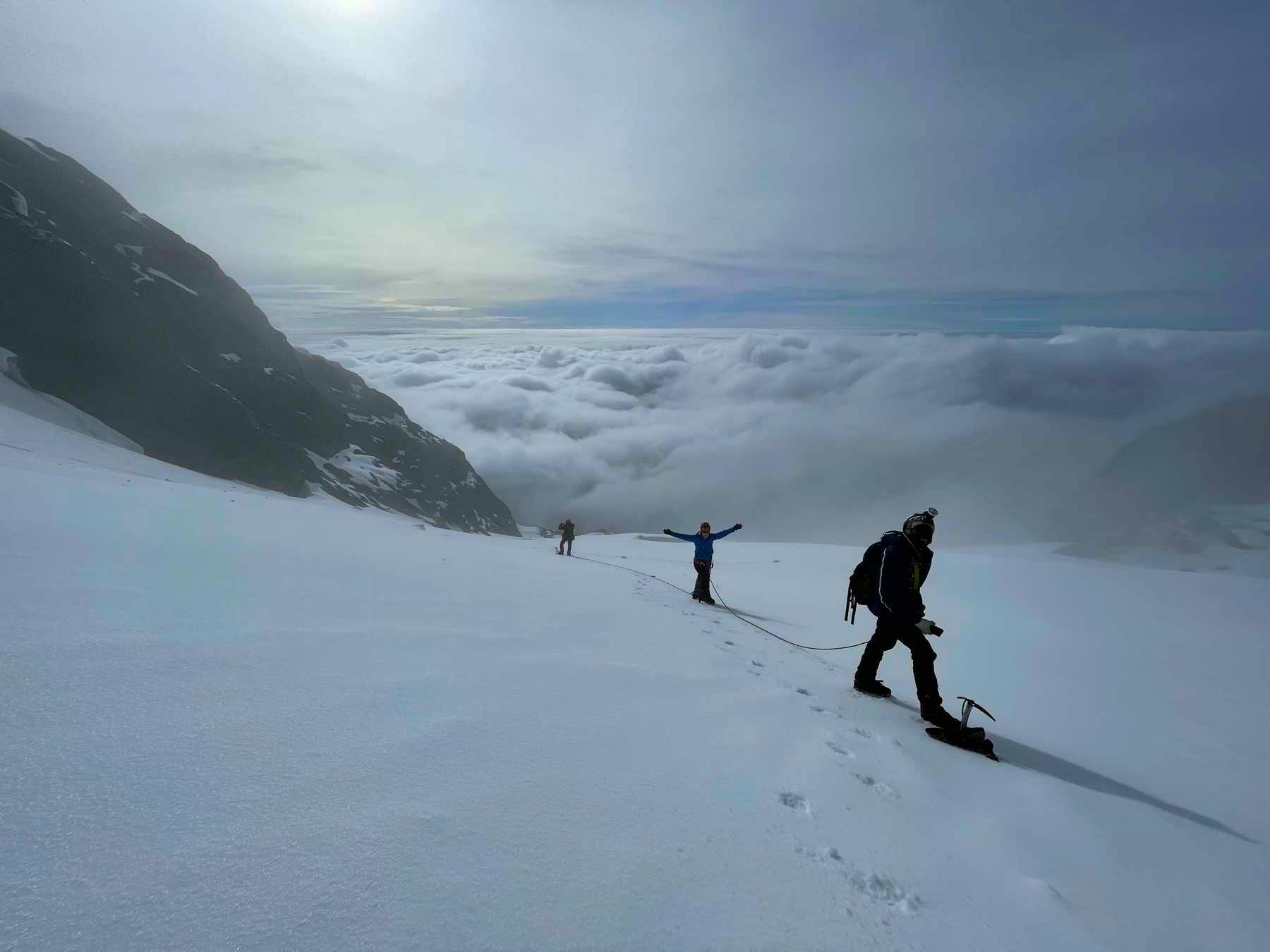
The ascent of Margaret Peak begins before dawn from the Elena hut. Participants put on crampons and harnesses, rope up and, under the direction of the mountain guides, cross a crevassed glacier, steep snow and ice slopes and iced rock sections. The decision on the time of departure, on continuing the ascent or on turning back is taken by the lead guide, taking account of the weather, the state of the glacier, the pace and how the team feels. The descent demands no less concentration, because after sunrise and as the day warms, the condition of the snow and ice can change.
To take part you need experience of multi-day mountain routes, good physical condition and basic skills in moving in crampons, using an ice axe and a harness, and travelling roped up. Anyone who wants to see the Mountains of the Moon without a technical glacier ascent should consider the Rwenzori trekking trip in Uganda instead.
Itinerary of the Margaret Peak (Stanley) ascent
Day 1. Arrival in Entebbe.
Arrival at Entebbe International Airport on the shore of Lake Victoria. After border formalities participants meet a representative of the team and transfer to a lodge. In the evening there is a briefing, the preparation of the group is checked and the coming route in the Rwenzori is discussed. Night at the lodge.
Day 2. Entebbe to Kasese, Nyakalengija and Nyabitaba.
A domestic flight from Entebbe to Kasese avoids a long overland transfer. On arrival the group heads for the village of Nyakalengija at the boundary of Rwenzori National Park, meets the local guides, the cook and the porters and begins the mountain section of the trip. The trail passes the settlements of the Bakonzo people, climbs along the Mubuku river and comes out at the Nyabitaba hut at 2650 m. Night in the hut.
Height gain 1000 m. Time on the move about 5 hours.
Day 3. Nyabitaba to Guy Yeoman.
The route continues through bamboo forest and the valley of the Kichuchu river. As height is gained, tropical vegetation gives way to heather thickets and high-mountain landscapes. By the end of the stage the group reaches the Guy Yeoman hut at 3505 m. In clear weather Mount Baker, 4843 m, is visible from here. Night in the hut.
Height gain 850 m. Time on the move about 5 hours.
Day 4. Guy Yeoman to the Freshfield Pass and Kitandara.
The trail climbs along the Kichuchu river, gradually leaves the vegetation zone and moves onto rocky high-mountain slopes. After the climb to the Freshfield Pass at 4282 m the group descends to the Kitandara lakes and the hut at 4023 m. Sleeping below the pass just crossed helps recovery before the next stage of the route. Night in the hut.
Height gain 750 m. Descent 260 m. Time on the move about 6 hours.
Day 5. Kitandara to the Scott Elliot Pass and Bujuku.
From the Kitandara lakes the route climbs to the Scott Elliot Pass at 4372 m. After the pass the group descends to Lake Bujuku and the hut at 3960 m. Sleeping below the height reached during the day gives the body extra time to acclimatise before the climb to the assault hut. Night in the hut.
Height gain 350 m. Time on the move about 5 to 6 hours.
Day 6. Bujuku to the Elena hut.
The group climbs a washed-out clay trail through thickets of groundsel and lobelia to the high part of the Stanley massif. As the Elena hut approaches, the vegetation thins and the route comes out onto the snow, rock and glaciers of the Rwenzori. The hut stands at 4541 m and serves as the starting point for the ascent of Margaret Peak. After settling in, participants prepare their personal equipment and rest before an early start. Night in the hut.
Height gain 580 m. Time on the move about 4 to 5 hours.
Day 7. The ascent of Margaret Peak, 5109 m.
The summit push begins before dawn. Participants put on crampons and harnesses, rope up and, under the direction of the mountain guides, cross the glacier, sections with crevasses, steep snow and ice slopes and iced rock. After reaching Margaret Peak the group begins the descent. The condition of the snow and ice can change after sunrise, so concentration must be maintained on the way back and the guides’ instructions followed. After passing the Elena hut the team continues down to the Bujuku hut at 3960 m. Night in the hut.
Height gain 560 m. Descent 1100 m. Time on the move about 9 hours.
Day 8. Bujuku to John Matte.
The descent follows a different part of the route, across the boggy shores of Lake Bujuku, high-altitude bog and rocky slopes. The group passes the Bigo hut, crosses the valley and arrives at the John Matte hut at 3505 m. This stage brings the team out of the glacier zone into the warmer, greener landscapes of the Rwenzori. Night in the hut.
Descent 457 m. Time on the move about 5 hours.
Day 9. John Matte to Nyabitaba, Nyakalengija and Kasese.
The final stage crosses heather meadows, mountain streams and bamboo forest. Through the Nyabitaba hut the group descends to the village of Nyakalengija, where the mountain section of the trip ends. After meeting the transport, participants transfer to Kasese and check into a hotel. Night at the hotel.
Descent 1890 m. Time on the move about 6 to 7 hours.
Day 10. Kasese to Entebbe. End of the trip.
A domestic flight from Kasese to Entebbe. On the current schedule, arrival is expected around midday. The international flight must be planned around the confirmed time of the domestic flight and with enough margin for the connection.
What's included
- A Mountain Guide team leader accompanying the group, with four participants or more
- The work of a local English-speaking mountain guide
- Meeting at the airport and all the ground transfers set out in the itinerary
- One night in a lodge in Entebbe and one night in a hotel in Kasese
- Seven nights in mountain huts on the route
- Rwenzori National Park entry fees and the permit for the ascent of Margaret Peak
- The work of a cook and porters during the mountain section of the trip
- Full board during the ascent, breakfasts, lunches and dinners
- Group equipment, ropes and cooking equipment
- A group first-aid kit
What's not included
- International air tickets to Entebbe and back
- The domestic flights Entebbe to Kasese and Kasese to Entebbe
- A Ugandan visa, where the participant’s nationality requires one
- Medical insurance covering mountaineering to an altitude of 5109 m and emergency evacuation
- Personal trekking and mountaineering equipment
- Lunches and dinners at the lodge and the hotel before and after the ascent
- Single occupancy at the lodge and the hotel
- Tips for the local guides, the cook and the porters
- Personal expenses
- Costs arising from change to the itinerary
The Margherita Peak climb for private groups
The Margherita Peak 5109 m climb can be arranged privately, with dates and a team agreed individually. Whether the expedition can run depends on the season in the Rwenzori and on the availability of permits, mountain huts, local guides and seats on the internal flights between Entebbe and Kasese.
A private format suits individuals, groups of friends, families with the necessary mountain experience and closed corporate teams. Participation by under-18s is considered case by case, taking account of age, fitness, experience of multi-day mountain routes, the insurance terms and the mountain guides’ decision. The summit section is not a route for children. The size of the guiding team is set by the number of participants and their experience. On request, a Russian-speaking trek leader from the Mountain Guide team joins the local team and helps participants at every stage of the expedition, from checking equipment and organising the daily stages to preparing for the glacier. A private format makes it easier to allow for the team’s pace, recovery between stages, technical preparation and how participants are doing. The route, the order of the mountain huts and the acclimatisation logic are all kept. A private format does not make the glacier section any easier and does not guarantee that you will reach the summit. Before the expedition is confirmed we need, for each participant, their previous mountain experience, the maximum altitude reached, their skills in crampons and on a rope, their ability to use an ice axe and harness, any chronic conditions and any dietary restrictions. The mountain guide takes the final decision on who may climb, on the start time and on continuing, taking account of the weather, the state of the glacier and how the team is doing. A private Margherita Peak expedition can be extended with a safari in Uganda and a mountain gorilla trek. Participants and companions who want to see the Mountains of the Moon without the technical summit push are better suited by the separate Rwenzori trek.
Documents for the Margherita Peak climb
Uganda’s entry requirements depend on your nationality and can change. Before buying tickets, check the visa rules, your passport validity, the health requirements and the rules of any transit country. Travel forums and unofficial visa services should not be your only source.
To take part you will need:
- A passport valid for at least six months on the date of entry to Uganda
- An electronic tourist visa, or confirmation that you may enter without one
- A printed visa approval letter, where a visa is required
- An international yellow fever vaccination certificate
- International and domestic air tickets
- Confirmation of the trip, the route and the accommodation
- Medical insurance covering mountaineering to 5109 m
- Confirmation that glacier routes, roped travel and the use of crampons and an ice axe are covered
- Cover for search and rescue, medical evacuation and repatriation
- Your policy number and the 24-hour assistance company’s contact details
- Paper and digital copies of your passport, visa, tickets, insurance and vaccination certificate
The tourist visa is issued through the official electronic portal of Uganda’s immigration service. An application normally needs a copy of your passport photo page, a photograph, your travel plan, flight confirmations and your accommodation address. Every document you upload must be in English. Once approved, keep the entry permit on your phone and print it. A tourist visa approval is valid for entry for a limited period. Apply with your confirmed dates in mind, so that the approval does not expire before you travel. At the border you may be asked for the originals of the documents uploaded with the visa application, proof of payment and the approval letter. Obtain an international yellow fever vaccination certificate in advance and carry the original. Discuss vaccination, contraindications and disease prevention with a doctor experienced in advising travellers to tropical countries. An ordinary travel policy is not suitable for the Margherita Peak climb. When choosing mountaineering insurance, check the territory covered, the maximum altitude, that there is no exclusion for glaciers or technical equipment, how rescue is arranged, and whether you can reach the assistance company from Uganda. Keep your original documents in your hand luggage. Pack paper copies in a waterproof bag and keep digital versions on your phone and in cloud storage. Your policy number and the insurer’s contact details must be available to you and to the group leader.
Weather and seasons on the Margherita Peak climb
The Rwenzori sit almost on the equator, but their climate is set less by latitude than by altitude and a constant supply of moist air. Rain, mist, wet snow and thick cloud are possible in any month. There is no completely dry season on this route, so even well-chosen dates do not guarantee clear weather or a dry trail.
January and June to July are considered the best periods for the Margherita Peak climb. These are the months the Uganda Wildlife Authority singles out as preferable for climbing in drier conditions. February can also suit an expedition, but the actual weather varies from season to season and has to be judged on the current forecast. The heaviest rainfall usually comes between March and May and between August and December. In those periods the high-altitude bogs fill with water, boardwalks and roots become slippery, rock slabs are wet, and visibility on the glacier worsens. Climbing remains possible, but hard days, delays and changes to the schedule become more likely. December and August should not be treated as equivalent to the main weather windows without the local mountain team confirming conditions. The lower part of the route is usually warm and very humid. The temperature falls quickly as you gain height. Above 4000 m there can be wet snow, ice, strong wind and sub-zero temperatures. After dark the temperature high on the mountain can fall below 0 °C. Around the Elena hut, at about 4500 m, the temperature is often around 2 °C or lower. Constant humidity is one of the defining features of the Rwenzori. Keep your sleeping bag, down jacket, base layers, documents and electronics in separate dry bags. Membrane clothing, waterproof trousers, gaiters and footwear treated with a waterproofing product beforehand are essential whatever month you travel. The state of the glacier cannot be judged from the calendar alone. How much snow there is, whether crevasses are open, how iced the rock sections are and how reliably particular stretches can be crossed all change even within one season. The summit push starts before dawn, to make use of firmer snow and ice, but the guide sets the exact time. In heavy precipitation, mist, wind or unsafe glacier conditions the push may be postponed, shortened or called off. The final decision to start and to continue the climb rests with the mountain guide, taking account of the forecast, visibility, the state of the route, the pace and how the participants are feeling.
Accommodation and meals on the Margherita Peak climb
There is a night in a lodge in Entebbe before the mountain section begins. After the route finishes, participants stay in a hotel in Kasese. The standard arrangement is twin accommodation. A single room is provided subject to availability and is paid separately. During the climb the group stays in the Nyabitaba, Guy Yeoman, Kitandara, Bujuku, Elena and John Matte mountain huts. These are basic high-altitude refuges with shared sleeping rooms and a minimal level of comfort. No tents are used on the route, but every participant needs their own warm sleeping bag. Full board is provided during the mountain section. The team’s cook prepares the meals. Depending on how long the day is, the midday meal is either a full lunch or a snack on the route. Dinner is served after you reach the hut. There is limited scope for storing food and preparing elaborate dishes in the mountains. Tell us before booking about allergies, medical restrictions and any special diet. Whether a special diet can be accommodated is confirmed individually. On the walking stages you need your own water bottle and a vacuum flask. Lunches and dinners at the lodge and hotel before and after the climb are not included in the price.
Day-to-day conditions on the Margherita Peak climb
The Margherita Peak climb runs in a remote area with limited infrastructure. The mountain huts keep out rain and wind, but they are not hotel accommodation. Sleeping rooms are shared, there is little personal space, and how well you sleep depends on how full the hut is and on other groups’ routines.
There is no proper shower during the mountain section. Washing facilities are limited and sanitation is basic. A hot shower is available after the route, at the hotel in Kasese. Bring wet wipes, a quick-drying towel, your own toiletries and flip-flops. Do not count on a reliable power supply or regular charging on the route. Bring a power bank of sufficient capacity, use your phone sparingly, and protect your electronics from water and condensation. Mobile signal and internet in the mountains are unreliable or absent. Tell family and friends in advance that you may be out of contact for several days. The team arranges emergency communication according to what is possible on the route. Porters carry part of your personal load. The permitted weight and the packing requirements are confirmed before the trip. You carry your own day pack with water, waterproofs, a warm layer, your first-aid kit, your documents and anything else you may need during the day. Constant humidity makes it hard to dry clothing and footwear. Keep your sleeping bag, base layers, down jacket and spare socks in separate dry bags. Keep one completely dry set of clothing for sleeping in. Participants must follow the national park rules, do as the guides ask, keep the huts tidy and leave no rubbish on the route.
Страхование
НаверхEquipment list for the Margherita Peak (Stanley) climb
Скачать PDFThe list is written for a multi-day route in the Rwenzori with a glacier section and an ascent to 5109 m. Check, fit and test your personal equipment in advance. Pay particular attention to the compatibility of your boots and crampons, to keeping your kit dry, and to the condition of your belay equipment.
Personal climbing and trekking equipment
- Rucksack of 30-50 litres with a rain cover
- Sleeping bag with a comfort rating no higher than -8 °C
- Trekking poles with baskets at least 70 mm across
- Steel crampons compatible with your mountaineering boots
- Ice axe with a leash
- Climbing harness
- Climbing helmet
- 4 screwgate karabiners
- Cow’s-tail lanyards
- Ascender
- Descender
- Gaiters
- Dry bags for your sleeping bag, clothing, documents and electronics
Clothing and footwear
- Single-layer mountaineering boots compatible with crampons, broken in beforehand and treated with a waterproofing product
- Trainers or light footwear for town
- waterproof shell jacket
- waterproof shell trousers
- Lightweight rain jacket or poncho
- Quick-drying trekking trousers
- Quick-drying T-shirts and a base layer for the lower part of the route
- Fleece jacket and warm trousers
- A set of base layers
- Down jacket with a hood
- Warm waterproof gloves
- Thin gloves
- Warm hat
- Bandana or buff
- Windproof mask or balaclava
- Trekking socks for each walking day
- A separate pair of warm socks for summit day
- A dry set of underwear and clothing to sleep in
Other items
- Head torch with at least 12 hours of battery life
- Spare batteries for your head torch
- Power bank and charging cables
- Sunglasses with a high level of UV protection
- Ski goggles
- Vacuum flask, 1 litre, without a push-button lid
- Reusable water bottle
- SPF 50 sun cream
- Lip balm with SPF 15 or higher
- Insect repellent
- Chemical hand warmers, optional
- A personal first-aid kit with any medication you take regularly
- Elastic bandage or a personal support brace
- Antimalarial medication, chosen by your doctor with your health and the route in mind — there is more in our article on avoiding malaria
- Toothbrush, toothpaste, soap, shampoo and other toiletries
- Wet wipes and hand sanitiser
- Flip-flops for the lodge, hotel and mountain huts
- Quick-drying towel
- Toilet paper
- Earplugs, for nights in shared rooms