- Guides
- B2B
-
#19607 (no title)
-
#15972 (no title)
- Climb Elbrus Individually
- Climb Elbrus from the South, 9 Days
- Climb Elbrus from the South, 7 Days
- Climb Elbrus from the South with Oxygen
- Climb Elbrus from the North, 10 Days
- Two Summits of Elbrus, 9 Days
- Elbrus Traverse from South to North, 9 Days
- Elbrus Traverse from North to South, 10 Days
- Cross of Elbrus, South to North, 9 Days
- 根据”来自北方的十字架”计划攀登厄尔布鲁士山
- Climb Kazbek and Elbrus — 10-Day Two-Summit Programme
- Climb Elbrus from the West, 11 Days
- 厄尔布鲁士乘坐直升机
- Elbrus Region Holiday and Trekking, 9 Days
- Elbrus Region Holiday, 7 Days
- Tinder 之旅,攀登厄尔布鲁士峰
- Climb Elbrus from the South, 9 Days with Sergey Baranov
-
#15539 (no title)
- Climb Carstensz Pyramid, 8 Days with Helicopter Access
- Climb Mont Blanc, 4810 m — 8-Day Guided Ascent
- Climb the Matterhorn, 4478 m — 8-Day Guided Ascent
- Climb Mount Vinson, 15-Day Antarctic Expedition
- Climb Kosciuszko and Travel in Australia, 7 Days
- Climb Fisht, 2868 m — 3-Day Ascent by the 1B Route
- Climb Mount Wilhelm, 6 Days
-
#15546 (no title)
- Climb Kilimanjaro: the Marangu Route
- Climb Kilimanjaro: the Lemosho Route
- Climb Ararat, 5137 m — 7-Day Classic Programme
- Climb Kazbek from the South, 5033 m — 8 Days in Georgia
- Climb Kazbek and Elbrus — 10-Day Two-Summit Programme
- 攀登火山在墨西哥
- Climbing Alpamayo — 16-Day Technical Expedition
- 攀登玛格丽特峰(斯坦利)
- Climbing Mount Kenya: Point Lenana, 4,985 m
- Climb Dykh-Tau by the North Ridge, 13 Days
-
#15554 (no title)
- Aconcagua Climb — 17-Day Guided Expedition
- Island Peak Climb — 18-Day Expedition
- Climb Mera Peak, 6476 m — 16-Day Hinku Valley Programme
- Climb Ama Dablam, 6812 m — 24-Day Expedition with Island Peak
- Climb Island Peak and Mera Peak — 24-Day Two-Summit Expedition
- Aconcagua and Ojos del Salado — 25-Day Combined Expedition
- Ojos del Salado Climb — 15-Day Expedition
- Climb Chimborazo and Cotopaxi — 14-Day Ecuador Programme
- 瓦斯卡兰攀岩
- Climb Razdelnaya Peak, 6148 m — 15-Day Pamir Expedition
- Climb Denali by the West Buttress, 23 Days
- #15565 (no title)
- #15572 (no title)
-
#15972 (no title)
-
#19592 (no title)
-
See 8000m
- K2 Base Camp Trek via the Gondogoro La
- Everest Base Camp Trek — 14 Days
- Everest Base Camp via Gokyo Lakes — 15 Days
- 一周内徒步前往珠穆朗玛峰
- Annapurna Circuit and Tilicho Lake Trek
- Manaslu Circuit Trek
- Kanchenjunga Circuit Trek (XXL)
- Kanchenjunga North Base Camp Trek (Short)
- Kanchenjunga from India: the Goecha La Trek in Sikkim
- 徒步前往马卡鲁大本营
- 徒步前往安纳布尔纳峰大本营
- South America
- Asia
- Africa
-
Russia
- Elbrus Region Holiday and Trekking, 9 Days
- Elbrus Region Holiday, 7 Days
- 徒步奥什滕 + 卡德瓦赫
- Lake Kardyvach — 5-Day Base-Camp Trek
- Route 30: Through the Mountains to the Sea, with Oshten — 4 Days
- Trekking in Arkhyz — 7 Days over the Ayulyu Pass
- Gvandra Trek — 7 Days to the Ullu-Kyol Lakes
- Trekking in Dombai — 7 Days with the Murudzhu Lakes
- Europe
-
See 8000m
- Adventures
- Ski-touring
- VIP
- #19722 (no title)
- About
Elbrus Region Holiday and Trekking, 9 Days
- Height (m)
- 5642
- Duration
- 9 дней
- Difficulty
- Low
- Continent
- Europe
- Children
- From 2 years old
- Accommodation
- Hotels only
1170 $
Почему такая цена?
This nine-day holiday trip in the Elbrus region is made for people who want to see Elbrus, the glaciers, the waterfalls and the finest places in the region without climbing the summit. Participants stay at a hotel, walk a route every day and get to know the atmosphere of big mountains without tents, high-mountain shelters or a summit day.
It is a suitable format for families and for people accompanying a climber, for parents with children from the age of 2, for older travellers and for anyone still unsure whether they are ready for the summit. The trip lets you ride the cable car onto the slope of Elbrus, see the routes the climbers take and test your own reaction to altitude without any obligation to go higher.
Its main strengths are hotel accommodation for the whole trip, walks in the southern Elbrus region, views of Elbrus and the Main Caucasus Range, the ability to adjust the length of each day out, and the company of Mountain Guide's guides. For small children, trekking child carriers can be requested in advance from an equipment-hire supplier; availability has to be confirmed before the trip.
The nine-day length makes it easy to combine a holiday with the trip of relatives or friends taking part in the nine-day south route ascent, the south to north traverse, the Cross of Elbrus from south to north or the two-summits trip. On the days when the routes overlap, families can spend time together.
We use several trusted hotels in Terskol and on the Azau meadow. The particular accommodation depends on the dates, on how full the hotels are and on the composition of the group. All published departures run with a minimum group size of two participants.
Important
- Children from the age of 2 can take part in the itinerary.
- The maximum altitude of the main trip is about 3888 m.
- Any outing above 3888 m is an extra, is agreed separately and is not guaranteed.
- The route to the Pastukhov Rocks is not part of the main trip and is only run in suitable weather, with the necessary preparation on the participant's part and a positive decision by the guide.
About the trekking and holiday trip
The Elbrus region is one of the easiest parts of the Caucasus for a first encounter with big mountains. You can see Elbrus, glaciers, alpine meadows, waterfalls, mineral springs and the panorama of the Main Caucasus Range, and still return to a comfortable hotel every evening.
This trip suits people who are not planning to climb the summit of Elbrus, who are afraid of heights or who are not yet sure of their physical condition. Nobody will persuade you to go higher or to prove your endurance. You can get to know the region calmly, look at the climbers’ routes and work out whether you might one day want to come back for the summit.
Children from the age of 2 can take part. The length and difficulty of the walks are adjusted to the age and abilities of the participants. For families with small children, branded German trekking child carriers are available from an equipment-hire supplier.
The main routes run through the southern Elbrus region: Terskol, Cheget, the Azau meadow, the Devichyi Kosy waterfall, the valley of the Terskol river, the Valley of Narzans and the southern slope of Elbrus. The trip requires no tents, no nights in mountain shelters and no carrying of a heavy rucksack.
The main high-altitude day includes a cable car ride to the area of the Gara-Bashi station and the high-mountain shelters, at about 3888 m. Here participants can see snow and glaciers, get to know the start of the classic southern route and judge how their body reacts to altitude. About 3888 m is the maximum altitude of the main trip.
Any outing above 3888 m falls outside the main trip. A walk in the direction of Priyut-11, a climb to about 4200 m and the route to the Pastukhov Rocks at about 4700 m can only be considered as extra options for physically prepared participants.
Such outings are agreed separately and are not guaranteed. Whether they can take place depends on the weather, the state of the snow slope, the equipment required, the availability of additional supervision, and the physical condition and wellbeing of the participant. The final decision is taken by the guide on the spot.
For future climbers the main trip can serve as a safe preview of Elbrus. It lets you see the high-altitude part of the route, feel thin air and understand how your body reacts to altitude, without requiring you to continue towards the summit.
The trip was also created for the relatives and friends of participants on the nine-day Elbrus ascents. While one part of the family acclimatises and prepares for the summit, the rest can walk in the Elbrus region, use the cable cars, relax in Terskol and on the Azau meadow, and join the wider group on the days when the trips overlap.
The free days can be spent at your own pace: resting at the hotel, walking around Cheget and Azau, visiting a cafe with a mountain view or choosing an additional excursion. Possible options include the Narzan Meadow, the Adyl-Su gorge, Lake Gizhgit, Dzhyly-Su and the northern foot of Elbrus, the Blue Lakes, Upper Balkaria, the Chegem waterfalls, horse riding, photography trips and panoramic routes. Additional trips depend on the weather, the season, road access and the interests of the participants.
Elbrus region trekking and holiday itinerary, 9 days
Day 1. Arrival in the Elbrus region.
The group meets at Mineralnye Vody airport. Two group transfers are provided on the first day of the trip: the first leaves at 12:00 for participants whose flights are scheduled to land no later than 11:00, and the second leaves at 15:00 for participants whose flights are scheduled to land no later than 14:00. Please allow time for baggage reclaim and for leaving the terminal when booking. If a flight is delayed and you miss the group transfer by more than 30 minutes, we will help you order a private transfer, which the participant pays for separately. The drive along the scenic Baksan valley to the foot of Elbrus takes about three hours. Views of the Caucasus mountains, fast rivers and the gorges of the Central Caucasus open up on the way. After checking into the hotel there is dinner, an introduction to the group, a briefing on the trip and a discussion of the routes ahead. Night at the hotel.
Day 2. Cheget and panoramic views of Elbrus, 3000 m.
After breakfast the group heads for Cheget, one of the best-known viewpoints in the Elbrus region. Many travellers consider that it offers one of the finest views of Elbrus. During the walk you can see the Semyorka glacier, the summit of Donguz-Orun, the Baksan valley and the panorama of the Main Caucasus Range.
If you wish, you can take the chairlift and go higher. Cheget cable car tickets are paid separately. The first active day is unhurried, helps you get used to the mountain climate and prepares you for the walks that follow. After the route the group descends to the Cheget meadow and returns to the hotel. Night at the hotel.
Day 3. The Devichyi Kosy waterfall and the high-altitude observatory, 3100 m.
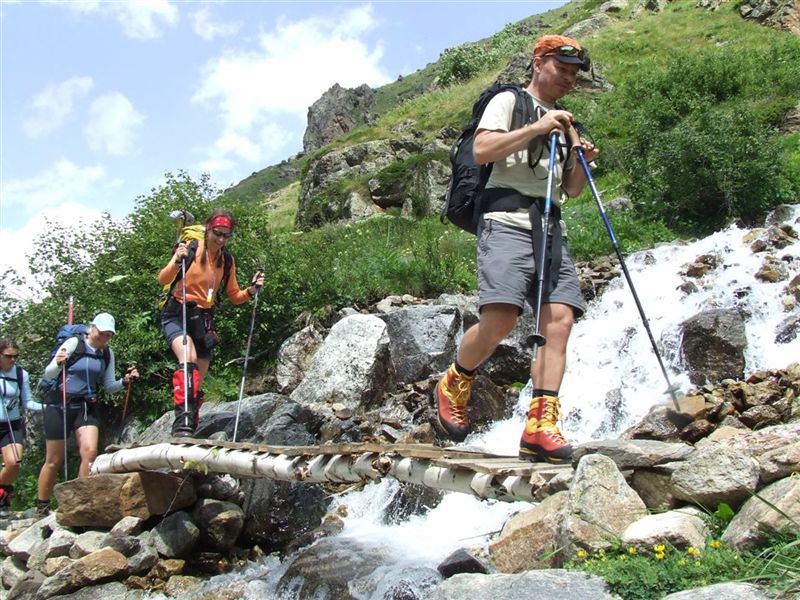
Today there is an acclimatisation walk to one of the best-known waterfalls in the Elbrus region, Devichyi Kosy. The route follows an old mountain road through pine forest, alpine meadows and open slopes with panoramic views of Elbrus and the surrounding summits.
The waterfall stands at about 2700 m. In good weather, with sufficient preparation and if everyone feels well, the route can continue to the high-altitude observatory at about 3100 m. From here the southern slope of Elbrus and the line the climbers take are clearly visible. After the walk the group returns to the hotel. Night at the hotel.
Day 4. The southern slope of Elbrus, glaciers and a first taste of altitude, 3888 m.
One of the most striking days of the trip. After breakfast the group transfers to the Azau meadow and rides the cable car to the area of the Gara-Bashi station and the high-mountain shelters at about 3888 m.
In September the cable car may be closed for scheduled maintenance. If the cable car cannot be used, the guide decides the onward logistics according to the actual situation; a vehicle is hired for the ascent if necessary. If the cost of the vehicle exceeds the price of a cable car ticket, participants pay the difference. Even in summer snow and sections of ice remain here, and in clear weather there are views of the Main Caucasus Range and the summits of the Central Caucasus.
The base trip covers getting to know the area of the high-mountain shelters and a walk that takes account of the weather and how participants feel. Here you can see the start of the classic southern route, watch climbers preparing and judge how your body reacts to altitude.
For physically prepared participants a walking acclimatisation outing to about 4200 m, or to the Pastukhov Rocks at about 4700 m, can be agreed separately. That is already a serious high-altitude route and may require special equipment and additional supervision. Whether such an outing is possible is decided by the guide, taking account of the weather, the state of the slope, and the preparation and wellbeing of the participant.
If you wish, and where it is technically possible, part of the high-altitude route can be covered by snowcat without significant physical effort. A snowcat ride is agreed in advance and paid for separately. After the high-altitude part participants descend by cable car and return to the hotel. Night at the hotel.
Day 5. Trekking in the valley of the Terskol river; up to 2800 m if the walk continues to the waterfall.
Today the group heads for one of the most scenic valleys in the Elbrus region. The route starts near the village of Terskol, passes through pine forest and gradually leads out to alpine meadows and the head of the valley. Along the way you can see unusual lava formations that recall the volcanic origin of Elbrus.
In summer there are raspberries, cowberries and bilberries along the route. When the berries ripen depends on the weather and the particular season. In good conditions, and if participants wish, the walk can continue to the Terskol waterfall. With that extension the high point of the day is about 2800 m. The guide decides whether the route continues, taking account of the weather, the state of the path and how participants feel. The route is unhurried and suits a calm introduction to the nature of the region. After the trek the group returns to the hotel. Night at the hotel.
Day 6. The Valley of Narzans.
After breakfast the group travels to the Valley of Narzans, an area of natural mineral springs surrounded by forest and mountain slopes. Here you can taste the mineral water straight from the spring, walk in the surroundings and rest after the previous active days.
If they wish, participants can climb to the viewpoints above the valley, which in good weather look out on Elbrus and the surrounding summits. The day combines light physical activity, an introduction to the nature of the Caucasus and unhurried rest. After the walk the group returns to the hotel. Night at the hotel.
Day 7. Free day in the Elbrus region.
This day can be spent at your own pace: resting at the hotel, walking around Terskol, Cheget or the Azau meadow, visiting a cafe with a mountain view and choosing souvenirs. A free day is particularly convenient for families and for those accompanying a climber, who need to set their own walking distances and level of effort.
If you wish, you can book a horse ride, a photography trip, an additional excursion or a cable car ascent. Additional activities are not part of the main trip and are paid for separately. Night at the hotel.
Day 8. Additional routes and excursions.
Another free day can be given to rest or to getting to know other sights of Kabardino-Balkaria. Possible options include the Adyl-Su gorge with its glaciers and alpine meadows, the Irik-Chat gorge with views of the eastern slopes of Elbrus, Lake Gizhgit, the Dzhyly-Su area and the northern foot of Elbrus, the Blue Lakes, Upper Balkaria and the Chegem waterfalls.
For those who enjoy photography, a trip along panoramic routes or a jeep tour of the most scenic parts of the Central Caucasus can be arranged. The particular option is chosen in advance and depends on the weather, the season, road access and the interests of the participants. Some routes may require permits to be arranged in advance. Additional excursions, transport and any necessary permits are paid for separately. Night at the hotel.
Day 9. End of the trip and journey home.
At 07:00 the group leaves for Mineralnye Vody airport. Please take the transfer time into account when choosing your return tickets. Participants with a late flight and enough time can leave their luggage at the airport and visit Pyatigorsk independently, one of the best-known spa towns of the Caucasian Mineral Waters. There you can walk through the historic centre, visit the site of Mikhail Lermontov’s duel or go up to one of the town’s viewpoints. End of the trip.
What's included
- A guide throughout the trip, except on the free days
- Hotel accommodation in twin rooms, for the number of nights set out in the itinerary
- All transfers on the trip, including the cable cars on Elbrus, from Mineralnye Vody airport or railway station and back
- Three meals a day throughout the trip, except lunches on the free days. Dinner on the first day and breakfast on the last day are included
What's not included
- Tours, excursions and additional activities on the free days
- Single occupancy supplement
- Early check-in and late check-out at the hotel before or after the trip. We always try to agree additional benefits for our guests with our partners, so where it is possible early check-in or late check-out is provided free of charge
- National park permit, where one is required
- Personal equipment
- Cheget cable car tickets
- A snowcat or snowmobile ascent on the slope of Elbrus
- Additional services and costs arising from deviating from the itinerary or changing it
- The supplement for an alternative ascent by vehicle if the cable car is closed for maintenance in September and the cost of the vehicle exceeds the price of a cable car ticket
Trekking and holidays in the Elbrus region for private groups
We arrange private trips in the Elbrus region for families, groups of friends, corporate groups and walking clubs. Dates are agreed around the availability of guides, transport and suitable accommodation. The trip can be adapted to participants’ ages, fitness and interests. We can change the length, choose the hotel, adjust how hard the walks are, and add excursions, jeep trips, horse riding, photography days or extra rest days. The format is especially popular with the families and companions of people climbing Elbrus. While part of the family prepares for the climb and goes to the summit, the others can stay in a comfortable hotel, walk in the Elbrus region, use the cable cars and visit the sights. The dates can be matched so that the whole family arrives and goes home together. Active participants can add extra walks and acclimatisation days on the slopes of Elbrus. Days out above the high refuges, including the route to the Pastukhov Rocks, are discussed separately and run only in suitable weather, with the necessary preparation and the right equipment. The pace can be eased for families with children and for older participants. Within one private group we can offer different levels of activity, so that everyone gets a suitable day and nobody has to attempt a route that is too hard for them. Get in touch to discuss dates and receive a quote for a private trip.
Documents you need for the Elbrus region trekking and holiday trip
To join this trip you will need:
- A valid passport
- Air or rail tickets
- Medical insurance covering trekking and the maximum altitude of the route chosen
- For foreign participants: a Russian visa and any other documents needed to enter Russia, where your nationality requires them
If you are planning the extra day up to the Pastukhov Rocks, your policy must cover trekking at an altitude of at least 4700 m. We recommend keeping digital copies of your documents on your phone and in cloud storage. Where it is needed we provide visa support for foreign participants and supply the documents required for a Russian visa application.
Weather and seasons for a holiday in the Elbrus region
The main season for trekking and a holiday in the Elbrus region runs from late spring to early autumn. That period usually brings the most comfortable conditions for walking in the valleys, visiting the waterfalls and taking the cable cars up onto Elbrus. In May and June the valleys gradually turn green and the alpine meadows come into flower. A great deal of snow remains on the higher slopes of Elbrus at that time. The contrast between green valleys and white glaciers makes the start of the season especially striking. July and August are the warmest months. Daytime temperatures in the valley are usually between +15 and +25 °C, though mornings, evenings and the period after rain can be noticeably colder. In the second half of summer raspberries, lingonberries, bilberries and other mountain berries begin to ripen in the Elbrus region. The exact timing depends on the weather in each particular season. September suits participants who prefer cooler weather and fewer visitors. The air often becomes clearer and the slopes gradually take on their autumn colours. At the same time daylight shortens, the temperature falls and early snow becomes more likely. The weather in the valley and on the slopes of Elbrus can differ enormously. Even in summer, above 3500-4000 m there is snow and there are ice sections, the temperature can fall to 0 °C or below, and clear weather can give way quickly to cloud, wind or snowfall. In a single day you can go from summer warmth in the valley to genuine winter conditions at altitude. At any point in the season you need warm clothing, a windproof jacket, and protection from rain, sun and wind. The guide decides whether the high-altitude days, including the route to the Pastukhov Rocks, can go ahead, taking account of the actual weather, the state of the slope and participants’ preparation.
Accommodation and meals on the Elbrus region trekking and holiday trip
Participants stay in hotels in the Elbrus region throughout. There are no tents and no nights in high-altitude refuges. We use several trusted options in Terskol and at Azau meadow. The particular hotel is chosen according to the dates, room availability and the group composition. The standard arrangement is twin rooms. Single occupancy is possible on request, subject to availability and at extra cost. Hotels are chosen for easy access to the main routes on the itinerary and to the Elbrus cable cars. Shops, cafes, restaurants, equipment hire and other tourist facilities are close by. Three meals a day are included throughout, apart from lunches on the free days. Dinner is provided on the day you arrive and breakfast on the day you leave. Meals are provided at the hotel or in cafes and restaurants in the Elbrus region, and may include Caucasian, Russian and European dishes. If you have any dietary requirements, tell us before the trip starts. By prior arrangement we will do our best to provide vegetarian, vegan, lactose-free or other special catering, within what the hotel and the places on the route can manage. You must tell us in advance about food allergies, intolerances and medical restrictions. That lets us check what is available and agree it with our partners before the group arrives. Traces of allergens cannot always be excluded in a shared kitchen, so participants with severe allergic reactions must carry the medication their doctor has prescribed.
Day-to-day conditions on the Elbrus region trekking and holiday trip
This is a comfortable trip: no tents, no nights in mountain refuges and none of the harder aspects of expedition life. Every night is spent in hotels in the Elbrus region. The hotels have the usual comforts: beds, bed linen, hot water, a shower, electricity and somewhere to charge your devices. Whether Wi-Fi, laundry and other hotel services are available, and how good they are, depends on the particular property. On the walks and treks participants carry small rucksacks with water, a snack, warm clothing, waterproofs and personal items. Your main baggage stays at the hotel. The group returns to the hotel in the evening, so there is no need to carry a sleeping bag, tent or large rucksack. The format suits families with children, companions of people climbing Elbrus, and travellers who want to get to know the mountains without serious hardship. The length of the walks and the physical effort do vary with the route chosen. Terskol and the Cheget and Azau meadows have cafes, shops, restaurants, equipment hire and cable cars. Timetables and the availability of particular attractions can change with the season, the weather, maintenance work and how busy they are. There is usually mobile coverage in the settlements and over much of the south side of Elbrus. Signal can be weak or entirely absent in the gorges, the remote valleys and some high-altitude sections. toilet and washing facilities on the walking days are not those of a hotel. Some routes have no toilets, cafes or anywhere to buy water, so bring everything you need with you. Comfortable though the accommodation is, the Elbrus region is still mountain country. The weather can change quickly, the cable cars can close temporarily, and whether particular routes and excursions go ahead depends on the state of the roads, the season and the conditions on the day. The guide decides on any change of route, on the basis of the group’s safety.
Страхование
НаверхEquipment and useful extras for trekking and a holiday in the Elbrus region
Скачать PDFIf you do not have your own kit, most of what you need can be reserved in advance from Rock and Rent. You can pick up clothing, footwear, trekking poles, rucksacks and other equipment there for walks, treks and days out on the slopes of Elbrus. Hire is particularly convenient for participants who do not want to buy kit for a single trip, or who prefer to travel light. We recommend reserving the sizes you need in advance.
Documents
- A valid passport
- Air or rail tickets
- Medical insurance covering trekking and the maximum altitude of the route chosen
We recommend keeping digital copies of your documents on your phone and in cloud storage.
Personal equipment
- A rucksack of about 20 litres
- Trekking poles
Clothing and footwear
Is downhill ski clothing suitable for Elbrus?
- Trekking shoes or trekking boots
- Windproof jacket
- A poncho or waterproof shell jacket for the rain
- Fleece jacket
- A set of base layers, top and bottoms
- Thin gloves
- Bandana or buff
- Warm hat
Trekking boots are particularly recommended in May and the first half of June, when snow can still lie on the routes. From mid-June to the end of September, good trekking shoes are enough for most participants, provided they suit long walks and keep your feet dry. Ski clothing can be used on the way up the slopes of Elbrus. Because it protects against wind, snow and cold, it suits the high-altitude section better than ordinary town clothing.
Other items
- Sunglasses
- Gaiters: whether you need them depends on the season, the weather and the footwear you choose
- Sun cream
- Lip balm
- Personal first-aid kit
- Elastic bandage and/or a support brace
This list is written for the main itinerary. An extra day above the high huts, or up to the Pastukhov Rocks, may call for warmer clothing, mountaineering boots, crampons and other equipment. The guide sets the final list, taking account of the altitude, the season and the state of the route.