Iztaccihuatl at 5230 m is, in the Mountain Guide programme, both a high summit in its own right and the key test before Orizaba at 5636 m. It does not come straight after the flight: before it a participant does two day outings and then sleeps at the huts at 4000 m. After the summit attempt the group goes down to Tlachichuca at 2900 m to recover before the next high stage.
That order does not guarantee acclimatisation and does not turn Iztaccihuatl into a pass mark. Its value lies elsewhere: the team learns about pace, how people feel, equipment and recovery before the main objective of the trip. Take this day out and you have a different programme with a different altitude profile.
Why Iztaccihuatl is not a gentle warm-up
The word “acclimatisation” sometimes creates the false impression that an intermediate summit does not draw on your reserves. In fact an outing above 5000 m comes after a night at 4000 m and several days of walking. A participant has to hold an even pace, eat and drink regularly, manage their layers and descend safely. All of that is a proper mountain day.
At the same time Iztaccihuatl should not take everything you have for the sake of a symbolic mark. In the nine-day route it sits before Orizaba, so the quality of the descent and how you are the next morning matter as much as the height reached. Turning round at the right moment can still give a useful day at altitude and keep the rest of the programme open.
The main mistake is to judge the day only by the formula “summit or failure”. Weather, access, the group’s pace or the guide’s decision can all stop an attempt. What matters for the plan afterwards is the reason for turning round, the maximum altitude, how long the effort lasted, the participant’s condition and how well they recovered after the descent.
Where Iztaccihuatl sits in the nine-day programme
The role of the summit only makes sense inside the whole sequence. Mountain Guide does not move a participant from the altitude of Mexico City straight to a push at 5230 m. First the programme gives two lower day routes, then the first night high up that it commits to. After Iztaccihuatl comes a descent to nearly 2300 m below the summit, and only then the move to the Orizaba base camp.
| Stage | Highest point | Next night | Purpose |
|---|---|---|---|
| Mexico City | 2300 m | 2300 m | Recovering from the journey and checking equipment |
| Ajusco | 3900 m | Mexico City, 2300 m | The first outing at altitude |
| Nevado de Toluca | 4680 m | Cholula | The second step, and a check on recovery |
| The Iztaccihuatl huts | 4000 m | About 4000 m | The first night high up that the programme commits to |
| Iztaccihuatl | 5230 m | Tlachichuca, 2900 m | A summit in its own right and a day above 5000 m |
| Orizaba base camp | 4200 m | About 4200 m | Preparing for the main summit |
| Orizaba | 5636 m | Descent | The main objective of the programme |
The table describes the published altitude profile, not a medical guarantee. The response to altitude is individual. Any substitution is judged not on one similar figure but on the sleeping altitude, the highest point, how long the effort lasts, the time allowed for recovery and where the day sits in the whole scheme.
What the night at the huts at 4000 m shows
Before Iztaccihuatl a participant has already been up to nearly 4700 m, but came back down each time. A night at 4000 m sets a different problem: you have to eat, get to sleep, stay warm, recover and start the next day fit to work. So the assessment carries on into the morning rather than ending at the high point of the previous route.
What matters is appetite, the quality of sleep, the ability to drink, clear thinking and coordination. A saturation reading on its own does not replace watching for symptoms and behaviour. This article grants no medical clearance: if someone deteriorates, the guides assess them, and the gain in height stops according to the situation on the ground.
Practical conditions affect the outcome too. Before the trip, get written confirmation of what the hut is like, of the sleeping arrangements, the heating, the water, the food, the sanitation and the electricity. None of that can be assumed to be included merely because the word “hut” is used.
What the guide watches for during the day at 5230 m
Reaching the summit does not by itself grant automatic clearance for Orizaba. The guide looks at how someone moves and recovers over time. One fast section can conceal too great an expenditure of energy, while a calm, even pace often says more about readiness for the next stage.
- A steady pace, without repeated bursts and long stops
- The ability to eat and drink through a long day at altitude
- Keeping coordination and attention on the way up and on the way down
- How the boots, gloves, insulation, torch and pack are working
- Reporting problems promptly
- The quality of recovery once back down at 2900 m
No one of these is judged in isolation from the rest. An unsuccessful attempt does not always close the way to Orizaba, and reaching the summit does not always mean a participant has recovered. The decision depends on why they turned round or succeeded, on their condition and on the conditions on the next route.
How to keep something back for Orizaba
The fifth day cannot be planned as an isolated race for a summit. A participant reaches it after Ajusco, Nevado de Toluca and the night at 4000 m, and after the descent has to pull themselves together again for the Orizaba base camp. It is better to move at a pace that lets you drink, eat and change clothing regularly without long stops.
The descent to Tlachichuca is part of the acclimatisation logic. The night at 2900 m is used for sleep, food, taking on fluid, drying kit and checking the technical set. Feeling well after the descent does not remove the need to go through how the day above 5000 m actually went.
Trying to hide a problem in order to keep your clearance reduces the number of safe decisions available. The guide has to know about a headache, nausea, unusual weakness, or trouble with coordination, vision or breathing before the situation deteriorates sharply. Individual medical questions are settled with a doctor before the trip.
Official access and an active Popocatepetl
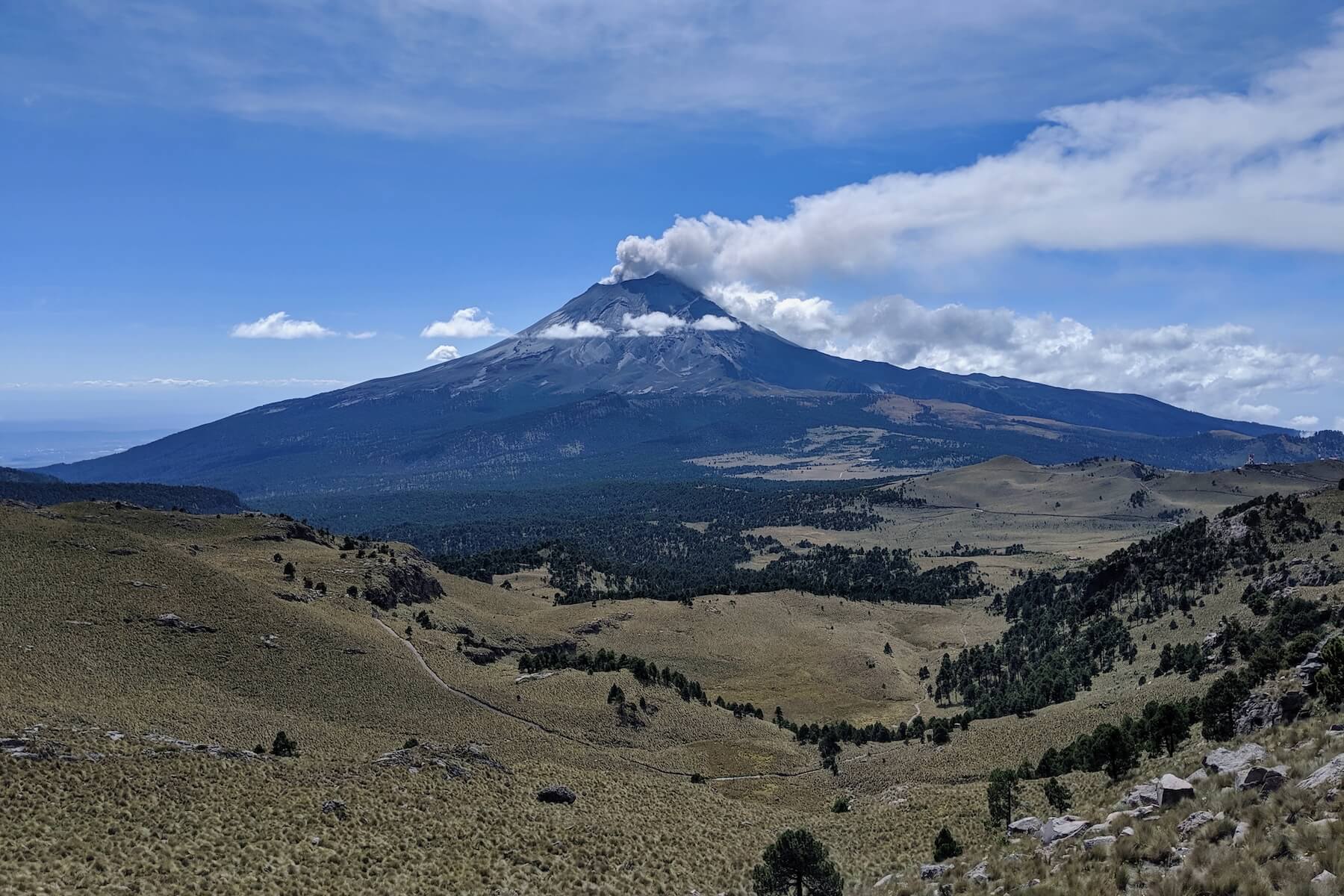
Iztaccihuatl lies in the area of the Iztaccíhuatl-Popocatépetl national park. The entry regime and actual access are checked against your dates through the notices of CONANP. The existence of a programme on a website does not mean the route will be open whatever the circumstances.
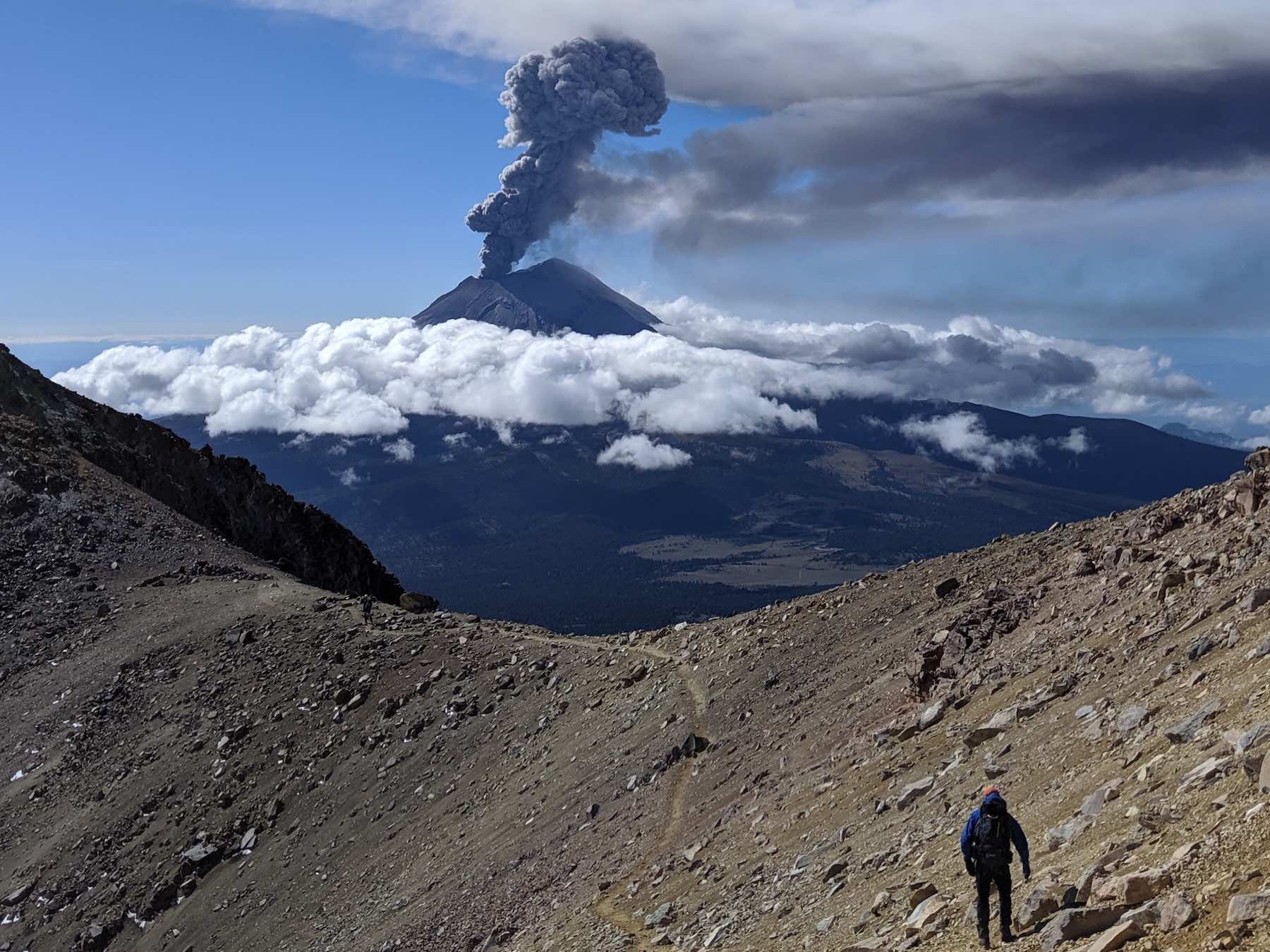
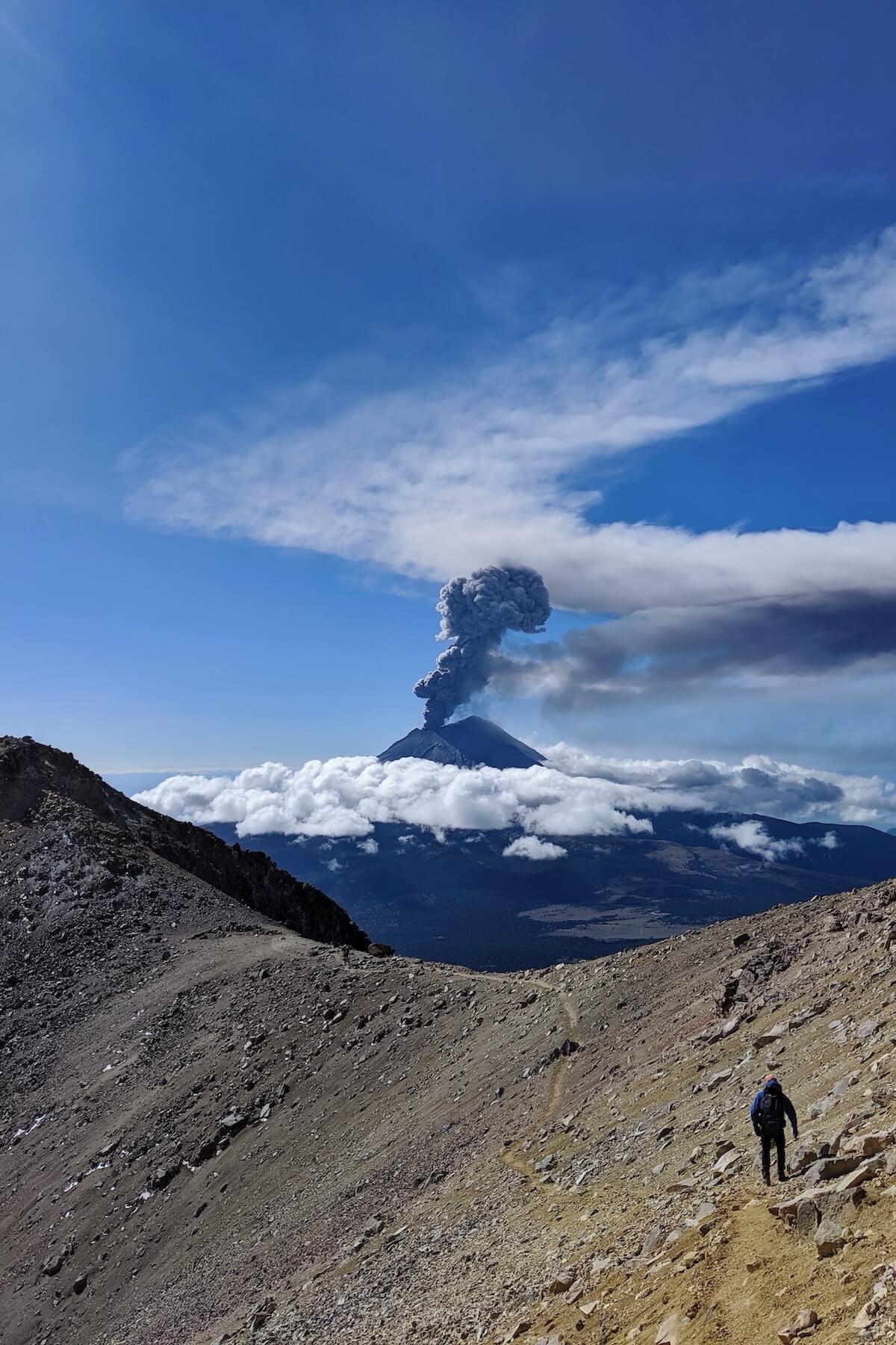
Popocatepetl, next door, is an active volcano and is not part of the climbing programme. CENAPRED warns against approaching the crater and gives an exclusion zone of 12 km. Instructions issued by the services at the time outrank old reports and photographs.
Before departure, access to the start point, the entry times, transport restrictions and the plan if the day has to change are all confirmed. This information belongs to the facts that change, and needs checking afresh for every group.
What happens if Iztaccihuatl is unavailable
Closure of the area, wind, the state of the route or volcanic activity may force a change. An equivalent substitute cannot be promised in advance: another summit of similar height may have a different approach, a lighter load, a lower night or leave no time for recovery.
A new option is judged on five points: the highest altitude, the sleeping altitude, how long the movement lasts, the technical demands and where it sits in the calendar before Orizaba. If those change substantially, the organiser has to explain plainly how the acclimatisation logic changes and what a participant gets instead of the original day.
Simply dropping Iztaccihuatl also makes a different product. It can be discussed for someone who arrives already acclimatised, but it needs its own programme, its own entry criteria and confirmed logistics. A short holiday is not in itself a source of acclimatisation.
How to prepare for Iztaccihuatl in particular
Preparation has to allow for the summit falling on the fifth day of a busy trip. What you need is long ascents at an even pace, stability on descents over rough ground, two demanding days in a row and the habit of carrying a moderate pack. A single fast session says nothing about how you will recover after several days at altitude.
Boots, socks, gloves, torch, insulation and pack are all tested beforehand. New footwear should not be used for the first time in Mexico. In training it helps to practise eating in small amounts, drinking without a long stop and changing a layer quickly with gloves on.
The last weeks before the flight are no time to increase the volume sharply. Overload and injury are more dangerous than one missed session. The preparation should leave you fresh at the start of the programme, not worn out by an attempt to make up lost ground.
The detailed work on fitness is described in the article on preparing for Orizaba, and checking the clothing and the technical set in the article on equipment for the Mexican volcanoes.
Who this sequence suits
The route is designed for a physically prepared participant who is ready for several days at altitude in a row and who accepts the mountain team’s decisions. Previous experience above 5000 m helps but is not the only criterion. What counts is how long those earlier outings lasted, the altitudes slept at, the recovery, the technical skills and how long ago the last mountain was.
If the only objective is Orizaba, what has to be compared is not the name of a mountain but the whole altitude profile. The nine-day programme provides three preceding summits and a separate night at 4000 m. Removing those stages calls for fresh acclimatisation and a new operating plan.
The minimum age given on the programme card is not automatic clearance for a teenager. For anyone under age, their own experience, their response to altitude, their physical and mental readiness, the composition of the group and the supervision arrangements are all assessed separately.
How to go through the day after the descent
The day is worth going through even when the group reached the summit. First record the actual maximum altitude, the time spent moving, how people were on the way up and the quality of the descent. Then look at whether a participant managed to eat and drink, whether there were problems with footwear or clothing, whether concentration held and how much was left after the return.
The next morning fills the picture in. Sleep, appetite, ordinary daily activity and the willingness to pack for the mountains again all matter. Someone may feel elated straight after a summit and notice the accumulated fatigue only later. So the move to Orizaba should not be decided on the impression made at the end of Iztaccihuatl alone.
If the attempt ended in turning round, it helps to separate external causes from individual ones. A closed route, strong wind or a decision taken for the whole group say nothing about one person’s physical readiness. Too slow a pace, problems with equipment or a decline in how someone feels call for a different discussion. What comes out of it is not a verdict of pass or fail but a clear plan for the next day.
This review must not be turned into self-diagnosis. Its purpose is to give the guide the full picture and to stop important details being lost in the fatigue. If there are symptoms or doubts about health, the decision is taken with safety first, and individual questions go to a doctor.
Personal kit and how the summit day is organised
The pack should hold only what is needed on that particular outing and what has been agreed against the final list. Excess weight costs you energy, but leaving out a warm layer, water or spare food for the sake of lightness creates a different risk. The kit is checked in the evening in the hut, not in the dark before the start.
Boots and socks should already have been tested over a long walk. Gloves are chosen so that you can open the pack, the torch and a water bottle without leaving your hands unprotected for long. Insulation goes on top so it can be added quickly. Spare batteries and electronics are protected from cold and wet.
Food is chosen not from sports theory but from what a person can actually eat while working at altitude. Small portions within reach are easier than a large meal that keeps being put off. Water is spread so that you do not depend on a single container. The exact volume and whether it can be topped up are confirmed against the group’s plan.
All the packing is finished before you sleep. The morning should be a clear sequence: dress, eat, check the torch, the water and the fastenings, report how you feel and set off when told. Extra fuss at the start makes it more likely you will forget something important and harder for the group to keep to its schedule.
Short answers about Iztaccihuatl
Can 5230 m be counted as sufficient acclimatisation for Orizaba? There is no single altitude that automatically confers readiness for the next summit. What counts is the night at 4000 m, the length of the outing, the participant’s response, the quality of the descent and the recovery at 2900 m. Iztaccihuatl creates an important step and yields information, but it does not guarantee the result at 5636 m.
Can the night at the huts be skipped and the summit done straight off? That would change the published route and the character of the effort. Such a scheme should not appear as a casual shortcut. It needs its own assessment of acclimatisation, confirmed logistics and a decision by the organiser for that particular participant.
Can I come for Iztaccihuatl alone? The summit has sporting value in its own right, but the current Mountain Guide page sells it inside the group of four volcanoes. A separate product would need its own length, price, included services, entry criteria and rules for changing the route.
What happens after turning round? There is no universal promise. The decision depends on the reason, the participant’s condition, the point at which they turned round, the group’s logistics and the conditions on the next stage. It is more useful to ask in advance who stays with the participant, how the descent is organised and on what terms the programme can be continued.
Get the answers to these questions before you pay, not at the start. They help you tell an exact programme from an advertising promise and to understand where responsibility lies. If the route is changed, a participant should have explained to them not only the new name of the objective but how the substitution affects the sleeping altitude, the effort, the recovery and the rest of the plan. Keep the written confirmation with the trip documents. A verbal promise should not stand in for the exact services, dates, limitations, procedure for changes and division of responsibility.
What to confirm before booking
- The actual access regime for the park and for the start point
- What the hut and the night at 4000 m consist of
- The guiding team and the ratio of guides to participants
- The current list of personal and group equipment
- How water and food are organised
- What happens if the area closes or the group turns round
- How a change to the day affects the Orizaba stage that follows
First set your own experience against the full acclimatisation scheme and go through the first two steps of the route. Then open the nine-day Mexican volcanoes programme and send the organiser the dates of your recent outings at altitude, the highest points you have slept at and climbed to, your experience with technical equipment and any constraints in your calendar.