Equipment for Elbrus is best divided into three groups: the sharp and bulky items into checked baggage, permitted electronics and batteries into hand luggage, and the personal items that are critical on the first day kept on you. The final rules are set by the airline and by airport security, so they are checked for each ticket. Packing is built on the list for the exact programme, not somebody else’s photograph of a suitcase.
Start with a complete list
Print the programme list or save it, and tick off each item as you pack it. Divide the items by where they will travel, and note separately what you plan to hire. That makes it clear where a gap has opened up and where the same item has accidentally been counted twice.
Photograph expensive equipment, its markings and its serial numbers. Photographs do not replace a baggage claim, but they help you describe an item if it is delayed or damaged.
Sharp items
Do not count on carrying crampons, an ice axe, trekking poles or a knife into the cabin. They go into checked baggage with every sharp part covered. The particular list of prohibited items has to be checked with the carrier.
Crampons go into a strong case, the ice axe is secured along the wall of the duffel bag, and the tips of the poles are covered. Nothing should shift about inside and cut through the fabric. Wrapping something in a thin bag is not protection.
Batteries and power banks
IATA treats power banks and spare lithium batteries as items to be carried in hand luggage rather than in checked baggage. The contacts are protected against a short circuit, and each cell is kept in its own packet or case.
Limits on capacity, on quantity and on use in flight may be stricter with a particular airline. Check the Wh marking on the power bank. A device whose capacity cannot be read may raise questions at security.
What to keep in hand luggage
Your passport, money, phone, charger, regular medication, glasses and documents should stay with you. It is worth taking one basic set of clothing in case the baggage is delayed, provided it fits the weight and size limits.
Do not put an item into your hand luggage simply because it is expensive. If its shape or its purpose is prohibited in the cabin, its value creates no exception. Better to ask in advance about special packing, or about hiring on the spot.
How to reduce the risk of a delay to the programme
- Label the duffel bag on the outside and put the owner’s contact details inside
- Remove old baggage stickers
- Do not exceed the weight and the dimensions of the fare you have chosen
- Keep the baggage receipt until you have your things back
- Do not check in your passport, your money or your regular medication
- Note in advance what can be hired quickly on the spot
If the baggage does not arrive, file a report at the airport straight away and tell the organiser. Do not wait for the next day in the hope that the bag will turn up by itself. Reporting early leaves more time to hire equipment and to adjust the set.
Duffel bag, suitcase or rucksack
A soft duffel bag suits bulky clothing and equipment, but the sharp parts need protection of their own. A suitcase holds its shape better, though its wheels and shell can eat into your weight allowance. A large trekking rucksack has to be covered with a transport bag so that the straps do not get caught in the baggage machinery.
The list for the south programme has a 30-40 litre summit rucksack and a large 80-100 litre duffel bag. These do different jobs. Do not try to go on an acclimatisation ascent with a suitcase, or to check in an empty summit rucksack with its straps unprotected.
Hire as part of the plan
If you would rather not carry boots, crampons, an ice axe and bulky clothing, part of the set can be booked at Rock and Rent. The booking has to be made in advance: the availability of the size you need cannot be left to the day you land.
Compare the cost of the baggage, the risk of damage and the price of hire, but do not decide on weight alone. Personal items you have proved are sometimes better brought with you, while the technical set is better collected as a compatible package on the spot. A general guide is given in the Elbrus equipment list.
Connections and different airlines
If the route involves several carriers, the rules of each leg apply. Baggage accepted by the first airline does not necessarily meet the fare and the limits of the second. Check whether the ticket is a single one, what the baggage allowance is, and whether you have to check in again at the connection.
A short connection increases the risk of baggage delay. Keep the critical documents, medication, a means of communication and one basic set with you. If you are making the connection yourself, allow time to collect and re-check the duffel bag. Save the flight numbers and the baggage service contacts offline: the internet may not be there the moment you land. Tell the organiser the flight routing if your arrival depends on a short connection. That makes it possible to judge the risk of missing the transfer and to plan a margin in advance.
Related programmes
Baggage logistics depend on the route. The cards below lead to the southern programme and to the self-sufficient western one.
-
 2,120 $
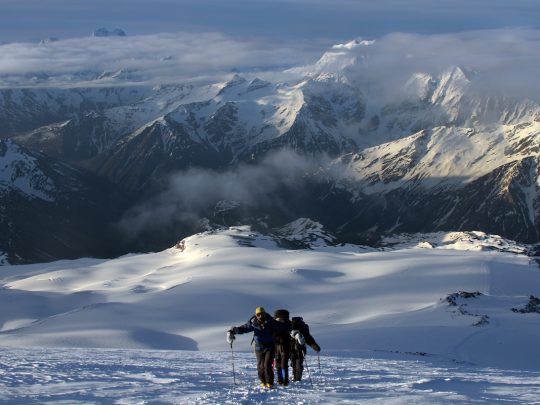
Climb Elbrus from the South, 9 Days
-
 3,700 $
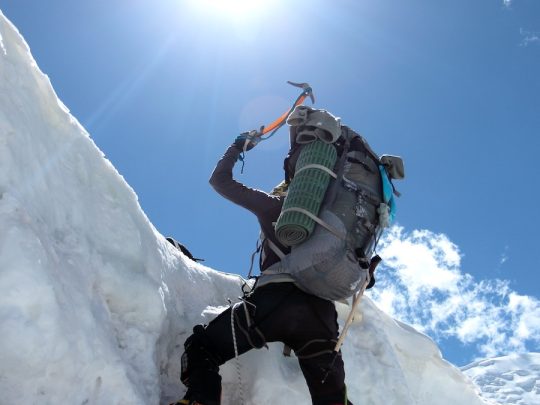
Climb Elbrus from the West, 11 Days
- Height (m)
- 5642
- Duration
- 11 days
- Difficulty
- Average
- Continent
- Europe
- Children
- Not suitable for children
- Accommodation
- Some nights in tents
In summary
Packing starts from the list for the exact programme. Sharp items are protected and go into the hold, batteries travel under the rules in force, and documents and medicines stay with you. Check the carrier’s requirements before you fly. Questions about hire and about the set: Mountain Guide, +7(988)382-98-44.
Putting your kit together? Open the full contents page for mountain equipment: clothing, footwear, technical items, hire and route-by-route lists.