Group and private ascents lead towards the same objective but organise time, the team and responsibility differently. An open-group programme offers the convenience of fixed dates and a predetermined price. A private format lets participants agree dates, group composition and individual route elements. A private trip does not, however, mean that a participant can override safety rules or demand a departure in unsuitable weather.
How a Group Ascent Works
On an open-group programme, participants join a published departure. The tour already has a defined duration, sequence of days, accommodation, meals and main included services. For example, the nine-day ascent from the south is designed around gradual acclimatisation and is suitable as a first high-altitude experience for someone with normal physical fitness.
The group completes acclimatisation outings together and must move at a pace that allows the guides to monitor all participants. This does not mean that everyone must walk at the same speed all the way to the summit: assistant guides join the lead guide on summit day, and the ratio defined by the programme allows participants to be divided as circumstances require. The tour’s overall schedule, however, remains shared.
What a Private Programme Provides
A private ascent of Elbrus is organised for one participant, a family, friends, a club or a corporate team. A proven nine-day programme from the south forms the basis, after which the changes genuinely needed by the particular group are discussed.
A private format is usually selected for the following possibilities:
- Agreeing dates when guides are available
- Avoiding joining unknown participants
- Selecting the duration of acclimatisation
- Discussing an additional reserve day
- Choosing the accommodation level and transfer format
- Arranging a programme for relatives who are not attempting the summit
- Selecting a route that matches the group’s confirmed experience
Changes are agreed before booking. If participants want the northern route, a traverse, both summits or the ‘Cross’, the name cannot simply be changed in a standard quotation: each option has its own logistics, requirements and duration.
What Cannot Be ‘Ordered’ Even on a Private Tour
A private format does not turn the mountain into a service with a guaranteed outcome. A client cannot insist in advance on a departure regardless of wind, visibility and slope conditions. Nor can the client require the guide to continue if a participant has acclimatised poorly or is no longer safely in control of their condition.
Four principles do not change:
- The guide makes the final decision about starting and turning around
- Reaching the summit is not guaranteed
- Good physical fitness cannot replace acclimatisation
- Technical and medical limitations take priority over a personal schedule
Comparing the Two Formats
| Criterion | Open Group | Private Programme |
|---|---|---|
| Dates | Published departures | Agreed subject to guide availability |
| Composition | Participants may not know one another | Your group only |
| Route | Fixed by the selected programme | Selected before the tour is confirmed |
| Pace | Coordinated with the group’s overall operation | Better able to reflect your team’s characteristics |
| Price | Shown on the departure page | Quoted individually |
| Guide’s decision | Binding | Binding |
Who Is an Open Group Suitable For?
A group tour is a sensible choice when the published dates work, standard accommodation is acceptable and there is no need to redesign the route. For a first Elbrus ascent, this format offers a clear preparation sequence alongside participants with a similar objective.
An open group is not necessarily worse at accounting for individual condition. Guides observe participants during acclimatisation and make decisions based on actual readiness. The programme cannot, however, wait indefinitely for one person or change the entire schedule because of a preference that was not agreed in advance.
When Is a Private Format Justified?
A private programme makes sense when leave is tied to specific dates, the group has already been assembled or a participant needs a particularly gentle pace. It is also convenient for families, corporate teams and people who want to combine an ascent with a separate holiday for companions.
If the main reason is a fear of falling behind an open group, first understand the source of the problem. Sometimes extending the acclimatisation period is more useful. In another situation, more training is required before the trip. A private guide can adapt the working pace but cannot compensate for the absence of minimum physical readiness.
Questions to Answer Before Requesting a Quote
- Who is in the group and what experience does each participant have?
- Which dates are genuinely fixed?
- Is the standard southern route required, or another format?
- How many reserve days are you prepared to allow?
- What are your requirements for the hotel, hut and transfers?
- Which companions do not intend to attempt the summit?
- Which personal equipment do you already own?
Before choosing, consult the preparation recommendations and understand the rules for attempts in advance. They are examined separately in the guide to reserve days and repeat attempts.
Compare Group and Private Formats
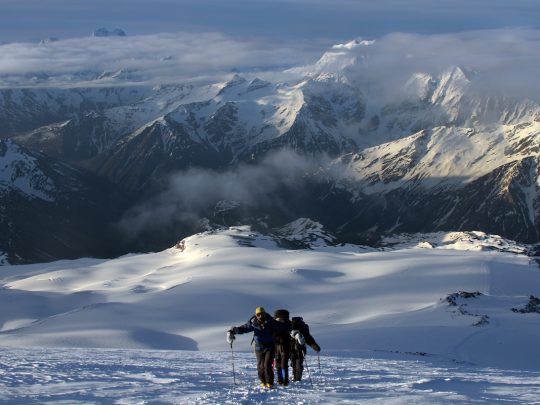
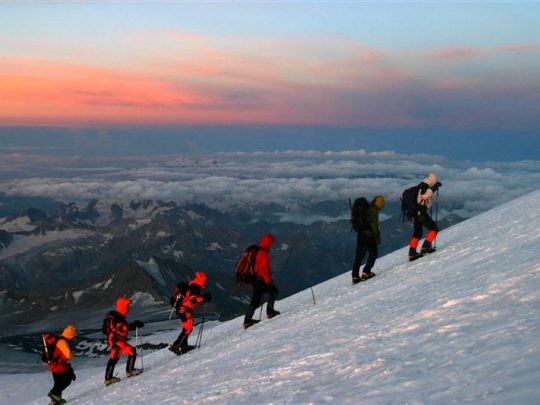
The nine-day ascent from the south illustrates the basic group format with published terms. A private programme is quoted according to the specific group’s composition, dates, route and desired comfort level.
-
 2,070 $
Climb Elbrus from the South, 9 Days
-
 3,900 $
Climb Elbrus Individually
- Height (m)
- 5642
- Difficulty
- Low
- Continent
- Europe
- Children
- Ages 10+
- Accommodation
- No nights in tents
Conclusion
The group format suits people who need a ready-made programme and published price. The private format suits those who value their own dates, a closed group and precise organisational customisation. Both options have the same limit: weather, the body’s response and safety cannot be subordinated to a commercial order.
Send the group composition and preferred dates to receive a quotation.