A head torch on Elbrus is there for the night start and for moving before dawn. It has to run for at least 12 hours, be operable in thick gloves and have a fresh power source. That requirement appears in the current kit list for the nine-day programme from the south. A phone torch is not a substitute: it occupies a hand, drains your means of communication faster and aims the light badly while you walk.
Burn time matters more than peak brightness
A big lumen figure looks impressive on the spec sheet, but on the highest setting the battery runs down far faster. What matters on the route is steady output on a middle setting, enough for your footing and for keeping an eye on the person in front. A boost mode can be useful briefly, but you cannot build your plan around it.
Quoted burn times are measured under the manufacturer’s conditions and do not guarantee the same result in the cold. Run a full test before the trip: set the mode you expect to use, leave the torch on and see how the brightness changes over several hours.
Rechargeable or disposable batteries
A built-in rechargeable battery is convenient for regular use, provided its capacity is sufficient and you can charge it at the hut. Replaceable batteries let you swap in a fresh set quickly, but the spares have to be kept dry and protected against short circuits. Some models take either.
In the cold a power source loses part of its usable capacity. If the battery pack sits on a lead, you can keep it under an outer layer, but the lead must not get in the way as you move. Improvised modifications to the housing or the contacts on the route are not acceptable.
What to check with gloves on
- You can find the button by feel and it needs no precise fingertip movement
- The modes change without a long accidental sequence
- The torch does not switch itself on inside the rucksack
- The headband adjusts over a hat and a hood
- The body does not slip when you tilt your head
- The battery compartment closes without removing your liner glove
If the model has a lock-out against accidental switching, practise using it beforehand. On the morning of the start you need to unlock and check the torch, not work out the system outside in the dark.
Setting the beam
A beam aimed too high dazzles the people in front; one aimed too low forces you to look only at your feet. Adjust the tilt in training, wearing full clothing. A diffused close beam is comfortable for moving in a group, and a narrower long-range mode is needed only in specific situations.
Red light helps you avoid dazzling others indoors, but it is not an essential criterion for summit day. Clear controls, a sound headband and a predictable burn time matter far more.
Do you need a spare torch
At minimum you need spare power, and you should check the state of the main torch every evening. A compact second torch adds resilience against failure, particularly if it runs on a different, fully charged set. Agree the exact arrangement with the operator.
Spares must not sit at the bottom of a large bag. Keep them accessible and protected from damp. Dry the torch after each outing and inspect the contacts before you use it again.
Preparation in the evening and the morning
The evening before summit day, charge the torch fully or fit a new set of batteries, then run briefly through all the modes. Adjust the headband to fit over your hat and put the spare power in one place you have chosen in advance. After that, do not use the torch for long domestic jobs around the hut.
Repeat the check in the morning before you leave the building. If the indicator shows less than a full charge, deal with it there and then. Counting on dawn coming soon takes no account of a delay, a turnaround or a slower descent.
Light within the group
Do not shine a bright beam into the face of the people around you or of your guide. After being dazzled, eyes need time to pick out the ground again. When you stop, point the torch down or switch to a low setting if that does not compromise safety.
Distance is not judged by a pool of light alone. You need to see the person ahead, watch the pace and hear instructions. A torch lights the way, but it does not replace the group’s formation or the guide’s navigation. Do not go beyond the group’s collective light without permission.
Buying, hiring and transport
A head torch is useful well beyond Elbrus, which is why people often buy one. If you are hiring, check the power source and the burn time with Rock’N’Rent in advance. Seeing the lamp come on when you collect it is not enough: check the headband, the cover and every mode you need.
Rechargeable batteries and spare lithium cells are carried according to the airline’s rules. Power banks and spare lithium batteries normally have to be in hand baggage rather than in the hold. Check the conditions before every flight.
Related programmes
A night start features in several programmes, but you must take the full kit list from the page of the specific route you have chosen.
-
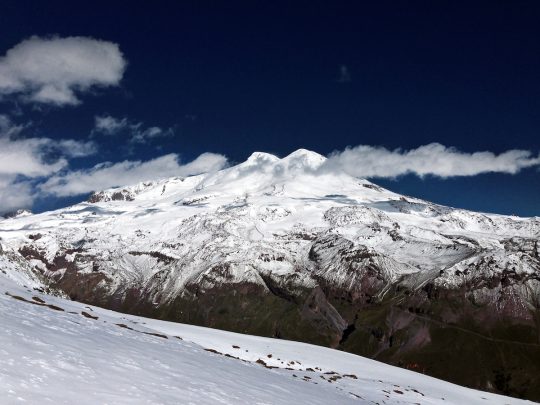 1,690 $
Climb Elbrus from the South, 7 Days
- Height (m)
- 5642
- Duration
- 7 days
- Difficulty
- Moderate
- Continent
- Europe
- Children
- Not suitable for children
- Accommodation
- No nights in tents
-
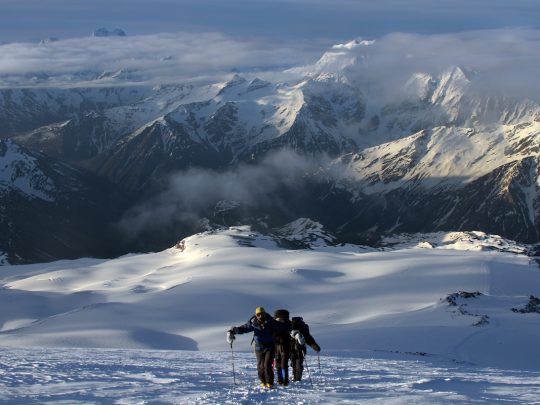 2,070 $
Climb Elbrus from the South, 9 Days
In short
A torch for Elbrus has to run reliably all night, be operable in gloves and have protected spare power. Test it with a long run, not a brief switch-on. The general list is in the article on equipment; you can put questions to Mountain Guide.
Putting a kit together? Open the full contents page for mountain equipment: clothing, footwear, technical items, hire and route-by-route lists.