- Guides
- B2B
-
Climbs
-
Climb Elbrus
- Elbrus individually
- Elbrus from the South, 9 days
- Elbrus from the South, 7 days
- Elbrus from the South in 1 day
- Elbrus from the North
- Elbrus Two Summits
- Elbrus Traverse South to North
- Elbrus Traverse North to South
- Elbrus "Cross" from South
- Elbrus "Cross" from North
- Kazbek+Elbrus
- Elbrus from the West
- Elbrus by helicopter
- Elbrus holidays, 9 days
- Elbrus holidays, 7 days
- Tinder Tour: Climbing Mount Elbrus
- Climb Elbrus from the South, 9 days with Sergey Baranov
- Under 5000 m
- 5000+ meters
- 6000+ meters
- 7000+ meters
- 8000+ meters
-
Climb Elbrus
-
Trekking
-
See 8000m
- K2 base camp
- Everest base camp
- Everest base camp via Gokyo
- Everest base camp in a week
- Annapurna circuit
- Trekking the Manaslu Circuit
- Trekking to Kanchenjunga Base Camp
- Trekking to Kanchenjunga Base Camp (Short)
- Trekking to Kanchenjunga Base Camp (India)
- Trekking to Makalu Base Camp
- Trekking to Annapurna BC
- South America
- Asia
- Africa
- Russia
- Europe
-
See 8000m
-
Adventures
-
Africa
- Tour to Morocco for New Year
- Morocco: Toubkal and the mysteries of the Sahara
- Tour to Eritrea: Dahlak Archipelago and Rashaida Nomads
- Tour to Rwanda: Mountain Gorillas and Mount Bisoke
- Ethiopia
- Tour to Uganda: Queen Elizabeth National Park and Mountain Gorillas
- Safari Tanzania
- Safari Uganda
- Tour to Zimbabwe and South Africa: Victoria Falls, Cape Town, and Cape of Good Hope
- Namibia
- Safari Kenya
- Tour to Botswana: Okavango Delta and Chobe National Park
- South America
- Asia
-
Africa
- Ski-touring
- VIP
- Useful
- About
Ethiopia
- Height (m)
- less than 2000
- Duration
- 9 days
- Difficulty
- Low
- Continent
- Africa
- Children
- From 6 years old
- Accomodation
- Without tents
4500 $
Why to go with us?
Temporarily unavailable
- Ancient tribes of Ethiopia: Dorze, Konso, Hamer, Karo, Dassanech, Arbore, Ari, Mursi
- Centuries-old traditions and unique rituals
- Comfortable travel pacing — we spend as much time with local communities as desired
- The ghost town of Dallol and an overnight stay in a campsite in the lifeless Afar Depression
- Salt flats and swimming in the saline Lake Karum
- Alien landscapes of the Danakil Depression, a picnic in a cave beneath a volcano, and deadly acidic pools
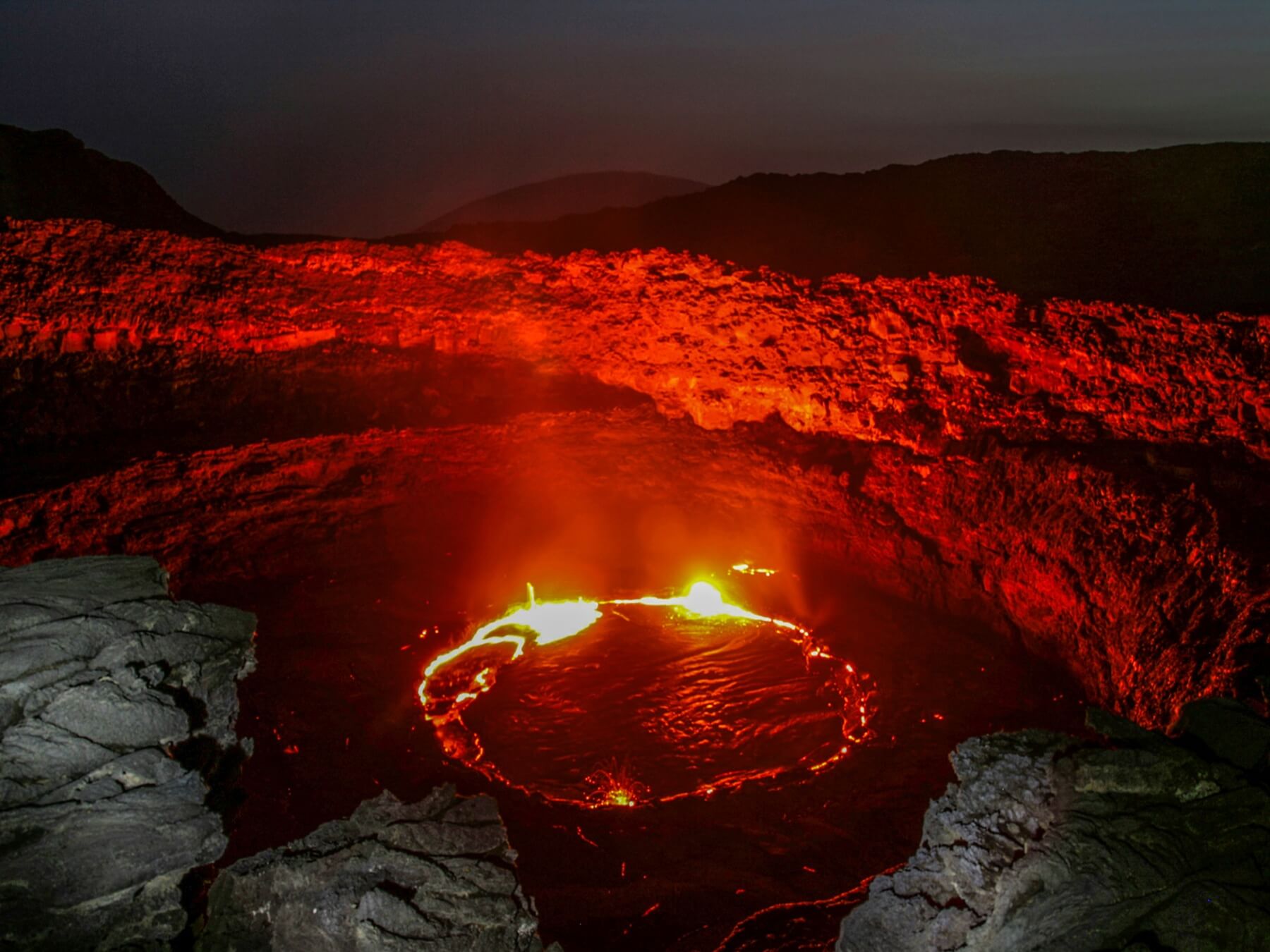
- Ascent to the summit of the unique active Erta Ale volcano, which has two lava lakes with boiling lava and fiery fountains
- Saline Lake Afdera and witnessing the extraction of Ethiopia’s “white gold”
*Please note that our company does not provide services for purchasing or selling air tickets or arranging visas and therefore is not responsible for force majeure related to flights or border crossings.
Important information:
- Hotel check-in and check-out times are regulated by the hotel: check-in from 15:00, check-out by 11:00–12:00. Luggage can be left at the hotel reception to explore the city, or, subject to availability, an additional fee may be paid for early check-in or late check-out.
- In Ethiopia, there are difficulties with exchanging small, worn, or old US dollar banknotes (issued before 2009). Please keep this in mind: in some places an extra commission is charged, while in others exchange may be refused.
We are heading to the many-sided and mysterious Ethiopia! We will immerse ourselves in the culture of some of the world’s most ancient tribes, meeting the Dorze weavers and Konso stone masons, the resilient Hamer and exotic Karo, the Arbore pastoralists and Ari potters, the inventive Dassanech and the formidable Mursi, who have preserved the way of life and rituals of their ancestors. We will travel to the ghost town of Dallol and spend a night camping in the sun-scorched Danakil Lowlands, visit the shimmering salt flats, and swim in the cool, salty waters of Lake Karum. We will walk along the vividly colored acidic lakes of the Danakil Depression, whose otherworldly landscapes are often compared to the surface of Io, one of Jupiter’s moons. We will enjoy a picnic in a cave beneath the Dallol volcano and climb to the rim of the caldera of the active Erta Ale volcano, watching the mesmerizing dance of flowing lava. We will visit the hypersaline Lake Afdera and see with our own eyes how Ethiopia’s “white gold” is добыed. A journey through Ethiopia will be an extraordinary experience both for first-time travelers and for the most seasoned explorers of other cultures.
Day 1. Addis Ababa – Arba Minch. Dorze Tribe.
We set off on an exciting journey through tribal Ethiopia, taking a morning flight from Addis Ababa to the bright and picturesque town of Arba Minch. Upon arrival and check-in at the hotel, we immediately head out to meet the unique Dorze tribe, who live in the mountains above Lake Chamo in unusual dwellings made of bamboo stalks and palm leaves, resembling huge inverted baskets. The shape of the houses also resembles an elephant’s head, with a thickened, trunk-like entrance and side parts that look like ears. Such huts can stand for up to 80 years! However, the Dorze are famous not only for the curious shape of their homes, but also for their amazing weaving skills. We will see how, using primitive looms and special techniques passed down from generation to generation, the Dorze skillfully create colorful fabrics with patterns and zigzags. If you wish, you can try the local cuisine: banana flatbreads, “kifto” (chicken in spicy seasonings), as well as the drink “katai,” made from the leaves of the khat plant. Overnight at a hotel in Arba Minch.
Day 2. Arba Minch – Turmi. Konso Tribe. Hamer Tribe.
After breakfast in Arba Minch, we head to Turmi, a small town famous for its colorful markets and handmade crafts such as bead jewelry, leather goods, and charming souvenirs. On the way to Turmi, we stop at a Konso village to discover their unique stone terraces, which many experts consider a marvel of engineering, and the cultural heritage of the Konso—the largest ethnic group in Ethiopia. The territory where the Konso villages are located is included in the UNESCO World Heritage List precisely because of these stone terraces. The village is built in a spiral of stone houses winding up a hill. We will also see wooden human figures called “waka,” erected in honor of deceased chiefs and heroes of the tribe. After enjoying the atmosphere and beauty of this unique place and taking memorable photos with the welcoming locals, we continue to Turmi, where we spend the rest of the day getting acquainted with the culture and traditions of the Hamer tribe.
The Hamer live in the Omo River Valley in East Africa. The women of the Hamer tribe are known for their unique beauty. They wear hairstyles made of numerous small braids coated with ochre, decorate their heads with woven headbands, and wear leather skirts adorned with cowrie shells, as well as copper bracelets—sometimes 15 or more on one arm. However, the most unusual symbol of beauty and strength among the Hamer is scarring. Both men and women decorate their bodies by burning patterns into the skin, which are then filled with ash. Women also receive scars during initiation rites, when a boy proves he is ready to become a man. To do so, young men strike the backs of young unmarried girls and mature women with water-soaked rods. Scars on the back are a sign of female strength—the more there are, the more attractive the woman is considered. The second stage of the boys’ coming-of-age ritual is running across the backs of a line of bulls, symbolizing overcoming obstacles and hardships. Full of impressions, we return to Turmi in the evening. Overnight at a lodge in Turmi.
Day 3. Turmi – Omorate. Karo Tribe. Dassanech Tribe.
Today our route leads us to the lands of Ethiopia’s smallest ethnic group—the Karo, who live along the banks of the Omo River. Their way of life and appearance will not leave us indifferent: the Karo use white clay, chalk, ochre, and charcoal to paint their bodies and hair, creating a variety of designs—from simple handprints and lines to animal patterns and bird plumage imitations. Intricate hairstyles with braids framing the forehead are decorated with pieces of bark and ostrich feathers, symbolizing victory over an enemy or wild animal. Scars among the Karo are valued as highly as among the Hamer: they are signs of valor for men and aesthetic beauty for women.
One of the most famous Karo rituals is associated with sacrifice—young men kill a bull to become men and defenders of their tribe. The animal’s blood is used to paint bodies, and the meat is shared with the entire community. These ceremonial combats allow men to demonstrate courage and attract women. After this impressive encounter, we head back toward Turmi, where we enjoy a refined lunch, and then drive almost to the Ethiopian–Kenyan border to the town of Omorate, homeland of the Dassanech tribe. Local residents warmly welcome us and help us cross the Omo River in dugout canoes. Here we immerse ourselves in the authentic atmosphere of a village whose way of life has remained unchanged for generations. The Dassanech live in traditional communities where decisions are made by councils of elders elected for life. They practice transhumant pastoralism and also make baskets, mats, and clothing. Jewelry plays an important role in Dassanech culture: women wear wide bracelets and necklaces, decorate their hairstyles with feathers, woven bands, and even bottle caps! Hair is shaved very high on the forehead, leaving only a small tuft at the front. The Dassanech have a fascinating ceremony called Daim, посвящённую the maturation of girls and their readiness for marriage. It takes place during the dry season and lasts more than six weeks, during which many domestic animals are sacrificed. Family members of girls aged 10–12 dress in animal-skin garments and celebrate with dancing, while elderly village elders bless the young women, who don leather skirts as a symbol of maturity. After getting to know the authentic life of the Dassanech, we cross the Omo River again and return to Turmi for the night. Overnight at a lodge in Turmi.
Day 4. Turmi – Jinka. Arbore Tribe. Ari Tribe.
Passing impressive termite mounds and trees dried by the African sun, we head toward the market town of Jinka, first stopping at another remarkable settlement—the pastoralist Arbore tribe. The Arbore live near the drying salt lake Chew Bahir and are one of the few Ethiopian tribes that still preserve traditional beliefs connected to gods of nature and the stars. The women of this tribe are true African beauties, drawing attention with their deep skin tone and expressive features. They accentuate their appearance with colorful clothing, intricate copper and iron earrings, bright necklaces, and bracelets that create complex patterns on the body. Unmarried girls shave their heads completely, giving them a distinctive charm. To fully experience their way of life, we enter their impressive round houses built from sturdy branches, clay, and tree bark. The entrances are so low and narrow that an adult must squeeze inside, and the interior is hot and dark. In the past, the Arbore were considered powerful sorcerers, both feared and sought for help—though this is now fading into history. After exploring Arbore culture, we continue to Jinka, where we meet the Ari tribe, who inhabit a large area north of Mago National Park, partly in the highlands.
We arrive in the afternoon and enter a world without electricity: in remote areas the Ari use kerosene lamps and firewood for lighting and cooking. The Ari are peaceful farmers and potters; they grow sorghum, maize, teff, beans, coffee, and moringa trees with edible leaves. Visiting the homes of friendly locals, we learn how injera—flatbread made from teff dough and a staple of Ethiopian cuisine—is baked. The most remarkable skill of the Ari is their pottery: women skillfully produce and sell a wide range of clay vessels—decorated coffee pots, large platters, elegant jugs, and more. Men practice blacksmithing, sometimes creating real masterpieces. The Ari are very creative people, which we witness while listening to traditional songs and the sounds of the krar, a traditional Ethiopian harp. After a full day, we settle in Jinka, anticipating our meeting with the formidable Mursi tribe. Overnight at a hotel in Jinka.
Day 5. Jinka – Mago National Park. Mursi Tribe. Flight to Addis Ababa.
We leave Jinka at dawn, as our goal is to reach the most wild and uncompromising tribe—the Mursi—through Mago National Park, which is not an easy task. The park’s territory is a vast green savanna with no traces of progress—no mobile connection, electricity, or familiar comforts. The Mursi, also known as Mun, inhabit the southern region of the Omo River Valley. Here we immerse ourselves in the unique atmosphere of the cradle of civilization, rich in mystical traditions and astonishing rituals. Mursi people are easily recognized by their appearance: shaved heads adorned with animal horns and bizarre compositions, fearsome amulets, numerous patterned scars, and protruding lower lips with large ceramic plates. The Mursi believe in spirits, which underlies many of their customs, such as painting faces and bodies with black and red clay. Even more striking is their scarification: among men it indicates the number of enemies or dangerous animals killed, while among women it serves purely as decoration. Some scars result from peculiar “vaccinations” used to prevent sleeping sickness, common in this tsetse-fly region.
The hallmark of the Mursi are the large ceramic lip plates worn by women. Piercing is done when girls reach 12–13 years old, and the opening is gradually stretched by replacing plates. Mursi men are harsh and warlike; boys are raised as future warriors, taught to fight with sticks and handle firearms. A young man must win a ritual stick fight to earn the right to marry that year. After this encounter with a truly primordial village, we return to Jinka and, after a hearty lunch, fly to Addis Ababa to begin the next chapter of our journey. In the evening we dine at Yod Abyssinia, the best restaurant of traditional Ethiopian cuisine, serving delicious injera, shiro, gomen, and other national dishes. Traditional dances and live music perfectly complement the atmosphere. Overnight at a hotel in Addis Ababa.
Day 6. Addis Ababa – Semera. Lake Assale.
We begin our journey to Ethiopia’s natural wonders with a morning flight to Semera, the regional capital of Afar. Here we are met by experienced drivers and comfortable air-conditioned 4×4 vehicles, a team of local guides and professional cooks, a tour leader from the tourism authorities, police escort, and all necessary equipment. Ready to go? Then we head straight along an ancient caravan route to the ghost town of Dallol in the Afar Depression—an abandoned settlement with the highest average annual temperature in the world, 35°C. Today it is uninhabited, though just 50 years ago people lived here extracting mineral ores.
By evening we reach the vast salt lake Assale (or Karum), located in the northern part of the Danakil Desert, 115 meters below sea level, with a salt concentration higher than that of the Dead Sea. Depending on conditions, the lake may appear as an endless white expanse or be covered with a thin layer of water creating a mirror-like illusion. We witness a stunning sunset, when the sun seems to pause above the horizon, leaving a colorful trail as its rays reflect in pink hues off salt crystals and the water’s surface. After dinner, we settle under the open sky at the nomadic settlement of Hamed Ela. Overnight camping
Day 7. Danakil Depression. Dallol Volcano. Erta Ale Volcano.
Before dawn, we head to the truly extraterrestrial landscapes of the Danakil Depression to explore the Dallol geothermal area—a place where a vivid palette of colors comes alive. We walk along the crater of the world’s lowest land volcano, 48 meters below sea level, where hyperacidic pools with pH values close to zero are uninhabitable even for microorganisms. Chemical reactions occur right before our eyes, mesmerizing with their colors. The scenery resembles the surface of Io, a moon of Jupiter, giving the Danakil Depression a unique, enchanting power.
After enjoying these cosmic landscapes, we drive to a fantastic cave formed of salt and mud beneath the Dallol crater, as if entering another dimension. We enjoy a unique picnic in a nearby cave. After lunch, we return to the vast salt flats of Dallol, where coarse crystalline salt crunches underfoot, and enjoy swimming in the cool waters of Lake Karum, a perfect contrast to the scorching sun. We visit salt miners who, in harsh conditions, extract salt by cutting slabs using methods refined over centuries. We return to Hamed Ela to rest, then continue toward the region’s crown jewel—the active Erta Ale volcano, the most active in Ethiopia. Erta Ale is one of only five volcanoes in the world with a lava lake, and uniquely has two, earning it the ominous local name “Gateway to Hell.” We reach the campsite on the rim of the caldera and watch the ever-changing fiery patterns of lava. Around 20:00 we return to camp and spend the night under the open sky. Overnight camping.
Day 8. Danakil Depression. Lake Afdera.
We wake with the first rays of the African sun and, after an energizing breakfast prepared by our cook, head to Salt Lake Afdera—heart of Ethiopia’s “white gold” production and distribution. As its nickname suggests, it lies on the shores of Lake Afdera deep in the Danakil Depression, 100 meters below sea level under relentless heat. After lunch in town, we head to the lake itself. This area has the highest perceived temperatures in the depression, yet Afar tribes extract salt here by evaporating water. Unlike Lake Assale, Afdera is deep—up to 80 meters—and, due to proximity to the active Nabro volcano, its water has low pH and contains sulfuric acid. We wander across endless, snow-like salt fields, observing Afar at work, then return to Semera for a comfortable rest after the journey. Overnight at a hotel in Semera.
Day 9. Semera – Addis Ababa.
With hearts still racing from impressions and memory cards full of striking images, we fly from Semera to Addis Ababa. We leave behind this extraordinary world of surreal landscapes and remarkable people, carrying with us a piece of the spirit of Ethiopia.
Insurance
Наверх Скачать PDFDocuments:
- Passport
- Airline tickets
- Medical insurance
- Yellow fever vaccination certificate
- Malaria prophylaxis medication
Clothing and footwear:
- Hiking boots / sneakers, 2 pairs
- Fleece suit or a similar set of warm clothing
- Bandana or buff
- Sun hat / cap
- Long-sleeve shirts / tops
- Lightweight trekking trousers
- Shorts
- T-shirts
Miscellaneous:
- Power bank
- Sunglasses
- Rain jacket / poncho
- Sunscreen SPF 50
- Lip balm SPF 10–15
- Personal first-aid kit
- Personal hygiene items, wet wipes, flip-flops
- Insect repellent
- Malaria medication
- Swimwear
- Mosquito net for the bed