- Guides
- B2B
-
Climbs
-
Climb Elbrus
- Elbrus individually
- Elbrus from the South, 9 days
- Elbrus from the South, 7 days
- Climb Elbrus with Oxygen
- Elbrus from the North
- Elbrus Two Summits
- Elbrus Traverse from South to North, 9 Days
- Elbrus Traverse from North to South, 10 Days
- Elbrus "Cross" from South
- Elbrus "Cross" from North
- Kazbek+Elbrus
- Elbrus from the West
- Elbrus by Private Helicopter, 3 Days
- Elbrus Region Holiday and Trekking, 9 Days
- Elbrus Region Holiday, 7 Days
- Elbrus Dating
- Climb Elbrus from the South, 9 Days with Sergey Baranov
- Under 5000 m
- 5000+ meters
- 6000+ meters
- 7000+ meters
- 8000+ meters
-
Climb Elbrus
-
Trekking
-
Trekking in Nepal: routes to the eight-thousanders
- K2 base camp
- Everest base camp
- Everest base camp via Gokyo
- Everest base camp in a week
- Annapurna Circuit and Tilicho Lake Trek
- Manaslu Circuit Trek
- Kanchenjunga Circuit Trek (XXL)
- Kanchenjunga North Base Camp Trek (Short)
- Kanchenjunga from India: the Goecha La Trek in Sikkim
- Makalu Base Camp Trek
- Annapurna Base Camp Trek
- Trekking in South America
- Asia
- Trekking in Africa
-
Trekking in Russia
- Elbrus Region Holiday and Trekking, 9 Days
- Elbrus Region Holiday, 7 Days
- Oshten + Kardyvach — 9-Day Western Caucasus Trek
- Lake Kardyvach — 5-Day Base-Camp Trek
- Route 30: Through the Mountains to the Sea, with Oshten — 4 Days
- Trekking in Arkhyz — 7 Days over the Ayulyu Pass
- Gvandra Trek — 7 Days to the Ullu-Kyol Lakes
- Trekking in Dombai — 7 Days with the Murudzhu Lakes
- Europe
-
Trekking in Nepal: routes to the eight-thousanders
-
Adventure expeditions
-
Trekking in Africa
- Tour to Morocco for New Year
- Morocco: Toubkal and the mysteries of the Sahara
- Eritrea: the Dahlak Archipelago and the Rashaida Nomads
- Rwanda: Mountain Gorillas and the Bisoke Volcano
- Ethiopia: Otherworldly Landscapes and the Peoples of the Omo Valley
- Tanzania Safari: Serengeti, Ngorongoro and Tarangire
- Zimbabwe and South Africa: Victoria Falls, Cape Town and the Cape of Good Hope
- Namibia: Etosha National Park and the Himba
- Kenya Safari: the African Big Five
- Trekking in South America
- Asia
-
Trekking in Africa
- Ski touring and ski mountaineering: chasing freedom in the mountains
- VIP tours
- Useful
- About
Climb Elbrus from the East, 12 Days
Price on request
Why to go with us?
Temporarily unavailable
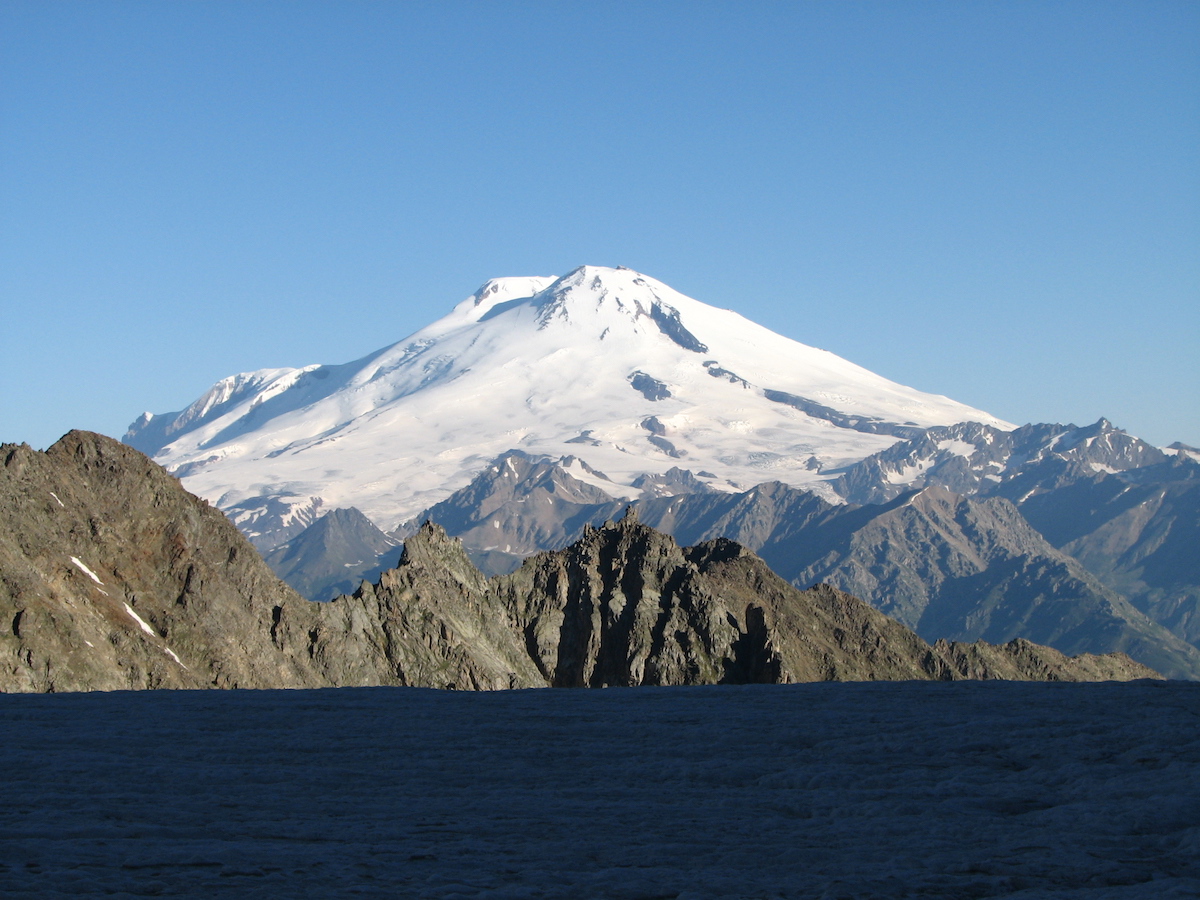
A self-supported twelve-day ascent of the East summit of Elbrus, 5621 m, through the Irik-Chat gorge and along the Achkeryakolsky lava flow. Tent camps, long days carrying a rucksack and almost no infrastructure.
Offered to private and corporate groups on request only. The quote is prepared once the composition of the group and the services required have been agreed.
Acclimatisation is built into the approach itself: the camps rise step by step from the valley to the area of the pass and then to the high camp at about 4100 m, with an acclimatisation hike and a rest day before the summit attempt. Participants walk with full rucksacks for several days and live in tents throughout the mountain section, so a good level of endurance and previous mountain experience matter.
Important
- This route climbs the East summit of Elbrus, 5621 m, not the higher West summit.
- There is no shelter accommodation and no cable car on the eastern side; the group carries its own equipment and camps.
- The lead guide decides the start time, the line taken and whether the ascent can continue, according to the weather and the condition of the group.
About the east route ascent of Elbrus
The eastern route is noticeably different from the busy southern ascent. The approach starts at the northern edge of the village of Elbrus and follows the Irik-Chat valley. Above the forest and the alpine meadows the group crosses the Irik-Chat pass at 3667 m, crosses a glaciated section and comes out onto the Achkeryakolsky lava flow. The route to the East summit of Elbrus, 5621 m, follows that lava flow.
Acclimatisation is built into the approach. The camps rise gradually: from the valley to the area of the pass, and then to the high camp at about 4100 m. Before the ascent the trip includes an acclimatisation hike to roughly 5000 m and a rest day. That structure does not remove the demands on fitness: participants walk with rucksacks for several days and live without shelters.
This is a route to choose not as another way of getting up Elbrus, but for the sake of a self-supported expedition. Before booking, compare it carefully with the standard Elbrus routes and review your own preparation, your experience of carrying loads at altitude and the cover provided by your insurance policy.
Elbrus east route itinerary, 12 days
Day 1. Meeting in Mineralnye Vody and transfer to the village of Elbrus.
The group meets at Mineralnye Vody airport. Two group transfers are provided on the first day of the trip: the first leaves at 12:00 for participants whose flights are scheduled to land no later than 11:00, and the second leaves at 15:00 for participants whose flights are scheduled to land no later than 14:00. Please allow time for baggage reclaim and for leaving the terminal when booking. If a flight is delayed and you miss the group transfer by more than 30 minutes, we will help you order a private transfer, which the participant pays for separately. After the drive into the Elbrus region we check personal and group equipment, divide the loads and go through how the team will work on the self-supported part of the route.
Day 2. Approach through the Irik-Chat gorge.
We start the route from the village of Elbrus and walk up the Irik-Chat gorge. The first camp is set at about 2300 m. The day is there for a calm start to the trekking rhythm and for the beginning of gradual acclimatisation.
Day 3. Move up below the Irik-Chat pass.
We continue up the valley and move the camp higher, into the area below the pass. The guide chooses the exact campsite according to the state of the trail, the weather and the pace of the group.
Day 4. Irik-Chat pass and skills session.
We cross the Irik-Chat pass at 3667 m, make camp at about 3700 m and hold a session on moving in crampons, using an ice axe and working as a roped party. These skills are needed on the glaciated and summit sections of the route.
Day 5. Out to the Achkeryakolsky lava flow.
We cross the glaciated section in roped parties and continue towards the Achkeryakolsky lava flow. The high camp is established at about 4100 m.
Day 6. Acclimatisation hike.
We climb in the direction of the summit route to about 5000 m and return to the camp at 4100 m. The hike helps the body adapt and lets the guide assess the condition of the participants before the summit attempt.
Day 7. Rest and preparation.
We recover after the acclimatisation hike, check clothing and technical equipment and prepare food and water for an early start. The guide sets the departure time according to the actual forecast and the state of the route.
Day 8. Ascent of the East summit of Elbrus.
At night or in the early morning we leave the high camp and climb the Achkeryakolsky lava flow to the East summit of Elbrus, 5621 m. From the summit we return to the high camp by the same route.
Day 9. Reserve day.
The day is used for a second attempt if weather or route conditions prevented the previous one. If the ascent went to plan, we rest and begin preparing for the descent.
Day 10. Descent into the Irik-Chat valley.
We strike the high camp and start back through the area of the pass. The guide chooses the campsite according to the pace of the group and the actual conditions.
Day 11. Out to the village of Elbrus.
We finish the walking part of the route, come out at the village of Elbrus and return to ordinary infrastructure. The rest of the day is for recovery after the self-supported section of the trip.
Day 12. Transfer to Mineralnye Vody.
We drive to Mineralnye Vody. The time of the return flight or train must be agreed before tickets are bought, so that a margin remains for the descent from the mountain.
What's included
- The work of the mountain guides; on summit day the ratio is no more than one guide to 3–4 participants
- Group transfers Mineralnye Vody – village of Elbrus – Mineralnye Vody as set out in the itinerary
- Three meals a day on the mountain part of the route: breakfast, dinner and a snack while moving
- Prielbrusye National Park tickets
- Registration of the group with the state mountain rescue service
What's not included
- Air or rail tickets to Mineralnye Vody and back
- Personal mountaineering, trekking and camping equipment
- Hire of personal equipment
- Medical insurance covering high-altitude mountaineering to 5621 m and evacuation
- Single occupancy and any services not included in the agreed group quote
- Costs arising from change to the itinerary requested by participants
For private and corporate groups
We run the eastern route only for private and corporate groups. Before confirming, we discuss each participant’s experience and fitness, the make-up of the team, your preferred dates and the equipment needed. We then work out the price and fix what the trip includes.
You can add days for acclimatisation or reserve, dedicated guiding, and a separate ground itinerary for colleagues or family who are not going to the summit. We will not cut the basic acclimatisation or remove reserve days to make the schedule faster.
Documents you need
- A valid passport
- Tickets to Mineralnye Vody and back, bought once the transfer times are agreed
- Medical insurance covering high-altitude mountaineering to 5621 m and evacuation
- Digital copies of your documents on your phone and in cloud storage
Weather and seasons
The eastern route runs in the summer season, when the approach via Irik-Chat and the high-altitude section are usually open for a multi-day trip. Even in summer Elbrus can bring strong wind, snow, poor visibility and rapid changes in the state of the glacier.
The dates in the calendar set the frame of the expedition, but they do not guarantee a summit on any particular day. The guide adjusts the timing of the stages, the camp site and the decision to climb day by day, on the actual weather and the state of the group. A reserve day is built in for that purpose.
Accommodation and meals
On the mountain section the group lives in tents. There are no refuges and no permanent tourist infrastructure on the eastern approach. The accommodation before setting out and after returning is agreed together with the quote for the private or corporate group.
Group meals are provided on the self-sufficient section: breakfast, dinner and a snack on the walking stages. Discuss dietary restrictions, allergies and any vegetarian or other special diet before the trip is confirmed.
Facilities on the route
After leaving the village of Elbrus the group spends several days away from roads, shops, showers and mains electricity. Water is taken from the sources available on the route, once the guide has assessed them. Devices can only be charged from your own power banks.
Mobile signal and internet are unreliable or absent over much of the route. Warn family and friends in advance and be prepared for the fact that regular contact during the expedition is not possible.
Insurance
Show insurance calculator (Russian)
This calculator is provided by an external provider and uses a Russian-language interface.
Equipment and useful extras for climbing Elbrus from the east
Download PDFAnything you are missing can be reserved in advance from Rock and Rent. The final list is checked with the guide before departure.
Personal equipment
- Rucksack of 80-100 litres
- Sleeping bag with a comfort rating of -15 °C or lower
- Foam sleeping mat
- Trekking poles
- Crampons
- Classic ice axe
- Climbing harness
- Helmet
- Two karabiners
- Cow’s-tail lanyards
- Ice screw on its own karabiner
- Ascender
- Your own eating utensils
Clothing and footwear
- Double mountaineering boots
- Trekking boots
- Waterproof jacket and trousers
- Fleece layer
- Base layers: top and bottoms
- Warm down jacket
- Warm mittens
- Thick and thin gloves
- Hat and face protection against the wind
- Warm trekking socks
Useful extras
- Head torch with a spare set of batteries
- Sunglasses
- Ski goggles
- Vacuum flask of 1 litre without a push-button lid
- Gaiters
- Sun cream and lip balm
- Chemical hand warmers, optional
- A personal first-aid kit; the organiser does not prescribe medication
- Elastic bandage or a support brace
- Power bank for your phone and other devices
You may also like
-
 3,620 $
Climb Elbrus from the West, 11 Days
- Height (m)
- 5642
- Duration
- 11 days
- Difficulty
- Average
- Continent
- Europe
- Children
- Not suitable for children
- Accommodation
- Some nights in tents
-
 2,400 $
Climb Kazbek and Elbrus — 10-Day Two-Summit Expedition
-
 2,960 $
Climb Mont Blanc, 4810 m — 8-Day Guided Ascent
-
 2,580 $
Cross of Elbrus, South to North, 9 Days