- Guides
- B2B
-
Climbs
-
Climb Elbrus
- Elbrus individually
- Elbrus from the South, 9 days
- Elbrus from the South, 7 days
- Climb Elbrus with Oxygen
- Elbrus from the North
- Elbrus Two Summits
- Elbrus Traverse from South to North, 9 Days
- Elbrus Traverse from North to South, 10 Days
- Elbrus "Cross" from South
- Elbrus "Cross" from North
- Kazbek+Elbrus
- Elbrus from the West
- Elbrus by Private Helicopter, 3 Days
- Elbrus Region Holiday and Trekking, 9 Days
- Elbrus Region Holiday, 7 Days
- Elbrus Dating
- Climb Elbrus from the South, 9 Days with Sergey Baranov
- Under 5000 m
- 5000+ meters
- 6000+ meters
- 7000+ meters
- 8000+ meters
-
Climb Elbrus
-
Trekking
-
Trekking in Nepal: routes to the eight-thousanders
- K2 base camp
- Everest base camp
- Everest base camp via Gokyo
- Everest base camp in a week
- Annapurna Circuit and Tilicho Lake Trek
- Manaslu Circuit Trek
- Kanchenjunga Circuit Trek (XXL)
- Kanchenjunga North Base Camp Trek (Short)
- Kanchenjunga from India: the Goecha La Trek in Sikkim
- Makalu Base Camp Trek
- Annapurna Base Camp Trek
- Trekking in South America
- Asia
- Trekking in Africa
-
Trekking in Russia
- Elbrus Region Holiday and Trekking, 9 Days
- Elbrus Region Holiday, 7 Days
- Oshten + Kardyvach — 9-Day Western Caucasus Trek
- Lake Kardyvach — 5-Day Base-Camp Trek
- Route 30: Through the Mountains to the Sea, with Oshten — 4 Days
- Trekking in Arkhyz — 7 Days over the Ayulyu Pass
- Gvandra Trek — 7 Days to the Ullu-Kyol Lakes
- Trekking in Dombai — 7 Days with the Murudzhu Lakes
- Europe
-
Trekking in Nepal: routes to the eight-thousanders
-
Adventure expeditions
-
Trekking in Africa
- Tour to Morocco for New Year
- Morocco: Toubkal and the mysteries of the Sahara
- Eritrea: the Dahlak Archipelago and the Rashaida Nomads
- Rwanda: Mountain Gorillas and the Bisoke Volcano
- Ethiopia: Otherworldly Landscapes and the Peoples of the Omo Valley
- Tanzania Safari: Serengeti, Ngorongoro and Tarangire
- Zimbabwe and South Africa: Victoria Falls, Cape Town and the Cape of Good Hope
- Namibia: Etosha National Park and the Himba
- Kenya Safari: the African Big Five
- Trekking in South America
- Asia
-
Trekking in Africa
- Ski touring and ski mountaineering: chasing freedom in the mountains
- VIP tours
- Useful
- About
Goecha La Trek in Sikkim with a Local Guide, 14 Days
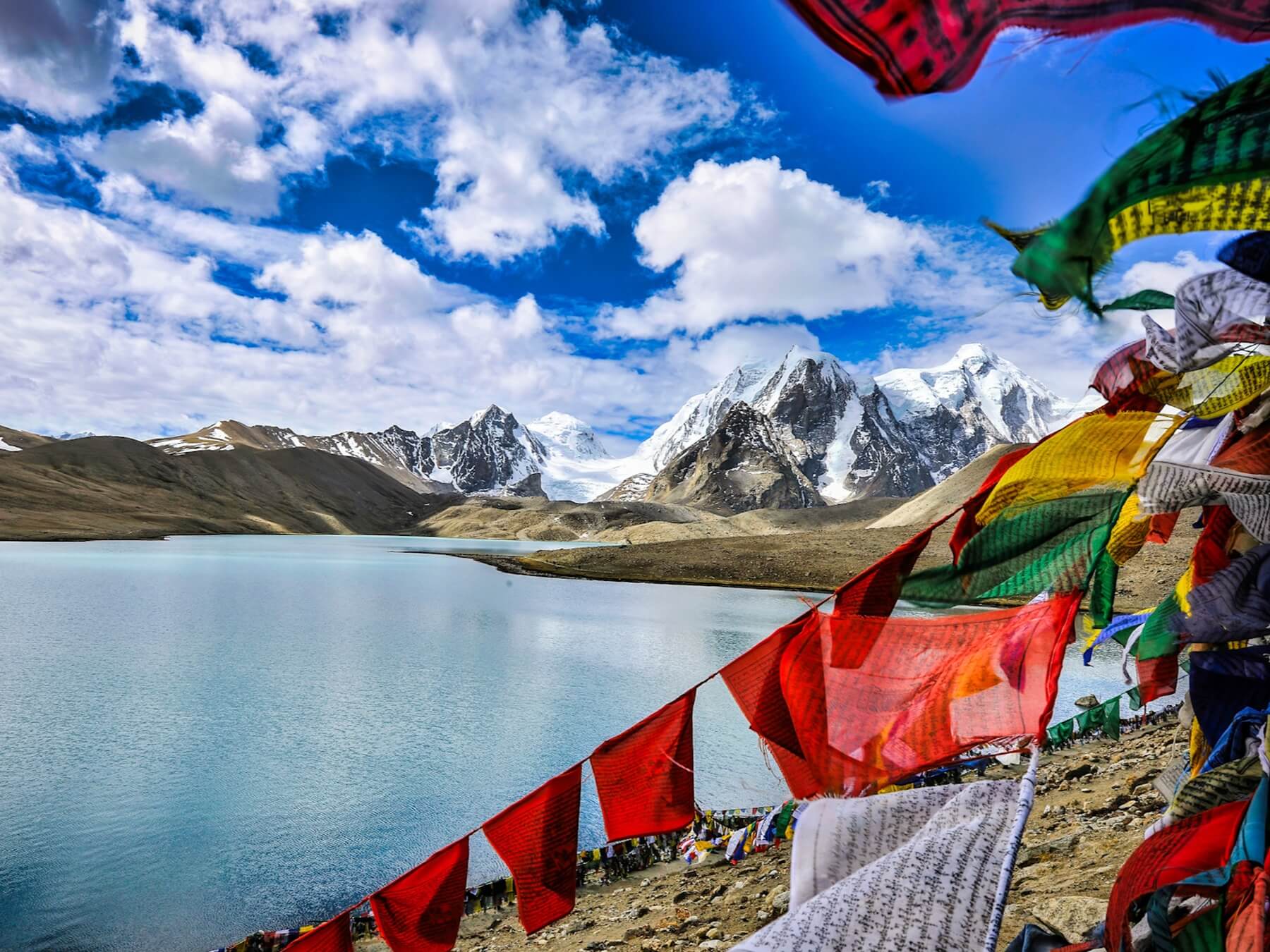
- Height (m)
- 4984
- Duration
- 14 days
- Difficulty
- Moderate
- Continent
- Asia
- Children
- Ages 14+
- Accommodation
- Includes camping
- suitable-for-beginners
- No
2880 $
Why to go with us?
Temporarily unavailable
The trek to Kanchenjunga in India with a local guide follows the Yuksom, Dzongri and Goecha La route in Sikkim. Over 14 days participants see rhododendron forests, high-altitude meadows, Samiti lake and the eastern side of the Kanchenjunga massif.
The name 'Kanchenjunga Base Camp' is used for this popular Indian approach, but the trip does not go to the expedition base camp on the Nepali side. The upper objective is the viewpoint of the Goecha La route that is permitted on the date of the trip.
The format is intended for self-reliant trekkers who are ready to receive their instructions from the local guide in English. Experience of multi-day treks, good endurance and readiness for cold nights under canvas above 4000 m are required.
Important
- The price of this trip is fixed in US dollars
- A Russian-speaking guide is not part of this package
- The highest point that can be reached depends on the permits, the state of the trail and the guide's decision
- Mountain Guide does not sell air tickets and does not process visas
About the Goecha La trek
The local-guide trip follows the same official Sikkim trek in the direction of Goecha La. It starts in Yuksom, leads through Tshoka and Dzongri to Thangsing and Lamuney, and returns to Yuksom with an onward transfer via Darjeeling.
The route is often called a trek to Kanchenjunga Base Camp, but its real objective is a high-altitude viewpoint facing the eastern side of the massif. The expedition base camp on the Nepali side is not part of the trip. This clarification matters for comparing tours correctly and for preparing properly.
The acclimatisation day in Dzongri helps in judging the body's reaction before the nights above 4000 m. The short stage to Lamuney conserves strength before the early start in the direction of Goecha La. Even on such a schedule altitude sickness is possible, and the maximum height reached is not guaranteed.
Technical mountaineering equipment is not normally required, but participants must have experience of multi-day treks and move confidently over rock, roots, mud and possible snow. The long descents after the high point demand no less attention than the climb.
The local guide runs the trip in English and is responsible for decisions on the route. Participants who need continuous interpretation, a detailed discussion of symptoms in Russian and help with communication should choose the main version with a Russian-speaking leader, which is a separate product.
Itinerary of the Goecha La trek in Sikkim
Day 1. Arrival in Bagdogra and transfer to Gangtok, 1650 m.
A team representative meets the group at Bagdogra airport and arranges the transfer to Gangtok. After check-in there is time to rest, to meet the guide and to discuss the onward logistics. The day is set aside for recovery after the flight and for checking documents before entering the protected districts of Sikkim. Night in a hotel.
Day 2. Gangtok and preparation for the trek.
The group visits the accessible sights of Gangtok, including monasteries and cultural centres, and then returns to the hotel. The order of the sites depends on their opening hours. In parallel the guide completes the check of equipment and permits, and participants prepare separate baggage for the mountain section. Night in a hotel.
Day 3. Transfer to Yuksom, 1780 m.
The group travels from Gangtok to Yuksom, the historic centre of Sikkim and the start of the Goecha La route. After check-in there is a chance to walk to the coronation site and the accessible monasteries. The task of the day is to reach the start without walking too far and to prepare for the first stage. Night in a hut or in the confirmed accommodation.
Day 4. Yuksom to Sachen, 2450 m.
The trek begins through pine and oak forest, crosses bridges over the Prek Chu and climbs to Sachen. The stage takes about 6 hours. The first day allows the pace to be set, the boots to be tested and strength to be distributed before the steeper climb to Tshoka. Night in tents.
Day 5. Sachen to Bakhim to Tshoka, 3000 m.
The climb continues through Bakhim and through magnolia and rhododendron forest to Tshoka. The stage takes about 7 hours and is one of the more tiring forest sections. After making camp it is important to restore fluids and food, because the next day the altitude will exceed 4000 m. Night in tents.
Day 6. Tshoka to Dzongri, 4020 m.
The group climbs steeply through rhododendron forest and Phedang to Dzongri. About 5 hours of walking bring participants to the first night above 4000 m. The guide slows the pace and watches carefully for signs of poor tolerance of altitude. Night in a hut or in tents according to the confirmed arrangements.
Day 7. Acclimatisation in Dzongri.
The group stays in Dzongri and, depending on its condition, climbs Dzongri Top, from where Kanchenjunga, Kabru, Rathong, Koktang and Pandim are visible in clear weather. The outing is needed for adaptation before Thangsing and Lamuney, not only for the panorama. After the descent there is rest and preparation for the continuation of the route. Night in tents.
Day 8. Dzongri to Thangsing, 3800 m.
The group climbs onto an open ridge to approximately 4115 m, then descends to the Prek Chu and, after crossing the river, gains height again to Thangsing. The stage takes about 5 to 6 hours. The alternation of climbing and descending calls for an even distribution of effort. Night in tents.
Day 9. Thangsing to Lamuney, 4298 m.
A short stage of about 3 hours runs along the Prek Chu towards Samiti lake and the Lamuney camp. The short distance conserves reserves before a night or early start and gives additional time for adaptation. After making camp the guide announces the permitted upper point and the start time. Night in tents.
Day 10. Outing in the direction of Goecha La, up to 4984 m.
The group starts early in the morning for the Zemathang plateau and the viewpoint of the Goecha La route that is accessible on the date of the trip. In clear weather the eastern side of Kanchenjunga opens up. The maximum point depends on the permits, the state of the trail, the weather and how participants feel; reaching 4984 m is not guaranteed. After the outing the group descends to the Kokchurang camp. Night in tents.
Day 11. Kokchurang to Tshoka.
An alternative trail avoids climbing back onto the Dzongri plateau and gives a long descent through forest. The stage takes about 7 to 8 hours. After the highest point of the route it is important to stay alert on damp roots, rocks and with tired legs. Night in tents.
Day 12. Tshoka to Yuksom.
The descent to Yuksom continues and takes about 5 to 6 hours. The self-reliant part of the route ends here. After check-in participants shower, sort their baggage and recover after several walking days. Night in a hotel.
Day 13. Yuksom to Darjeeling.
In the morning there is a walk to the Dubdi monastery and the historic site in Yuksom, after which the group transfers to Darjeeling. The stated road journey is about 95 km and 5 hours. The day links the trek with the cultural part and leaves the evening free for rest. Night in a hotel.
Day 14. Transfer to Bagdogra airport.
After breakfast the group says goodbye to the team and transfers to Bagdogra airport. The stated road journey is about 90 km and 3 hours, so a flight after 14:00 is recommended and should be confirmed with Mountain Guide before purchase. At the airport participants check in independently.
What's included
- A local guide in a group of 1 to 3 participants
- Meeting and seeing off at the airport
- Hotel accommodation, the number of nights according to the itinerary
- Breakfasts in the hotels before and after the trek
- Accommodation in lodges and tented camps according to the itinerary
- Three meals a day and hot tea or coffee during the trek
- Vegetarian meals during the trek
- Boiled drinking water on trekking days
- The necessary permissions, permits and national park entry fees
- Entrance tickets to the sightseeing sites in the itinerary
- Group equipment, a basic medical set and a first-aid kit
- Kitchen, dining and toilet tents on the stages where they are needed
- A sleeping bag; bringing your own is recommended for reasons of hygiene
What's not included
- International flights
- An Indian visa or any other entry permit the participant requires
- Medical insurance and the costs of emergency evacuation
- Lunches and dinners while staying in the city hotels
- A personal porter, 25 US dollars a day for baggage up to 20 kg; more often one porter is used by two participants, and the porter's insurance is included in the stated cost
- Single occupancy
- Early check-in and late check-out at the hotel before or after the trip
- Tips for the local team
- Additional costs if the trip deviates or changes
- Costs arising from cancellations, weather, illness, damage to property and other unforeseen circumstances
Private groups
The trek to Kangchenjunga in India can be arranged for a closed group of friends, a club or a corporate team, with no one else joining. Dates, the make-up of the guiding team and any extra services available on the route are agreed individually.
For a closed group we can discuss your own dates, the working language, a personal porter, single rooms in the towns and extra days in Sikkim. Access to the area and the set of permits required are checked for each participant's nationality.
The acclimatisation days, the nights at altitude and the order of the stages are not shortened. Whether teenagers can join is assessed case by case, taking account of altitude, the length of the trek and readiness for the tented stage.
The price depends on the number of participants, the dates you choose, the make-up of the team and any extra services confirmed.
Documents you need
Document requirements depend on your nationality and can change. Check them before you buy non-refundable tickets, and again before you fly. The first name and surname on every booking must match the spelling in your passport exactly.
Mountain Guide does not sell air tickets and does not arrange entry visas, but it does provide the booking confirmations it holds and the documents issued by the host team.
Documents
- A valid passport
- A visa or other entry permit for India, if one is required for your nationality
- International and domestic air tickets, or e-ticket receipts, for the trip
- Medical insurance covering high-altitude trekking, a maximum altitude of at least 4984 m, search and rescue and emergency evacuation
- Your insurance policy number and the insurer's 24-hour emergency contact details
- Your booking confirmation for the trip and the organisers' contact details
- Passport copies and photographs in the format requested for Sikkim permits
- Any further details required to admit a foreign national to a restricted area
- Documents for a participant under 18, where these apply
- Digital copies of your passport, visa, tickets and insurance on your phone and in cloud storage
- Waterproof wallet for your original documents
The permits for the confirmed route are arranged by the host team as part of the services included. Which documents are needed depends on your nationality, so copies must be supplied by the deadline the organisers set.
Weather and seasons
Treks in Sikkim usually use the spring and autumn periods. India's official tourism portal gives March to May and September to mid-December as the periods for walking in the mountains of this region. The dates you choose must take account of permits and the state of the high-altitude trail.
The lower sections pass through humid forest, where rain, mud and mist are all possible. Wind and cold increase above the treeline; around Dzongri and the higher points there can be snow, ice and sub-zero night temperatures.
The views of Kangchenjunga depend on the cloud and are not guaranteed. Your local guide may change the start time, shorten an out-and-back outing or turn the group round if the weather, the state of the trail or a participant's condition deteriorates.
Accommodation and meals
Hotel accommodation is provided in the towns for the number of nights in the itinerary, with breakfasts included before and after the trek. The specific properties and room category are confirmed before the trip. Single occupancy is paid separately.
The route uses lodges, and a tented camp on the stage around Dzongri. Where necessary the local team sets up kitchen, mess and toilet tents. A sleeping bag is provided where one is available, though for reasons of hygiene we recommend bringing your own, which you know and trust.
Breakfast, lunch, dinner, hot tea or coffee and boiled drinking water are included during the trek. Lunches and dinners at the hotels before and after the mountain section are paid separately.
A vegetarian menu is available. Tell us about other dietary restrictions and allergies before booking, so the host team can confirm what can be substituted.
Facilities on the route
Showers and hot water. Town hotels have the usual facilities. Hot water in the lodges may be available on request and is not always included in the price. A regular shower is not guaranteed at the tented camp.
Toilets. Conditions vary from lodge to lodge. On the camping stage a toilet tent is put up where necessary. For a night start you need a head torch and footwear you can put on quickly.
Power and charging. Plan on charging your devices reliably in the towns. On the trek, charging may cost money, be slow, or not be available at all. You will need a power bank and spare batteries.
Internet and phone signal. Mobile signal and internet are unreliable in the remote parts of Sikkim. On the high-altitude section there may be long stretches with no phone coverage. Satellite devices must not be brought into India without checking separately whether they are permitted.
Laundry and drying. Plan on doing proper laundry before or after the trek. In the forest zone things can take a long time to dry, so bring spare dry clothing and waterproof packing.
Insurance
Show insurance calculator (Russian)
This calculator is provided by an external provider and uses a Russian-language interface.
Equipment list for the trek to Kangchenjunga Base Camp (India)
Download PDFYou bring all of your own personal equipment. Before the trip, agree your footwear, sleeping bag and personal kit with the guide, taking the season and the conditions on the route into account.
Documents
- Passport
- Air tickets or e-ticket receipts
- Medical insurance covering helicopter evacuation
- We recommend keeping digital copies of your documents on your phone and in cloud storage
Personal equipment
- Rucksack of 30-50 litres
- Duffel bag for personal items (our team provides one locally)
- Sleeping bag with a comfort rating of -5 °C
- Trekking poles, which must have baskets
Clothing and footwear
- Trekking boots, thoroughly treated with a waterproofing product beforehand
- Trainers (for town)
- Waterproof membrane shell: jacket and trousers
- Fleece top and bottoms
- Base layer, top and bottoms
- Down jacket
- Thick gloves
- Thin gloves
- Bandana or buff (as well as sun protection in the valley, it can keep your throat or face warm in the cold)
- Warm hat
- Warm trekking socks
Other items
- LED head torch
- Power bank
- Sunglasses
- Rain jacket
- Rain cover for your rucksack
- Vacuum flask or water bottle, 1 litre
- Gaiters
- SPF 50 sun cream
- SPF 10-15 lip balm
- Personal first-aid kit
- Elastic bandage and/or a support brace
- Toothpaste, toothbrush, soap, shampoo and flip-flops
- Towel
- Toilet paper (on sale in the lodges along the way)