- Guides
- B2B
-
Climbs
-
Climb Elbrus
- Elbrus individually
- Elbrus from the South, 9 days
- Elbrus from the South, 7 days
- Elbrus from the South in 1 day
- Elbrus from the North
- Elbrus Two Summits
- Elbrus Traverse from South to North, 9 Days
- Elbrus Traverse from North to South, 10 Days
- Elbrus "Cross" from South
- Elbrus "Cross" from North
- Kazbek+Elbrus
- Elbrus from the West
- Elbrus by Private Helicopter, 3 Days
- Elbrus Region Holiday and Trekking, 9 Days
- Elbrus Region Holiday, 7 Days
- Elbrus Dating
- Climb Elbrus from the South, 9 Days with Sergey Baranov
- Under 5000 m
- 5000+ meters
- 6000+ meters
- 7000+ meters
- 8000+ meters
-
Climb Elbrus
-
Trekking
-
Trekking in Nepal: routes to the eight-thousanders
- K2 base camp
- Everest base camp
- Everest base camp via Gokyo
- Everest base camp in a week
- Annapurna Circuit and Tilicho Lake Trek
- Manaslu Circuit Trek
- Kanchenjunga Circuit Trek (XXL)
- Kanchenjunga North Base Camp Trek (Short)
- Kanchenjunga from India: the Goecha La Trek in Sikkim
- Makalu Base Camp Trek
- Annapurna Base Camp Trek
- Trekking in South America
- Asia
- Trekking in Africa
-
Trekking in Russia
- Elbrus Region Holiday and Trekking, 9 Days
- Elbrus Region Holiday, 7 Days
- Oshten + Kardyvach — 9-Day Western Caucasus Trek
- Lake Kardyvach — 5-Day Base-Camp Trek
- Route 30: Through the Mountains to the Sea, with Oshten — 4 Days
- Trekking in Arkhyz — 7 Days over the Ayulyu Pass
- Gvandra Trek — 7 Days to the Ullu-Kyol Lakes
- Trekking in Dombai — 7 Days with the Murudzhu Lakes
- Europe
-
Trekking in Nepal: routes to the eight-thousanders
-
Adventure expeditions
-
Trekking in Africa
- Tour to Morocco for New Year
- Morocco: Toubkal and the mysteries of the Sahara
- Eritrea: the Dahlak Archipelago and the Rashaida Nomads
- Rwanda: Mountain Gorillas and the Bisoke Volcano
- Ethiopia: Otherworldly Landscapes and the Peoples of the Omo Valley
- Tour to Uganda: Queen Elizabeth National Park and Mountain Gorillas
- Tanzania Safari: Serengeti, Ngorongoro and Tarangire
- Safari Uganda
- Zimbabwe and South Africa: Victoria Falls, Cape Town and the Cape of Good Hope
- Namibia: Etosha National Park and the Himba
- Kenya Safari: the African Big Five
- Tour to Botswana: Okavango Delta and Chobe National Park
- Trekking in South America
- Asia
-
Trekking in Africa
- Ski touring and ski mountaineering: chasing freedom in the mountains
- VIP tours
- Useful
- About
Annapurna Circuit and Tilicho Lake Trek
- Height (m)
- 5416
- Duration
- 14 days
- Difficulty
- Low
- Continent
- Asia
- Children
- Ages 12+
- Accommodation
- No nights in tents
2030 $
Why to go with us?
The Annapurna Circuit with Tilicho Lake is a fourteen-day route through the Marsyangdi valley, Manang, the high-altitude lake and the Thorong La pass. In a single trip participants walk from forest and mountain settlements into dry Tibetan-style landscape, cross the highest point of the circuit and complete the loop at Muktinath.
- Tilicho Lake, 4920 m
- Thorong La pass, 5416 m
- An acclimatisation day in Manang
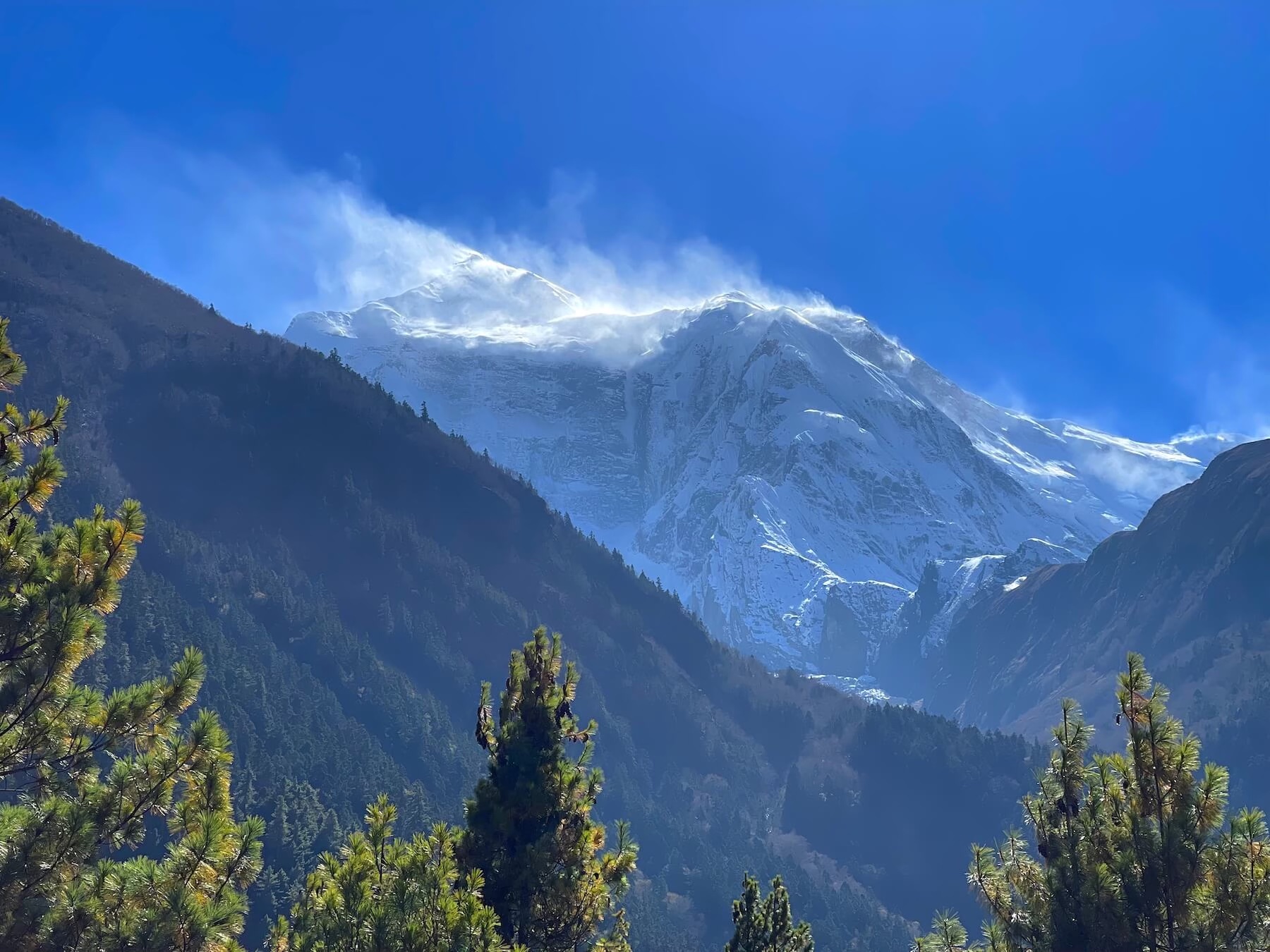
- Views of Annapurna II, III and IV, Gangapurna, Tilicho Peak and Machapuchare
- High mountain settlements and the cultural site at Muktinath
- The road transfer from Muktinath to Pokhara
- The domestic flight Pokhara – Kathmandu is already included
- A Mountain Guide team leader with groups of four participants or more
The route does not normally call for technical mountaineering skills, but participants need good endurance and readiness for one early, long day over the pass. Tilicho Lake adds a rocky section with a risk of falling stones, and altitude above 5000 m demands strict acclimatisation discipline.
The trip price is fixed in US dollars.
Important
- International flights, meals on the trek, a personal porter, the visa and insurance are paid separately
- Horse hire on individual sections depends on availability and does not replace physical preparation
- The state of the Tilicho trail and of the Thorong La pass depends on snow, rockfall and weather
- Any additional equipment for current conditions is confirmed by the guide before the trip
- Mountain Guide does not sell international air tickets and does not arrange visas
About the Annapurna Circuit and Tilicho Lake trek
The Annapurna Circuit runs around a large Himalayan massif and links the Marsyangdi valley with the Kali Gandaki valley. The modern trip begins with a transfer to Dharapani, because the lower section of the traditional route now follows a road. The walking part climbs gradually through Chame and Pisang to Manang, then branches off to Tilicho Lake and rejoins the main line towards the Thorong La pass.
The chief quality of the circuit is how quickly its natural and cultural zones change. Forested valleys and rivers give way to a dry high plateau, and the settlements of different districts show the influence of both Tibetan and Nepali tradition.
Tilicho Lake at 4920 m is a separate out-and-back objective. The climb from base camp takes roughly three to four hours, and after the visit the group descends to Khangsar. The rocky slopes require the group to move compactly and to follow the guide’s instructions because of the risk of falling stones. Whether the outing goes ahead is decided by the weather and the state of the trail.
The Thorong La pass at 5416 m is the high point and the longest day. The group leaves Thorong Phedi before dawn, climbs to the pass and then descends a long way to Muktinath. Acclimatisation in Manang, the night at Tilicho and the successive stages above 4000 m prepare the body but do not rule out an altitude reaction. It is worth reading the guidance on preventing altitude sickness before the trip.
The route suits people of average to good physical condition who can walk for five to seven hours on several consecutive days. A horse and driver can sometimes be hired on individual sections, but the availability and the safety of that service are confirmed locally. It is not a way to skip acclimatisation and it does not guarantee that the pass will be crossed.
The price includes the flight from Pokhara to Kathmandu, which spares the group a long road journey back. If you want a shorter route without a pass above 5000 m, consider the Annapurna Base Camp trek. A Mountain Guide team leader accompanies groups of four participants or more; in a small group a Nepali guide works under the confirmed package.
Before a circuit route with a high pass it is useful to study the practical advice for a first trip to Nepal. It helps you understand lodge conditions and mountain logistics in advance, while individual preparation requirements are set by the guide.
Itinerary of the Annapurna Circuit with Tilicho Lake
Day 1. Arrival in Kathmandu.
Participants fly into Kathmandu independently. A team representative meets the group and arranges the transfer to a hotel in the Thamel district. After check-in there is an introduction to the guide, an equipment check and a briefing on the high-altitude stages. Dinner and rest in the evening. Night at the hotel.
Day 2. Road transfer from Kathmandu to Dharapani, 1995 m.
The group travels by road to the start of the walking section. The modern road allows the group to drive beyond the traditional Besisahar and avoid spending a walking day on a low road section that gives no meaningful acclimatisation. On arrival participants settle in and prepare their day packs. Night at a lodge.
Day 3. Trek from Dharapani to Chame, 2710 m.
In five to six hours the group passes through deciduous and coniferous forest, mountain villages and the river valley. The gradual gain in altitude helps everyone find a working rhythm without a sharp climb. In Chame participants rest and monitor how they feel before going above 3000 m. Night at a lodge.
Day 4. Trek from Chame to Pisang, 3300 m.
A stage of five to six hours crosses the river and passes through the Bhratang area, after which the trail climbs to Pisang. The terrain and the vegetation change gradually and views of Annapurna II and the neighbouring peaks appear. The day forms the next acclimatisation step. Night at a lodge.
Day 5. Trek from Pisang to Manang, 3500 m.
In six to seven hours the group walks among high-altitude fields, forests and traditional settlements. Views of the Annapurna massif and Gangapurna accompany much of the route. On arrival in Manang participants stay for two nights, which allows preparation for going above 4000 m. Night at a lodge.
Day 6. Acclimatisation in Manang.
The group stays at the same altitude and makes an acclimatisation walk chosen by the guide according to the weather and the condition of participants. Walks in the direction of Gangapurna Lake and visits to local monasteries are possible. The main task is adaptation, recovery and a readiness check before the route to Tilicho. Night at a lodge.
Day 7. Trek from Manang to Tilicho Base Camp, about 4200 m.
The route runs through Khangsar and Shree Kharka, then climbs to base camp. Manang to Khangsar takes about two hours, and Shree Kharka to the camp a further two to three hours. On the remote upper section conditions are more basic and the cold and wind are more noticeable. A night at 4200 m creates the altitude step before the early start for the lake. Night at a lodge.
Day 8. Tilicho Lake, 4920 m, and descent to Khangsar.
The early climb to the lake takes roughly three to four hours across rocky slopes. On some sections there is a risk of falling stones, so the group moves on the guide’s instructions and does not linger in exposed places. After the stop at the lake participants descend to Khangsar, losing substantial altitude for recovery. Night at a lodge.
Day 9. Trek from Khangsar to Yak Kharka, 4150 m.
In four to six hours the group returns to the main line of the circuit and gains about 400 m. Vegetation thins and high pastures appear. The stage returns participants to a steady gain in altitude before Thorong Phedi. Night at a lodge.
Day 10. Trek from Yak Kharka to Thorong Phedi, 4600 m.
The stage takes about three to four hours and leads into high-altitude desert with rocky slopes. The group sleeps at Thorong Phedi rather than at high camp, which keeps conditions more acceptable. After arrival participants rest and prepare warm clothing, head torches and water for the early start. Night at a lodge.
Day 11. Thorong La pass, 5416 m, and descent to Muktinath, 3800 m.
The start is before dawn. The group climbs steep and possibly snow-covered sections to the pass, then makes a long descent to Muktinath. This is the hardest day of the route: after the high point you must keep strength and attention for the descent. The guide may change the start time or turn a participant back on grounds of weather or condition. Night at a hotel.
Day 12. Road transfer from Muktinath to Pokhara.
Before departure, and if time allows, the group visits the sacred complex at Muktinath. Participants then travel by jeep along the mountain road through the Kali Gandaki valley to Pokhara. The transfer closes the active part and gives time to recover after the pass. Night at a hotel.
Day 13. Flight from Pokhara to Kathmandu.
The group takes the included domestic flight and checks into a hotel in Kathmandu on arrival. How much free time there is depends on the schedule and any delay to the flight. An independent trip to Bhaktapur is possible only with a sufficient margin. Night at a hotel.
Day 14. End of the trip.
After breakfast there is a transfer to the international airport at the agreed time. Participants check in on their own. The international ticket should be chosen with possible changes to the Pokhara – Kathmandu domestic flight in mind.
What's included
- A Mountain Guide team leader with groups of four participants or more
- A Nepali guide
- Meeting and seeing off at Kathmandu airport
- Accommodation in a four-star hotel in Kathmandu – two nights
- Accommodation in lodges and hotels according to the confirmed itinerary
- Group equipment – first aid kit and satellite navigator
- A duffel bag for personal belongings – provided on site
- The permits, authorisations and entry fees required for the confirmed route
- The transfer to the start of the trek at Dharapani
- The transfer Muktinath – Pokhara
- The domestic flight Pokhara – Kathmandu
What's not included
- International flights to Kathmandu and back
- Nepal visa – $30 for a 15-day visa, which matches the length of the trip
- Medical insurance covering trekking to at least 5416 m, search and rescue and helicopter evacuation
- Lunches and dinners in Kathmandu
- Meals during the trek – approximately $30–50 a day in the lodges
- A personal porter for participant baggage – $30 a day including transport. In a trekking group one porter may carry the belongings of two participants
- Horse and driver services
- Single occupancy
- Early check-in, late check-out and additional nights
- Tips for the local team
- Costs arising if you leave the trip early
- Additional costs caused by delays, weather or a forced change to the itinerary
Private groups - a bespoke Annapurna Circuit
The Annapurna Circuit can be run for a family, a group of friends, a club or a corporate group, with no outside participants joining. Dates, Russian-speaking support, personal porters, the standard of town accommodation and extra days in Kathmandu or Pokhara are all agreed individually. The route can be adapted to a private group’s pace, but the day in Manang, the sequence of overnight stops before Thorong La and the high-altitude stages towards Tilicho cannot be shortened without a risk assessment. A horse is confirmed separately and is not used as a substitute for acclimatisation. Any change to the plan is decided by the guide. A Russian-speaking leader from the Mountain Guide team must be confirmed before booking.
Documents for the Annapurna Circuit trek
Prepare your documents before you buy non-refundable tickets. The trip includes an international flight and the domestic Pokhara-Kathmandu flight, so the given name and surname on every booking must match your passport exactly. Check the current visa requirements and the passport validity you need on the website of the Nepal Department of Immigration. Mountain Guide does not arrange visas and does not sell international air tickets.
Documents
- A passport that meets Nepal’s current requirements
- A tourist visa or another valid entry permit
- International air tickets
- Confirmation of the domestic Pokhara-Kathmandu flight
- An insurance policy covering trekking to at least 5416 m, rescue and helicopter evacuation
- Your policy number and the insurer’s 24-hour emergency contact details
- Your booking confirmation and the organisers’ contact details
- Documents for a participant under 18, where these apply
- Digital copies of your passport, visa, tickets and insurance
- Waterproof document wallet
The permits for the confirmed trekking route are arranged by the local team. The current rules on TIMS and on guiding requirements are published on the website of the Nepal Tourism Board.
Weather and seasons on the Annapurna Circuit
The route is usually planned for the periods of steadier visibility before and after the summer monsoon. The circuit crosses several climate zones, so rain in the lower valley can go together with snow and wind on Tilicho or the Thorong La. The trail to the lake crosses a stony slope where the state of the scree and the risk of rockfall depend on rain and on freezing. On the pass you can meet snow, ice, strong wind and poor visibility. Whether additional equipment is needed is decided by the guide according to the conditions at the time. The road journeys and the domestic flight also depend on the weather and on the state of the roads. The guide may change the start time, drop the out-and-back leg to Tilicho, or turn the group back before the pass. Finishing safely matters more than completing the plan.
Accommodation and meals on the Annapurna Circuit
Two nights in a 4-star hotel are provided in Kathmandu. Hotels or lodges are used in Pokhara, Muktinath and on the walking section, as set out in the itinerary. The team picks the best of what is available, but the specific properties and room types are confirmed for your travel dates. Standards on the Annapurna route are on average higher than on Nepal’s remoter treks, but a private bathroom, a hot shower, panoramic windows or a heated bed cannot be treated as guaranteed until a particular property has been confirmed. A higher standard of accommodation is planned in Muktinath to help you recover after the pass; the details are given before the trip. Meals on the trek, and lunches and dinners in Kathmandu, are not included. Participants order from the menu and pay for their own meals. Choice can be limited at Tilicho and Thorong Phedi. Tell us about any dietary restrictions in advance.
Facilities on the Annapurna Circuit
Showers and water. A hot shower is available in many villages, sometimes for a charge, but neither its availability nor the water temperature is guaranteed at the higher stops. Conditions are simpler at Tilicho Base Camp and Thorong Phedi.
Toilets. The type of washing facilities depends on the particular lodge. A room with its own bathroom is provided only where one is actually available and has been confirmed. You will need a head torch at night.
Power and charging. Charging your devices may cost extra or be limited. You will need a power bank, your own cables and spare batteries for your torch.
Internet and phone signal. Wi-Fi and a mobile signal are found in the villages, but may be absent on the Tilicho and Thorong La sections. Phone coverage depends on the weather and on the local infrastructure.
Laundry and drying. Do not plan on doing proper laundry above Manang. In the cold, clothing dries slowly, so bring spare socks and underwear and keep a dry set sealed in a waterproof bag.
Insurance
Back to topEquipment and useful extras for the Annapurna Circuit and Tilicho Lake
Download PDFThe standard route does not require constant use of a helmet, harness or ice axe. You bring all of your own personal equipment. Your footwear, sleeping bag and any additional kit for the snow pass should be agreed with your guide according to the conditions on your particular departure.
Documents
- Passport
- Air tickets or e-ticket receipts
- Medical insurance with altitude cover and evacuation
- Digital copies of your documents
- Waterproof cover
Baggage and personal equipment
- Rucksack of 30-50 litres
- Soft duffel bag, provided locally
- Sleeping bag with a comfort rating no higher than -5 °C
- Two trekking poles with baskets
- Waterproof rucksack cover
- Dry liner bags for clothing and electronics
Clothing and footwear
- Broken-in waterproof trekking boots
- Light footwear for towns and lodges
- Waterproof shell jacket and waterproof trousers
- Fleece jacket or fleece set
- Base layer, top and bottoms
- Down jacket with a hood
- Thick and thin gloves
- Buff or bandana
- Warm hat
- Warm trekking socks
- Gaiters
Useful extras
- Head torch with at least 12 hours of battery life
- Power bank
- Sunglasses
- Rain jacket
- Vacuum flask or water bottle, 1 litre
- SPF 50 sun cream
- Lip balm with sun protection
- Personal first-aid kit
- Elastic bandage or a personal support brace
- Personal toiletries and a quick-drying towel
- Toilet paper